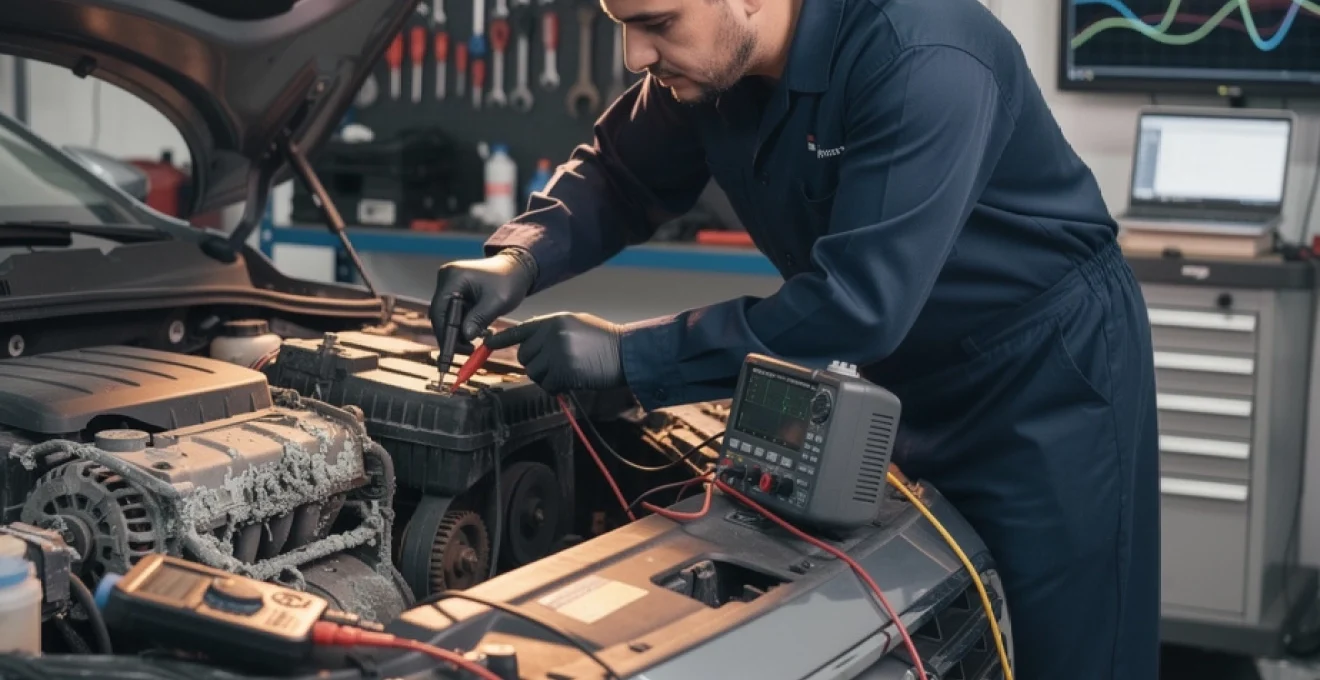
A non-charging battery represents one of the most frustrating automotive problems, particularly when you’re stranded at the most inconvenient times. Modern vehicles rely heavily on sophisticated electrical systems, making proper battery charging absolutely critical for reliable operation. When your battery fails to accept or maintain charge, the underlying causes often extend far beyond simple battery deterioration, encompassing complex interactions between alternators, voltage regulators, and electronic control modules.
Understanding the intricate charging system dynamics becomes essential for effective diagnosis and repair. The charging system operates as a precisely calibrated network where the alternator generates electrical current, the voltage regulator maintains optimal charging rates, and various electronic components monitor system performance continuously. Professional diagnostic approaches reveal that approximately 68% of charging system failures stem from alternator-related issues, whilst 23% originate from battery-specific problems, and the remaining 9% involve wiring or connection faults.
Common car battery charging failures: identifying root causes
Battery charging failures manifest through various symptoms, each pointing toward specific system components requiring attention. The charging system’s complexity means that seemingly simple problems often have multiple contributing factors working simultaneously. Modern automotive charging systems operate under demanding conditions, with alternators producing between 13.8 and 14.4 volts whilst simultaneously powering numerous electrical accessories.
Temperature extremes significantly impact charging efficiency, with cold conditions reducing chemical reaction rates within batteries by up to 50%. Conversely, excessive heat accelerates electrolyte evaporation and internal component degradation. Industry data indicates that charging system failures increase by 34% during winter months, primarily due to increased electrical demands from heating systems, lights, and starter motors working harder in cold conditions.
Alternator belt slippage and pulley system malfunctions
Belt-driven alternator systems depend entirely on proper tension and alignment for optimal performance. Worn or stretched serpentine belts create slippage conditions where the alternator pulley cannot maintain synchronisation with engine rotation. This results in reduced alternator speed and consequently diminished electrical output, particularly noticeable during idle conditions when belt tension naturally decreases.
Pulley misalignment compounds these issues by creating uneven belt wear patterns and additional friction losses. Misaligned pulleys can reduce charging efficiency by up to 25%, whilst also generating excessive heat that accelerates belt deterioration. Professional technicians recommend checking belt tension using specialised gauges, ensuring proper deflection rates typically ranging between 6-10mm under moderate pressure.
Voltage regulator circuit breakdown in electronic control units
Modern vehicles integrate voltage regulation functions within engine control modules or dedicated power management units. These sophisticated circuits monitor battery voltage continuously, adjusting alternator field current to maintain optimal charging rates. Circuit board corrosion, component aging, and electromagnetic interference can disrupt these delicate control signals, resulting in overcharging or undercharging conditions.
Electronic voltage regulators operate using pulse-width modulation techniques, rapidly switching field current on and off to achieve precise voltage control. When these circuits malfunction, they may deliver inconsistent field excitation, causing erratic charging behaviour.
Temperature-related expansion and contraction of circuit board components represents the primary cause of voltage regulator failures, particularly in vehicles exceeding 100,000 miles.
Corroded battery terminal connections and sulphation build-up
Battery terminal corrosion creates high-resistance connections that impede current flow in both directions. This resistance not only prevents adequate charging current from reaching the battery but also limits the battery’s ability to deliver power during starting. Corrosion typically appears as white, blue, or green crystalline deposits around terminal connections, indicating electrolyte leakage and subsequent chemical reactions with terminal metals.
Sulphation occurs when lead sulphate crystals form on battery plates during discharge cycles, particularly when batteries remain in partially charged states for extended periods. These crystals gradually become permanent, reducing active plate surface area and charging acceptance. Severe sulphation can permanently reduce battery capacity by up to 80%, making restoration impossible through conventional charging methods.
Parasitic draw from faulty control modules and accessories
Modern vehicles contain numerous
electronic control modules, sensors, and comfort systems that continue drawing power even with the ignition switched off. While a small standby current (typically 20–50mA) is normal to preserve memory functions, faulty control units, stuck relays, or aftermarket accessories can create excessive parasitic draw. This continual drain prevents the car battery from reaching full charge and can leave you with a flat battery after just a few days of inactivity.
Typical culprits include glovebox or boot lights that never switch off, malfunctioning infotainment units that stay awake, or alarm and tracking systems that cycle repeatedly. In severe cases, parasitic draw can exceed 300–500mA, which is enough to discharge a healthy battery overnight. Systematic diagnosis with an ammeter, combined with methodical fuse-pulling procedures, is essential to pinpoint the faulty circuit and restore normal charging performance.
Internal cell damage and electrolyte depletion symptoms
Even when the alternator and wiring are functioning correctly, internal battery damage can prevent the battery from accepting charge. Lead-acid batteries rely on a balanced mixture of plates and electrolyte; when individual cells become shorted, sulphated, or physically damaged, overall voltage and capacity drop dramatically. You may notice symptoms such as the engine cranking very slowly, dashboard lights flickering under load, or the battery case bulging due to internal gas pressure.
Electrolyte depletion, often caused by prolonged overcharging or high ambient temperatures, lowers the fluid level above the plates and accelerates plate corrosion. In conventional flooded batteries, low electrolyte levels may be visible through inspection caps, whilst maintenance-free AGM units show their condition via built-in indicators or specialised tests. Once multiple cells are compromised, even a powerful charger cannot restore normal performance, and professional guidance typically recommends replacement rather than further charging attempts.
Diagnostic testing procedures for non-charging battery systems
Before replacing expensive components, structured diagnostic testing is crucial to identify why a car battery is not charging. Modern charging systems involve the battery, alternator, voltage regulator, wiring harness, and control modules, all of which must operate within precise voltage ranges. By following a step-by-step testing process, you can separate a failing battery from a weak alternator, or a simple wiring fault from a complex electronic issue.
Professional workshops use a combination of multimeter checks, oscilloscopes, conductance testers, and voltage drop tests to build a complete picture of system health. Even if you are working at home with basic tools, understanding how these tests work will help you interpret results and decide when to seek expert help. Ultimately, methodical diagnostics save time, prevent misdiagnosis, and help you fix a car battery that won’t stay charged in a cost-effective way.
Multimeter voltage testing: load vs no-load measurements
A digital multimeter represents the starting point for most charging system diagnostics. With the engine off and all accessories switched off, a fully charged 12V lead-acid battery should read between 12.6V and 12.8V at rest; readings consistently below 12.2V suggest partial discharge or capacity loss. This no-load measurement gives you an initial snapshot of battery health but does not reveal how it behaves under stress.
To evaluate charging performance, start the engine and measure voltage directly at the battery terminals with headlights and blower fan switched off. A healthy alternator and voltage regulator should produce approximately 13.8–14.4V; significantly lower readings indicate undercharging, while values above 14.8V suggest overcharging that can damage the battery. You can then repeat the test with multiple accessories turned on (heated screens, lights, AC) to observe how the system responds under load, helping you decide whether poor charging is due to the alternator, battery, or excessive electrical demand.
Alternator output analysis using oscilloscope readings
While a multimeter provides average voltage, an oscilloscope reveals the quality and stability of alternator output over time. Alternators generate three-phase AC current that is rectified into DC by a diode bridge; when any phase or diode fails, characteristic ripple patterns appear on the voltage waveform. By connecting an oscilloscope across the battery terminals with the engine running, technicians can visualise these ripples and identify subtle charging issues that basic meters might miss.
Excessive ripple voltage, typically anything above about 0.5V peak-to-peak on a 12V system, often indicates a failing rectifier or damaged stator winding. You may also see irregular spikes caused by poor grounding, loose connections, or noisy electronic components. Think of the oscilloscope trace as a heart monitor for your charging system: smooth, regular waves signal a healthy alternator, while jagged, inconsistent patterns point toward impending failure and help guide targeted repairs.
Battery conductance testing with digital battery analysers
Traditional load testers apply a heavy current draw to assess whether a battery can maintain voltage under stress, but modern conductance testers go further. Digital battery analysers inject a small AC signal into the battery and measure how easily it flows through the internal structure. This conductance value correlates closely with the battery’s cold cranking amps (CCA) capability and remaining service life, even without fully discharging the unit.
For drivers wondering whether a car battery that won’t hold a charge can be saved, conductance testing provides clear evidence. A battery may still reach 12.6V at rest yet show dramatically reduced conductance, indicating sulphation or plate deterioration that limits real-world performance. Professional testers often display results as “Good,” “Recharge and retest,” or “Replace,” giving you a straightforward decision point before investing in alternator or wiring repairs unnecessarily.
Charging system circuit integrity using voltage drop testing
Even if the alternator produces correct voltage, excessive resistance in cables, grounds, or connectors can prevent full charging current from reaching the battery. Voltage drop testing checks how much voltage is lost across specific segments of the charging circuit while current is flowing. By placing a multimeter’s probes at two points along the same cable or connection and running the engine with accessories on, you can measure this loss directly.
As a rule of thumb, voltage drop across major charging and ground cables should generally remain below 0.2V under load. Higher readings highlight corroded terminals, frayed wiring, or loose connections that restrict current flow much like a partially blocked pipe restricts water. Addressing these unseen resistance points often restores normal charging performance without replacing the alternator or battery, underscoring why thorough circuit integrity checks are so valuable.
Alternator-related charging system failures
Given that the alternator is the primary source of electrical power once the engine is running, any alternator fault can quickly lead to a car battery not charging while driving. Inside the housing, multiple components must work together perfectly: the rotor and stator generate current, diodes rectify it, brushes maintain contact, and the regulator controls field strength. When one element fails, symptoms may range from a dim battery light to intermittent stalling and repeated flat batteries.
Manufacturers such as Bosch, Denso, Valeo, and Mitsubishi each use slightly different alternator designs, but the fundamental failure modes remain similar. Heat, vibration, and electrical stress gradually degrade internal parts, especially on high-mileage vehicles or those used for frequent short trips. Understanding specific alternator failure patterns helps you interpret diagnostic results and decide whether repair, rebuilding, or complete replacement offers the best long-term solution.
Diode bridge rectifier failure in bosch and denso units
The diode bridge, or rectifier, converts the alternator’s AC output into DC current suitable for charging the battery and powering electronics. In Bosch and Denso alternators, this rectifier assembly typically contains six or more high-current diodes pressed into a heat sink. Over time, thermal cycling and electrical spikes can cause diodes to short or open, disrupting the smooth flow of current and introducing voltage ripple.
When diodes fail, you may notice flickering headlights, radio interference, or a battery warning light that appears only at certain engine speeds. In more advanced stages, the car battery may repeatedly go flat despite correct alternator voltage readings at idle, because effective current output collapses under higher loads. Oscilloscope testing and specialised alternator bench tests confirm rectifier faults, after which many workshops either replace the rectifier pack or fit a complete reconditioned alternator, depending on cost and availability.
Carbon brush wear in valeo and mitsubishi alternators
Carbon brushes provide the sliding electrical contact that delivers current to the spinning rotor via slip rings. In Valeo and Mitsubishi alternators, these brushes are usually integrated into the voltage regulator assembly, making them a common wear item. As brushes wear down, spring pressure weakens and contact becomes intermittent, causing unstable field current and erratic charging behaviour.
Symptoms often include an intermittent battery light, charging that fails only at certain RPM ranges, or a car battery that charges fine on some journeys and then goes flat unexpectedly. Because brush wear is gradual, the problem can be difficult to spot without dismantling the alternator or using live data from the engine control unit. Regular inspection during high-mileage services and timely replacement of brush and regulator assemblies can extend alternator life significantly and prevent sudden non-charging events.
Rotor winding short circuits and slip ring deterioration
The rotor’s copper windings generate the magnetic field that induces current in the stator; any short circuit within these windings reduces field strength and alternator output. High temperatures, insulation breakdown, or mechanical damage can all cause internal shorts that are not visible from the outside. Similarly, the slip rings that the brushes contact can become grooved, pitted, or contaminated, further disrupting the flow of field current.
From a driver’s perspective, rotor or slip ring problems may present as chronic undercharging, with system voltage struggling to rise above 13V even at higher revs. In severe cases, the alternator may fail to charge at all, leaving the battery to shoulder the entire electrical load until it is fully discharged. Advanced diagnostics using an ohmmeter, growler tester, or alternator bench rig can confirm rotor integrity, but in many situations, replacement of the alternator is more economical than component-level repair.
Stator coil open circuits and phase imbalance issues
The stator contains the stationary windings that convert the rotor’s magnetic field into usable AC power. These windings are arranged in three phases to provide smooth output; when one phase develops an open circuit or high resistance, overall alternator capacity drops and voltage ripple increases. Physical damage, manufacturing defects, or long-term overheating can all contribute to stator breakdown.
Phase imbalance often manifests as low charging voltage under load, excessive alternator heating, and sometimes a faint whining noise that changes with engine speed. Because stator failures affect the alternator’s core generating ability, they are among the more serious faults and typically justify full replacement rather than repair. If your car battery is not charging despite a new regulator and good wiring, stator integrity should be high on the list of remaining suspects.
Battery-specific charging problems and solutions
Not every non-charging situation originates in the alternator; in many cases, the battery itself is the root cause. Age, usage patterns, and environmental conditions all influence how well a battery accepts and holds charge. Repeated deep discharges, frequent short journeys, and extended periods of inactivity encourage sulphation and reduce available capacity, even if the alternator output is within specification.
To address battery-specific charging problems, start by confirming the battery’s age and specification relative to the vehicle’s requirements. High-demand vehicles with start-stop systems or numerous electrical accessories often require enhanced flooded (EFB) or AGM batteries with higher cycling resistance. If a conventional battery is used where an AGM unit is specified, it may appear to charge initially but deteriorate rapidly under normal use. In many cases, replacing the battery with the correct technology and rating, combined with a full charging system check, restores reliable operation.
Step-by-step repair procedures for charging system restoration
Once you have identified whether the issue lies with the alternator, battery, or wiring, structured repair procedures help ensure that the charging system is restored safely. Rushing this stage or skipping steps can introduce new faults, from poor earth connections to incorrect ECU coding. Treat the repair process as you would a medical procedure: diagnose accurately, plan carefully, and verify outcomes with post-repair testing.
Depending on the results of your diagnostic work, you may proceed with alternator removal and bench testing, battery reconditioning or replacement, wiring harness repairs, or ECU programming. Each of these tasks requires appropriate tools and safety precautions, particularly when working near high-current circuits and sensitive electronics. If at any point you feel uncertain, involving a qualified auto electrician can prevent expensive mistakes and help ensure your car battery charges correctly for the long term.
Alternator removal and bench testing protocols
Before removing the alternator, always disconnect the negative battery terminal to eliminate the risk of short circuits. Next, document the routing of the serpentine belt and any electrical connectors using photos, as this will simplify reinstallation. Carefully release belt tension with the appropriate tool, unbolt the alternator mounting points, and support its weight as you withdraw it from the engine bay.
On the bench, the alternator can be tested using specialised machines that simulate engine operation and vary electrical loads. These testers measure output current, voltage regulation, and ripple to determine whether the unit meets original specifications. Many parts suppliers offer bench testing services and will provide a printed report; this evidence helps you decide whether to rebuild the alternator, replace individual components such as the regulator or rectifier, or install a fully reconditioned or new unit.
Battery reconditioning using pulse charging technology
For batteries suffering from moderate sulphation rather than severe internal damage, pulse charging technology can sometimes restore useful capacity. Pulse chargers apply controlled bursts of high-frequency energy designed to break down lead sulphate crystals on the plates, allowing the active material to participate in chemical reactions again. This process differs from simple trickle charging, which maintains voltage but does not actively reverse sulphation.
Reconditioning is not a guaranteed cure, but when applied early it can extend battery life and improve cold cranking performance. Follow the manufacturer’s instructions closely, selecting modes such as “Recondition” or “Desulfate” where available, and monitor temperature to avoid overheating. If the battery fails a conductance or load test even after reconditioning, continuing to rely on it can leave you stranded; at that point, replacement is the most reliable option to ensure your car battery charges properly and holds that charge.
Wiring harness replacement and terminal crimping techniques
Damaged or corroded wiring between the alternator, battery, and chassis ground can undermine even the best components. When voltage drop tests reveal excessive resistance in a particular cable run, replacement of that section of the harness is often the most effective repair. Cut back to clean, shiny copper, and use appropriately sized automotive cable rated for the expected current and environmental conditions.
Proper terminal crimping is essential to avoid future charging problems. Use a quality ratcheting crimp tool matched to the terminal type, ensuring that the conductor and insulation are both securely clamped. Where appropriate, seal joints with heat-shrink tubing or adhesive-lined sleeves to keep out moisture and road salt. By treating every new connection as a potential weak point and building it to OEM or better standards, you greatly reduce the risk of intermittent faults that can cause a car battery to stop charging without obvious warning.
ECU programming requirements after component replacement
On many late-model vehicles, the engine control unit or body control module actively manages charging strategy, adjusting alternator output based on driving conditions, battery temperature, and state of charge. When you replace key components such as the alternator, battery, or battery monitoring sensor, the ECU may require programming or adaptation procedures. Skipping this step can lead to incorrect charging behaviour, dashboard warnings, or premature battery wear.
Typical procedures include registering a new battery so the ECU knows its capacity and type, updating alternator coding, or resetting learned charging parameters. These tasks usually require manufacturer-specific diagnostic tools or high-end aftermarket scan equipment. If you notice strange behaviour after a repair—such as the alternator not charging at idle or the battery light staying on despite correct voltages—confirm with a professional workshop whether ECU updates or adaptations are needed for your particular model.
Preventive maintenance strategies for optimal charging performance
Preventing charging system failures is far easier—and cheaper—than dealing with repeated flat batteries and unexpected breakdowns. Regular visual inspections of the battery, cables, and alternator belt can catch early signs of corrosion, fraying, or misalignment before they escalate. Cleaning battery terminals annually, checking electrolyte levels on serviceable batteries, and ensuring secure mounting all contribute to a stable electrical environment.
Driving habits also play a major role in how well your car battery charges. If you primarily make short trips with heavy electrical loads, consider taking a longer journey or using a smart charger every few weeks to fully recharge the battery. In periods of extended storage, disconnecting the battery or using a quality maintenance charger will prevent deep discharge and sulphation. By combining good maintenance practices with informed diagnostics, you significantly reduce the chances of facing a car battery that won’t charge—and when problems do arise, you will be far better equipped to resolve them quickly and safely.