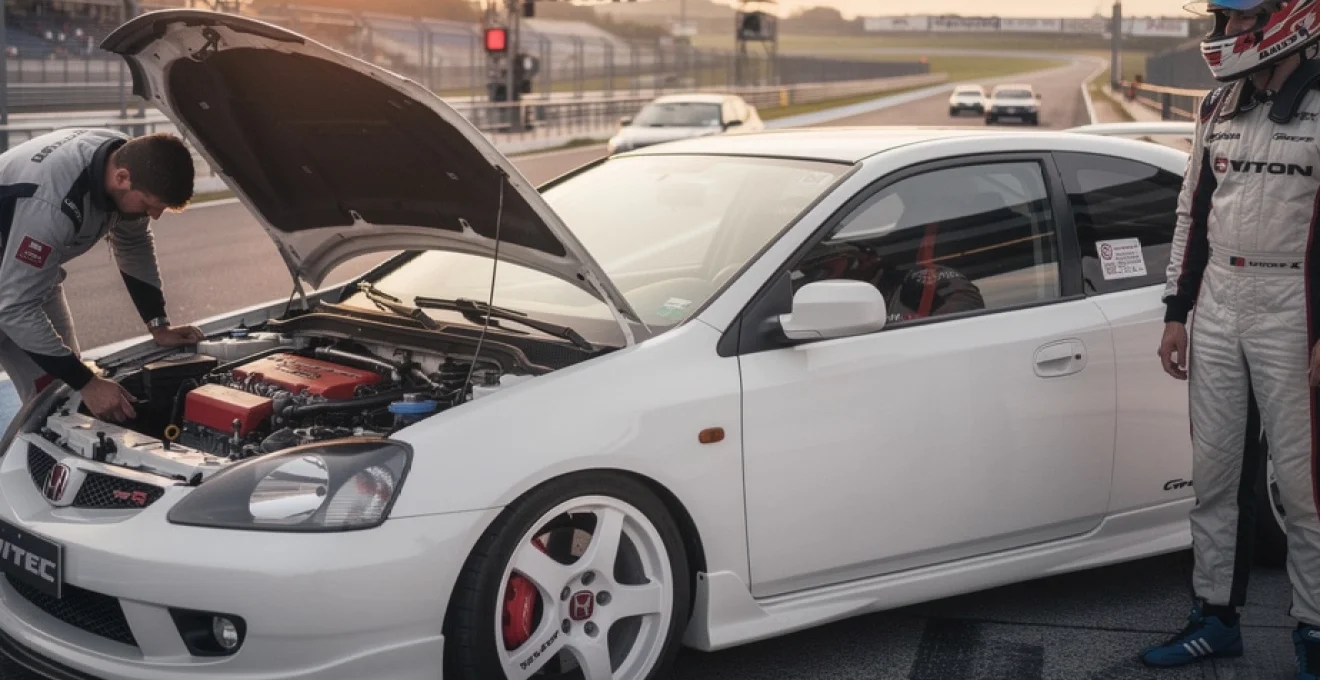
The automotive landscape of the early 2000s was defined by raw mechanical excellence and uncompromising engineering philosophy. Among the standout performers of this era, the 2002 Honda Civic Type R EP3 emerged as a masterclass in naturally aspirated performance, establishing benchmarks that continue to influence hot hatch development today. This machine represented Honda’s purest expression of their racing DNA translated into a road-legal package, combining the legendary K20A engine with championship-proven chassis dynamics. While modern hot hatches rely heavily on turbocharging and electronic assistance, the EP3 Type R’s approach remained refreshingly analogue, delivering an authentic driving experience that has become increasingly rare in contemporary automotive design.
Engineering excellence: K20A engine architecture and performance specifications
The heart of the 2002 Civic Type R lies in its meticulously engineered K20A powerplant, representing Honda’s pinnacle achievement in naturally aspirated four-cylinder technology. This 2.0-litre unit produces 197 brake horsepower at 8,000 rpm, delivering a specific output of 98.5 bhp per litre without forced induction assistance. The engine’s construction utilises lightweight aluminium throughout, featuring a die-cast aluminium block with steel cylinder liners and an aluminium cylinder head optimised for high-rpm operation.
VTEC i-VTEC variable valve timing technology implementation
Honda’s Variable Valve Timing and Lift Electronic Control system reaches its most sophisticated implementation in the K20A engine. The i-VTEC technology combines traditional VTEC cam profile switching with continuously variable cam timing on the intake side. This dual approach allows the engine to maintain excellent low-rpm driveability while unleashing maximum performance beyond the 6,000 rpm VTEC engagement point. The intake cam timing adjusts continuously across the rev range, optimising volumetric efficiency at all engine speeds.
The VTEC crossover point occurs at precisely 5,800 rpm, where the engine character transforms dramatically. Below this threshold, the engine operates on a mild cam profile optimised for fuel economy and emissions compliance. Once the VTEC engagement occurs, the high-performance cam profile takes control, featuring increased lift and duration specifications that enable the engine’s remarkable 8,400 rpm redline capability.
High-compression 11.5:1 ratio impact on power delivery
The K20A engine employs an aggressive 11.5:1 compression ratio, significantly higher than contemporary mainstream engines. This elevated compression ratio contributes directly to the engine’s impressive thermal efficiency and power output characteristics. The high compression design requires premium unleaded fuel with a minimum 98 RON rating to prevent detonation under high-load conditions.
This compression ratio represents a careful balance between performance and reliability. Honda’s engineers utilised sophisticated combustion chamber design and precise fuel injection timing to manage the increased cylinder pressures. The result is an engine that delivers linear power delivery throughout its rev range while maintaining long-term durability under enthusiastic driving conditions.
Close-ratio Six-Speed manual transmission gear ratios
The Type R’s six-speed manual gearbox features closely spaced ratios designed to keep the engine within its optimal power band. First gear provides a ratio of 3.267:1, while sixth gear offers a relatively short 0.659:1 ratio that prioritises acceleration over fuel economy. The transmission case mounts directly behind the engine, creating a compact powertrain package that contributes to the vehicle’s excellent weight distribution.
The close-ratio gearing ensures that drivers can maintain engine speeds within the VTEC powerband during spirited driving, maximising the naturally aspirated engine’s performance potential across various driving scenarios.
Helical Limited-Slip differential torque distribution mechanics
Honda equipped the EP3 Type R with a helical limited-slip differential to manage the substantial torque output effectively. This mechanical differential system utilises helical gears to automatically distribute torque between the front wheels based on available traction. Unlike clutch-type limited-slip differentials, the helical design operates smoothly without the harsh engagement characteristics that can affect daily driveability.
This torque distribution capability is particularly noticeable when accelerating hard out of tight bends. Where an open differential would allow the inside wheel to spin away precious traction, the helical unit quietly shuffles torque to the wheel with more grip, helping the 2002 Honda Civic Type R put its power down cleanly. The result is a front-wheel-drive hot hatch that feels remarkably composed under load, even by modern standards, and gives you the confidence to lean on the chassis without the usual tugging at the steering wheel associated with powerful FWD layouts.
Championship-proven motorsport heritage and racing development
The 2002 Honda Civic Type R EP3 was never just a fast road car; it was conceived with motorsport in mind from the outset. Honda’s engineers developed the platform with touring car racing and one-make series requirements in parallel, which is why so many of its components seem “over-engineered” for a typical commuter hatchback. This deep-rooted motorsport connection is a major reason the EP3 Civic Type R still matters today, especially for enthusiasts who value race-bred engineering over marketing-led performance claims.
BTCC british touring car championship homologation requirements
To compete in the British Touring Car Championship (BTCC), manufacturers must base their race cars on production models that meet strict homologation rules. For the EP3 Civic Type R, Honda needed a shell, suspension pickup points and drivetrain layout that could withstand the rigours of a full BTCC season. The reinforced bodyshell, stiffened front subframe and robust MacPherson strut towers you find on the road-going 2002 Civic Type R are direct beneficiaries of this process.
Because the Type R shared its basic architecture with BTCC machinery, race teams could adopt many components without extensive custom fabrication. That meant the steering geometry, wheelbase and weight distribution all had to work both on the road and on circuits like Brands Hatch and Donington Park. When you drive an EP3 on a fast B-road, that sense of underlying racing intent is clear: the car feels like a detuned race car, not a warmed-over shopping hatch, and that is precisely what homologation was intended to achieve.
Spoon sports N1 endurance racing modifications
In Japan, the EP3 Civic Type R quickly became a favourite base car for N1 and endurance racing, particularly in the hands of legendary tuner Spoon Sports. Their N1-spec cars retained the fundamental K20A engine and front-wheel-drive layout but received painstaking attention to detail: blueprinted engines, balanced rotating assemblies and revised cooling systems to survive hours of flat-out running. These modifications were evolutionary rather than revolutionary, underscoring how capable the standard 2002 Civic Type R package already was.
Interestingly, many of the changes Spoon made for endurance racing echo the priorities of serious track-day enthusiasts today. Upgraded radiators, baffled sumps, more aggressive brake pads and slightly stiffer springs are all common upgrades owners still carry out on their EP3s. If you follow Spoon’s N1 philosophy, you are essentially fine-tuning an already excellent tool rather than fixing inherent flaws, which is why a well-prepared EP3 can still embarrass newer hot hatches on track.
Time attack circuit records at tsukuba and suzuka
The 2002 Honda Civic Type R EP3 also earned its stripes in Japanese Time Attack competition, where lap times at circuits like Tsukuba and Suzuka are treated almost like currency. Tuned K20A-powered Civics recorded highly competitive times against more powerful turbocharged machinery, thanks in large part to their high-revving engines, low weight and finely balanced chassis. At Tsukuba Circuit, sub-1:05 laps in modified EP3s placed them squarely in the mix with contemporary Imprezas and Evos.
What makes these achievements significant today is not the raw lap time alone, but how close many of these cars remained to road-going specification. With bolt-on modifications and careful suspension tuning, the EP3 Civic Type R could punch far above its nominal 197 bhp output. For modern track drivers evaluating whether a 2002 Civic Type R is still a serious tool, those Time Attack results answer the question convincingly: yes, this car still has the fundamental pace and stamina to be relevant.
One-make racing series legacy in EP3 type R cup
One-make racing series such as the EP3 Type R Cup highlighted another key strength of the 2002 Civic Type R platform: consistency. When every car on the grid runs the same basic chassis, engine and gearbox, the differences come down to driver skill and fine setup. Organisers chose the Civic Type R because its K20A engine could withstand repeated abuse, the gearbox tolerated aggressive shifting and the suspension responded predictably to adjustments.
For you as a buyer or driver today, that legacy means two things. First, you can be confident that the underlying hardware in a 2002 Honda Civic Type R is tough enough for serious use, whether that’s a track-day calendar or spirited road driving. Second, there is a deep knowledge base within the community, from alignment settings to tyre choices, all refined over years of one-make competition. If you want a hot hatch with proven race pedigree and strong aftermarket support, the EP3 platform delivers in a way many newer models still struggle to match.
Advanced chassis dynamics and suspension technology
Underpinning the 2002 Civic Type R’s enduring appeal is a chassis that blends simplicity with sophisticated tuning. While the suspension layout looks conventional on paper, Honda’s engineers spent countless hours refining geometry, bush stiffness and weight distribution to extract maximum performance. The result is a car that feels alert without being nervous, and which still sets a high bar for front-wheel-drive handling more than two decades on.
Macpherson strut front suspension geometry optimisation
The EP3 Civic Type R uses a MacPherson strut front suspension, a layout often criticised for its limitations compared with double wishbones. However, Honda mitigated many of these downsides through careful geometry optimisation. Increased negative camber, revised kingpin inclination and a reduced scrub radius work together to keep the tyre contact patch stable under load, especially when the helical limited-slip differential is working hard out of a corner.
For the driver, that engineering translates into steering that stays faithful even when the front axle is dealing with both cornering and acceleration forces. There is less of the “wrestling match” feel you might associate with powerful front-wheel-drive cars of the same era. If you are considering a 2002 Honda Civic Type R as a weekend car or track toy, this front suspension tuning is one of the reasons it rewards precise inputs and allows you to build confidence quickly.
Multi-link rear suspension setup for stability control
At the rear, the EP3 relies on a multi-link arrangement rather than a simpler torsion beam. This design offers more freedom to tune camber gain, toe change and roll steer characteristics as the suspension moves through its travel. Honda exploited this flexibility to deliver a rear end that feels stable at speed yet willing to rotate when you trail the brakes or lift off the throttle mid-corner.
Think of the rear suspension as the “editor” of your line through a bend: it subtly corrects and supports what the front end is doing rather than dominating the conversation. On a flowing road, you can feel the rear axle gently helping the car pivot into corners, a trait that modern drivers raised on heavily damped, electronically controlled hot hatches may find surprisingly organic. This natural balance is a big reason the 2002 Civic Type R still feels instructive to drive, teaching you how weight transfer and throttle inputs affect stability.
Brembo Four-Piston brake caliper performance analysis
Although not all markets received factory Brembo brakes, many special editions and track-focused builds of the 2002 Civic Type R adopted four-piston Brembo calipers with larger, ventilated discs. This upgrade underscores how seriously Honda and aftermarket partners treated braking performance for a car capable of sustained high-speed running. Compared with the standard sliding calipers, the fixed Brembos offer improved pedal feel, better heat management and more consistent performance over a long session.
From a technical standpoint, the stiffer caliper body reduces flex under pressure, so the energy you apply at the pedal goes directly into clamping the disc rather than deforming components. On track, that means lap after lap of predictable stopping power, allowing you to brake later and with more confidence. If you are evaluating a used 2002 Honda Civic Type R, a well-executed Brembo conversion is a strong indicator that the car has been set up with serious driving in mind—provided the rest of the braking system, including lines and fluid, has been maintained accordingly.
17-inch championship white wheels and bridgestone RE040 tyre compound
The wheel and tyre package on the EP3 plays a crucial role in how the chassis communicates with the driver. Factory 17-inch alloys—often finished in iconic Championship White on special editions—are relatively light, reducing unsprung mass and helping the suspension respond quickly to surface changes. Wrapped around these wheels, the Bridgestone Potenza RE040 tyres provided a performance-oriented compound and sidewall stiffness that complemented the Civic Type R’s firm suspension tuning.
While tyre technology has moved on considerably since 2002, the original setup still offers a useful benchmark for modern replacements. If you’re refreshing an EP3 today, choosing a high-quality performance tyre with similar sidewall characteristics will help preserve the car’s original balance. Upgrading to excessively wide or soft-sidewall tyres can blunt the crisp responses that define the 2002 Honda Civic Type R driving experience, much like putting hiking boots on a sprinter—capable, but not optimised for the job.
Market impact on contemporary hot hatch development
When the EP3 Civic Type R arrived, it reshaped expectations of what a front-wheel-drive hot hatch could be. Its combination of a high-revving naturally aspirated engine, sharp chassis and everyday usability forced rivals to respond, triggering a new performance arms race. You can trace a direct line from the 2002 Honda Civic Type R to the power outputs, Nürburgring lap times and increasingly track-focused nature of today’s hot hatches.
Manufacturers such as Renault, Ford and Volkswagen took careful note. The Renault Clio 197, Ford Focus ST and later VW Golf GTI generations all leaned more heavily into driver engagement and chassis sophistication after seeing how enthusiast and media circles praised the EP3. Even where rivals chose turbocharging for easier torque, they often benchmarked the Civic Type R’s throttle response and gearshift feel. In this sense, the 2002 Civic Type R acted as a yardstick that helped define “serious” hot hatch credentials for the next two decades.
Collector value appreciation and investment potential analysis
From a market perspective, the 2002 Honda Civic Type R has transitioned from used performance bargain to emerging modern classic. Over the past five years, values for clean, unmodified EP3s have firmed up significantly, particularly for low-mileage cars with full service history. Auction results and specialist dealer listings show a clear premium for original examples, with prices in some regions doubling compared with their low point a decade ago.
Why is this happening? As turbocharged, electronically managed hot hatches become the norm, demand grows for analogue, high-revving cars that capture a more mechanical era. The EP3 ticks many of the boxes collectors look for: motorsport pedigree, a distinctive engine character, manual gearbox only and a clear place in the brand’s performance story. For buyers considering a 2002 Civic Type R as an investment, the key is condition and originality. Cars that have avoided heavy modification, rust and track abuse are the ones most likely to appreciate over the next decade.
That said, viewing the EP3 purely as a financial asset misses part of the story. Much of its attraction lies in the fact that you can still drive and enjoy it while it slowly gains value—unlike more fragile exotics. Sensible upgrades, regular maintenance and sympathetic use will not only protect your investment but also ensure the car continues to deliver the vivid driving experience that made it special in the first place. In a market where many collector cars are stored away, the 2002 Honda Civic Type R remains one of the few you can justify using as intended.
Modern performance benchmarking against current civic type R FK8
Comparing the 2002 Civic Type R EP3 with the later FK8 Civic Type R highlights just how far hot hatch performance has evolved—and why the older car still matters. The FK8’s 2.0-litre turbocharged engine produces around 316 bhp in European trim, eclipsing the K20A’s 197 bhp by a huge margin. On paper, the newer car wins every quantitative measure: acceleration, top speed, Nürburgring laptimes and even fuel efficiency. Yet when you drive them back-to-back, the contrast in character is what stands out most.
The FK8 delivers crushing mid-range torque and relentless speed, aided by adaptive dampers, multiple drive modes and sophisticated stability systems. It feels like a precision tool designed to dominate modern performance benchmarks. By contrast, the 2002 Honda Civic Type R asks more of you as a driver. To extract its best, you need to work the gearbox, keep the engine on the boil and manage weight transfer manually rather than relying on electronics. It is the difference between a high-tech DSLR camera and a classic manual film camera: both can capture stunning results, but the process and level of involvement are completely different.
For enthusiasts trying to decide between an EP3 and a newer FK8 (or its successors), the question is not which is objectively faster, but which kind of experience you value. If you prioritise raw pace, daily usability and modern safety, the FK8 is the rational choice. If, however, you want to feel every nuance of the chassis, hear an engine climb to 8,000 rpm and enjoy a cabin free from distracting drive modes and touchscreens, the 2002 Civic Type R remains uniquely compelling. That is precisely why it still matters: in an era of ever more capable but increasingly insulated performance cars, the EP3 offers a direct, analogue connection between driver, machine and road that modern technology has yet to replicate.