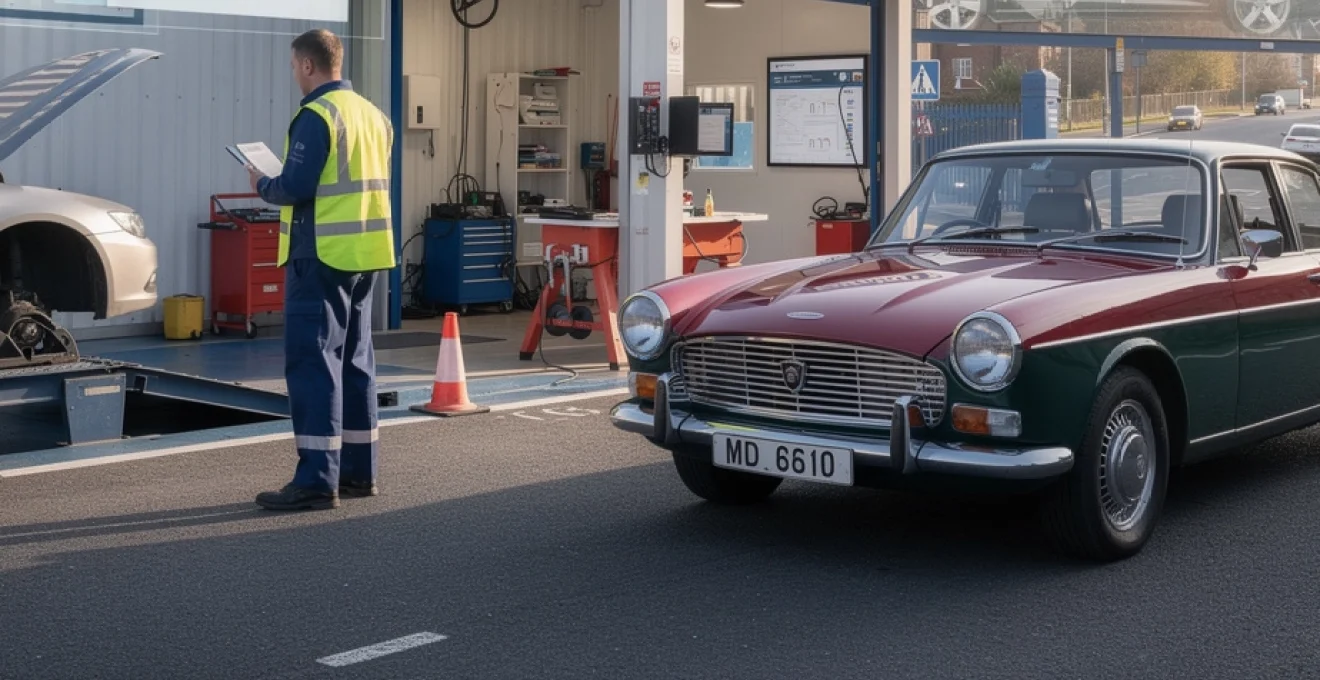
The Ministry of Transport test, commonly known as the MOT, represents one of Britain’s most significant road safety initiatives, yet vehicles over 40 years old enjoy complete exemption from this annual roadworthiness assessment. This exemption affects thousands of classic car owners across the United Kingdom, from pristine Jaguar E-Types to well-worn Morris Minors. The policy stems from extensive government consultation revealing that historic vehicles typically maintain exceptionally high safety standards whilst covering significantly fewer miles than modern cars.
Understanding why this exemption exists requires examining decades of automotive legislation, safety data analysis, and the unique characteristics of classic car ownership. The decision to exempt historic vehicles wasn’t made lightly – it emerged from compelling evidence that passionate enthusiasts maintain their treasured machines to standards often exceeding those required for modern vehicles.
Historical evolution of MOT testing legislation since 1960
The MOT testing system began in 1960 as a response to growing concerns about road safety and the increasing age of vehicles on British roads. Initially, the test applied to vehicles over ten years old, focusing on basic safety components like brakes, lights, and steering. This decade-long exemption period reflected the understanding that newer vehicles required less scrutiny, establishing a precedent for age-based testing variations that would evolve significantly over subsequent decades.
Road traffic act 1988 and MOT certificate requirements
The Road Traffic Act 1988 consolidated existing MOT legislation, establishing the legal framework that continues to govern roadworthiness testing today. This comprehensive Act mandated that most motor vehicles undergo annual testing to ensure compliance with construction and use regulations. The legislation empowered the Secretary of State to prescribe testing requirements, exemptions, and procedures, creating the flexibility necessary for future modifications to accommodate different vehicle categories.
Under this Act, vehicles required valid MOT certificates before they could legally operate on public roads, with severe penalties for non-compliance. The legislation recognised that certain vehicle types might warrant different treatment, laying the groundwork for future exemptions based on age, usage patterns, or specific characteristics that distinguished them from conventional passenger cars.
Transport act 2000 rolling exemption implementation
The Transport Act 2000 introduced significant changes to vehicle taxation and testing regimes, establishing the foundation for rolling age-based exemptions. This legislation recognised that vehicles reaching certain ages often transitioned from everyday transport to cherished possessions, warranting different regulatory treatment. The Act provided mechanisms for implementing graduated exemptions based on vehicle age, usage patterns, and historical significance.
Most importantly, this Act established the principle that regulations should reflect the practical realities of vehicle ownership and usage. The legislation acknowledged that blanket approaches to vehicle regulation might not serve the public interest effectively, particularly when dealing with vehicles that served specialized purposes or demonstrated exceptional maintenance standards.
DVSA policy changes under conservative government initiatives
Conservative government initiatives between 2010 and 2024 significantly reformed MOT exemption policies, driven by extensive consultation with classic car organisations and safety experts. The Driver and Vehicle Standards Agency (DVSA) conducted comprehensive reviews of historic vehicle safety data, revealing that vehicles over 40 years old demonstrated remarkably low failure rates when voluntarily submitted for testing.
These policy changes reflected a broader government commitment to reducing regulatory burden whilst maintaining public safety standards. The reforms recognised that classic car owners typically possessed deep mechanical knowledge and maintained their vehicles to exceptionally high standards, often exceeding contemporary safety requirements through careful restoration and ongoing maintenance.
European union roadworthiness directive 2014/45/EU compliance
The European Union Roadworthiness Directive 2014/45/EU established harmonised testing standards across member states whilst permitting specific exemptions for historic vehicles. This directive recognised that vehicles of particular historical interest warranted special consideration, provided they met strict criteria regarding age, authenticity, and usage patterns. The directive balanced road safety objectives with cultural heritage preservation, acknowledging the unique position of historic vehicles within European motoring culture.
British implementation of this directive maintained alignment with EU standards whilst preserving domestic flexibility for historic vehicle regulation. The directive’s framework supported age-based exemptions provided that member states could demonstrate equivalent safety outcomes through alternative mechanisms, such as owner responsibility requirements and voluntary testing programmes.
Current MOT exemption criteria for vehicles over 40 years
Registration date calculations using DVLA database records
Determining whether an old car is MOT exempt in the UK starts with the vehicle’s date of first registration and its recorded build year in the DVLA database. For most vehicles, the DVLA uses the date of first registration field on the V5C logbook to calculate when it passes the 40-year threshold. Each year on 1 April, vehicles that reached 40 years of age in the previous calendar year become eligible for historic status and potential MOT exemption.
Complications arise when a car’s build date and registration date differ, which is common with imports, kit cars or vehicles stored before first use. Where documentary evidence exists – such as manufacturer’s dating certificates, heritage records or club verification – owners can ask DVLA to update the logbook to show an earlier build year. This can bring forward the eligibility date for MOT exemption and historic vehicle tax class. Without such evidence, the DVLA will usually rely on the first UK registration date, even if the car is clearly older.
The DVLA database acts as the single source of truth for enforcement agencies checking whether a vehicle should have a current MOT. Automatic number plate recognition (ANPR) systems, police roadside checks and online MOT status tools all reference the same records. That is why ensuring the vehicle’s details are correctly recorded before you claim MOT exemption is crucial; any discrepancies could result in enforcement action, even if you believe the car is old enough to qualify.
Historic vehicle classification under class 4 testing standards
Even though old cars can become MOT exempt once they reach 40 years of age, the default assumption in law is still that every vehicle requires a test unless it is correctly reclassified. In practical terms, a car must first be placed into the DVLA’s historic vehicle tax class before it is treated differently from a modern car for MOT purposes. This change of class is usually done at a Post Office branch that deals with vehicle taxation, using the V5C logbook and a completed V112 declaration form.
When a historic car is tested voluntarily, it still falls under the standard Class 4 MOT testing category, alongside most passenger cars and light vans. However, DVSA guidance allows testers to apply “age-appropriate standards” when assessing classic vehicles. For example, a car that never had rear seatbelts when new is not failed for lacking them, and braking efficiency thresholds or lighting requirements are interpreted in line with the vehicle’s original design, not modern expectations.
This age-sensitive approach is important because it ensures historic vehicles are judged by realistic safety standards while still confirming basic roadworthiness. Owners who continue to test their MOT-exempt classics effectively benefit from an official recognition that their car meets the correct safety benchmark for its era. For insurers, buyers and enforcement bodies, a recent Class 4 test on a historic car can therefore serve as a powerful indicator of responsible ownership, even where the law no longer demands it.
Substantial modification rules and type approval regulations
The MOT exemption for old cars is not unconditional. One of the most important limitations concerns “substantial changes” to the vehicle over the last 30 years. Government guidance, originally developed alongside the 2014 EU Roadworthiness Directive, explains that if a historic vehicle’s chassis, body, axles or engine have been significantly altered in a way that changes how it drives, it may lose eligibility for MOT exemption. In these cases, the car is treated more like a modern modified vehicle than a preserved historic example.
How does this work in practice? The rules look at whether the vehicle still broadly corresponds to the type originally approved for road use. If an owner swaps a small four-cylinder engine for a large modern turbocharged unit, fits completely different suspension geometry, or converts the car to a radically different configuration, the changes may be considered substantial. The closer a vehicle moves towards a restomod or custom build, the more likely it falls outside the old-car MOT exemption and back into the regular testing regime.
These principles are linked to the broader type approval framework and DVLA’s points-based system for retaining a vehicle’s identity. Where major components are replaced with non-standard parts, the DVLA may require an Individual Vehicle Approval (IVA) test or re-registration on a Q plate. In this context, MOT exemption is seen as a privilege reserved for vehicles genuinely preserved in line with their original specification, not for heavily modified classics that perform and behave like entirely different machines.
Commercial vehicle exclusions for PSV and HGV categories
While many private cars over 40 years old can claim MOT exemption, the rules are stricter for older commercial vehicles. Buses, coaches and heavy goods vehicles (HGVs) fall into dedicated testing categories and are subject to separate roadworthiness regimes that often continue for the entire working life of the vehicle, regardless of age. This reflects the higher potential risk associated with large, heavy vehicles carrying passengers or goods on public roads.
Public service vehicles (PSVs) used to carry passengers for hire and reward must typically undergo regular inspections under the operator licensing regime. Even where an old bus is used only occasionally – for example, by an enthusiast group or museum – it may still require annual testing if it is used commercially or carries paying passengers. The law draws a clear line between genuinely preserved heritage vehicles used for display and education, and those still undertaking commercial work.
Similarly, historic lorries and commercial trucks are usually subject to HGV testing rather than standard Class 4 MOT procedures. Some exemptions do exist for very limited use, such as pre-1960 vehicles used unladen or for certain shows and events, but these are narrow and must be interpreted carefully. For most owners of heavy historic vehicles, the assumption should be that regular, formal testing will continue to apply even when the vehicle is more than 40 years old.
DVSA technical standards and safety assessment protocols
Behind every MOT test, whether for a modern hatchback or a 50-year-old classic, lies a detailed set of technical standards created and updated by the DVSA. These standards define exactly how each component should be inspected, what constitutes a defect, and when an item becomes a reason for failure. When policymakers decided that old cars could be MOT exempt, they did so with a clear understanding of how these standards operate and how safety could still be assured without compulsory annual testing.
The DVSA’s role is not limited to writing the rulebook. The agency also trains and audits MOT testers, calibrates the equipment used in test lanes and monitors failure patterns nationwide. Whenever changes are made to MOT exemption rules, the DVSA examines national defect data to ensure that any reduction in testing does not translate into an unacceptable rise in dangerous vehicles on the road. For historic cars, the data has consistently shown low failure rates and limited mileage, helping to justify continued reliance on owner responsibility.
Manual for authorised examiners section 1A compliance
The Manual for Authorised Examiners sets out the obligations of MOT testing stations, including how they must apply the rules to historic vehicles. Section 1A of the manual emphasises that authorised examiners must ensure their facilities, staff and procedures comply fully with DVSA requirements. This includes following official guidance when testing vehicles that pre-date many modern safety systems, such as anti-lock braking or advanced lighting technology.
For old cars that remain voluntarily MOT tested, examiners are instructed to take into account the specifications that applied when the vehicle was first used. A classic car with original drum brakes, for instance, should not be failed simply because it lacks the performance of a modern disc brake system, provided it meets the efficiency levels deemed acceptable for its era. The manual stresses consistency, objectivity and the avoidance of imposing contemporary standards where they are not legally required.
This approach is crucial because it prevents classic vehicles from being unfairly penalised when enthusiasts choose to maintain them in original condition. At the same time, the manual empowers testers to identify genuinely dangerous defects such as severe corrosion, perished tyres or ineffective brakes. When a historic vehicle fails such a test, it serves as a strong indication that, regardless of legal exemption, the car should not be driven until remedial work is carried out.
Construction and use regulations 1986 legal framework
Even when an old car is exempt from MOT testing, it is never exempt from the underlying safety laws that govern vehicles on UK roads. The Road Vehicles (Construction and Use) Regulations 1986 set out the fundamental requirements for brakes, steering, tyres, lighting and many other components. These regulations apply to almost every motor vehicle, regardless of age or MOT status, and form the backbone of what “roadworthy condition” means in legal terms.
Think of Construction and Use Regulations as the blueprint for how a vehicle should be built and maintained, while the MOT is simply an annual health check to verify compliance. When the government removed the MOT requirement for cars over 40 years old, it did not remove the obligation to comply with Construction and Use. Police officers and traffic examiners can still inspect a classic car at the roadside, and if they find serious defects, they can issue prohibition notices or pursue prosecutions.
For owners of MOT-exempt cars, this means that day-to-day responsibility for compliance sits squarely on their shoulders. You cannot rely on an annual test to identify problems; instead, regular servicing, pre-journey checks and prompt repairs become essential. From a legal perspective, a defect that would cause an MOT failure can equally support a charge of using a vehicle in a dangerous condition, whether the car is 5 years old or 55 years old.
Roadworthiness testing equipment calibration requirements
One reason policymakers are comfortable allowing old cars to be MOT exempt is the confidence they have in the robustness of the testing system for vehicles that do remain in scope. MOT stations must operate calibrated equipment for brake testing, headlamp alignment, emissions measurement and axle weight assessment. DVSA mandates regular calibration intervals and audits to ensure that results are accurate and consistent nationwide.
Why does this matter for historic vehicles? When a classic owner chooses to submit their MOT-exempt car for a voluntary test, they are gaining access to highly controlled, objective measurements of safety-critical systems. A set of brake roller readings or headlamp beam images provides a level of precision that home inspections often cannot match. It is rather like visiting a specialist medical clinic: you may feel well, but objective diagnostics can reveal issues before they become serious.
The calibration requirements create a useful safety net for enthusiasts who want reassurance about their car’s condition. For example, an owner who has just recommissioned a vehicle after long-term storage might book a voluntary MOT to confirm that the brakes, steering and suspension behave as expected under test-lane conditions. In effect, the sophistication of the MOT infrastructure offers an alternative, high-quality check for those who recognise the limits of visual inspections and driveway testing.
Insurance and legal liability framework for exempt vehicles
From an insurance and liability standpoint, the fact that a car is MOT exempt does not mean it enjoys a free pass if something goes wrong. Insurers generally require that any vehicle they cover is kept in a roadworthy condition, and this obligation applies regardless of whether the law demands an MOT. If a crash investigation reveals that an old car had defective brakes, dangerous tyres or significant structural corrosion, the absence of an MOT certificate will not shield the owner from consequences.
In serious accidents, particularly those involving injury or fatalities, investigators may look closely at maintenance records, service invoices and any voluntary MOT history. An owner who can point to a recent MOT pass, regular servicing and prompt attention to advisories will be in a stronger position than someone who has done little more than basic checks. While insurers seldom refuse cover solely because a car is MOT exempt, they may challenge claims where there is clear evidence of neglect or misrepresentation.
Legally, using a vehicle in a dangerous condition can attract fines of up to £2,500, three penalty points and even disqualification in severe cases. Criminal liability may also arise under the Road Traffic Act if a defective vehicle contributes to a collision. For this reason, many classic car specialists recommend voluntary MOT testing as a practical way to demonstrate due diligence. It serves as an independent record that, at least on the test date, the vehicle complied with the safety standards appropriate to its age.
One useful way to think about MOT exemption is as a shift in where the burden of proof lies. With a valid MOT, the starting assumption is that the car was roadworthy on the test date unless strong evidence suggests otherwise. Without an MOT, the owner may be required to show, through other records and expert testimony, that they took reasonable steps to ensure safety. In everyday use, this may never become an issue, but in the rare event of a serious incident, it can make a material difference.
Classic car preservation versus road safety considerations
The debate around why old cars are MOT exempt in the UK centres on a delicate balance between preserving automotive heritage and maintaining high road safety standards. On one side, enthusiasts argue that classic cars are part of the nation’s cultural fabric, much like historic buildings or heritage railways. They are typically driven infrequently, cherished, and maintained by owners who often know every nut and bolt. On the other side, critics question why a 40-year-old car should escape the basic safety scrutiny faced by a three-year-old family hatchback.
Government consultations leading up to the 40-year exemption revealed some telling statistics. Historic vehicles made up a tiny fraction of the national fleet and an even smaller share of annual mileage, yet their MOT failure rates were lower than those of everyday cars. Many classic owners were already investing in routine inspections and maintenance far beyond what the law required. Taken together, this evidence suggested that compulsory annual testing for these vehicles delivered limited additional safety benefits relative to its cost and complexity.
However, the picture is not entirely straightforward. Not every old car on the road is a lovingly restored icon; some are tired, low-value vehicles kept running on a shoestring budget. For these cars, the MOT test often acts as an early warning system, flagging worn brakes, corroded structures or deteriorated tyres before they cause harm. Removing that safety net can appear risky, which is why the government has retained the overarching legal duty for all vehicles, exempt or not, to be kept in a roadworthy condition at all times.
So where does this leave the informed classic car owner? In practice, the exemption represents a vote of confidence rather than an invitation to neglect. Owners who truly value preservation tend to view voluntary MOT checks, professional servicing and club-based inspections as part of responsible custodianship. After all, if the aim is to keep these cars on the road for decades to come, preventing avoidable mechanical failures is just as important as polishing paintwork or sourcing rare trim pieces.
Alternative safety compliance pathways for historic automobiles
For drivers of MOT-exempt classics who still want structured reassurance about safety, several alternative compliance pathways have emerged. The most obvious is the voluntary MOT test: even though the law no longer demands it, any owner can book a test, obtain a certificate and use the result as an objective measure of condition. For many, this becomes an annual ritual, offering peace of mind before a busy driving season or a long tour.
Beyond the MOT lane, specialist garages and marque experts offer detailed inspection services tailored to older vehicles. These assessments often go deeper than a standard test, checking known weak points on specific models, confirming torque settings on critical components, and advising on preventative maintenance. Club-based schemes sometimes provide informal safety checks at events or through technical officers, helping owners who may lack confidence in assessing structural or mechanical issues themselves.
As technology evolves, some owners are also turning to digital tools and diagnostic equipment to supplement traditional checks. For example, portable brake testers, infrared thermometers and affordable endoscopes can all reveal hidden problems before they become safety risks. While these tools do not replace the legal framework of an MOT, they illustrate how enthusiasts can embrace a proactive, data-led approach to maintaining roadworthiness in the absence of mandatory testing.
Ultimately, the UK’s decision to make old cars MOT exempt rests on a simple expectation: that enthusiasts will take responsibility for the safety of the machines they cherish. Whether you choose voluntary MOTs, specialist inspections, or a rigorous personal maintenance regime, the goal remains the same – to ensure that historic automobiles can be enjoyed on public roads without compromising the safety of their drivers, passengers or other road users.