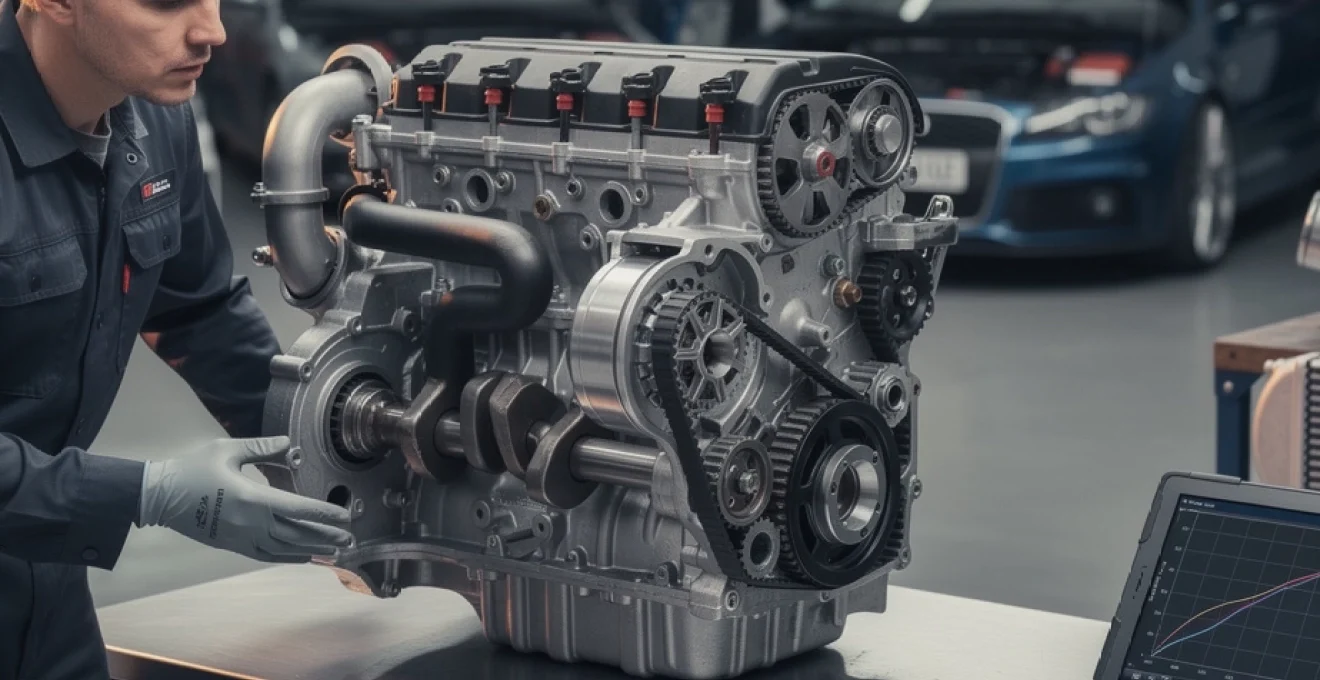
The Volkswagen-Audi Group’s 1.8-litre turbocharged engine family represents one of the most significant achievements in automotive engineering of the late 1990s and early 2000s. Among the various iterations of this celebrated powerplant, the BAM engine code stands out as a particularly noteworthy variant, renowned for its robust construction, impressive performance credentials, and exceptional tuning potential. Originally developed to power premium-brand performance vehicles, this engine has earned a dedicated following among enthusiasts who appreciate its combination of factory reliability and aftermarket flexibility. Understanding the technical intricacies, maintenance requirements, and performance characteristics of the BAM engine is essential for anyone considering ownership of a vehicle equipped with this powerplant, whether for daily driving, weekend spirited motoring, or serious performance modifications.
Technical specifications and engineering architecture of the 1.8 T BAM engine
The BAM engine represents the culmination of Volkswagen-Audi Group’s development efforts on the EA113 platform, incorporating numerous refinements over earlier 1.8-litre turbocharged variants. This particular engine code designates a specific configuration optimised for premium-brand applications, featuring enhanced internal components and more sophisticated engine management systems compared to lower-output variants sharing the same fundamental architecture.
Displacement, bore, and stroke measurements in the BAM configuration
The BAM engine maintains the standard EA113 dimensions with an 81.0mm bore and 86.4mm stroke, yielding a total displacement of 1,781 cubic centimetres. This relatively oversquare design—where the stroke exceeds the bore measurement—provides favourable characteristics for turbocharged applications, including reduced piston speeds at higher engine speeds and improved combustion chamber geometry. The 88mm bore spacing, inherited from the original EA827 engine family dating back to the 1970s, allowed Volkswagen-Audi Group to maintain manufacturing efficiencies whilst incorporating modern materials and technologies. The cylinder block utilises the later 06A casting, which eliminated the intermediate shaft found in earlier 058 blocks, instead employing a timing belt-driven water pump integrated directly into the block. This design change reduced parasitic losses and improved packaging whilst maintaining excellent cooling efficiency.
Longitudinal Five-Valve cylinder head design and flow dynamics
One of the most distinctive features of the BAM engine is its sophisticated five-valve cylinder head configuration, featuring three intake valves and two exhaust valves per cylinder. This arrangement, marketed as the “20V” designation, provides significantly improved volumetric efficiency compared to conventional four-valve designs. The additional intake valve increases the total valve curtain area, reducing flow restrictions during the intake stroke and enabling more air-fuel mixture to enter the combustion chamber. The head casting incorporates integral mounting provisions for the dual side-mounted intercoolers characteristic of high-output 1.8T variants, with a cast hole specifically designed to accommodate charge pipe brackets. This attention to detail in the casting process demonstrates the engineered approach taken throughout the BAM’s development, where every component serves multiple functions to optimise both performance and manufacturing efficiency.
Variable valve timing system and camshaft profile characteristics
The BAM engine incorporates a two-stage variable valve timing system on the intake camshaft, allowing up to 22 degrees of camshaft advancement. This system operates through a hydraulically-actuated cam phaser, controlled by the engine management system based on engine speed, load, and temperature parameters. During part-load operation, the system advances the intake cam timing to create valve overlap with the exhaust valves, promoting internal exhaust gas recirculation which reduces oxides of nitrogen emissions whilst improving fuel economy. At full throttle above approximately 4,400 rpm, the VVT actuator de-energises, allowing the camshaft to return to its mechanical end-stop position at 18 degrees after top dead centre. This effectively creates a fixed, performance-oriented cam timing during high-load operation, identical to the non-VVT APX and APY variants. The camshaft profiles themselves feature moderate duration and lift figures optimised for broad torque delivery across the rev range, rather than peak power at high engine speeds.
K04 turbocharger integration and boost pressure management
The BAM engine
is equipped from the factory with a K04-series turbocharger from Kühnle, Kopp & Kausch (KKK), specifically configured for high-output 1.8T applications. Compared with the smaller K03 units found on lower-powered AUQ or AUM engines, the K04 features a larger compressor and turbine assembly, along with strengthened bearings designed to withstand sustained higher boost pressures. In stock calibration, the BAM typically operates with peak boost in the region of 0.9–1.0 bar (13–15 psi), tapering slightly towards the upper rev range to protect both the turbo and the engine internals. Boost control is managed by the Bosch ME7.x engine control unit using an N75 duty-cycle solenoid valve, which modulates the pressure signal to the wastegate actuator. The combination of an efficient turbocharger, dual side-mount intercoolers, and precise electronic boost regulation provides a stable and repeatable power delivery, even under extended high-load conditions.
Forged crankshaft and connecting rod specifications
At the heart of the BAM engine lies a robust bottom end designed to tolerate significant cylinder pressures, both in standard form and when subject to moderate tuning. The crankshaft is an 86.4mm stroke forged steel item, shared across many EA113 engines, offering excellent torsional rigidity and fatigue resistance. Connecting rods in the high-output BAM, AMK, and APX variants are of the stronger 144x20mm configuration, using a 20mm non-tapered wrist pin and a conventional I-beam profile suitable for sustained high-load operation. Compression ratio for the BAM is approximately 9.0:1, achieved through Mahle pistons with a deeper dish than those used in higher-compression, lower-powered 1.8T variants such as the AUM or AUQ. This slightly reduced compression, combined with the forged rotating assembly, allows the BAM to run higher boost levels safely from the factory and provides additional detonation margin when owners choose to increase power through ECU remapping.
Performance output and power delivery characteristics across RPM range
On paper, the 1.8 T BAM engine is rated at 225 metric horsepower, but the way it delivers that output across the rev range is what makes it so highly regarded among drivers and tuners. Rather than chasing headline numbers at very high rpm, the calibration is engineered to provide a broad, flexible torque band that suits both real-world road driving and fast road or track use. When you drive a BAM-powered car, what stands out is the strong, linear surge from relatively low engine speeds right through to the upper mid-range, followed by a clean, sustained pull to the rev limiter. This balanced character is the result of careful turbo sizing, conservative factory boost targets, and camshaft timing designed around usable mid-range torque rather than peak-power theatrics.
Factory power rating: 225 HP at 5,900 RPM analysis
The official factory rating for the BAM engine is 225 PS (approximately 221 bhp or 165 kW) at 5,900 rpm. In practice, many healthy examples will show slightly higher figures on a calibrated chassis dynamometer, often in the 230–240 bhp region when measured at the flywheel. This discrepancy is not unusual and is largely due to conservative factory ratings, minor production tolerances, and the effect of cooler ambient conditions often present during enthusiast dyno sessions. The power peak at 5,900 rpm reflects the compromise between the flow capacity of the five-valve cylinder head, the efficiency envelope of the K04 turbocharger, and the desire to maintain reliability under sustained load. Beyond 6,000 rpm, airflow and turbine speed reach a point of diminishing returns, so the ECU progressively tapers boost and ignition advance, resulting in a gentle fall-off in power rather than an abrupt drop.
From a driver’s perspective, this means you rarely need to explore the very top of the rev range to access the engine’s best performance. Shifting around 6,200–6,500 rpm typically keeps the engine in its most effective zone, where boost pressure, airflow, and ignition timing are all operating close to their optimal values. This characteristic suits both spirited road use and circuit driving, where repeatable, mid-range thrust is usually more important than chasing the last few hundred rpm. It also contributes to the long-term durability of the 1.8 T BAM engine, as the factory calibration avoids prolonged operation in regions where turbine speeds and exhaust gas temperatures could compromise component life.
Torque curve behaviour and peak output at 2,200–5,500 RPM
One of the key strengths of the 1.8 T BAM engine is its broad, plateau-like torque curve. Factory figures quote 280 Nm (207 lb ft) of torque available from as low as 2,200 rpm, sustained up to approximately 5,500 rpm. In reality, the engine feels even more muscular than these numbers suggest, thanks to the way boost builds smoothly and the relatively short gearing fitted to many BAM-equipped models. This wide torque band means you can accelerate briskly from low to mid engine speeds without frequent downshifts, making the engine both flexible in traffic and highly effective on twisting B-roads.
The combination of early boost onset and sustained mid-range torque is made possible by the K04 turbo’s sizing and the ME7 ECU’s closed-loop boost and load targeting strategies. Rather than simply aiming for a fixed boost value, the management system calculates an engine load request and adjusts charge pressure, ignition timing, and lambda targets to achieve the desired output. As a result, the engine adapts well to changing environmental conditions, fuel quality, and altitude, maintaining a consistent driving feel. For many owners, this broad torque delivery is a major part of the 1.8 T BAM engine’s appeal, especially when compared to more peaky, naturally aspirated alternatives of the same era.
Throttle response and turbo lag mitigation strategies
Given that the 1.8 T BAM engine relies on a relatively large K04 turbocharger for its displacement, you might expect pronounced turbo lag. In practice, however, response is impressively sharp for a late-1990s/early-2000s turbocharged engine. This is achieved through a combination of modest turbine housing sizing, carefully tuned boost control maps, and the use of drive-by-wire throttle actuation. The Bosch ME7.x system can pre-empt driver inputs by managing throttle plate angle, wastegate position, and ignition timing together, helping to keep the turbocharger spinning and ready to deliver boost as soon as you request more power.
From behind the wheel, there is a perceptible but brief pause as you move from light throttle to heavy acceleration, particularly below 2,000 rpm, but once the turbo is on song, response is immediate and linear. Regular maintenance of the diverter valve, N75 boost control valve, and vacuum lines is crucial to preserving this crisp behaviour; small leaks or sticky components can make the engine feel lazy and unresponsive. When tuned correctly, you can think of the 1.8 T BAM engine’s turbo system as a well-primed air pump: as long as the supporting hardware is healthy, it will respond quickly and consistently to your right foot.
Comparison with 1.8 T AUQ and APY engine variants
The BAM sits at the top of the transverse 1.8T hierarchy, but it shares much of its architecture with other familiar engine codes such as the AUQ and APY. The AUQ, typically rated at 180 PS, uses a smaller K03-series turbocharger, higher compression pistons (around 9.5:1), a single side-mount intercooler, and less aggressive fueling and ignition maps. As a result, the AUQ offers brisk performance and good fuel economy but cannot match the BAM’s mid- to high-range pull or thermal headroom under sustained hard use. The APY and AMK engines, on the other hand, are closer relatives to the BAM, sharing the low-compression forged internals, K04 turbo hardware, and twin-intercooler layout.
Where the BAM differentiates itself from earlier high-output variants like the APY is in its adherence to stricter EU3 emissions standards and its enhanced engine management. BAM units benefit from wideband lambda (UEGO) sensors, more advanced knock control, and, in many markets, additional exhaust gas temperature monitoring. These features make the BAM easier to tune safely and allow the ECU to react more intelligently to adverse conditions such as poor fuel quality or high intake temperatures. In short, while AUQ and APY engines can be strong performers in their own right, the 1.8 T BAM engine offers a more sophisticated foundation for both stock and modified use, especially where precise control and emissions compliance are important.
Original equipment manufacturer applications and production timeline
The BAM engine was never intended as a mass-market powerplant; instead, it was reserved for premium performance applications within the Volkswagen-Audi Group. Production spanned the early 2000s, roughly aligning with the final years of the first-generation Audi TT and the later lifecycle of the 8L Audi S3 and SEAT León Cupra R. During this period, tightening emissions regulations and evolving customer expectations pushed VAG to adopt more advanced engine management while still delivering standout performance figures. As a result, the 1.8 T BAM engine became something of a halo power unit for compact performance models, sitting above more modest 150–190 PS 1.8T offerings.
Audi TT quattro sport 225 HP implementation (2000–2006)
In the Audi TT 8N platform, the BAM engine was used predominantly in the 225 PS quattro models, which sat above the 150 and 180 PS front-wheel-drive variants. These cars combined the 1.8 T BAM engine with Haldex-based quattro all-wheel drive, a six-speed manual gearbox, and upgraded cooling and braking systems compared to their lower-powered siblings. Production of BAM-equipped TTs began in the early 2000s and continued until the end of the 8N’s lifecycle around 2006, with regional variations in exact dates depending on market. The TT’s packaging constraints dictated the use of twin side-mount intercoolers, which, while adequate for factory power levels, are often upgraded by enthusiasts seeking lower intake temperatures.
Later in the model run, Audi introduced the TT quattro Sport (also known as TT QS or TT 240 in some markets), which used a closely related high-output 1.8T variant (engine code BFV) rated at 240 PS. Although not a BAM engine in the strict sense, the BFV shares many components and design philosophies, further underlining the strength of the original BAM specification. For buyers and tuners today, a BAM-powered TT offers a strong blend of character, performance, and aftermarket support, provided that common wear items such as the Haldex coupling, suspension bushes, and cooling system have been properly maintained.
SEAT león cupra R integration and model-specific modifications
The SEAT León Cupra R (1M) represents one of the most focused factory applications of the BAM engine. In this platform, the 225 PS BAM is paired with a front-wheel-drive layout, six-speed manual gearbox, and chassis tuning aimed squarely at enthusiastic drivers. Early Cupra R models used the AMK engine code, while later examples adopted the BAM, but in both cases the hardware specification was closely aligned with that of the Audi S3 8L. SEAT revised suspension geometry, brake hardware, and cooling packages to suit the León’s different weight distribution and intended use, while retaining the core strengths of the 1.8 T BAM engine.
From an engineering standpoint, one of the interesting aspects of the Cupra R is how it manages torque delivery through the front wheels. The broad torque plateau of the BAM engine can easily overwhelm front-axle grip on low-traction surfaces, so SEAT paired the engine with specific ECU calibrations and traction control strategies to maintain drivability. For enthusiasts, the León Cupra R offers an attractive combination: BAM-level performance in a more affordable and slightly lighter chassis than its Audi siblings. However, as with any BAM-powered car, buyers should pay close attention to service history, especially regarding oil changes, timing belt intervals, and boost control components.
Audi S3 8L platform compatibility and shared components
The 8L Audi S3 is often considered the spiritual home of the 1.8 T BAM engine. Early S3 models were fitted with the APY and AMK engine codes, while later cars received the BAM, largely to meet updated emissions regulations and to take advantage of improved engine management features. Mechanically, these high-output 1.8T engines share the same fundamental layout: forged crankshaft and rods, low-compression pistons, K04 turbocharger, twin side-mount intercoolers, and a six-speed manual transmission driving all four wheels through a Haldex-based quattro system.
Because of this high degree of component commonality, many parts are interchangeable between APY, AMK, and BAM-equipped S3s, which simplifies maintenance and upgrades. That said, the BAM’s use of wideband lambda control, updated sensors, and different ECU hardware means that tuning strategies and diagnostic procedures can differ from earlier engines. For anyone considering an S3 8L with a 1.8 T BAM engine, it is worth confirming that the correct BAM-specific components are still in place and that any modifications have been carried out with an understanding of the differences between engine codes.
Common mechanical failures and known weak points in BAM units
Although the 1.8 T BAM engine is fundamentally robust, no 20-year-old performance engine is entirely free from issues. Many of the weaknesses associated with BAM units stem from age-related wear, neglected maintenance, or modifications performed without a proper supporting hardware and calibration strategy. Understanding these common failure points can help you make informed decisions when buying, maintaining, or tuning a BAM-powered car. By addressing known problem areas proactively, you significantly reduce the risk of unexpected failures and costly repairs.
Diverter valve failure symptoms and N75 boost control issues
The factory plastic or early-revision rubber diaphragm diverter valve (DV) is one of the most frequent failure items on the 1.8 T BAM engine. Over time, the diaphragm can split or the internal spring can weaken, leading to boost leaks, sluggish spool, and an audible “flutter” as the turbocharger stalls against a closed throttle. Symptoms often include inconsistent boost levels, surging under acceleration, and fault codes related to charge pressure deviation. Replacing the DV with a later OEM piston-type unit or a high-quality aftermarket metal valve is a straightforward and cost-effective way to restore proper boost control and throttle response.
The N75 valve, which controls the pressure signal to the turbo’s wastegate actuator, is another critical component. A sticky or failing N75 can cause underboost, overboost, or oscillating boost levels, all of which compromise performance and can potentially stress the engine. If you experience erratic boost behaviour, it is wise to pressure-test the intake system, inspect vacuum and boost hoses, and consider replacing the N75 with a genuine OEM part. While cheap pattern parts exist, they often introduce more problems than they solve, so sticking with original equipment is generally the safest route for reliable boost control.
Timing belt tensioner degradation and catastrophic failure risk
Like many interference engines, the 1.8 T BAM relies on a timing belt to synchronise the crankshaft and camshafts, and failure of this belt or its associated tensioner can result in catastrophic valve-to-piston contact. Over time and mileage, the timing belt tensioner, idler pulleys, and water pump bearings can wear, increasing the risk of failure. Owners who stretch intervals beyond the recommended service mileage—or who rely on incomplete service records—are gambling with the engine’s survival. A seized water pump or collapsed tensioner bearing can cause the belt to jump teeth or break entirely, instantly destroying the top end of the engine.
To mitigate this risk, it is essential to treat timing belt replacement as a non-negotiable maintenance item, especially on newly acquired cars with uncertain history. A complete timing kit should include the belt, tensioner, idlers, and water pump with a metal impeller. When these components are replaced on schedule, the 1.8 T BAM engine’s valvetrain is generally very reliable, and you can enjoy the performance without worrying about sudden, catastrophic failures. Think of the timing belt service as an insurance policy: a relatively modest upfront cost that protects you from a far larger bill later.
PCV system blockage and crankcase pressure problems
The positive crankcase ventilation (PCV) system on the 1.8T family is complex, consisting of multiple hoses, check valves, and a pressure regulating valve designed to manage blow-by gases under both vacuum and boost conditions. With age and heat, these components become brittle, clogged with oil residue, or simply crack, leading to vacuum leaks, unmetered air entering the intake, and elevated crankcase pressure. On a 1.8 T BAM engine, PCV issues can manifest as rough idle, poor fuel economy, oil leaks from seals and gaskets, and even dipstick tube blow-out under sustained boost.
Addressing PCV problems typically involves a thorough inspection of all associated hoses and valves, followed by replacement with new OEM parts or a simplified and well-engineered aftermarket catch-can system. While it may be tempting to delete components without understanding their function, doing so can upset fueling trims and emissions performance. Approached correctly, however, restoring or upgrading the PCV system helps maintain clean oil, stable idle quality, and consistent boost behaviour—especially important if you plan to increase power beyond factory levels.
Coil pack deterioration and cylinder misfiring diagnostics
Another well-known weak point on early 2000s VAG engines, including the 1.8 T BAM, is ignition coil pack reliability. Age, heat cycling, and oil contamination can cause the coils to break down, leading to intermittent or persistent misfires under load. Drivers often report a sudden loss of power, flashing check engine light, and a rough-running engine, usually triggered under moderate to high boost conditions. Fault codes will typically point to misfires on one or more specific cylinders, making diagnosis straightforward with a basic OBD-II scanner.
The long-term solution is to replace all four coil packs with the latest revision OEM units and fit fresh spark plugs of the correct heat range and gap. Some owners choose to carry a spare coil pack in the boot, especially on long journeys, given how quick and simple it is to swap one by the roadside. By keeping the ignition system in top condition, you help the 1.8 T BAM engine maintain clean combustion, stable power delivery, and safe exhaust gas temperatures—particularly important on tuned engines running higher boost.
Performance tuning potential and aftermarket upgrade pathways
One of the primary reasons the 1.8 T BAM engine remains so popular is its remarkable headroom for performance tuning. Thanks to its forged internals, lowish compression ratio, and robust K04 turbo hardware, even modest modifications can unlock substantial gains without compromising everyday drivability. That said, it is crucial to approach tuning in a structured way, matching hardware upgrades with appropriate ECU calibrations and maintaining a strong focus on supporting systems such as cooling, fueling, and lubrication. When you treat the engine as a complete system rather than a collection of isolated parts, you are far more likely to achieve reliable, repeatable results.
Stage 1 ECU remapping with revo and APR software solutions
The most cost-effective and popular modification for the 1.8 T BAM engine is a Stage 1 ECU remap from a reputable tuner such as Revo, APR, or equivalent specialists. A well-developed Stage 1 map on an otherwise stock but healthy BAM engine can typically raise peak output from the factory 225 PS to around 250–265 PS, with torque increasing into the 320–360 Nm range depending on fuel quality and ambient conditions. These gains are achieved through increased boost targets, optimised ignition timing, and refined fuel delivery maps, all while retaining factory safety strategies such as knock control and exhaust gas temperature protection.
From a driving standpoint, a Stage 1 BAM feels significantly stronger across the mid-range, with more urgent acceleration and improved in-gear flexibility. Provided the clutch, diverter valve, and coil packs are in good condition, such a setup remains perfectly suitable for daily use. When considering an ECU remap, it is important to ensure the engine is mechanically sound first: fresh plugs, a clean air filter, no boost leaks, and up-to-date servicing. Think of Stage 1 as the foundation of your tuning journey; if the basics are in order, your 1.8 T BAM engine will reward you with reliable extra performance.
K04 turbo upgrade to garrett GT2871R or borg warner S3 options
For those seeking power levels beyond what the standard K04 can deliver efficiently, upgrading to a larger turbocharger is a logical next step. Popular choices for the 1.8 T BAM engine include compact Garrett units such as the GT28 series (for example, GT2871R) or modern BorgWarner turbochargers designed for high-flow applications. These turbos offer substantially greater airflow and efficiency at higher boost pressures, enabling outputs in the 320–400+ bhp range when paired with appropriate fueling, intercooling, and engine internals.
However, stepping up to a larger turbo is not as simple as bolting on the new unit and increasing boost. You will need an appropriate exhaust manifold, downpipe, intake plumbing, and often a different intercooler configuration. The ECU calibration must be completely reworked to manage increased airflow, changed spool characteristics, and higher injector duty cycles. At this level, it also becomes wise to consider stronger clutches, upgraded engine mounts, and, on quattro cars, attention to drivetrain health. Properly executed, a big-turbo 1.8 T BAM engine can deliver performance that rivals modern turbocharged sports cars, but the margin for error is smaller, so partnering with an experienced tuner is highly advisable.
Forge motorsport and EVOMS intercooler system enhancements
Cooling is a critical aspect of any high-output turbocharged setup, and the stock twin side-mount intercoolers on BAM-powered vehicles, while adequate for factory levels, can quickly become a limiting factor once boost and ignition advance are increased. Upgraded intercooler systems from reputable manufacturers such as Forge Motorsport or EVOMS are a common and effective modification. These kits typically replace the original side-mounts with a larger front-mount intercooler (FMIC) or significantly higher-capacity side-mounts, reducing intake air temperatures and improving charge-air density.
Lower intake temperatures not only increase power potential but also reduce the risk of detonation and protect the turbocharger and engine from excessive thermal stress. On a mildly tuned 1.8 T BAM engine, you might see gains of 10–15 bhp and, more importantly, much more consistent performance during repeated full-throttle runs or track sessions. When choosing an intercooler, it is worth considering pressure drop, core design, and packaging constraints; a well-matched system will support your current power goals while leaving some headroom for future upgrades.
Upgraded fuel injectors and high-pressure fuel pump requirements
As you push the 1.8 T BAM engine beyond Stage 1 or mild Stage 2 levels, fuel system capacity becomes a key consideration. The standard injectors and fuel pump are adequate for moderate increases in power but will eventually reach their safe duty cycle limits, particularly on high-octane fuel and aggressive boost targets. Upgraded injectors with higher flow rates—matched to the intended horsepower level and calibrated correctly in the ECU—ensure that the engine can maintain safe air-fuel ratios under full load. Choices vary from larger OEM-style injectors used on other VAG models to high-performance aftermarket options.
Although the BAM uses a return-style fuel system with a conventional in-tank pump, many high-power builds benefit from an uprated pump to maintain stable fuel pressure at high demand. Unlike later direct-injection engines which require high-pressure fuel pumps on the cylinder head, the BAM’s port-injection system is technically simpler but still vulnerable to fuel starvation if components are underspecified. As a rule of thumb, once you move into the 300+ bhp territory with your 1.8 T BAM engine, it is wise to have a tuner review logs of injector duty cycle, fuel trims, and lambda values to confirm that your fuel system is keeping up with your power ambitions.
Maintenance intervals and critical service procedures for longevity
Even the strongest engine will not tolerate neglect, and the 1.8 T BAM is no exception. While it is widely regarded as durable and tune-friendly, its long-term reliability depends heavily on regular, high-quality maintenance. Because most BAM-powered vehicles are now well over a decade old—many exceeding 100,000 miles—adhering to conservative service intervals is more important than ever. By following a structured maintenance schedule and paying attention to known wear items, you can enjoy the performance of the 1.8 T BAM engine for many years and miles to come.
Timing belt and water pump replacement at 60,000-mile intervals
As discussed earlier, the timing belt system is a critical maintenance area on the BAM. While some original manufacturer schedules once suggested intervals of up to 80,000 miles or more, most specialists and owners now adopt a more cautious approach, replacing the belt, tensioner, idlers, and water pump every 60,000 miles (or approximately every 5 years, whichever comes first). Given the age of these engines, shorter intervals are cheap insurance, especially if the car sees frequent high-rpm use or spirited driving.
When planning a timing belt service, it is sensible to replace ancillary components such as the thermostat and accessory belt at the same time, reducing labour duplication and potential future downtime. Using high-quality OEM or OEM-equivalent parts is strongly recommended; cutting corners with low-cost kits can undermine the entire point of preventative maintenance. If you are unsure when the timing belt was last changed, it is wise to assume that it is due and factor the cost into your purchase or ownership budget.
Spark plug specification: NGK BKR7E gap settings and replacement frequency
The 1.8 T BAM engine is sensitive to spark plug condition and specification, particularly when tuned. Many enthusiasts and tuners favour NGK BKR7E or equivalent plugs, which offer a slightly colder heat range than some factory-fit plugs, helping to manage combustion temperatures under higher boost levels. For stock or mildly tuned engines, a plug gap in the region of 0.7–0.8 mm is common, while higher-boost setups may require gaps as tight as 0.6 mm to prevent spark blowout under load.
Because copper-core plugs like the BKR7E do not have the extended service life of long-life platinum or iridium plugs, replacement intervals are shorter—often every 10,000–15,000 miles or annually on tuned engines. This may sound frequent, but the cost is low and the benefit in terms of smooth running, reliable ignition, and knock resistance is significant. Regular plug inspection also provides a useful window into the health of your 1.8 T BAM engine: abnormal deposits, oil fouling, or uneven wear patterns can highlight issues before they become serious.
Engine oil selection: 5W-40 fully synthetic and extended drain considerations
High-quality engine oil is the lifeblood of any turbocharged engine, and the 1.8 T BAM is no different. A fully synthetic 5W-40 oil meeting VW 502.00 or better specifications is widely recommended for both stock and tuned engines, offering good protection across a wide temperature range and maintaining viscosity under sustained high-load conditions. While some owners may be tempted by extended drain intervals advertised under “LongLife” servicing regimes, these are generally not advisable for older, performance-oriented engines subject to frequent short trips or spirited driving.
Instead, many specialists suggest oil changes every 5,000–6,000 miles or once a year, whichever comes first, using a quality filter and inspecting the oil for signs of contamination or fuel dilution. Regular oil changes help prevent sludge build-up, protect the turbocharger bearings, and maintain stable oil pressure at hot idle. If you plan to use your 1.8 T BAM engine on track or in particularly demanding conditions, stepping up to a high-quality motorsport-oriented 5W-40 or even 10W-50 oil (where appropriate) can provide additional thermal margin, provided cold-start conditions in your climate are taken into account. By prioritising lubrication, you greatly increase the odds that your BAM engine will remain as strong and responsive in the future as it was when it left the factory.