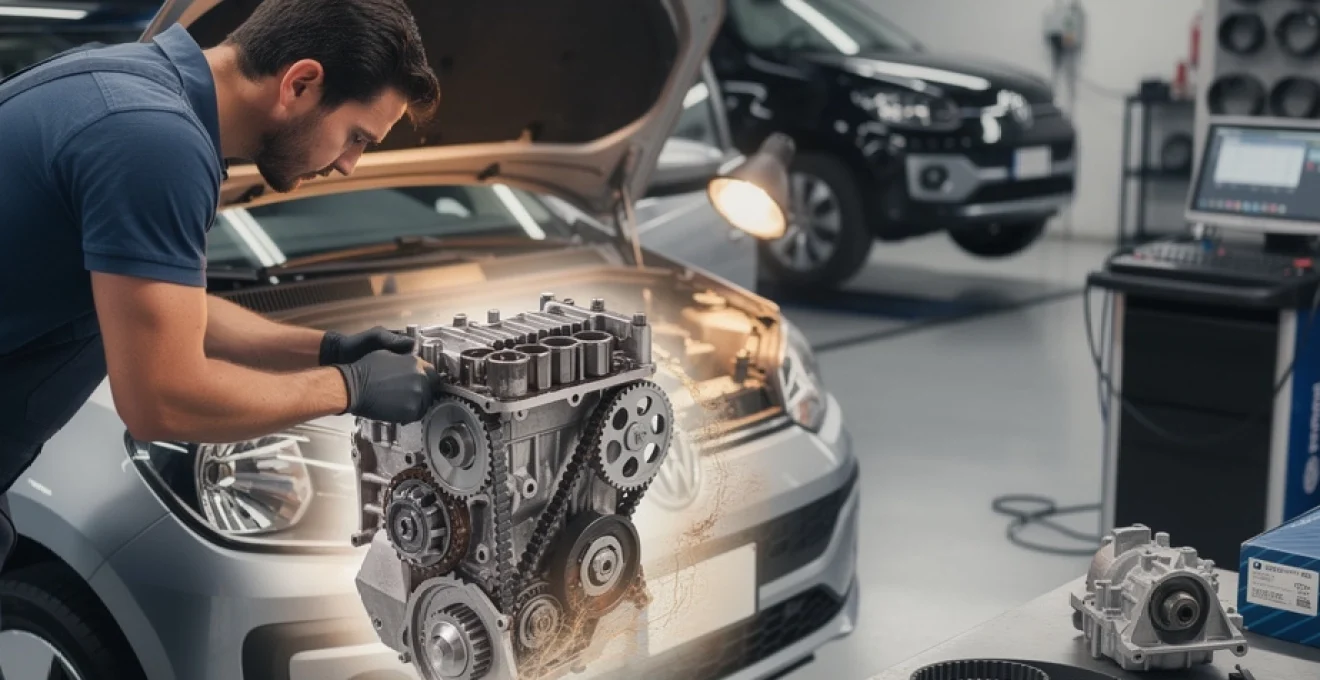
The Volkswagen Up has earned a reputation as a reliable, economical city car since its introduction in 2012. However, one aspect of maintenance that often generates confusion among owners is the timing belt replacement schedule. Unlike many modern vehicles that feature timing chains designed to last the vehicle’s lifetime, the VW Up’s 1.0-litre three-cylinder engine relies on a rubber timing belt—a component that requires periodic replacement to prevent catastrophic engine failure. Understanding when to change this critical component can save you from expensive repairs and unexpected breakdowns. The timing belt debate surrounding the Up has created considerable uncertainty, with different sources providing conflicting information about replacement intervals, making it essential for owners to understand the facts.
VW up timing belt replacement intervals: manufacturer specifications
The confusion surrounding timing belt replacement for the VW Up stems from a significant discrepancy between Volkswagen’s official factory specifications and recommendations from third-party service data providers. This divergence has left many owners uncertain about the correct maintenance schedule for their vehicle.
Volkswagen’s official service schedule for the 1.0 MPI engine
According to Volkswagen’s official factory service data system (Erwin), the naturally aspirated 1.0-litre MPI (Multi-Point Injection) engine used in the VW Up features a remarkably extended timing belt service interval. The manufacturer specifies the first inspection of the timing belt at 240,000 kilometres (approximately 150,000 miles), with replacement only required if visual inspection reveals signs of wear, fraying, cracking, or other degradation. This represents one of the longest timing belt intervals in the automotive industry and reflects Volkswagen’s confidence in the belt’s durability under normal operating conditions.
The official VW position notably does not include an age-based replacement interval, focusing exclusively on mileage and condition. This approach differs substantially from the common industry practice of recommending replacement based on whichever comes first—mileage or age. Volkswagen marketed this engine with promotional materials emphasizing the timing belt’s extended service life, positioning it as a low-maintenance solution that would reduce ownership costs over the vehicle’s lifespan.
Extended intervals for the 1.0 TSI turbocharged variant
The turbocharged 1.0 TSI engine, available in higher-specification Up models and the performance-oriented Up GTI, follows similar extended service intervals. While sharing the same fundamental architecture as the naturally aspirated MPI engine, the TSI variant operates under higher stress due to forced induction. Despite this, Volkswagen maintains confidence in the timing belt’s longevity, with factory specifications mirroring those of the MPI engine. The timing belt inspection interval remains at 240,000 kilometres, with replacement contingent upon visible deterioration rather than automatic renewal.
However, owners of TSI-equipped vehicles should consider that turbocharged engines typically generate higher operating temperatures and place greater stress on auxiliary components. While Volkswagen’s testing has validated the extended interval, some automotive professionals suggest a more conservative approach for vehicles subjected to demanding driving patterns or harsh environmental conditions.
Mileage vs Age-Based replacement criteria
The absence of an age-based replacement criterion in Volkswagen’s official service schedule has created considerable debate among technicians and owners. Third-party service data providers, including AutoData—widely used by independent garages throughout the UK—recommend timing belt replacement at five years or 60,000 miles, whichever occurs first. This significant disparity between manufacturer specifications and industry recommendations has understandably confused many Up owners.
The fundamental question becomes: should you trust the manufacturer’s extensive testing and engineering data, or follow the more conservative approach advocated by independent service providers?
The argument for age-based replacement centres on rubber degradation over time, regardless of mileage. Rubber components naturally deteriorate due to heat cycling, oil contamination, environmental exposure, and simple ageing. A timing belt on a vehicle used primarily for short urban journeys might accumulate minimal mileage whilst experiencing thousands of start-stop cycles and temperature fluctuations—conditions that can accelerate material degradation without reflecting in the odometer reading.
Model year variations: 2012
Model year variations: 2012-2023 service requirements
Although the basic 1.0 MPI and 1.0 TSI engines share the same long timing belt inspection interval of 240,000 km on paper, there are subtle differences in how various model years are treated by dealers and independent garages. Early cars from 2012–2014 were often serviced by the book at Volkswagen retailers using Erwin data, so you will rarely see a timing belt recorded before very high mileage. From around the mid-2010s onwards, however, many independents began to adopt more conservative schedules based on systems like AutoData, which list a five-year or 60,000-mile replacement recommendation for the VW Up timing belt.
For this reason, two seemingly identical 2015 cars can have very different service histories: one might still be on its original belt at 90,000 miles, while another had the belt changed at five years and 55,000 miles as a “belt and braces” precaution. Later in the production run, particularly around the facelifted Up and the introduction of WLTP emissions testing, Volkswagen did not materially alter the official timing belt guidance, but the messaging around “lifetime belt” technology became more muted. If you own a 2019–2023 VW Up, your handbook and service book may still reference inspection at high mileage rather than a fixed change point, but many dealers now discuss an optional preventive replacement once the car is eight to ten years old, regardless of mileage.
So how should you interpret this if you drive a low-mileage, early Up that has sailed past its fifth or even tenth birthday? In practice, most timing belt specialists suggest that age starts to matter more from around the eight-year mark, especially if the car lives outside, does many short trips, or shows any signs of oil seepage near the belt area. Owners of later Up GTI and TSI models often take a slightly more cautious approach still, opting to renew the belt around 80,000–100,000 miles or ten years, even though the official inspection interval is much longer. Ultimately, the best strategy is to cross-check your specific model year’s handbook, ask a trusted garage to visually inspect the belt, and then decide on a mileage or age at which you are comfortable replacing it as preventive maintenance.
Identifying timing belt wear symptoms in the VW up
Because the VW Up timing belt is hidden behind covers, many owners assume there is no way to tell whether it is still healthy. While it is true that some belts fail with little warning, there are often early clues that something is not right. Learning to recognise symptoms of a worn or failing belt can give you valuable time to book a professional inspection and plan a replacement before serious damage occurs. You will usually notice changes in how the engine sounds or behaves long before the belt actually snaps.
Think of the timing belt as the “conductor” of the engine’s orchestra: it keeps the camshaft and crankshaft in perfect rhythm. When that rhythm starts to drift, the engine can misfire, idle roughly, or make unusual noises. In some cases, you might even be able to see physical damage if the upper timing cover is removed and the belt is inspected with good lighting. Although none of these signs on their own prove that the belt is about to fail, they are all reasons to stop ignoring the issue and seek a professional opinion.
Engine misfiring and rough idling patterns
One of the more subtle symptoms of timing belt issues on a VW Up is a change in how smoothly the engine runs, particularly at idle. If the belt has stretched slightly, lost teeth, or jumped a tooth on the sprocket, the precise valve timing that these small three-cylinder engines rely on can be thrown out of sync. You might notice the engine hunting at idle, feeling lumpy in traffic, or hesitating when you pull away from a junction. In more advanced cases, the engine management light (EML) may illuminate and store fault codes related to misfires or camshaft/crankshaft correlation.
It is important to remember that rough running is not unique to timing belt problems; ignition coil packs, spark plugs, fuel injectors, or air leaks can all produce similar symptoms. However, if your VW Up timing belt is overdue on mileage or age, and you start to experience misfires or poor idle quality, it becomes a key suspect. A technician can use diagnostic tools and physical inspection to confirm whether the belt has slipped or whether another component is responsible. Ignoring these warning signs can allow a minor timing discrepancy to develop into a major failure.
Abnormal ticking or squealing noises from the engine bay
Unusual noises from the front of the engine are another common sign that it is time to pay attention to the VW Up timing belt and its associated components. A light, rhythmic ticking or clicking noise that rises and falls with engine speed can sometimes indicate excessive belt wear or a failing tensioner. In other cases, a high-pitched squealing or chirping noise may suggest that the belt is slipping on the pulleys, especially when the engine is cold or under load. These sounds may be more apparent with the bonnet open or when standing beside the car at idle.
Of course, not every tick or squeal means the timing belt is at fault. Auxiliary drive belts, pulleys and even the fuel injectors on a three-cylinder engine can all create distinctive noises. The key is to pay attention to any new or worsening sound and have it investigated rather than hoping it will disappear. Timing belt noise is like a rattle in a bicycle chain: by the time it is loud enough to notice, there is already wear present, and leaving it unchecked simply increases the risk of sudden failure.
Visible belt degradation: cracks, fraying and glazing
Visual inspection remains one of the best ways to judge the condition of a VW Up timing belt, although access is somewhat limited without removing covers and engine mounts. A technician will typically rotate the engine by hand and examine several sections of the belt for signs of cracking between the teeth, frayed edges, missing chunks of material, or a shiny, “glazed” surface. Any of these defects indicate that the rubber has hardened, fatigued, or been exposed to excessive heat, and that the belt is nearing the end of its safe service life.
If you have had a service report mentioning that the timing belt is “cracked”, “perished” or “showing signs of wear”, this is not something to defer indefinitely. Even if the mileage is well below the official inspection point, visible deterioration is a clear reason to schedule a VW Up timing belt change at the earliest convenient opportunity. A worn belt is like an ageing tyre with visible cracks: it may still hold together today, but it is operating with much less margin before a failure occurs.
Oil contamination on the timing belt surface
Oil contamination is a particularly serious concern for any rubber timing belt, including the one fitted to the VW Up. Engine oil degrades the belt material over time, causing it to swell, soften, and lose structural integrity. Common sources include leaking camshaft or crankshaft oil seals, a weeping rocker cover gasket, or even careless oil filling that spills onto the belt area. During a service, a mechanic may remove the upper cover and discover oil mist or staining on the belt and pulleys, even if the belt itself still looks structurally sound.
Once a timing belt has been exposed to oil, replacement is strongly recommended, regardless of mileage or age. Oil-soaked belts are far more likely to lose teeth or delaminate without warning. Addressing the underlying leak at the same time is essential; otherwise, a brand-new belt can quickly be ruined in the same way. If your VW Up service advisor mentions oil near the timing area, it is wise to treat this as an urgent maintenance item rather than a cosmetic issue.
Component replacement during timing belt service
When the time comes to replace the VW Up timing belt, the belt itself is only one part of the job. Because access requires partial disassembly at the front of the engine, it makes financial sense to replace certain related components at the same time. Skipping these items to save a small amount upfront can be a false economy if a tensioner, idler pulley or water pump fails later and requires the whole job to be done again. A well-planned timing belt service is therefore about renewing a whole system, not just a single rubber band.
So what exactly should you ask your garage to replace during a VW Up timing belt change? The precise answer depends on the engine variant (MPI vs TSI) and the parts included in the chosen kit, but the general principle is the same: renew any component whose failure would affect the belt’s tension, alignment, or reliability. This approach provides peace of mind for the next 60,000–100,000 miles or more, rather than merely “resetting the clock” on one part of the system.
Water pump concurrent replacement strategy
On many engines, the water pump is driven directly by the timing belt, making it common practice to replace the pump whenever the belt is renewed. The VW Up 1.0 MPI and 1.0 TSI engines are a little different in their design, and on some variants the water pump is driven from the camshaft on the opposite side of the engine, not by the belt itself. This has led to some debate among technicians about whether a water pump change is strictly necessary during a VW Up timing belt service.
However, even when the pump is not physically driven by the timing belt, it is still positioned in areas that are difficult to access. If your car has covered significant mileage or is over ten years old, combining a water pump replacement with the timing belt job can be a smart preventive measure. Think of it like changing the boiler in a house when you already have half the heating system drained down: the additional labour is relatively small compared to doing the work as a separate job later. Ask your garage to confirm the specific layout of your engine and quote for a complete package including the pump if appropriate.
Timing belt tensioner and idler pulley renewal
The timing belt tensioner and any idler pulleys are critical to maintaining correct belt tension and alignment over time. These components usually incorporate bearings and springs that wear just like any other moving part. If a bearing seizes or a tensioner fails, the result can be just as catastrophic as the belt breaking, since the belt can jump or derail from the pulleys. For this reason, reputable timing belt kits for the VW Up include a new tensioner and, where fitted, new idler pulleys as standard.
When comparing quotes for a VW Up timing belt change, it is important to confirm whether the price includes these associated components or only the belt itself. A very cheap quote may appear attractive but could indicate that only the belt is being replaced, leaving old tensioners in place. In contrast, a slightly higher price that includes a full kit from a quality brand is likely to offer much better long-term value and reliability. As with replacing all four tyres rather than just one, renewing the complete set of components ensures the whole system works together as designed.
Camshaft and crankshaft seal inspection protocol
During a timing belt replacement, the mechanic has rare access to the front of the engine, making it an ideal opportunity to inspect the camshaft and crankshaft seals. These seals prevent engine oil from escaping and contaminating the timing belt area. Over time, heat and age can cause them to harden and shrink, leading to small leaks. Even a light film of oil can gradually degrade a new belt, reducing its effective lifespan and increasing the risk of premature failure.
A thorough VW Up timing belt service therefore includes careful visual inspection of these seals for any signs of weeping, staining or fresh oil. If a leak is detected, replacing the seal at the same time as the belt is usually straightforward, since the pulleys and covers are already removed. Leaving a known leak in place is akin to fitting new carpets while the roof still leaks: you may not see the damage immediately, but it will eventually undo your investment. Discuss seal inspection and potential replacement with your chosen workshop before authorising the job.
Consequences of timing belt failure in VW up engines
Understanding the potential consequences of timing belt failure is crucial when deciding how cautiously to approach replacement intervals. The 1.0-litre engines in the VW Up are interference designs, meaning there is not enough clearance between the valves and pistons if the timing is lost. When the belt fails, the damage is often sudden and severe, turning a running engine into an expensive paperweight within a fraction of a second. This is why many owners choose to replace the belt early rather than gamble on stretching the service life to its absolute limit.
What actually happens inside the engine when the timing belt snaps or jumps? In simple terms, the camshaft stops turning while the crankshaft continues to rotate, driven by the car’s momentum or the starter motor. Valves that should be safely out of the way can be left protruding into the combustion chamber as pistons rush upwards, resulting in collisions that bend metal components with enormous force. The aftermath is often hidden from view, but the repair bills bring the reality into sharp focus.
Interference engine design: valve and piston collision risk
The VW Up’s 1.0 MPI and 1.0 TSI units are classified as interference engines because the normal operating position of the valves and pistons overlaps in space. Only precise timing, managed by the belt, keeps them from occupying the same space at the same time. When the belt slips or breaks, that coordination is lost, and the likelihood of contact between valves and pistons becomes extremely high. Even at idle speed, the forces involved are sufficient to bend valves and mark piston crowns.
This design is not unique to Volkswagen; many modern, efficient petrol engines use interference architecture to maximise compression ratio and performance. The trade-off is that timing belt integrity becomes absolutely critical. In contrast, a non-interference engine may simply stop running when the belt fails, often with little internal damage. The VW Up timing belt therefore sits at the heart of the engine’s survival: maintaining it properly is not merely about avoiding inconvenience, but about protecting the most expensive part of the car.
Cylinder head damage and bent valve scenarios
In real-world timing belt failures on small interference engines, the most common damage is found in the cylinder head. When valves strike pistons, their slender stems bend, and the valve faces no longer seal against their seats. This can crack valve guides, distort seats and in some cases even fracture the head casting itself. On a VW Up engine, repairing this level of damage usually involves stripping the head, replacing multiple valves, checking guides, and re-cutting or replacing seats—a labour-intensive and therefore costly process.
Occasionally, the piston crowns or connecting rods may also be affected, especially if the engine was under high load at the moment of failure. Deep impact marks, broken ring lands or even cracked pistons can push the repair well beyond a simple top-end rebuild. Once bottom-end damage is discovered, many workshops will advise that an engine replacement is more economical than attempting a full rebuild. At that point, the decision not to replace a £300–£500 timing belt kit earlier in the car’s life can translate into a bill several times higher.
Complete engine rebuild vs replacement cost analysis
If the worst happens and the VW Up timing belt fails, you are typically faced with two broad options: rebuild the original engine or replace it with a good used or reconditioned unit. A partial rebuild involving a refurbished cylinder head, new valves, gaskets and labour can easily run into four figures at UK labour rates, especially when you factor in ancillary items and fluids. If lower-end damage is discovered once the head is removed, costs escalate further as pistons, rings, or even the crankshaft must be replaced.
By contrast, fitting a low-mileage used engine sourced from a breaker or a reconditioned unit can sometimes be cheaper overall, but this route carries its own risks. You are relying on the unknown history of another engine, which may itself be approaching the point where its timing belt needs attention. When you compare these scenarios with the relatively modest cost of preventive belt replacement, it becomes clear why many owners see a scheduled VW Up timing belt change as affordable insurance. Spending a few hundred pounds today can help you avoid a repair bill several times larger—or even the need to scrap an otherwise sound car—later.
Professional vs DIY timing belt replacement considerations
Given the potential cost of professional labour, some mechanically minded owners wonder whether they can change the VW Up timing belt themselves. On paper, the 1.0-litre three-cylinder layout looks simple, and workshop manuals outline the steps in a logical sequence. However, timing belt replacement is a precision job where even a small mistake can have serious consequences. Before deciding between DIY and a garage, it is worth weighing the tools, skills and risks involved.
For many owners, the peace of mind that comes with having a properly equipped technician handle the job is worth the extra expense. That said, if you are experienced with engine work, have access to correct locking tools, and understand how to set and verify timing marks, a DIY timing belt change can be a satisfying project. The key is to be honest about your own skills and to recognise that saving money on labour should never come at the expense of the engine’s safety.
Specialised tools required: cam locking tools and TDC setting
One of the main barriers to DIY timing belt work on the VW Up is the need for specialised tools. Correctly locking the camshaft and crankshaft at top dead centre (TDC) is critical to ensure the new belt is installed without altering the engine’s timing. Dedicated camshaft and crankshaft locking tools, often specific to the VW Group 1.0 engine family, are designed to hold components firmly in place while the old belt and tensioner are removed. Relying on improvised marks or paint pens alone can lead to small but significant timing errors.
In addition to locking tools, you will need a torque wrench, suitable pullers or sockets for crank pulley bolts, and in some cases an engine support bar or jack to hold the engine when a mounting bracket is removed. Access on the compact Up engine bay can be tight, requiring patience and careful organisation of parts. If you are not comfortable with the idea of setting an engine’s valve timing and double-checking it before first start-up, this is a strong signal that professional help may be the safer route.
Labour costs at authorised VW service centres vs independent garages
Labour pricing for a VW Up timing belt change varies considerably depending on where you take the car. Authorised Volkswagen service centres typically charge higher hourly rates but offer brand familiarity, access to factory technical information, and the reassurance of OEM parts and procedures. A dealer quote may also include a courtesy car, software updates, and a full health check, which some owners value as part of a “main dealer” experience. For a belt and tensioner job, you might reasonably expect a dealer price in the mid-hundreds of pounds, with regional variations.
Independent garages and VW specialists can often perform the same work for less, thanks to lower overheads and more flexible parts sourcing. Many independents are staffed by ex-dealer technicians and have extensive experience with the 1.0 MPI and TSI engines. Provided they use quality parts and follow proper timing procedures, there is no inherent disadvantage in choosing an independent, and the savings can be significant. When comparing quotes, always ask what is included: does the price cover a full timing belt kit, fresh coolant if the water pump is changed, and VAT? A slightly higher but fully transparent quote is usually preferable to a low headline figure that hides extras.
Genuine VAG parts vs aftermarket alternatives: gates, dayco and INA
Another key decision during a VW Up timing belt replacement is whether to use genuine VAG parts or high-quality aftermarket kits from manufacturers such as Gates, Dayco or INA. Genuine parts purchased from a VW dealer will match the original equipment specification exactly and often come with strong warranty support. They may, however, be more expensive than equivalent kits sold under well-known aftermarket brands, even though many of those brands are original suppliers to vehicle manufacturers.
For most owners, the priority should be to avoid cheap, unbranded timing belts and tensioners in favour of reputable names. Gates, Dayco and INA, for example, have long track records in OEM supply and produce kits specifically engineered for the VW Up engine family. Whether you choose genuine or premium aftermarket, the aim is the same: to fit components that will comfortably last until the next planned replacement interval. If in doubt, ask your garage which brand they intend to use, and do not be afraid to request a particular kit if you have a preference.
Preventative maintenance to extend timing belt lifespan
While you cannot make a VW Up timing belt last forever, you can certainly help it reach—or even comfortably exceed—its intended service life. Preventive maintenance is less about constantly checking the belt itself and more about creating conditions that are kind to rubber and mechanical components. Smooth driving, regular servicing, and prompt attention to oil leaks all contribute to a healthier timing system. The goal is not to avoid replacement altogether but to reduce the likelihood of premature failure or unpleasant surprises.
Simple habits make a real difference. Allowing the engine to warm up gently before heavy acceleration reduces thermal stress on the belt and tensioner. Sticking to recommended oil change intervals, and using the correct VW-approved oil, helps keep seals supple and less prone to leaking into the belt area. Asking your mechanic to inspect the timing belt and surrounding components during major services gives you advance warning of any emerging issues, so you can plan a VW Up timing belt change on your own terms rather than in response to a breakdown.
Ultimately, the timing belt on your VW Up is one of those components that quietly does its job every time you turn the key, with no complaints and little fanfare. Giving it the attention it deserves—by understanding the real-world intervals, watching for warning signs, and choosing quality parts and workmanship when replacement is due—is one of the smartest ways to protect your car’s engine. In a city car designed for low running costs and long-term reliability, taking a proactive approach to timing belt maintenance keeps that promise intact for years to come.