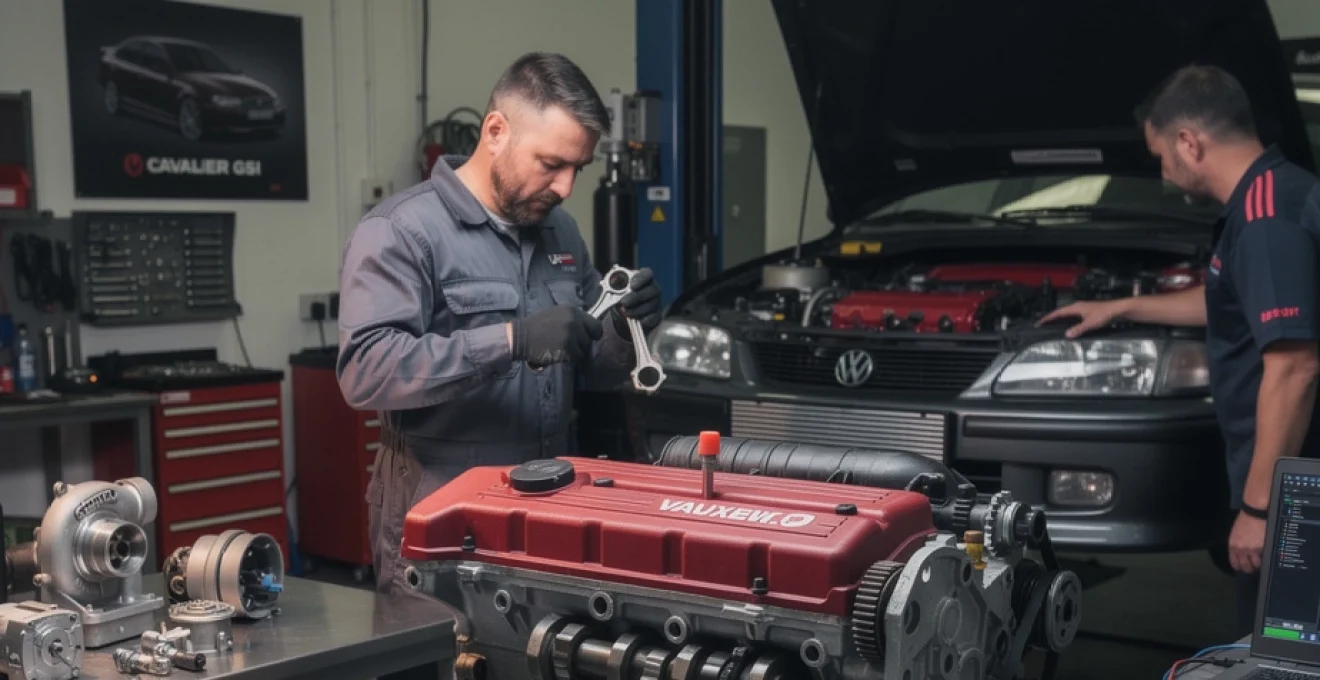
The Vauxhall Red Top engine stands as one of the most enduring symbols of European automotive tuning culture. Despite ceasing production over two decades ago, the C20XE and its turbocharged sibling, the C20LET, continue to power everything from rally-prepared Mk2 Escorts to track-focused Caterhams and modified hot hatches across the continent. This remarkable longevity stems from a combination of robust engineering, exceptional tuning potential, and a design philosophy that prioritised motorsport applications from the outset. Understanding the specifications and capabilities of these engines reveals why they remain the go-to choice for enthusiasts seeking reliable, cost-effective performance.
Red top engine architecture and factory specifications
The foundation of the Red Top’s success lies in its meticulously engineered architecture, a product of collaboration between General Motors and legendary tuning firm Cosworth. This partnership, forged in the mid-1980s, resulted in an engine that combined production feasibility with competition-grade performance characteristics. The designation “Red Top” derives from the distinctive red cam cover that adorned naturally aspirated variants, whilst turbocharged models featured a black cover.
C20XE and C20LET block construction and material composition
At the heart of both naturally aspirated and forced induction variants sits the cast iron GM Family II block, bored to 1998cc. This construction material choice, whilst adding considerable weight compared to aluminium alternatives, provides exceptional strength and thermal stability. The cylinder walls measure a robust thickness throughout, allowing for significant overboring—many tuners routinely enlarge the bore to 88mm or beyond, creating displacements of 2.1 litres or more without compromising structural integrity. The block’s webbing between cylinders proves substantial enough to withstand cylinder pressures exceeding those generated by factory specifications, making it suitable for forced induction applications producing double the original power output.
The crankshaft represents another triumph of robust engineering. Manufactured from forged steel and featuring five main bearings, this component has earned a reputation for near-indestructibility. Documented cases exist of crankshafts surviving catastrophic engine failures—including connecting rod departures through the block wall—whilst remaining serviceable. The factory stroke measures 86mm, creating the classic “square” engine configuration when paired with the 86mm bore. This dimensional balance contributes to the Red Top’s characteristic blend of responsive acceleration and usable torque across a broad rev range.
DOHC 16-valve cylinder head design and flow characteristics
The cylinder head design represents Cosworth’s most significant contribution to the Red Top’s performance credentials. Cast in aluminium and featuring dual overhead camshafts operating four valves per cylinder, this component was engineered with motorsport homologation requirements firmly in mind. The combustion chamber shape promotes efficient burning whilst minimising knock tendency, allowing the naturally aspirated variants to run relatively aggressive ignition timing on period-appropriate fuel.
Port design reflects a clear focus on high-rpm breathing capacity. The intake ports measure generously in cross-sectional area, whilst maintaining velocity characteristics suitable for strong mid-range torque. Factory valve sizes—34mm intake and 30mm exhaust in most applications—flow impressively for a mass-produced engine, though they represent one area where significant gains remain accessible through modification. The valve angle and combustion chamber roof design create a pent-roof configuration that maximises volumetric efficiency whilst keeping compression ratios within sensible limits for pump fuel.
Early production cylinder heads, manufactured by Cosworth themselves and identified by the “Coscast” marking, command premium prices in the used market. These units feature superior casting quality compared to later GM-produced heads, with particular attention paid to eliminating porosity in critical oil gallery areas. The transition to GM production introduced cost-saving measures that unfortunately compromised reliability in certain respects, though properly prepared later heads perform comparably when rebuilt to proper standards.
Factory compression ratios: 10.5:1 vs turbocharged variants
Naturally aspirated C20XE engines employed a compression ratio of 10.5:1, achieved through dished piston crown designs and careful combustion chamber volume control. This relatively aggressive ratio for the era contributed to the engine’s responsive character and strong mid-range
torque, but it also demands careful consideration when planning forced induction conversions. High compression on a turbocharged red top engine sharply limits safe boost levels on pump fuel unless you combine it with sophisticated engine management and intercooling. Builders aiming for reliable track use often reduce static compression via alternative pistons or thicker head gaskets to create a more tolerant setup for sustained high-load operation.
OEM fuel injection systems: bosch motronic and multec configurations
From the factory, the Vauxhall red top engine family relied on period Bosch and GM Multec fuel injection systems that prioritised driveability and emissions over outright power. Early C20XE units typically used Bosch Motronic ECU variants with an airflow meter, narrowband oxygen sensor (in later models), and distributor-based ignition. These systems delivered smooth cold starts and good fuel economy, but their resolution and processing speed are modest by modern standards, limiting how far you can push tuning whilst retaining the stock ECU.
Later engines transitioned to distributorless ignition, with coil-packs and crank sensors offering more accurate spark control across the rev range. Certain applications, particularly in non-UK markets, used GM Multec management, which followed a similar philosophy but differed in sensor strategy and calibration. While both Bosch Motronic and Multec can be “chipped” or remapped to a degree, tuners frequently bypass these systems once modifications exceed basic bolt-ons. If you are planning substantial upgrades, viewing the OEM injection as a solid baseline rather than a long-term solution is a sensible approach.
Standard power output across calibra, astra GTE and cavalier GSi models
The naturally aspirated C20XE left the factory with quoted outputs in the 148–156 bhp range, depending on market, emissions equipment and specific model. Early Astra GTE 16v and Kadett GSi 16v examples often carried the higher 156 bhp rating, while later “C20XE” badged engines in Calibra and Cavalier GSi models were typically rated at 150 bhp. In real-world conditions many healthy, well-maintained engines still produce close to these figures on a modern rolling road, underlining the robustness of the original calibration and hardware.
The C20LET turbocharged red top engine, fitted to the Calibra Turbo 4×4 and some Cavalier Turbo models, produced a factory-rated 204 bhp and around 206 lb ft of torque. Achieved via a relatively small turbocharger and conservative boost pressure, these numbers might not seem spectacular against modern “hyper hatch” benchmarks, but they were impressive in the early 1990s and remain very tuneable today. The important takeaway is that both the naturally aspirated and turbocharged red top engines provide a strong baseline that responds predictably to well-planned modifications.
Performance limitations of stock red top components
However tough the red top engine may be, every factory component has a limit. Understanding where these weak points lie lets you plan upgrades in a way that maximises reliability rather than simply chasing peak dyno numbers. Think of it as building a chain: the engine is only as strong as its weakest link, whether that’s the connecting rods at high rpm, the piston ring lands under detonation, or the stock clutch once torque climbs past its design window.
Connecting rod strength thresholds at high RPM
One of the best-known constraints of the standard C20XE bottom end is the factory connecting rod and, more specifically, the OEM rod bolts. The rods themselves will typically survive up to around 230–250 bhp in naturally aspirated trim, provided you keep revs within sensible limits and avoid frequent over-rev events. The bolts, on the other hand, are widely regarded as a “must-upgrade” item once you push beyond fast-road tuning and into regular circuit or competition use.
Most experienced builders treat 7,500 rpm as the practical ceiling for stock rods with uprated bolts such as ARP. Beyond this point, inertia loads rise steeply and the margin for error narrows. Occasional bursts to 7,800 rpm may be tolerated on a well-balanced engine, but sustained operation at those speeds is playing with fire on OEM hardware. If your red top build plan includes high-rpm camshafts, aggressive mapping and regular track use, uprated rods should be viewed as an investment in reliability rather than a luxury.
Piston ring land failure points under boost pressure
On turbocharged or supercharged red top engine builds, the pistons and, in particular, their ring lands often become the first internal casualties. Early C20XE pistons are forged and surprisingly resilient, but even these will crack ring lands if subjected to detonation or excessive cylinder pressure for prolonged periods. Later cast pistons found in C20XE-LN and some C20LET engines are less forgiving and should be treated carefully once boost and ignition advance are pushed beyond factory levels.
Symptoms of ring land failure include sudden loss of compression on one or more cylinders, increased blow-by and visible oil consumption, sometimes accompanied by metallic debris in the sump. The risk rises sharply when combining high compression ratios with more than around 0.7–0.8 bar of boost on pump fuel, especially if charge cooling and mapping are not optimised. If you are planning to run a turbocharged red top engine at more than 1.0 bar on a regular basis, forged pistons designed specifically for boosted applications are highly advisable to avoid “glass ceiling” failures at the ring lands.
Factory engine management ECU mapping constraints
The stock Bosch or Multec ECU mapping, whilst robust for standard hardware, places strict limitations on how far you can safely modify a red top engine without switching to standalone management. Fuel and ignition tables lack the fine resolution required to exploit modern high-flow injectors, aggressive cam profiles or substantial boost increases. Additions such as larger turbochargers, significant head work or increased displacement quickly push the OEM ECU outside its comfort zone.
Another constraint is sensor strategy: relying on a dated airflow meter and narrowband oxygen sensor limits how accurately the original ECU can respond to changes in volumetric efficiency. You may see some gains from performance “chips” or basic re-mapping, but these are incremental rather than transformational. For serious power increases, particularly on a turbocharged red top engine, migrating to a modern standalone ECU with wideband feedback and 3D fuel and ignition maps is the most sensible path.
Standard clutch and gearbox torque capacity limits
It is easy to focus on the engine itself and overlook the drivetrain that has to transmit the extra power. Factory clutches paired with C20XE and C20LET engines were designed around torque outputs of roughly 150–210 lb ft. They cope well with mild upgrades but will begin to slip once torque levels climb towards 260–280 lb ft, particularly in heavier vehicles or when subjected to repeated hard launches. An uprated organic clutch and, for more extreme builds, a paddle or twin-plate setup become necessary as torque approaches 300 lb ft and beyond.
The commonly mated F20 and F28 gearboxes are relatively stout, but they are not invincible. The F20 is generally comfortable up to around 220–240 lb ft in road use, while the F28, used with the C20LET, copes with 280+ lb ft when in good condition. Hard drag starts, wheel hop and shock loads from aggressive clutch engagement are what typically kill these boxes rather than steady-state torque alone. When planning a high-power red top engine build, factoring in gearbox health, differential upgrades and appropriate clutch selection is just as important as picking pistons and rods.
Forced induction upgrades: turbocharger and supercharger systems
One of the reasons the Vauxhall red top engine remains so popular is its ability to handle boost when configured correctly. Whether you are replicating the C20LET layout, adding a modern turbo to a C20XE, or experimenting with a centrifugal supercharger, the iron block and Cosworth head make a strong starting point. The key is to treat forced induction as a complete system—turbo choice, intercooling, fuelling and management all need to work together if you want power gains without reliability nightmares.
Garrett GT28 and T25 turbo manifold conversions for C20XE
For naturally aspirated C20XE owners looking to add boost, one common path is to adapt the engine using a custom or aftermarket turbo manifold, often paired with Garrett GT28 or T25-series turbos. The GT28 range, such as the GT2860RS, offers an excellent balance of spool and top-end power on a 2.0-litre four-cylinder, making it ideal for fast-road and track-day builds targeting 280–350 bhp. A T25 or slightly larger T28, by contrast, will spool earlier and suit those prioritising strong mid-range torque and driveability over peak numbers.
Most conversions involve fabricating a tubular exhaust manifold or modifying a C20LET-style log manifold to accept the chosen turbo flange. You will also need to consider external wastegates, downpipe routing and heat management around the engine bay. As a rule of thumb, a conservative GT28-based setup on a low-compression red top engine with quality mapping can achieve around 300 bhp on pump fuel whilst maintaining reasonable lag characteristics. Pushing beyond that often calls for larger-frame turbos and a willingness to accept later boost onset.
Intercooler sizing and placement for maximum charge cooling
Effective charge cooling is fundamental to a reliable turbocharged red top engine, particularly if you are aiming to run more than around 0.7 bar of boost. An intercooler works much like a radiator for your intake air: larger cores dissipate more heat but can also introduce pressure drop and packaging challenges. On most FWD Astra, Cavalier or Calibra installations, an efficient front-mount intercooler with a core size in the 450–600 mm width and 60–75 mm thickness range strikes a good balance for sub-400 bhp builds.
Placement matters just as much as size. You want the intercooler directly in the airflow, with minimal obstruction from bumpers or crash bars, and short, smooth pipework connecting it to the turbo and throttle body. Excessive pipe length adds volume and can worsen turbo lag, whereas tight bends create pressure drops and turbulence. If you are working with a rear-wheel-drive conversion—say an XE-powered Mk2 Escort or kit car—you will need to consider radiator and intercooler stacking carefully to avoid heat-soak at low speeds or during sustained track use.
Fuel system upgrades: uprated injectors and walbro 255 fuel pumps
Increased airflow from a turbo or supercharger is worthless without the fuelling to match. The factory injectors on a C20XE or C20LET red top engine quickly reach their duty cycle limits once power climbs much beyond 230–250 bhp. Common upgrades include Bosch “cream” or “green” injectors in the 350–440 cc/min range for moderate builds, and 550–750 cc/min units for more serious turbo setups. Selecting injectors with sufficient headroom—aiming for no more than 80–85% duty cycle at peak power—is a simple way to build reliability into your system.
On the supply side, high-flow in-tank or external fuel pumps such as the widely used Walbro 255 lph are typical choices. These pumps can reliably feed red top engines up to around 400 bhp when paired with appropriate wiring, relays and fuel pressure regulation. Upgrading the fuel lines and fitting a modern fuel filter are sensible complementary steps, especially on older chassis where corrosion or debris may compromise flow. Skimping on fuelling is a false economy; it is far cheaper to specify injectors and a pump with room to grow than to rebuild a melted engine caused by lean running.
Standalone ECU options: MegaSquirt, emerald and DTA systems
As power levels rise and hardware changes proliferate, a standalone ECU becomes one of the most important components in any serious red top engine build. Popular choices in the community include MegaSquirt, Emerald and DTA, all of which can provide full 3D fuel and ignition control, boost management and advanced safety strategies such as knock control and rev limiting. The choice often comes down to your tuner’s familiarity with a given system, available support, and the specific features you require.
MegaSquirt appeals to budget-conscious builders and those who enjoy a DIY approach, offering huge flexibility and a large online knowledge base. Emerald has a long track record with four-cylinder performance engines and offers user-friendly software and good UK-based support. DTA, meanwhile, is well-regarded in club motorsport for robust hardware and powerful logging capabilities. Whichever route you choose, the critical factor is securing an experienced mapper who understands the nuances of the Vauxhall red top engine; even the best ECU cannot compensate for poor calibration.
Safe boost levels on standard internals: 0.5 to 1.0 bar considerations
How much boost can a stock-internal red top engine safely handle? The answer depends on compression ratio, fuel quality, intercooling and the thoroughness of your mapping. As a broad guideline, many builders consider 0.5–0.7 bar of boost on a standard compression C20XE to be the upper limit for regular road use on pump fuel, assuming excellent intercooling and conservative ignition timing. This can yield power figures in the 250–280 bhp range when paired with an efficient turbo and exhaust system.
On factory C20LET engines with lower compression pistons, boost levels around 1.0 bar are commonly run on stock internals, often delivering 260–280 bhp with good reliability when managed correctly. Pushing beyond 1.0 bar on standard rods and pistons quickly becomes a gamble, with ring land failures, head gasket issues and rod fatigue all becoming more likely. If you have ambitions of sustained 300+ bhp from your turbocharged red top engine, upgrading internal components is strongly advised before you start turning the boost controller.
Internal engine strengthening for high-power applications
Once you move beyond the limits of standard hardware, the focus shifts to building a red top engine bottom end that can thrive at elevated power and rpm levels. This is where terms like “forged pistons”, “race bearings” and “blueprinting” enter the conversation. While such upgrades undeniably add cost, they also transform the engine’s durability, turning a fragile high-power build into a robust package capable of surviving seasons of hard use in competition or on track days.
Forged piston and uprated rod selection: wiseco and CP pistons
Forged pistons and uprated connecting rods form the backbone of any high-power red top engine. Brands such as Wiseco and CP Pistons offer forged piston sets specifically designed for C20XE and C20LET applications, with options to tailor compression ratios to your intended use case. Lower compression pistons in the 8.5:1–9.0:1 range suit high-boost turbo builds, while slightly higher compression forged pistons can be used for naturally aspirated or low-boost supercharged setups where throttle response is a priority.
On the rod side, H-beam or I-beam forged steel items rated for 600+ bhp provide a generous safety margin, even if your immediate goal is a more modest 350–400 bhp. These rods typically come with high-strength fasteners such as ARP bolts as standard, addressing the well-known weakness of OEM hardware at high rpm. When combined with correctly specified pistons, you gain the freedom to explore more aggressive turbocharger options or high-lift camshafts without constantly worrying about bottom-end survival.
ACL race bearing upgrades and oil pump modifications
Bearings and oil supply are often overlooked until something goes wrong, yet they are fundamental to keeping any performance red top engine alive. ACL Race bearings are a popular upgrade, offering improved load-carrying capacity and more consistent clearances compared to tired OEM parts. When setting up a high-power engine, many builders take the opportunity to measure and adjust bearing clearances carefully, optimising them for the intended oil viscosity and usage pattern.
The oil pump also deserves attention, especially on engines destined for sustained high rpm and track use. Options include refreshing the standard pump with new internals, fitting uprated gears, or switching to an aftermarket high-volume unit where available. Simple modifications, such as blueprinting the pump, ensuring correct relief valve operation and deburring oil galleries in the block, can significantly improve reliability. For extreme applications—such as high-grip slick-tyre racing or long-duration circuit work—a dry sump system becomes the ultimate safeguard against oil starvation and pressure fluctuations.
Head gasket solutions: MLS vs composite for boosted applications
Keeping combustion pressure where it belongs is critical once cylinder pressures climb, and the choice of head gasket can make or break a boosted red top engine. Multi-layer steel (MLS) gaskets offer superior strength and sealing capabilities compared to traditional composite gaskets, particularly when combined with properly prepared block and head mating surfaces. They are well suited to turbocharged builds targeting 300+ bhp, provided the surfaces are machined to the required smoothness and flatness for MLS to seal correctly.
Composite gaskets still have their place, especially on naturally aspirated or mild-boost engines where ultimate sealing strength is less critical and slightly greater compliance can help accommodate minor surface imperfections. Some builders also use slightly thicker gaskets—whether MLS or composite—to nudge compression ratios down on high-boost conversions. Whatever gasket you choose, pairing it with quality head bolts or, ideally, ARP head studs, and ensuring correct torque procedures are followed, is essential to long-term reliability.
Balancing and blueprinting procedures for reliability
Balancing and blueprinting might sound like old-school race engine buzzwords, but they remain highly relevant if you want your red top engine to live a long, hard life at elevated power levels. Dynamic balancing of the crankshaft, rods, pistons, flywheel and clutch assembly reduces vibration and stress on bearings, allowing smoother operation at high rpm. The result is not just improved reliability but often a more eager, freer-revving engine that feels “lighter” on its feet.
Blueprinting takes this concept further by carefully measuring and optimising clearances, alignments and tolerances throughout the engine. Main bearing housing alignment, deck heights, combustion chamber volumes and even cam timing events are verified against target specifications rather than simply being “within factory tolerance”. In practice, a fully balanced and blueprinted red top engine will typically run cooler, rev more cleanly and withstand abuse that would quickly expose weaknesses in a hastily assembled unit.
Camshaft profiles and valvetrain optimisation
The Cosworth-designed cylinder head already gives the Vauxhall red top engine impressive air-flow, but camshaft and valvetrain upgrades can unlock even more potential. Whether your goal is a tractable fast-road setup or a high-revving naturally aspirated screamer, choosing the right cam profiles and supporting hardware is crucial. Get it right and the engine will feel transformed; get it wrong and you may end up with a peaky, unpleasant powerband or, worse, mechanical failure at high rpm.
Piper, kent and newman fast road camshaft specifications
Several established camshaft manufacturers offer grinds for the red top engine, with Piper, Kent and Newman among the most popular. Fast-road profiles typically fall in the 260–270° advertised duration range, with modest increases in lift over stock. These cams aim to improve breathing and extend the powerband without sacrificing low-speed manners, making them ideal for dual-purpose road and occasional track cars.
More aggressive “rally” or “track day” profiles push duration into the 280–300° range with significantly higher lift, shifting the torque curve further up the rev range. Such cams often require upgraded valve springs, vernier pulleys and, in some cases, piston pocketing to provide adequate valve-to-piston clearance. As cam profiles become more radical, idle quality deteriorates and low-rpm driveability diminishes, so it pays to be honest about how you will use the car. For many owners, a well-chosen fast-road camshaft combined with improved intake and exhaust flow offers the best balance of everyday usability and performance.
Vernier pulley timing adjustments for peak torque delivery
Vernier cam pulleys provide the fine control needed to extract the most from any aftermarket camshaft on a red top engine. Factory cam timing is a compromise aimed at meeting emissions, fuel economy and noise regulations across a huge range of conditions. By contrast, performance builds often prioritise a narrower band of use—such as track driving or spirited back-road use—so retiming the cams by a few degrees can yield measurable gains in torque and responsiveness where you actually need them.
On the dyno, tuners will typically “dial in” cam timing by advancing or retarding each cam in small increments and observing changes in the torque curve. Advancing the intake cam, for example, can boost mid-range torque at the expense of some high-rpm power, while retarding it can favour top-end output. The exhaust cam can also be tweaked to optimise scavenging. This process is part science, part art, but when done properly it can make the difference between a peaky, awkward engine and one that pulls strongly and cleanly across the rev range.
Uprated valve spring pressures to prevent float above 7500 RPM
As red top engines are pushed to higher rpm with aggressive cams and lighter rotating assemblies, valve control becomes a critical consideration. Valve float—where the spring can no longer keep the valve following the cam profile accurately—can occur above 7,500 rpm on tired or stock springs, especially when matched with higher-lift profiles. The consequences range from lost power and misfires to catastrophic contact between valves and pistons.
Uprated valve springs, often paired with titanium retainers for reduced mass, increase the seat and open pressures to maintain control at elevated rpm. The goal is to provide just enough additional pressure to prevent float without unnecessarily increasing friction and wear in the valvetrain. For most performance road and track applications, a well-specified spring and retainer kit will provide reliable operation up to 8,000 rpm or beyond, giving you the confidence to exploit the full potential of your chosen camshaft setup.
Real-world red top power figures and build costs
Ultimately, theory only goes so far—what matters is the power you can realistically expect from a Vauxhall red top engine and what it will cost to get there. Thanks to decades of development by tuners and club racers, we now have a clear picture of common power “steps” and the budgets required. Whether you are planning a mild refresh for a road car or a full-house competition engine, having realistic expectations will help you avoid costly missteps.
At the mild end, a healthy C20XE with a performance exhaust manifold, free-flowing exhaust, intake improvements and a remapped or aftermarket ECU will typically produce around 170–190 bhp. This kind of “Stage 1–2” package remains relatively affordable and preserves OEM reliability, making it an excellent starting point. Step up to quality individual throttle bodies, fast-road cams and head work, and 210–230 bhp becomes achievable, albeit with a noticeable increase in cost and tuning complexity.
Naturally aspirated builds in the 230–250 bhp range often involve high-compression forged pistons, more aggressive cams, extensive head porting and fully optimised management. Budgets here frequently stretch into the £4,000–£6,000 range for parts and machining alone, excluding labour. Turbocharged combinations, by contrast, can reach similar or higher power levels on stock internals at lower initial cost—but only if you remain conservative with boost and prioritise mapping and charge control. Well-executed turbo setups producing 280–320 bhp from a red top engine are common in the UK and European tuning scenes, with total build costs varying widely depending on whether you fabricate components yourself or opt for off-the-shelf kits.
At the extreme end, fully forged and dry-sumped red top engines with bespoke turbo systems or highly developed naturally aspirated specs can exceed 350 bhp, but total investment often rivals or exceeds the value of the car they power. These are specialist builds, typically reserved for competition use where every last horsepower matters and budget takes a back seat to performance. For most enthusiasts, a well-planned 220–300 bhp red top engine offers the sweetest spot: fast enough to be genuinely exciting, yet still affordable to build, run and maintain over the long term.