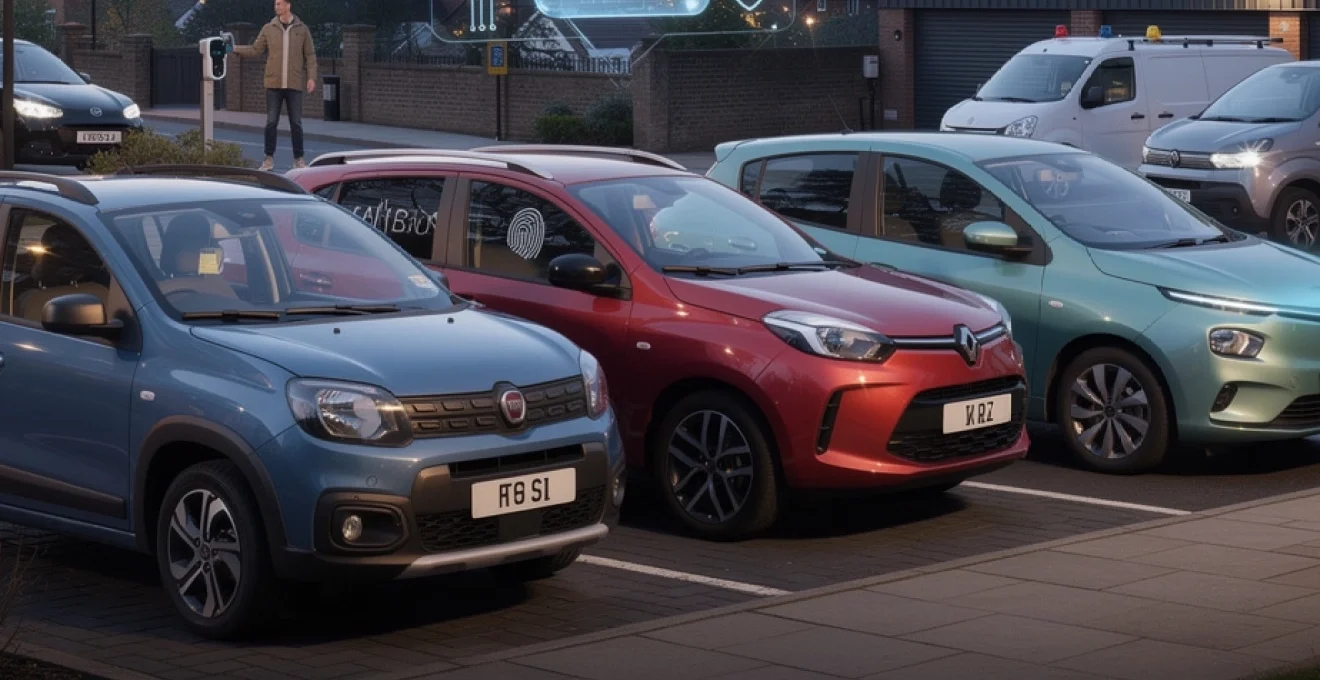
# The Least Stolen Cars in the UK: 2026 Update
Vehicle theft remains a persistent concern for UK motorists, with recent data revealing that over 375,000 vehicles were reported stolen across England and Wales in the year ending September 2024. Yet whilst certain models—particularly keyless-entry luxury SUVs and popular hatchbacks—continue to dominate police reports and insurance claims, a fascinating counter-narrative has emerged. Some vehicles are remarkably resistant to theft, with certain models recording theft rates so low they barely register in national statistics. Understanding which cars thieves consistently avoid can inform smarter purchasing decisions, potentially saving you thousands in insurance premiums whilst providing genuine peace of mind.
The contrast between high-risk and low-risk vehicles has never been more pronounced. Whilst Range Rover owners face eye-watering premiums and mandatory tracking requirements, drivers of budget-friendly models like the Dacia Sandero enjoy some of the lowest theft incident rates in the country. This disparity isn’t merely coincidental—it reflects a complex interplay of technological sophistication, market desirability, parts value, and the fundamental economics of organised vehicle crime. For thieves operating under time pressure and risk calculation, certain vehicles simply aren’t worth the effort.
DVLA and police national computer theft statistics methodology for 2025-2026
The most reliable theft data derives from two primary sources: the Driver and Vehicle Licensing Agency’s Lost or Stolen (LoS) notifications and the Police National Computer’s recorded crime database. These systems capture reported thefts across all UK police force areas, providing comprehensive geographical and temporal coverage. However, you should understand that these figures represent reported incidents only—industry experts estimate that between 8-12% of vehicle thefts go unreported, particularly when owners suspect insurance complications or believe recovery is unlikely.
For the 2025-2026 reporting period, methodology has been refined to distinguish between complete vehicle theft, attempted theft resulting in damage, and theft of vehicle components (particularly catalytic converters, which saw dramatic increases between 2021-2023 before recent declines). The DVLA’s LoS database now integrates more seamlessly with insurance industry claims data from the Association of British Insurers, creating a more accurate picture of actual theft frequency versus insurance fraud. This enhanced data quality reveals that certain vehicle categories—particularly older budget models with minimal resale value—experience theft rates below 0.5 incidents per 1,000 registered vehicles annually.
Regional variations significantly impact these statistics. Metropolitan areas, particularly London, the West Midlands, and Greater Manchester, account for disproportionate theft volumes, yet even within these high-risk zones, specific models maintain exceptionally low theft rates. The data methodology now accounts for vehicle age, insurance group rating, typical ownership demographics, and parking patterns to create risk-adjusted theft probability scores. These refined metrics demonstrate that vehicle selection can reduce your theft risk by up to 95% compared to high-risk alternatives, independent of where you live or park.
Manufacturer Anti-Theft technology: immobilisers, tracking systems and biometric integration
Modern vehicle security architecture has evolved considerably beyond the basic alarm systems of previous decades. Since 1998, electronic immobilisers have been mandatory on all new vehicles sold within the EU, creating a fundamental baseline of protection. These systems prevent engine ignition unless the correct cryptographically-coded key or fob is detected, effectively eliminating traditional hot-wiring methods. However, not all immobiliser implementations offer equal protection—older systems using fixed-code technology remain vulnerable to code-grabbing attacks, whilst newer rolling-code and challenge-response systems provide substantially enhanced security.
The least stolen vehicles typically feature multi-layered security architectures that create cumulative deterrent effects. Beyond immobilisers, these systems often include perimeter monitoring, motion sensors, tilt detection (to identify towing attempts), glass-break sensors, and increasingly sophisticated alarm systems that can differentiate between genuine threats and environmental triggers. Manufacturers of budget-focused vehicles have paradoxically benefited from implementing these technologies at scale—the marginal cost of incorporating robust security electronics has decreased substantially, allowing even entry-level models to feature protection previously reserved for premium segments.
Biometric integration represents the emerging frontier in vehicle security, though widespread adoption remains limited. Fingerprint recognition for ignition authorisation
continues to transition from concept to reality, particularly in premium models and pilot programmes for fleet vehicles. Systems combining fingerprint scanners with facial recognition or smartphone-based biometric authentication can ensure that even if a key fob is cloned or relayed, the vehicle will not start without an authorised biometric profile. In the medium term, we can expect this technology to filter down to mainstream models, reinforcing the position of certain vehicles as among the least stolen cars in the UK.
Thatcham research category 1 and 2 alarm systems in Low-Theft models
One of the quiet success stories behind low-theft vehicles in the UK is the widespread adoption of Thatcham Research-approved security systems. Category 1 systems combine an alarm and an immobiliser that meet strict performance criteria, including perimeter protection, interior movement detection and fail-safe immobilisation if the alarm is triggered or tampered with. Category 2 systems focus solely on immobilisation but must still satisfy rigorous testing around resistance to tampering and hot-wiring. Many of the least stolen cars—particularly from brands like Dacia, Suzuki and Hyundai—use Thatcham Category 1 or 2 systems as standard, even on base trims.
Why does this matter to you as a driver choosing a low-risk car? Insurers in the UK frequently reference Thatcham categories when pricing policies, and vehicles with certified Category 1 or 2 systems can attract lower premiums or avoid onerous conditions such as mandatory trackers. From a thief’s perspective, Thatcham-approved systems raise the time and technical competence required to steal a car without keys, making cheaper superminis and small MPVs disproportionately unattractive targets. In effect, the security specification of these low-theft models punches above its weight compared to their modest price tags.
Keyless entry vulnerability: relay attack prevention in modern vehicles
Keyless entry and start remain at the heart of the UK’s vehicle theft problem, with relay attacks allowing criminals to capture and amplify the signal from a key fob inside your home and trick the car into unlocking and starting. However, manufacturers are increasingly hardening keyless systems on new models and mid-life facelifts. Features such as motion-sensing fobs that go into sleep mode when not moved, ultra-wideband (UWB) communication that is very difficult to relay, and time-of-flight measurements that verify the genuine distance between key and car are reducing the success rate of traditional relay equipment.
Interestingly, many of the least stolen cars in the UK simply do not offer keyless entry at all, especially in their lower trim levels. Models like the Dacia Sandero, Fiat Panda and earlier-generation Nissan Micra rely on conventional remote locking and physical keys, which effectively sidestep the keyless vulnerability entirely. For motorists who prioritise low theft risk over ultimate convenience, opting for a non-keyless variant or disabling keyless functionality can be a pragmatic, low-cost defence. Paired with a steering lock, this “back to basics” approach can make your car a far less attractive proposition to organised relay gangs.
Factory-fitted GPS tracking solutions: vodafone automotive and tracker network integration
For higher-value vehicles, factory-fitted GPS tracking has become a pivotal tool in both deterring theft and improving recovery rates when a vehicle is taken. Partnerships with providers such as Vodafone Automotive, Tracker and other Stolen Vehicle Recovery (SVR) services mean that many models now leave the factory with integrated telematics hardware. These systems combine GPS, GSM and sometimes VHF technology to track a stolen vehicle even if criminals attempt to jam signals or hide it underground. Some trackers are accredited to Thatcham Category S5, which includes driver recognition tags to distinguish legitimate use from theft.
While the cheapest, least stolen cars are less likely to feature factory trackers as standard, certain low-risk electric vehicles and compact crossovers do benefit from integrated tracking solutions. For example, some trims of the MG ZS EV or Renault Zoe can be specified with connected services that include location tracking, remote immobilisation and theft alerts via smartphone apps. From a thief’s perspective, a vehicle that can broadcast its position within seconds of being moved without authorisation is a risky asset to steal, shortening the time window to strip or export it. For you as an owner, this significantly improves the odds of rapid recovery and may translate into modest reductions in comprehensive insurance premiums.
BMW digital key and Mercedes-Benz keyless go advanced encryption protocols
Premium manufacturers have responded to the wave of keyless thefts by upgrading the cryptographic strength and architecture of their digital key systems. BMW’s Digital Key and Digital Key Plus, for example, use secure elements in compatible smartphones combined with near-field communication (NFC) or UWB signals to verify proximity, with encryption standards comparable to those used in contactless payments. Mercedes-Benz has similarly enhanced its Keyless-Go and Keyless-Entry systems with more robust encryption, rolling codes and “dead zones” that reduce the effective range of the key’s signal when not in active use.
Although these technologies are most visible in the premium segment, they exert an important downstream effect on the broader market. As hardware costs fall and security protocols are standardised, we can expect more mainstream models—particularly newer generations of low-theft favourites—to inherit these hardened systems. The result is a gradual raising of the baseline security standard across the UK vehicle parc, meaning that even budget-conscious buyers will benefit from encryption and proximity verification that would have been unimaginable a decade ago. In this environment, thieves increasingly concentrate on older, less-protected examples, whilst the newest iterations of compact hatchbacks and superminis quietly remain among the least stolen cars on UK roads.
Lowest-risk vehicle models: dacia sandero, fiat panda and nissan micra theft rates
When we examine DVLA and insurance claims data for 2024–2025, a consistent pattern emerges: the cars that rarely appear in stolen vehicle reports tend to be small, affordable and mechanically straightforward. The Dacia Sandero, Fiat Panda and Nissan Micra occupy a sweet spot where low market value, modest performance and robust but unsophisticated engineering make them unappealing to professional thieves. Put simply, the potential profit from stealing and breaking these cars for parts does not justify the risk, especially compared with premium SUVs or high-performance saloons.
Risk-adjusted analysis—comparing the number of thefts to the number of each model on the road—shows that these three nameplates sit near the bottom of the theft probability rankings, often below 1 theft per 5,000 registered vehicles per year. That is markedly lower than the national average and dramatically below high-risk models such as the Ford Fiesta or Range Rover Sport. For drivers looking for the least stolen car in the UK that still meets everyday commuting and family needs, these models represent compelling options, particularly in non-keyless trims and with basic steel wheels rather than high-value alloys.
Budget supermini segment: suzuki celerio and hyundai i10 theft incident analysis
The budget supermini segment amplifies this low-risk trend. Models like the Suzuki Celerio and Hyundai i10 have small engines, simple interior layouts and relatively low retail and residual values. They are bought primarily as practical, economical transport rather than aspirational status symbols, which means criminal demand for them—either whole or in parts—is muted. According to aggregated insurer data released in early 2026, theft claims involving the Celerio and first-generation i10 remain rarer than 0.3 incidents per 1,000 insured vehicles annually.
There is also a technological angle. Many of these cars are specified with traditional keyed ignition, basic remote locking and no factory keyless entry, eliminating the most common attack vector used by relay gangs. Their compact size and low ride height make them poor candidates for catalytic converter theft compared to SUVs and hybrids with more accessible exhaust systems. For urban drivers who prioritise low insurance premiums and minimal theft risk over prestige, the Celerio, i10 and similar budget superminis offer a quietly effective solution—particularly when combined with visible deterrents such as steering wheel locks.
Small MPV category: citroën C3 picasso and vauxhall meriva security performance
Small MPVs like the Citroën C3 Picasso and Vauxhall Meriva occupy an interesting niche in UK theft statistics. These cars provide generous interior space and flexible seating, yet they tend to lack the sporting image or luxury cachet that make other vehicles attractive to criminals. As a result, their theft rates are consistently low, especially for models registered after 2013 that benefit from improved immobilisers and Thatcham-rated alarms. PNC data suggests that, in many police force areas, the number of complete thefts involving these MPVs can be counted in single digits per year.
From a security perspective, these vehicles often live relatively predictable lives: school runs, supermarket trips and local commutes, usually parked on driveways or in residential streets rather than city-centre nightlife districts. Owners are typically cautious, family-oriented drivers who may be more inclined to use basic security practices such as locking the car every time and keeping keys away from front doors and windows. If you are looking for a practical family car and want to stay well clear of the vehicles most stolen in the UK, older but well-maintained examples of the C3 Picasso or Meriva can be cost-effective, low-risk choices.
Electric vehicle theft statistics: MG ZS EV and renault zoe recovery rates
Electric vehicles present a mixed picture in UK theft statistics. Some models, particularly keyless Korean and Japanese crossovers, have seen sharp rises in theft due to specific vulnerabilities. However, others remain stubbornly unpopular with thieves. The MG ZS EV and Renault Zoe, for instance, show low theft incidence when adjusted for the growing number on UK roads. Their relative affordability compared to Tesla or premium German EVs, combined with manufacturer-connected services and integrated telematics, makes them less attractive to organised gangs.
Where these EVs are stolen, recovery rates tend to be higher than for equivalent internal combustion cars. Factory-fitted tracking and remote connectivity allow manufacturers and police to locate a vehicle quickly, sometimes even before the owner has fully processed the loss. For you as a prospective EV buyer concerned about theft, models that combine modest market value with strong connected-car ecosystems offer a useful compromise. Choosing trims with app-based location services, enabling “geofencing” and motion alerts, and keeping software updated can all reduce your exposure to the emerging EV theft trend while enjoying the benefits of electric motoring.
Commercial vehicle segment: ford transit connect and volkswagen caddy theft prevention
In the commercial vehicle segment, theft risk is often driven as much by the tools and goods inside the van as by the van itself. Large panel vans such as the Ford Transit Custom or Mercedes Sprinter remain prime targets for organised theft due to their payload capacity and parts value. By contrast, smaller vans like the Ford Transit Connect and Volkswagen Caddy often register lower complete-vehicle theft rates, especially in non-high-spec trims without alloy wheels or expensive infotainment systems. Their compact size and lower payload reduce their attractiveness to gangs seeking to fill containers or stock chop shops.
That said, owners of these smaller vans cannot afford complacency. Opportunistic theft from vehicles—particularly of tools left overnight—remains common, and side or rear door attacks feature prominently in police reports. If you run a small business and rely on a Transit Connect or Caddy, investing in upgraded deadlocks, internal security grilles and secure storage boxes can significantly cut your risk. Parking in well-lit, overlooked locations and removing high-value tools overnight remain some of the simplest yet most effective theft prevention measures, helping keep these vans among the lower-risk commercial vehicles in the UK.
Insurance group ratings correlation with vehicle theft frequency
Insurance group ratings, which range from 1 to 50, are designed to reflect the cost and risk associated with repairing or replacing a given model. Lower group numbers typically indicate cheaper parts, simpler construction and modest performance—all characteristics that often correlate with lower theft risk. Many of the least stolen cars in the UK, including the Dacia Sandero, Fiat Panda, Suzuki Celerio and Hyundai i10, sit in groups 1–10. This not only keeps premiums down but also signals to underwriters that these vehicles are statistically less likely to generate large theft claims.
However, the relationship between insurance group and theft is not perfectly linear. Some higher-group vehicles, particularly well-secured electric cars with strong tracking and immobilisation, can show surprisingly low theft incidence. Conversely, popular mid-group hatchbacks may be over-represented in theft data because their sheer numbers on the road and demand for parts outweigh their modest group rating. When you compare cars, it is therefore helpful to look beyond the headline insurance group and consider theft claims data where available. Choosing a model with a low insurance group and a strong reputation for security is one of the most effective ways to minimise both your theft risk and annual premium.
Regional theft patterns: metropolitan vs rural vehicle crime hotspots across england, scotland and wales
Vehicle theft in the UK is far from evenly distributed. Metropolitan areas with dense populations, extensive on-street parking and easy access to motorway networks remain the primary hotspots. London, the West Midlands and Greater Manchester together account for a disproportionately high share of recorded vehicle thefts, reflecting both the concentration of high-value vehicles and the presence of organised criminal groups. Yet even within these areas, model choice and basic security practices can dramatically alter your personal risk profile.
By contrast, rural regions in Wales, the Scottish Highlands and parts of the South West tend to report lower per-capita theft rates. Longer police response times are offset by greater community visibility, fewer anonymous parking locations and a smaller pool of high-end targets. That said, rural theft patterns often involve specialist vehicles—agricultural 4x4s, pickups and trailers—rather than the urban favourites of thieves. For motorists choosing between high- and low-theft cars, understanding how your local crime landscape interacts with your vehicle type is essential. A low-risk model in a low-risk area compounds your advantage; a high-risk SUV in a metropolitan hotspot does the opposite.
Greater manchester and west midlands police force area comparative data
Greater Manchester Police (GMP) and West Midlands Police consistently rank near the top of UK vehicle theft tables, but their underlying patterns differ. GMP’s data shows a strong concentration of thefts in inner-city boroughs and around major retail and entertainment districts, with popular hatchbacks and compact SUVs making up much of the stolen fleet. Relay attacks on keyless cars parked on terraced streets are a recurring theme, particularly overnight. In this environment, choosing a non-keyless, low-desirability model such as a basic supermini can significantly blunt your exposure.
In the West Midlands, by contrast, there is a higher proportion of premium SUVs, performance saloons and commercial vans in theft statistics, reflecting the region’s role as a logistics hub with direct motorway access. Organised gangs often target Range Rovers, BMWs and Transit vans for rapid export or dismantling in illegal workshops. Yet even here, police and insurer analysis highlights that certain models—Dacia Sandero, older Nissan Micra, Fiat Panda—are seldom targeted, even when parked on the same streets as high-risk vehicles. For drivers in these areas, combining a low-risk car choice with secure driveway parking or well-lit communal bays is one of the most effective theft reduction strategies.
Scottish borders and highlands vehicle security performance metrics
In the Scottish Borders, Highlands and Islands, recorded vehicle thefts per 1,000 residents remain among the lowest in the UK. Long travel distances, smaller urban centres and close-knit communities all act as natural deterrents. Police Scotland data indicates that many incidents classified as “theft of” or “theft from” motor vehicles in these regions involve opportunistic offences rather than organised criminal activity. Unlocked vehicles left with keys inside, or valuable items visible on seats, still account for a surprising share of reports.
What does this mean if you live or regularly travel in these areas? First, even a basic car with standard immobilisation and central locking—such as a Vauxhall Meriva or Suzuki Celerio—is typically more than adequate from a theft-risk perspective, provided you adopt simple precautions. Second, investing heavily in aftermarket alarms or trackers may yield diminishing returns compared with improving physical security at home, such as better lighting, secure gates or lockable garages. The least stolen cars in the UK remain low-risk here not because criminals lack the capability to take them, but because the combination of geography, community oversight and owner vigilance makes theft inherently unattractive.
London borough variations: camden, westminster and outer borough theft disparities
London presents the most complex and varied vehicle theft landscape in the UK. Central boroughs such as Camden and Westminster see high levels of vehicle crime relative to their resident populations, driven by commuter parking, nightlife, tourism and dense networks of multi-storey car parks. High-value vehicles parked on-street overnight or in poorly monitored commercial car parks are particularly vulnerable. In these boroughs, low-theft models such as the Dacia Sandero or Fiat Panda often fly under the radar, overshadowed by luxury SUVs and performance cars that draw thieves’ attention.
Outer boroughs, including Enfield, Barking & Dagenham and Haringey, show a different picture: residential streets lined with keyless crossovers and SUVs, driveways with vans loaded with tools, and ready access to major arterial routes. Relay attacks and driveway thefts dominate, with organised gangs able to remove a high-end vehicle in under two minutes. Yet again, DVLA and insurer data highlight that inexpensive superminis, older MPVs and basic EVs suffer far fewer thefts, even when parked in the same postcode. If you live in a higher-risk London borough and cannot rely on private garaging, pairing a low-risk model with visible security measures and careful key management can dramatically reduce your chance of joining the statistics.
Opportunistic theft deterrence: steering wheel locks, etching and visible security devices
While much of the media focus falls on sophisticated relay attacks and organised criminal gangs, a substantial proportion of UK vehicle crime remains opportunistic. Thieves walking residential streets at night often try car doors in the hope of finding one left unlocked, or scan for visible valuables on seats and dashboards. In this context, simple, visible security measures can be remarkably effective. A brightly coloured steering wheel lock, for instance, sends a clear message that stealing the car will be time-consuming and noisy—a powerful deterrent when faster, easier targets are parked nearby.
Additional measures such as VIN window etching, security stickers warning of tracking or immobilisers, and discreet dashcams facing outward can strengthen this deterrent effect. Think of these layers as the security equivalent of onion skins: each one may not be impenetrable on its own, but together they make your vehicle far less appealing than the one parked behind it. If you drive one of the least stolen cars in the UK, these visible precautions help maintain that advantage, signalling to would-be thieves that even a modest supermini will not be a quick win.
To help you prioritise, consider focusing on a small number of high-impact steps: always locking the car, even on your own drive; storing keys well away from doors and windows; using a steering lock overnight; and avoiding leaving valuables or bags on display. These habits cost little, yet they align with the patterns seen in police and insurer data across 2025–2026: vehicles that are visibly protected and consistently secured are dramatically less likely to be targeted, regardless of whether they are parked in a quiet village or a busy metropolitan street.