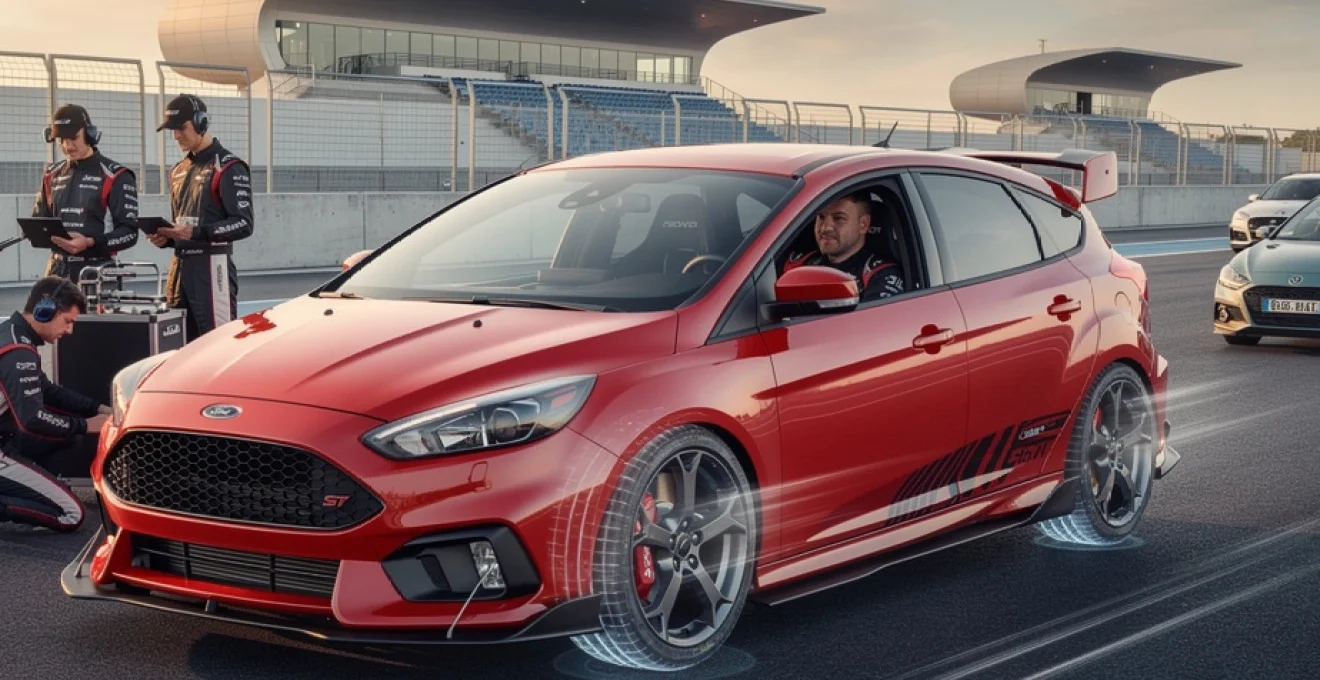
The automotive world has witnessed countless hot hatches over the decades, but few command attention quite like the Ford Focus ST dressed in Race Red. This particular combination represents more than just aesthetic appeal – it embodies Ford’s commitment to delivering performance-oriented vehicles that refuse to compromise on visual impact. The Focus ST’s distinctive red paintwork has become synonymous with driving enthusiasm, transforming everyday commutes into spirited journeys whilst maintaining the practicality that modern drivers demand. Ford’s engineering philosophy shines through every crimson-painted panel, where advanced aerodynamics meet striking visual design to create a vehicle that performs as impressively as it looks.
Ford focus ST mk3 performance engineering specifications
The current generation Ford Focus ST represents the culmination of decades of hot hatch development, incorporating sophisticated engineering solutions that deliver both raw performance and everyday usability. At its core lies a meticulously engineered powertrain designed to extract maximum efficiency from every combustion cycle whilst maintaining reliability standards expected from Ford’s performance division.
Ecoboost 2.0-litre turbocharged engine architecture
The heart of the Focus ST’s performance credentials lies within its 2.3-litre EcoBoost turbocharged petrol engine, which shares fundamental components with Ford’s Mustang powerplant. This sophisticated four-cylinder unit produces 276 brake horsepower alongside 420 Newton-metres of torque, figures that translate into genuine performance credentials on both road and track. The engine’s direct injection system operates at pressures exceeding 200 bar, ensuring precise fuel delivery under all operating conditions.
Ford’s engineers have implemented twin-scroll turbocharger technology to minimise lag whilst maximising power delivery across the rev range. The turbocharger’s variable geometry system adjusts boost pressure according to engine load and driver demand, creating a progressive power delivery that feels natural rather than artificially assisted. This approach ensures that the Focus ST delivers consistent performance whether navigating urban traffic or exploring challenging B-roads.
Torque vectoring control and electronic Limited-Slip differential
Managing the substantial power output requires sophisticated traction management systems, and the Focus ST employs an electronic limited-slip differential working in conjunction with torque vectoring control. This combination actively monitors wheel speeds, steering angle, and throttle position to distribute power precisely where it’s needed most. The system can redirect up to 100% of available torque to the wheel with greatest traction, eliminating wheelspin and maximising acceleration potential.
The torque vectoring system operates seamlessly with the vehicle’s stability control, creating a safety net that allows enthusiastic drivers to explore the car’s capabilities with confidence. During cornering, the system can apply selective braking to individual wheels whilst simultaneously adjusting power distribution, effectively pulling the vehicle through corners with remarkable precision and control.
Brembo brake system configuration and heat management
Stopping power matches the Focus ST’s acceleration capabilities through a comprehensive Brembo brake system featuring 330mm ventilated discs at the front and 302mm solid discs at the rear. The front calipers utilise four-piston configurations that provide consistent pedal feel and exceptional stopping power, even during repeated high-speed braking events. Heat dissipation receives particular attention, with cooling ducts channelling airflow directly onto the brake discs.
The brake system incorporates advanced pad compounds designed to maintain effectiveness across a wide temperature range, ensuring consistent performance from cold starts through to track day sessions. Electronic brake distribution works alongside ABS to optimise braking force across all four wheels, whilst brake assist detects emergency braking situations and applies maximum stopping force automatically.
Macpherson strut front suspension geometry
The Focus ST’s handling characteristics stem from carefully engineered suspension geometry that balances comfort with sporting prowess. The front suspension employs MacPherson strut architecture with specially tuned spring rates and damper settings that provide precise steering response whilst maintaining ride quality suitable for daily use. Anti-roll bars front and rear work to minimise body roll during cornering without compromising straight-line stability.
Ford’s engineers have incorporated specific bushings and mounting points that reduce unwanted compliance whilst filtering out road imperfections that would otherwise upset
imperfections and driver confidence. The rear suspension complements this setup with a multi-link arrangement tuned specifically for the Focus ST, allowing the chassis to remain composed when you load it up through fast bends. Together, these components create the kind of agile, communicative handling that has made the Ford Focus ST in red a benchmark in the hot hatch segment.
Race red paint technology and ford’s colour science
Beyond performance figures and chassis tuning, the Race Red Ford Focus ST owes much of its character to Ford’s colour science. Race Red is engineered not simply as a bold hue, but as a finish that interacts with light and surface form to accentuate the car’s muscular lines. Colour specialists work alongside aerodynamicists and designers to ensure the paint highlights key creases, arches, and aero elements, reinforcing the car’s athletic stance. In many ways, the paint is a functional design tool as much as it is an aesthetic choice.
Ford’s global colour and materials team develops each high-impact shade using advanced spectrophotometers and digital simulations to predict how the paint will appear under different lighting environments. Whether you are viewing the Ford Focus ST in red under bright showroom LEDs, overcast British skies, or low evening sun, the car maintains a deep, consistent tone. This stability in colour perception is part of what makes the red hot hatch so photogenic and instantly recognisable on the road.
Tri-coat metallic paint application process
Although it appears simple at a glance, the Race Red finish is the result of a multi-stage paint application process. The body shell is first treated with an electrocoat primer that adheres at a microscopic level to the galvanised steel, providing corrosion resistance and a uniform base. A dedicated primer layer tailored to red pigments is then applied to optimise adhesion and ensure that the final colour appears rich rather than washed out. This undercoat acts almost like the canvas for a painting, sharpening the final effect of the pigment.
The colour layer itself is sprayed using robotic arms that maintain precise nozzle distance, temperature, and flow rate to achieve even coverage across complex surfaces such as the sculpted rear bumper and front splitter. On top of this base colour, Ford applies its clear lacquer, which can include fine metallic or pearlescent particles depending on specification. The result is a finish that captures light in motion, helping the Ford Focus ST in red look alive even at a standstill.
Uv-resistant clear coat durability engineering
One key challenge for any vivid colour is resisting fading and environmental damage over time. Ford combats this with a UV-resistant clear coat that incorporates stabilising additives, helping the Race Red paint maintain its depth for many years. These additives absorb and disperse ultraviolet energy before it can break down the pigment structure, much like a high-quality sunscreen protects skin. For an owner who keeps their hot hatch outdoors, this engineering detail can make the difference between a car that still looks sharp after a decade and one that appears tired and chalky.
The clear coat is also engineered for chip and chemical resistance, helping protect against road debris, winter salt, and aggressive detergents. If you are serious about keeping your Ford Focus ST in red looking factory fresh, combining this OEM protection with regular washing, a quality wax or ceramic coating, and prompt touch-ups on any stone chips is highly recommended. In practice, the combination of Ford’s UV-resistant lacquer and sensible maintenance means that used Race Red Focus ST models often present better than rivals with less robust finishes.
Colour-coded aerodynamic body kit integration
The visual drama of the Race Red Focus ST is amplified by its colour-coded body kit, which includes a deeper front bumper, sculpted side skirts, and a rear diffuser assembly. Painting these performance-oriented components in the same vivid red rather than leaving them in bare plastic integrates them into the car’s overall form. This approach helps the silhouette appear lower and wider, which not only looks purposeful but also mirrors the actual chassis tuning beneath. You see what you feel from behind the wheel.
Because the body kit surfaces extend closer to the ground and are more exposed to stone impacts, Ford uses flexible plastics and elastomeric primers in these areas to reduce cracking and flaking of the paint. The colour science extends here too: the pigment mix and clear coat formulation are matched to the metal bodywork, ensuring that the Race Red remains visually consistent from bonnet to diffuser. When you view the car in profile, the uninterrupted sweep of red emphasises the ST’s sporty proportions and underlines its role as a serious driver’s car.
Racing stripe and ST badge placement dynamics
Many owners choose to enhance their Ford Focus ST in red with racing stripes or contrasting decals, and Ford itself has experimented with factory stripe packages on special editions. Placement of stripes down the centreline or offset to one side is not random; it is guided by sightline studies that consider how the human eye tracks the car in motion. Stripes that follow the natural flow of the bonnet creases and roof contours can make the car appear longer and more streamlined, while shorter, bolder graphics emphasise muscularity.
The ST badges follow a similar logic. Positioned on the grille, front wings, and tailgate, they sit at points where reflections change direction, drawing the eye to the car’s key design breaks. This subtle visual cue reinforces the performance message without overwhelming the clean lines of the body. If you are considering aftermarket stripes or de-badging, it is worth mocking up designs with vinyl or temporary film first to ensure you enhance, rather than disrupt, Ford’s carefully considered placement dynamics.
Aerodynamic enhancement package and downforce optimisation
The Ford Focus ST is not a full-blown track car, but its aerodynamic package is tuned with genuine performance intent. At typical motorway speeds, airflow management has a tangible impact on stability, fuel efficiency, and noise levels. For a red hot hatch that may see both daily commuting and enthusiastic weekend driving, the goal is to generate useful downforce and reduce lift without incurring excessive drag. Ford’s wind tunnel testing for the Focus ST logged hundreds of hours to arrive at a balanced aero configuration.
One way to understand this is to think of the Focus ST’s body as a three-dimensional wing. Subtle changes to splitters, spoilers, and underbody panels alter how air flows around and beneath the car, much like flaps and ailerons adjust the behaviour of an aircraft. You may never notice the individual elements in isolation, but together they give the Ford Focus ST in red its planted, confidence-inspiring feel at speed.
Front splitter design and airflow channelling
The front splitter on the Focus ST extends slightly lower and further forward than on standard Focus models, creating a defined separation point for incoming air. This helps increase the pressure above the splitter and reduce the volume of air travelling underneath the car, which in turn reduces front-end lift. On the road, that translates into a more secure steering feel, particularly when you crest a rise or brake hard from motorway speeds. It is a subtle effect, but one that keen drivers notice immediately.
Airflow is also channelled through carefully shaped ducts towards the brakes and radiator, improving thermal management without adding unnecessary drag. The edges of the splitter and lower bumper feature small sculpted guides that minimise turbulence around the front wheels, an area that typically creates aerodynamic “noise”. By smoothing out this airflow, Ford reduces both drag and wind roar, which is why the Ford Focus ST in red can feel surprisingly refined on a long cruise despite its aggressive front end.
Rear spoiler wing configuration and wake management
At the rear, the roof-mounted spoiler does far more than complete the classic hot hatch silhouette. Its angle, surface area, and end-plate design have been tuned to modify the low-pressure wake that forms behind the car at speed. This wake can cause instability if left unmanaged, as disturbed air pulls randomly on the tail of the vehicle. The spoiler energises the airflow leaving the roofline, helping it detach cleanly and reducing buffeting around the rear screen.
While the Focus ST’s spoiler does not produce race-car levels of downforce, independent tests have shown measurable reductions in rear lift compared with a standard Focus. That added stability is most noticeable when changing lanes at high speed or when driving in strong crosswinds. For anyone considering aftermarket spoiler upgrades on a Ford Focus ST in red, it is important to choose components validated in wind tunnel or CFD testing; a poorly designed “wing” can actually increase drag and lift, undermining the factory tuning.
Side skirt venturi effect engineering
The extended side skirts fitted to the ST serve two main purposes: cosmetically, they visually lower the car; aerodynamically, they help manage the flow of air between the wheel arches and underbody. By reducing the amount of high-pressure air that can spill under the car from the sides, the skirts help maintain a smoother, faster airflow beneath the chassis. This is similar in principle to the venturi effect in a carburettor, where a narrower passage accelerates air and reduces pressure.
In practice, this contributes to a small but meaningful reduction in overall lift and can even help the underbody aero elements work more consistently. The side skirts on the Ford Focus ST in red are designed to work hand in hand with the front splitter and rear diffuser, which is one reason why swapping them for non-OEM parts purely for style can upset the car’s balance. If you love the stance scene and plan to lower or bag your ST, it is worth considering how altered ride height might change the effectiveness of this venturi-style airflow management.
Diffuser blade geometry and ground effect principles
The rear diffuser is one of the most visually striking elements when you follow a Ford Focus ST in red, with its contrasting inserts and twin exhaust outlets. Functionally, the diffuser expands the airflow exiting from under the car, reducing pressure and helping to “pull” the vehicle downwards at higher speeds. The vertical fins or blades guide this flow, minimising cross-currents that could otherwise create drag-inducing vortices. Think of it as tidying the wake of air in much the same way that a well-designed hull reduces turbulence behind a speedboat.
While road-going diffusers work at a gentler level than true racing ground-effect tunnels, the principle is the same. The carefully calculated angle of the diffuser ramp ensures that air expands without separating too early, which would create drag instead of downforce. Pair this with the Ford Focus ST’s sports-tuned suspension, and you get a red hot hatch that feels reassuringly planted when you commit to a high-speed corner. For owners who enjoy occasional track days, maintaining clean underbody panels and avoiding damage to the diffuser blades is a simple but effective way to preserve this aerodynamic advantage.
Interior ergonomics and performance-oriented cabin design
Open the door of a Ford Focus ST in red and the performance story continues inside, with a cabin designed around the driver. The deeply bolstered Recaro front seats are arguably the focal point, offering significant lateral support during hard cornering while still providing enough adjustability for everyday comfort. Their combination of aggressive bolstering and fine-tuned cushioning is one of the reasons many owners describe the Focus ST as a true “driver’s car”, even on long motorway journeys.
The driving position has been carefully calibrated so that the steering wheel, pedals, and gearlever fall naturally to hand. This is not accidental: Ford’s ergonomics team uses data from thousands of test subjects to set ideal ranges for seat height, rake, and reach, then layers on adjustability to accommodate different body types. As a result, you can dial in a low, sporty stance reminiscent of a coupe, or opt for a slightly higher, more relaxed position for daily commuting. Either way, the interaction between seating, controls, and visibility encourages confident, precise driving.
Instrumentation in recent Focus ST models includes a 12.3-inch digital driver’s display, complementing the central 13.2-inch SYNC 4 touchscreen. Key performance information such as revs, boost pressure, and gear selection can be prioritised in the cluster, reducing the need to glance away from the road. At the same time, physical controls remain for core functions like volume and temperature, avoiding the “all-touchscreen” trap that some rivals fall into. For anyone who plans to use their Ford Focus ST in red as both a family car and a weekend toy, this balance of modern tech and tactile feedback is a major plus.
Material quality has also taken a step up in later Mk3 and Mk4 cars, with soft-touch surfaces on the dashboard and doors, contrast stitching on the steering wheel and seats, and available aluminium or carbon-effect trim. Red accents, from the ST logo to subtle stitching and seat inserts, echo the exterior paint and help tie the whole design together. Practicality has not been forgotten either: rear-seat space is competitive, the boot is generous for a hot hatch, and you still get the folding rear seats that make the Focus platform so versatile.
Track-tested performance metrics and benchmark comparisons
When we discuss the Ford Focus ST in red as a hot hatch icon, it is not just about looks or feel; the numbers matter too. The 2.3-litre EcoBoost engine delivers around 276 bhp and 420 Nm of torque, enabling 0–62 mph times comfortably under six seconds in independent tests. Top speed sits in the region of 155 mph (where unrestricted), placing the ST firmly in contention with class stalwarts like the Volkswagen Golf GTI and Hyundai i30 N. On a typical British circuit such as Brands Hatch Indy, magazine testing has shown lap times within a second or two of these rivals, despite differences in power and weight.
What sets the Ford Focus ST in red apart is how accessible this performance feels. The broad torque band means strong acceleration from as low as 2,000 rpm, making real-world overtakes effortless. Turbo lag is well controlled thanks to the twin-scroll turbocharger, so you do not need to thrash the engine to make brisk progress. For many drivers, this combination of tractability and outright pace is more valuable than an extra 20 horsepower on paper. It is the difference between a car that feels quick only at ten-tenths and one that feels lively all the time.
Handling benchmarks tell a similar story. Independent skidpad tests report lateral grip figures approaching 0.9–1.0 g, depending on tyre specification, while braking distances from 60 mph routinely fall below 36 metres. These metrics are on par with leading hot hatches and speak to the effectiveness of the Brembo braking system and sports-tuned suspension. Yet, unlike some more hardcore rivals, the Focus ST retains enough compliance to cope with rough B-roads and city speed bumps. If you plan to use your Ford Focus ST in red year-round, in all weather, this blend of capability and comfort is a strong argument in its favour.
Of course, no performance discussion is complete without acknowledging efficiency and running costs. Official combined fuel economy figures hover in the low-30s mpg for the petrol ST, with real-world owners often reporting high-20s when driving enthusiastically and low-30s on steady motorway runs. Insurance group ratings and tyre costs are in line with other 270–300 bhp hot hatches, meaning the Focus ST is not cheap to run, but neither is it prohibitively expensive. For many enthusiasts, the balance of day-to-day usability, pace, and reliability makes it a compelling long-term ownership proposition.
Ford focus ST red edition market positioning against volkswagen golf GTI and honda civic type R
In the competitive hot hatch arena, the Ford Focus ST in red inevitably finds itself compared with two titans: the Volkswagen Golf GTI and the Honda Civic Type R. Each of these cars represents a distinct philosophy. The Golf GTI leans towards understated sophistication, offering strong performance wrapped in a more conservative design, while the Civic Type R pushes further towards track-focused aggression in both looks and engineering. The Race Red Focus ST sits between these extremes, combining daily usability with an extrovert appearance and engaging dynamics.
From a pricing perspective, the Focus ST typically undercuts an equivalently specified Civic Type R and sits broadly in line with, or slightly below, a well-optioned Golf GTI in many markets. This positions the red Ford Focus ST as a high-value offering for drivers who want serious pace and character without fully committing to the more expensive, often firmer-riding Civic. Residual values for the Focus ST have historically been strong, particularly for desirable colours like Race Red, which continue to attract enthusiasts in the used market.
How do they compare on the road? The Honda Civic Type R edges ahead in outright track performance, thanks to greater power, more extreme aero, and a more focused chassis tune. The Golf GTI counters with an exceptionally polished interior, a slightly more refined ride, and the brand cachet that Volkswagen has cultivated over decades. The Ford Focus ST in red counters by delivering perhaps the most playful handling balance of the three, with steering feel and chassis feedback that echo Ford’s long experience in performance tuning. For drivers who prioritise involvement over lap times, this is often the deciding factor.
Styling is another area where the Race Red Focus ST carves its own niche. While the Golf GTI is subtle and the Civic Type R borderline outrageous, the red Focus ST strikes a sweet spot: bold, sporty, and attention-grabbing without tipping into full boy-racer territory. For many buyers, especially those who want a car that can handle school runs and client visits on weekdays yet look at home at a track day on Sunday, that balance is ideal. The colour itself becomes part of the market positioning, signalling intent without alienating more conservative tastes.
Ultimately, choosing between a Ford Focus ST in red, a Golf GTI, and a Civic Type R comes down to what you value most. If you want razor-sharp lap times and do not mind a more extreme aesthetic, the Honda is hard to beat. If you prefer a discreet, premium-feeling all-rounder, the VW makes a strong case. But if you are looking for a hot hatch that blends characterful styling, communicative handling, and everyday practicality at a keen price, the red Ford Focus ST stands out as a compelling, emotionally engaging choice that continues to win over enthusiasts around the world.