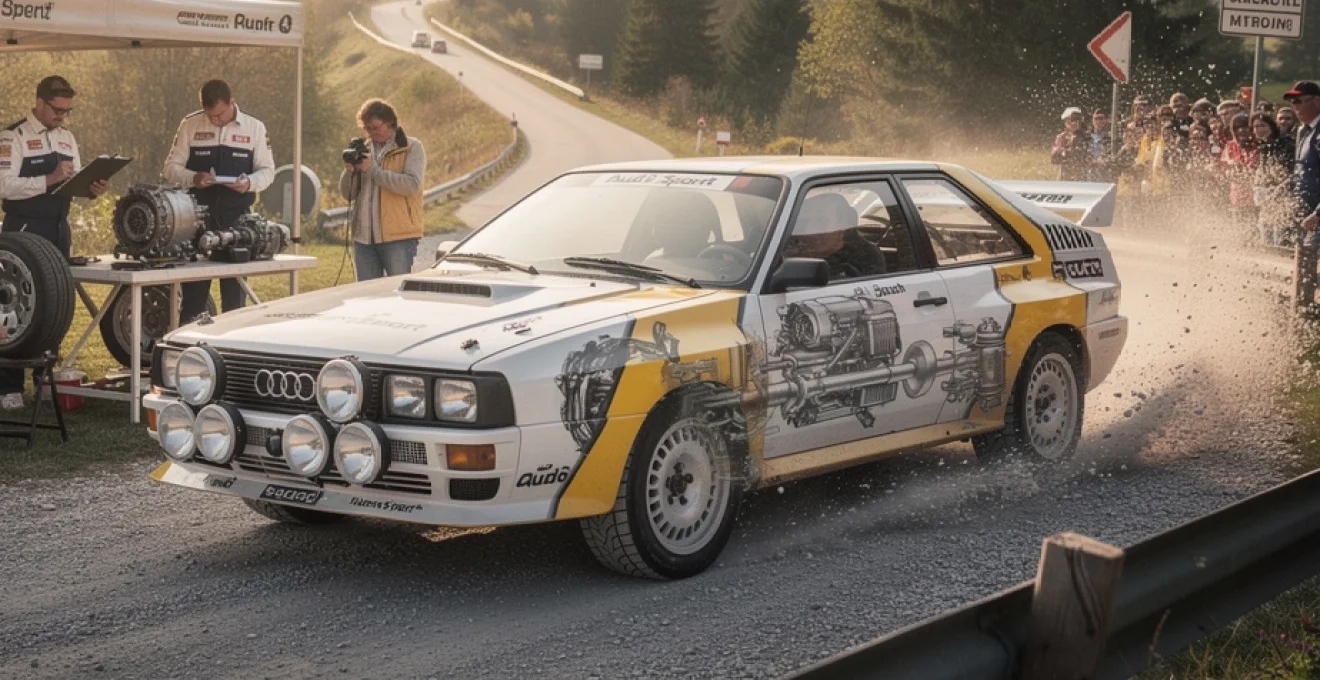
The roar of a turbocharged five-cylinder engine echoing through forest stages, the distinctive silhouette carving through snow-covered Swedish roads, and the revolutionary all-wheel-drive system that forever changed motorsport – this is the legacy of the Audi UR Quattro. Born from Ferdinand Piëch’s visionary engineering and launched into an unsuspecting rally world in 1980, this German masterpiece didn’t just compete; it redefined what was possible on gravel, tarmac, and ice. The UR Quattro became the catalyst that transformed Audi from a conservative manufacturer into a motorsport powerhouse, while simultaneously establishing the blueprint for modern performance cars that continues to influence automotive design today.
Development genesis and quattro All-Wheel drive revolution
Ferdinand piëch’s vision for permanent Four-Wheel drive technology
Ferdinand Piëch’s revolutionary approach to automotive engineering found its ultimate expression in the Quattro project. His vision stemmed from observing the limitations of conventional two-wheel-drive systems during harsh weather conditions and challenging terrain. Piëch recognised that permanent all-wheel drive could provide unprecedented levels of traction and control, transforming the fundamental dynamics of high-performance driving. This insight emerged from his experiences with Volkswagen’s military vehicle development, where four-wheel-drive systems demonstrated superior performance characteristics across diverse environments.
The engineering philosophy behind Piëch’s vision centred on creating a seamless power distribution system that would operate continuously without driver intervention. Unlike traditional part-time four-wheel-drive systems found in off-road vehicles, the Quattro concept demanded sophisticated mechanical solutions that could handle high power outputs while maintaining reliability under extreme conditions. This permanent all-wheel-drive approach represented a paradigm shift in automotive engineering, challenging conventional wisdom about weight distribution, mechanical complexity, and performance optimisation.
Torsen centre differential implementation in competition motorsport
The Torsen centre differential became the mechanical heart of the Quattro system, enabling precise power distribution between front and rear axles. This torque-sensing differential automatically adjusted power delivery based on traction conditions, providing optimal grip without requiring electronic intervention. The system’s purely mechanical operation ensured reliability in the harsh conditions of rally competition, where electronic systems might fail due to vibration, moisture, or extreme temperatures.
Engineering teams at Ingolstadt refined the Torsen differential specifically for motorsport applications, modifying gear ratios and torque splits to maximise competitive advantage. The differential’s ability to transfer power instantaneously between axles gave Quattro drivers unprecedented confidence when attacking challenging sections of rally stages. This mechanical sophistication allowed drivers to maintain higher average speeds through corners and over varied terrain, fundamentally changing rally driving techniques and strategies.
Turbocharger integration with Five-Cylinder engine architecture
The marriage of turbocharging technology with Audi’s distinctive five-cylinder engine created one of motorsport’s most recognisable powerplants. The 2.1-litre inline-five configuration provided an ideal balance between power delivery and packaging constraints, while the turbocharged induction system generated the substantial power outputs required for Group B competition. Engineers carefully calibrated boost pressure, intercooling systems, and fuel injection to maximise performance while maintaining reliability across diverse operating conditions.
Turbocharger selection and integration required extensive development work to minimise lag while maximising power output. The system incorporated water-cooled intercoolers and sophisticated waste-gate control to optimise boost pressure across the engine’s operating range. This forced induction approach enabled the relatively compact five-cylinder engine to produce power figures that rivalled much larger naturally aspirated units, while maintaining the distinctive acoustic signature that became synonymous with Quattro performance.
Homologation requirements for group B rally championship
Group B regulations demanded manufacturers produce a minimum of 200 road-going examples to qualify their competition vehicles for world championship events. This homologation requirement drove the development of the Sport Quattro, a shortened and lightened version of the standard model that served as the basis for the most extreme rally variants. The homologation process required careful balance between road-going usability and competition preparation, ensuring that essential performance characteristics remained consistent between road and rally versions.
The road-legal UR Quattro models retained much of the competition car’s DNA: permanent quattro all-wheel drive, the turbocharged five-cylinder engine, and a chassis tuned for high-speed stability. For Audi, these homologation models were more than a regulatory box-ticking exercise; they were rolling test beds that allowed the brand to refine durability, drivability, and component life in real-world conditions. In many respects, owning a homologation Quattro meant living with a slightly tamed Group B rally car on public roads, complete with the same charismatic turbo rush and distinctive drivetrain character.
Technical engineering specifications and performance characteristics
2.1-litre inline-five turbocharged engine output analysis
At the heart of the Audi UR Quattro rally car sat a 2.1-litre inline-five engine, a power unit that became legendary for its unique blend of torque, sound, and tuneability. In early road-going form, this turbocharged five-cylinder produced around 200 bhp and 210 lb ft (285 Nm) of torque, enough to propel the car from 0–62 mph in approximately 7.1 seconds. For Group 4 and later Group B rally specifications, output climbed dramatically, with works cars often quoted at 300 bhp and beyond, depending on boost settings and event-specific mapping. Later evolutions of the Sport Quattro and S1 E2 pushed well past 450 bhp, with some development engines reputed to exceed 500 bhp on full boost.
The inline-five layout offered a sweet spot between compact packaging and smooth power delivery, combining some of the refinement of a straight-six with the footprint of a four-cylinder. Turbocharger sizing, compression ratio, and fuel system calibration were all carefully balanced to provide usable mid-range torque while still delivering a brutal surge at higher revs. In competition trim, engineers accepted significant turbo lag at low rpm in exchange for explosive power when the boost finally arrived, a characteristic that shaped how drivers approached each stage. You can think of it as a slingshot: there is a moment of tension as the turbo spools, followed by a violent release of energy that launches the car out of bends and down straights.
To manage the thermal and mechanical stresses of rallying, the engine benefited from upgraded internal components, reinforced crankcases, and sophisticated cooling solutions relative to the production car. Water-cooled intercoolers, improved oil circulation, and precise ignition control all played critical roles in keeping the high-output five-cylinder reliable over long, punishing stages. This combination of robust engineering and aggressive tuning meant the UR Quattro engine could endure prolonged full-throttle use on gravel, snow, and tarmac, conditions that would quickly expose weaknesses in less thoroughly developed powertrains.
Quattro drivetrain power distribution mechanisms
The defining feature of the UR Quattro rally car was its advanced all-wheel-drive system, which transformed how power was deployed to the road. Rather than relying on a crude transfer case, Audi employed a centre differential to continuously split torque between the front and rear axles. Early versions used manually lockable differentials, while later competition cars integrated the Torsen (torque-sensing) centre differential to automatically vary the torque split according to available grip. This meant that when one axle began to slip, more power could be sent to the other, all without driver intervention.
In typical rally specification, the quattro drivetrain offered a nominal 50:50 front-to-rear torque distribution, although this could be biased as conditions demanded. On loose gravel, a slightly rearward bias improved rotation and allowed drivers to steer with the throttle, whereas on high-grip tarmac a more neutral setup ensured maximum stability. The mechanical nature of the system, without reliance on early-generation electronics, ensured immediate response and bulletproof reliability under extreme loads. For drivers, the effect was profound: they could apply power earlier in the corner, maintain higher minimum speeds, and trust that all four tyres were working to claw the car out of trouble.
From a modern perspective, the UR Quattro’s drivetrain might seem simple compared with today’s torque-vectoring, electronically controlled systems. Yet in the early 1980s, it was nothing short of revolutionary. Where rival two-wheel-drive rally cars fought wheelspin and traction loss, the Audi could convert more of its engine output into forward motion, especially on low-grip surfaces. This is why period onboard footage often shows the Quattro looking unusually composed; instead of extravagant slides, it carves its line with clinical efficiency, demonstrating how a well-calibrated all-wheel-drive system could dominate rally stages.
Suspension geometry modifications for rally stage adaptability
To fully exploit the quattro drivetrain, Audi engineers invested heavily in suspension geometry and chassis setup, tailoring the UR Quattro rally car to cope with an extraordinary range of surfaces. MacPherson struts combined with lower steel or aluminium wishbones formed the basis of both front and rear suspension, chosen for their robustness and packaging efficiency. However, what really distinguished the rally cars was the adjustability built into their geometry: camber, caster, toe, ride height, and damping characteristics could all be tuned to match the demands of individual stages. From fast, flowing gravel roads to tight, technical tarmac sections, each setup represented a carefully calculated compromise between grip, stability, and responsiveness.
Long-travel suspension and reinforced mounting points allowed the Quattro to absorb huge impacts from jumps, ruts, and compressions without compromising structural integrity. Damping rates were often adjusted between stages, with softer settings used on rough gravel to maintain tyre contact, and firmer setups selected for smooth tarmac to sharpen turn-in and reduce body roll. In a sense, the suspension acted as the interpreter between the aggressive powertrain and the unpredictable rally surface, smoothing out violent inputs and keeping the tyres within their optimal operating window. If the drivetrain was the brain of the car, constantly deciding where to send power, the suspension was its nervous system, transmitting information and maintaining control.
The ability to reconfigure the suspension so extensively also gave Audi a strategic edge in the World Rally Championship. Teams could arrive at events with baseline setups then iterate rapidly during shakedown and early stages, refining geometry to suit local conditions. For you as an enthusiast or restorer, understanding this inherent adaptability is crucial; attempting to run a period-correct rally setup on modern roads without adjustment can result in a car that feels overly stiff or nervous. The original engineering was always about balance, not simply maximum stiffness or minimum roll.
Weight distribution optimisation through aluminium body panels
One of the persistent challenges Audi faced with the UR Quattro was weight distribution. The longitudinal engine layout and all-wheel-drive hardware added mass, much of it towards the front of the car. To counteract this, particularly in the Sport Quattro and later S1 variants, engineers employed lightweight materials such as aluminium, fibreglass, and Kevlar for key body panels. Bonnet, wings, doors, and even parts of the roof structure were redesigned to shed kilograms while preserving rigidity and safety. In combination with the shortened wheelbase of the Sport Quattro, these changes aimed to make the car more agile and responsive on twisty stages.
Shifting the weight balance even marginally rearwards made a noticeable difference to the car’s handling, especially at the limit. A lighter front end reduced initial understeer and allowed the nose to bite more effectively into turn-in, giving drivers the confidence to commit earlier and harder. This weight-saving strategy was analogous to a marathon runner shedding unnecessary equipment: each kilogram lost contributed to sharper reactions and reduced fatigue over the course of an event. Crucially, Audi achieved this without sacrificing the structural strength needed to withstand the violent forces of Group B competition.
For road-going UR Quattros, the use of aluminium was more limited but still significant in demonstrating Audi’s materials engineering capabilities. These early experiments with lightweight construction foreshadowed techniques that would later become commonplace in performance car design, including the extensive use of aluminium and composites in modern RS models. Today, when you see a high-performance Audi boasting an aluminium-intensive structure, you are witnessing the long-term influence of lessons first learned on the Quattro rally car.
World rally championship dominance period 1981-1987
The Audi UR Quattro’s impact on the World Rally Championship was immediate and dramatic. Debuting in competition in 1981, the all-wheel-drive coupe began winning stages and events almost from the outset, catching established teams off guard. On snow and ice, particularly in rallies such as Sweden and Monte Carlo, the Quattro’s superior traction translated into crushing advantages; rival drivers often described the experience as trying to keep up with a car from another category entirely. By 1982, Audi had secured the manufacturers’ title, and in 1983, Hannu Mikkola claimed the drivers’ championship, firmly establishing the Quattro as the car to beat.
Throughout the mid-1980s, the UR Quattro and its derivatives remained at the sharp end of the WRC field, even as lighter, mid-engined rivals such as the Peugeot 205 T16 and Lancia Delta S4 emerged. Audi followed an evolutionary path, progressing from the original long-wheelbase Quattro to the more compact Sport Quattro and ultimately the extreme S1 and S1 E2. Each iteration brought more power, more downforce, and further refinements to the drivetrain and chassis. The team added a second manufacturers’ title in 1984, while drivers like Stig Blomqvist and Walter Röhrl added to the Quattro’s haul of victories on gravel, tarmac, and snow.
However, the very strengths that made the Quattro dominant also contributed to the escalation of speed and risk that defined the Group B era. By 1986, some Quattro variants were reputed to produce over 500 bhp, harnessed through the advanced quattro drivetrain and increasingly aggressive aerodynamics. On narrow, poorly protected stages lined with spectators, these cars were often simply too fast for the available margins of safety. The tragic accidents of 1986, including the deaths of Henri Toivonen and Sergio Cresto, led the FIA to cancel Group B from the end of that season. With it, the Quattro’s frontline WRC career came to an end, but its legend was already firmly etched into motorsport history.
Legendary driver partnerships and championship victories
Hannu mikkola’s 1983 drivers’ championship campaign
Hannu Mikkola’s 1983 World Rally Championship title remains one of the defining achievements of the UR Quattro era. A seasoned Finnish driver with experience in rear-wheel-drive machinery, Mikkola adapted quickly to the new demands of all-wheel-drive rallying. His ability to harness the Quattro’s traction on loose surfaces, while managing the turbocharged power delivery, gave Audi a consistent front-runner across diverse events. Over the course of the 1983 season, he combined measured aggression with mechanical sympathy, a vital quality when dealing with early high-boost turbo systems and complex drivetrains.
Mikkola’s campaign showcased not only his talent but also the maturing reliability and competitiveness of the Quattro platform. Victories on gravel and snow confirmed the car’s status as the benchmark for all-weather performance, while solid points finishes on tarmac underlined its growing versatility. From a technical standpoint, his feedback helped Audi’s engineers refine suspension setups, differential calibrations, and engine mapping to suit different rally characteristics. As you look back at onboard footage from that season, it is striking how composed Mikkola appears behind the wheel, even as the Quattro devours stages at a pace that, for the time, seemed almost otherworldly.
Stig blomqvist’s technical driving style with quattro systems
Stig Blomqvist brought a different but equally effective style to the UR Quattro. Known for his calm, methodical approach and technical precision, the Swedish driver extracted remarkable consistency from the car, particularly in treacherous winter conditions. His deep understanding of how the quattro system responded to throttle, braking, and steering inputs allowed him to fine-tune his driving to maximise grip. Instead of dramatic slides, Blomqvist often favoured a smooth, flowing line, trusting the drivetrain to pull the car through corners with minimal wasted movement.
Blomqvist’s sensitivity to weight transfer and traction made him an ideal match for the sometimes front-heavy Quattro chassis. By carefully balancing the car on the brakes and feeding in power progressively, he could neutralise understeer and maintain remarkable cornering speeds. His driving style has been likened to a chess player thinking several moves ahead; each input was calculated not just for the current moment, but for how the car would respond over the next few metres of stage. In 1984, this approach paid off with the drivers’ championship title, further cementing the UR Quattro’s dominance and demonstrating that, in the right hands, the car could be both brutally quick and technically sophisticated.
Michèle mouton’s pioneering performances in male-dominated sport
Among all the drivers associated with the UR Quattro, Michèle Mouton occupies a uniquely inspiring place. As the first woman to win a World Rally Championship event, and a serious contender for the 1982 title, she shattered expectations in what was then an almost exclusively male domain. Driving the Quattro at a time when its full potential was still being explored, Mouton combined fearless commitment with sharp technical understanding. Her victories at events like Rallye Sanremo and competitive performances across the season showed that the combination of quattro technology and exceptional driver skill could rewrite not only lap times, but social norms.
Mouton’s relationship with the Quattro highlighted how accessible its performance could be to a driver willing to adapt and learn. She quickly grasped that the car rewarded early throttle application, trust in the all-wheel-drive system, and a willingness to manage turbo lag with decisive inputs. Her success helped Audi connect with a broader audience, inspiring a new generation of fans and future competitors. Even today, when you hear discussions about diversity and inclusion in motorsport, Mouton’s achievements in the UR Quattro era remain a powerful reference point for what is possible when opportunity meets talent.
Walter röhrl’s precision engineering feedback for development
Walter Röhrl, often described as “a genius on four wheels”, brought an engineer’s sensitivity to the development of the later Quattro variants. Already a two-time World Rally Champion before joining Audi, Röhrl was renowned for his analytical approach and ability to articulate exactly how a car behaved at the limit. In the context of the Quattro programme, his feedback was invaluable for refining suspension settings, steering response, and turbocharger characteristics. Röhrl did not simply drive the car fast; he dissected its behaviour and worked closely with engineers to transform subjective impressions into concrete development goals.
His role was particularly important during the evolution from the original UR Quattro to the more extreme Sport Quattro and S1 E2. These cars demanded new driving techniques and pushed the boundaries of what was physically and mentally manageable on a rally stage. Röhrl’s input helped tame some of the more intimidating aspects of the high-power, short-wheelbase machines, making them more predictable and exploitable. His famous victories, including Pikes Peak hillclimb success with the S1 E2, served as dramatic proof that Audi’s continuous development—guided by detailed driver feedback—had created one of the most advanced rally cars of its era.
Group B era legacy and modern motorsport influence
The legacy of the Audi UR Quattro and its Group B derivatives extends far beyond their competition years. By demonstrating that full-time all-wheel drive could be not only viable but dominant in top-level motorsport, Audi forced every major manufacturer to reassess their engineering priorities. Today, the idea of a high-performance all-wheel-drive rally car is taken for granted, but before the Quattro, it was considered unnecessary weight and complexity. The Quattro’s success redefined that thinking, laying the groundwork for later icons such as the Lancia Delta Integrale, Subaru Impreza WRX, and Mitsubishi Lancer Evolution.
Even outside rallying, the influence of the UR Quattro is visible in modern GT racing, touring cars, and road-going performance vehicles. The principles it championed—intelligent torque distribution, compact turbocharged engines, and chassis systems tuned for real-world traction—are now central to many manufacturers’ performance strategies. Audi itself built an entire brand identity around the quattro name, extending it from niche rally technology to a core feature across sedans, coupes, and SUVs. When you see an RS3, RS6, or even an electric e-tron deploying power with unflappable composure, you are witnessing a direct philosophical descendant of the original rally car.
The Group B era’s abrupt end in 1986 also left an enduring safety legacy. The extreme performance of cars like the Quattro S1 E2, combined with minimal spectator control and limited circuit protection, led to several high-profile accidents and fatalities. In response, motorsport authorities introduced stricter regulations on power, aerodynamics, and crowd management. While some enthusiasts lament the loss of Group B’s unfettered spectacle, few would argue against the improvements in safety for drivers and fans alike. In this sense, the UR Quattro’s story is also a cautionary tale about how quickly technological progress can outpace the structures designed to contain it.
Collector market valuation and restoration considerations
In the decades since its competition heyday, the Audi UR Quattro has evolved from cutting-edge rally weapon to highly sought-after collectors’ item. Values for well-preserved road cars have risen steadily, with pristine examples of the earliest “Ur-Quattro” models and limited-production Sport Quattros commanding particularly high prices. By the mid-2020s, auction results regularly showed Sport Quattro road cars selling for well over $500,000, with top-condition, low-mileage examples approaching or exceeding the $750,000 mark. Standard UR Quattros, while more attainable, have also appreciated significantly, especially those with documented history and original specification.
For collectors, the appeal lies not only in the car’s motorsport pedigree but also in its role as the foundation of Audi’s modern performance image. Limited production numbers—around 11,000 UR Quattros in total, and only a little over 200 Sport Quattros—ensure genuine rarity, particularly when compared to mass-produced performance cars of the same era. As a result, originality, provenance, and structural condition are critical factors in valuation. A car with factory-correct paint, interior, matching-numbers engine, and unmodified drivetrain will generally command a substantial premium over heavily altered or poorly restored examples.
Restoring a UR Quattro or Sport Quattro to a high standard is both rewarding and challenging. Many components, especially model-specific body panels, interior trim, and certain drivetrain parts, are difficult to source and can be expensive. Rust in the sills, floorpans, and suspension mounting points is a known issue on neglected cars, and addressing it properly often requires extensive metalwork. From a mechanical perspective, rebuilding the turbocharged five-cylinder engine and quattro drivetrain demands specialist knowledge and precise tolerances; shortcuts here can quickly undermine reliability and value. If you are considering a project car, commissioning a thorough pre-purchase inspection by a marque expert is essential.
On the positive side, a well-executed restoration can transform a tired UR Quattro into a machine that feels remarkably fresh, while still retaining its period character. Modern materials and techniques—when used discreetly—can improve corrosion resistance and durability without compromising originality. For example, careful application of advanced rustproofing treatments, or the use of modern equivalents for certain wear items, can significantly extend the car’s usable life. Ultimately, whether you intend to show the car at concours events or enjoy it on spirited drives, approaching restoration with respect for the Quattro’s engineering heritage will ensure that this icon of motorsport continues to be appreciated for generations to come.