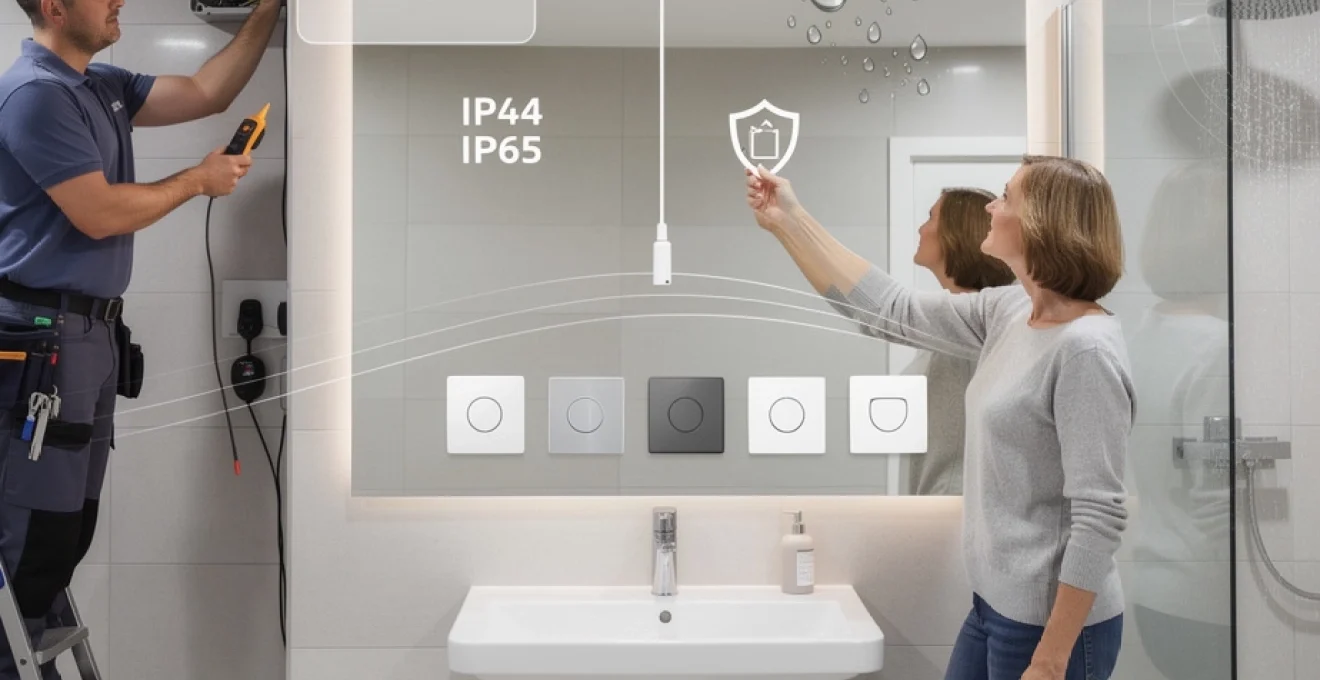
Silent bathroom pull cord switches represent a significant advancement in home comfort technology, addressing one of the most common sources of household sleep disruption. Traditional pull cord switches produce loud clicking or clunking sounds that can wake entire households during nighttime bathroom visits. Modern silent alternatives utilise advanced microswitch technology and acoustic dampening mechanisms to reduce noise levels by up to 80%, creating a more peaceful living environment whilst maintaining the safety and functionality required for bathroom electrical installations.
The demand for quiet switching solutions has grown dramatically as homeowners recognise the impact of noise pollution on sleep quality and family harmony. Silent pull cord switches not only improve comfort but also comply with stringent bathroom safety regulations, offering waterproof protection ratings and zone-specific installation capabilities that ensure electrical safety in moisture-prone environments.
Understanding silent bathroom pull cord switch technology and IP rating requirements
Silent bathroom switches employ sophisticated engineering principles to minimise acoustic output whilst maintaining reliable electrical switching performance. The technology behind these devices centres on precision-manufactured internal mechanisms that eliminate the traditional mechanical snap associated with conventional switches. Instead of relying on spring-loaded contacts that create audible vibrations, silent switches utilise micro-precision switching elements that engage smoothly without generating significant sound waves.
Zone classification systems in bathroom electrical installations
Bathroom electrical installations operate under strict zonal classification systems defined by BS 7671 wiring regulations. Zone 0 encompasses areas inside baths and shower basins where electrical equipment must achieve IPX7 rating. Zone 1 covers areas above baths to 2.25 metres height, requiring IPX4 minimum protection. Zone 2 extends 0.6 metres horizontally from Zone 1 boundaries, where standard pull cord switches typically install with IP44 or higher ratings.
Silent switches designed for bathroom use must demonstrate compliance with these zonal requirements whilst maintaining their acoustic properties. The positioning of switching mechanisms within protective enclosures requires careful consideration to prevent moisture ingress that could compromise both electrical safety and the precision components responsible for quiet operation.
IP44 and IP65 rated silent switch mechanisms
Ingress Protection ratings define the level of protection electrical equipment provides against solid particles and liquid penetration. IP44 rated switches offer protection against objects larger than 1mm and water splashing from any direction, making them suitable for Zone 2 bathroom installations. IP65 rated alternatives provide complete protection against dust ingress and water jets from any direction, enabling installation in more challenging environments.
The internal architecture of silent switches with higher IP ratings incorporates sealed switching chambers and gasket systems that maintain acoustic properties whilst preventing moisture damage. These designs often feature double-wall construction with acoustic dampening materials positioned between outer protective shells and internal switching mechanisms.
Microswitch technology vs traditional mechanical systems
Traditional pull cord switches rely on mechanical lever systems that create distinctive clicking sounds when contacts engage or disengage. The acoustic signature results from rapid contact closure generating vibrations that transmit through mounting surfaces and surrounding structures. Microswitch technology eliminates these vibrations by employing precision-engineered contact surfaces that engage gradually rather than snapping into position.
Advanced silent switches incorporate magnetic switching elements that utilise electromagnetic fields to control electrical circuits without physical contact engagement. This contactless switching eliminates mechanical wear whilst producing minimal acoustic output. The technology ensures consistent switching performance over extended operational periods whilst maintaining the instantaneous response characteristics required for lighting control applications.
BS 7671 wiring regulations compliance for bathroom switches
BS 7671 regulations mandate specific requirements for bathroom electrical installations, including minimum distances from water sources, appropriate IP ratings, and circuit protection measures. Silent pull cord switches must demonstrate compliance with these regulations whilst maintaining their acoustic performance characteristics. The regulations require switches in bathroom environments to incorporate appropriate overcurrent protection and earth fault protection measures.
Compliance testing for silent switches encompasses both electrical safety standards and acoustic performance verification. The testing protocols ensure that noise reduction measures do not compromise electrical safety or switching reliability. Regular compliance certification ensures that silent switch designs meet evolving safety standards whilst maintaining their primary function of reducing acoustic disturbance.
Leading silent pull cord switch manufacturers and product specifications
The silent switch market features several established manufacturers offering
The silent switch market features several established manufacturers offering purpose-designed products that combine quiet operation, robust safety credentials and long service life. While budget pull cords are widely available, not all are engineered with acoustic performance in mind. When you are comparing options, you will want to look beyond the packaging claims and review detailed specifications such as decibel ratings, IP classifications, switching technology and warranty coverage.
MK electric K4896 silent pull cord switch features
MK Electric is a long-established brand in the UK wiring accessories market, and its K4896 series is often specified where reliability and compliance are critical. Although not marketed as “silent” in the consumer sense, the K4896 benefits from MK’s refined contact mechanisms and robust mouldings, which help reduce resonance and rattling compared with low-cost commodity switches. This product typically offers 10A switching capacity, making it suitable for controlling bathroom lighting and extractor fans on the same circuit.
The K4896 is designed for ceiling mounting in domestic and light commercial environments and is compatible with standard 60.3mm ceiling boxes. The switch mechanism is enclosed within a high-impact thermoplastic housing that is resistant to discolouration and everyday wear. While MK does not publish a specific decibel rating, independent installers frequently report that the K4896 has a softer actuation sound than generic 10A pull cords, primarily due to its controlled contact movement and tighter manufacturing tolerances.
From a safety perspective, MK Electric products are manufactured to BS EN standards and are fully compatible with BS 7671 installation practices. They are often used in conjunction with RCD-protected lighting circuits, ensuring that the quest for a quieter bathroom pull cord switch does not compromise electrical protection. If you are upgrading from an older, worn or internally arcing switch, moving to a high-quality model like the K4896 can also reduce sporadic “crack” noises caused by deteriorated contacts.
Crabtree 4070 series bathroom switch technology
Crabtree, another recognised professional brand, offers the 4070 series of bathroom pull switches that focus on durability and stable contact performance. The 4070 models are generally rated at 6A or 10A, depending on configuration, and use a cam-operated mechanism that provides a cleaner, more controlled switching action than basic spring-loaded designs. This smoother movement can noticeably reduce the “gunshot” style clunk that many homeowners find disruptive at night.
In terms of bathroom suitability, the Crabtree 4070 range is designed for use in locations where a ceiling pull cord is preferred to a wall switch, helping installers comply with zone requirements and IP protection needs. While not fully sealed like specialist IP65 enclosures, these units are manufactured with close-fitting covers and gasketed entries to minimise moisture ingress from condensation and steam. This contributes both to longevity and to the consistent behaviour of the internal mechanism over time.
One of the key benefits of the Crabtree 4070 series is its mechanical robustness. The pull cord anchoring, strain relief and cord guide components are engineered to withstand frequent use, including occasional heavy tugs that might damage cheaper alternatives. Why is this relevant to silent operation? Because a mechanism that does not deform or loosen is less likely to develop rattles, squeaks or inconsistent “double clicks” as it ages. In this way, engineering for durability indirectly supports lower long-term noise levels.
Varilight V-Pro silent switch range specifications
For homeowners seeking advanced control, the Varilight V-Pro range introduces dimming functionality alongside quieter switching. Although best known for wall-mounted dimmers, Varilight also produces ceiling-mounted and remote-controlled solutions that can be integrated with bathroom pull cords via compatible modules. These products use trailing-edge dimming technology, which is inherently quieter than older leading-edge types, reducing both electrical hum and mechanical noise from the dimming circuit.
V-Pro modules are typically rated for LED compatibility and can handle loads from very low wattage up to around 100–120W depending on the specific product. This makes them suitable for modern low-energy bathroom lighting where a traditional 400W dimmer would be both unnecessary and potentially noisy. The electronics are designed to minimise flicker and buzzing, which not only improves comfort but also ensures that the overall acoustic environment of the bathroom remains calm.
When used in conjunction with a pull cord actuator, the Varilight V-Pro system can offer soft-start and smooth fade functions. These features gently ramp light levels up and down, avoiding abrupt changes that can feel jarring when you use the bathroom at night. In practice, this means you can create a low-level “night mode” setting that further reduces the temptation to yank the pull cord repeatedly, cutting down on mechanical noise and extending the life of the switch.
British general nexus silent pull cord options
British General (BG) Nexus pull cord switches are a popular choice in UK DIY outlets and trade counters, offering a balance between affordability and performance. Within the Nexus range, there are models specifically optimised for quieter operation, often combining improved contact geometry with damping features in the actuator. Many homeowners report that upgrading from a generic 10A unit to a BG Nexus 6A or refined 10A version results in a perceivably softer click.
BG Nexus pull cords commonly feature smooth, rounded housings and quality cord bushings that help prevent vibration transfer to the ceiling or plasterboard. Some models include additional fixing points and secure terminal clamps that keep the switch firmly seated, reducing the resonance that can make a modest click sound like a much louder clack. For many bathrooms, simply pairing a reasonably quiet Nexus mechanism with careful mounting is enough to transform the night-time soundscape.
From a specification standpoint, BG Nexus switches are typically CE and UKCA marked, tested to BS EN 60669-1, and available in 6A and 10A versions for lighting and fan control. The brand also offers complementary accessories such as decorative ceiling roses and matching wiring accessories, useful if you are undertaking a broader bathroom refresh. When combined with acoustic mounting strategies, BG Nexus units can be an effective, budget-conscious route to a quieter bathroom pull cord switch.
Installation methods and ceiling box compatibility requirements
However advanced the internal technology, a silent bathroom pull cord switch will only perform at its best if it is installed correctly. Poor mounting, loose fixings and incompatible ceiling boxes can all amplify noise, much like a drum skin amplifies the tap of a stick. Paying attention to installation methods and ensuring compatibility with existing back boxes is therefore critical if you want to achieve a genuinely quiet result.
Most UK ceiling pull switches are designed to fit standard circular pattress boxes, typically 60.3mm in diameter with fixing centres to match common brands. Before purchasing a silent pull cord switch, you should check the manufacturer’s dimensional drawings to confirm that the fixing holes align with your existing box. If they do not, an adaptor plate or new box may be required, and improper alignment can cause stress on the housing that leads to creaks and clicks when operated.
Installers also need to consider how the switch interacts with the ceiling material. Mounting directly onto thin plasterboard without backing can turn the ceiling into a sounding board, exaggerating the actuation noise. Where possible, fixing into or through to a timber joist provides a more solid anchoring point and can reduce perceived volume. If a joist is not conveniently located, adding a timber noggin above the board or using specialised fixings can provide a firmer, quieter installation.
Acoustic decoupling is another effective technique for reducing noise from a bathroom pull cord switch. Some professionals use rubber tap washers, neoprene gaskets or other compliant materials between the switch base and the ceiling to isolate vibrations. In this arrangement, the fixing stack might be plasterboard, rubber washer, switch base, second washer and then a large metal washer under the screw head. Tightening should be firm enough to prevent movement but not so tight that the rubber is fully compressed, preserving its damping properties.
Electrical compatibility should never be overlooked. Silent bathroom pull cord switches must be matched to the circuit rating, load type and any connected devices such as extractor fans, transformers or dimmable LED drivers. Overloading a switch can cause arcing and heat, which not only shortens its life but may also introduce crackling or popping sounds during operation. When in doubt, consulting a qualified electrician and adhering strictly to BS 7671 guidance is the safest approach.
Noise reduction engineering and acoustic performance metrics
To understand why some bathroom pull cords are almost whisper-quiet while others sound like a starting pistol, it helps to look at the underlying noise reduction engineering. Manufacturers of silent bathroom pull cord switches take a holistic view, addressing not just the contact mechanism but also the materials, housing geometry and how vibrations travel through the product. In acoustic terms, the aim is to reduce both the peak sound level and the overall energy transmitted into the building structure.
One of the primary design strategies is to slow and control the movement of internal components. Instead of relying on a powerful spring that snaps contacts together, silent switch mechanisms use carefully profiled cams, micro-springs and sometimes magnetic assistance to achieve a smoother transition between on and off states. This is similar to the difference between slamming a door and gently closing it with a soft-close hinge: the function is the same, but the energy is dissipated over a longer time, reducing the audible impact.
Another key element is material selection. High-density plastics, elastomeric dampers and internal ribs can all be used to absorb and scatter vibration rather than letting it pass straight through the housing. Some premium products even employ double-shell constructions where the inner mechanism is mounted inside an outer casing with a small air gap or resilient mountings, acting a bit like the suspension system in a car that isolates passengers from bumps in the road. For a bathroom pull cord switch, this means less vibration makes its way into the ceiling and walls.
In terms of measurement, acoustic performance is often expressed in decibels (dB) at a standard distance, such as 1 metre directly beneath the switch. A typical low-cost mechanical pull cord might produce peak levels in the region of 60–70dB, comparable to normal conversation or a sewing machine. Silent bathroom pull cord switches are often engineered to operate below 35–40dB, which falls closer to a quiet library or soft whisper. When manufacturers claim “up to 80% noise reduction,” they are usually referring to a reduction in sound energy rather than a simple linear drop in perceived loudness.
It is important to note that the human ear perceives loudness on a logarithmic scale. A reduction of 10dB is commonly experienced as roughly half as loud, even though the actual sound energy has dropped by a factor of ten. This means that shaving a few decibels off a bathroom pull cord’s click can make a big subjective difference during the night, particularly in quiet flats or terraced houses where structure-borne sound travels easily. Have you ever noticed how a small tap on a shared wall sounds much louder at 2am? The same principle applies here.
Laboratory testing can provide controlled decibel readings, but real-world performance also depends on installation quality and the acoustic character of the building. Hard, reflective surfaces such as tiled walls and ceilings can amplify sounds, while soft furnishings and carpets help absorb them. That is why two households using identical silent pull cord switches may still report different experiences. To get the most from noise reduction engineering, it pays to combine a well-designed product with careful mounting and, where possible, a generally “softened” acoustic environment in and around the bathroom.
Cost analysis and long-term maintenance considerations for silent switch systems
When evaluating silent bathroom pull cord switches, many homeowners naturally ask whether the higher initial cost is justified. Basic mechanical pull cords can be purchased very cheaply, whereas premium silent models, smart pull cord dimmers and microswitch-based systems command a noticeable price premium. To make a fair comparison, it helps to consider not just the purchase price but also longevity, maintenance, energy savings and the less tangible benefits of improved sleep and reduced neighbour disturbance.
From a straightforward financial perspective, quality silent switches are often designed to last significantly longer than budget alternatives. Better materials, more precise mechanisms and more robust strain relief reduce the likelihood of early failures such as broken cords, worn contacts or cracked housings. Over a 10–15 year period, the total cost of ownership may actually be lower if a slightly more expensive silent switch outlasts several cheaper units. Additionally, some manufacturers back their products with two-year or longer guarantees, providing further peace of mind.
Maintenance requirements for silent bathroom pull cord switches are generally minimal, but they are not entirely maintenance-free. Over time, dust, steam residue and minor building movement can affect both acoustic and electrical performance. Periodic visual inspections to ensure the housing remains tight to the ceiling, the cord is not frayed and there are no signs of heat discolouration can help you catch issues early. If you notice a previously quiet switch becoming noisier, it may indicate loosening fixings or internal wear that merits replacement.
Smart pull cord dimmers and Wi-Fi enabled switches introduce additional considerations. While they can offer advanced features such as scheduling, dimming and integration with voice assistants, they rely on electronic components that may have different failure modes to purely mechanical switches. Firmware updates, network compatibility and the availability of replacement apps or ecosystems should all be factored into a long-term cost analysis. Are you comfortable maintaining a small piece of connected technology in your bathroom for the next decade, or would you prefer a simpler, purely mechanical silent switch?
Energy consumption is another subtle factor in the cost equation. A basic mechanical silent pull cord switch consumes no power when idle, whereas some smart dimmers draw a small standby current to maintain connectivity and control logic. In most domestic situations this standby draw is modest, but over many years it can add up. If your primary objective is reducing noise rather than adding smart features, a high-quality mechanical or microswitch-based silent bathroom pull cord switch may be the more economical and environmentally friendly choice.
Finally, it is worth considering the “soft” benefits that are harder to quantify but very real in everyday life. A quieter bathroom pull cord switch can prevent family members from waking each other, reduce tension in shared households and even resolve disputes with neighbours in flats where structure-borne noise travels easily. When you view the purchase through the lens of wellbeing, better sleep and a calmer home environment, the additional investment in a silent bathroom pull cord switch often feels modest compared to the long-term comfort it delivers.