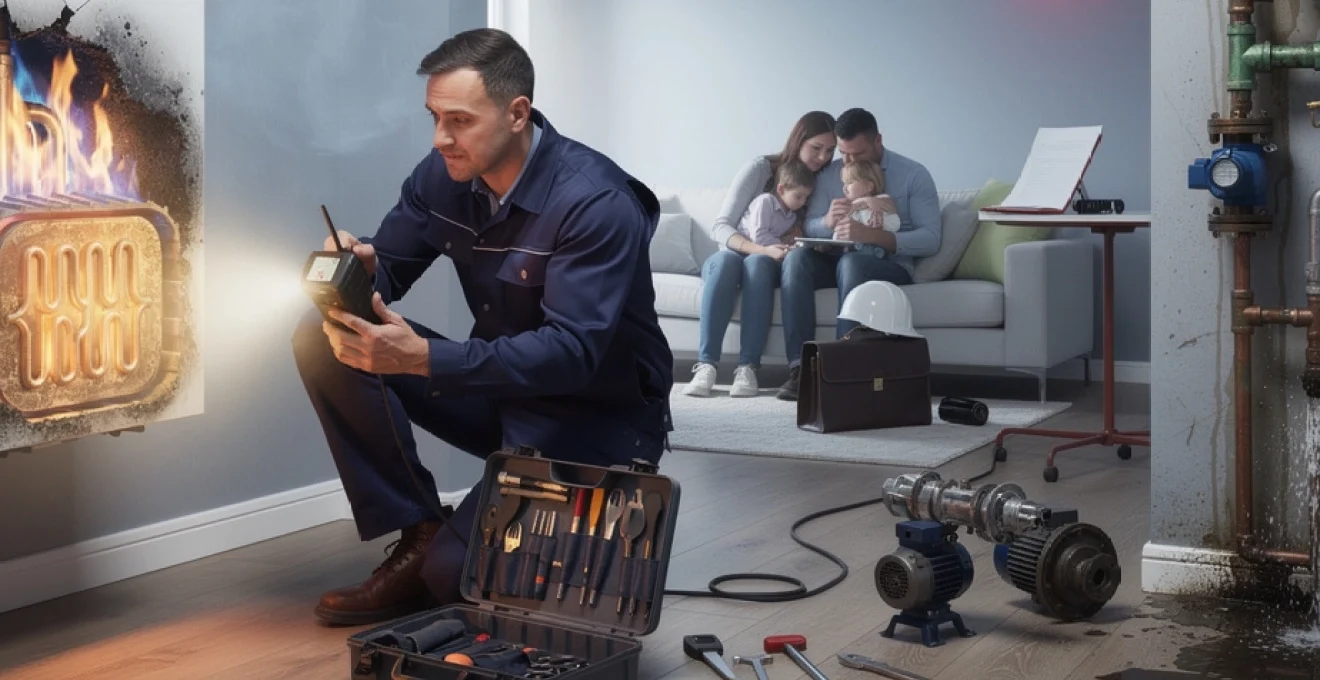
A neglected boiler represents one of the most significant threats to household safety and financial stability that homeowners can face. When a heating system operates without professional maintenance for five years or more, it transforms from a reliable home comfort appliance into a potential liability that can endanger lives, cause catastrophic property damage, and result in thousands of pounds in unexpected costs. The complex network of components within modern boilers requires regular inspection and maintenance to prevent the gradual deterioration that inevitably occurs over time.
Professional heating engineers consistently report that the majority of emergency callouts could have been prevented through regular annual servicing. The risks associated with unserviced boilers extend far beyond simple mechanical failures, encompassing serious safety hazards, legal compliance issues, and insurance complications that can leave homeowners exposed to significant financial and personal liability. Understanding these risks is crucial for any property owner who values both safety and financial prudence.
Carbon monoxide poisoning from faulty heat exchanger components
The most serious consequence of prolonged boiler neglect is the increased risk of carbon monoxide exposure, a silent killer that claims approximately 50 lives annually in the UK alone. Carbon monoxide production typically occurs when heating systems develop faults that compromise proper combustion, with heat exchanger deterioration being the primary culprit. This colourless, odourless gas can accumulate in living spaces without detection, causing symptoms ranging from headaches and nausea to unconsciousness and death.
Heat exchanger failures account for nearly 40% of all carbon monoxide incidents in residential properties, with the majority occurring in boilers that haven’t received professional maintenance for three years or longer.
Hairline cracks in primary heat exchanger surfaces
Primary heat exchangers endure extreme temperature fluctuations during normal operation, expanding and contracting thousands of times each heating season. After five years without service, microscopic stress fractures often develop into visible cracks that allow combustion gases to escape into the surrounding air. These hairline fissures are particularly dangerous because they’re virtually impossible to detect without specialised equipment and professional inspection.
Modern condensing boilers are especially susceptible to heat exchanger cracking due to their compact design and high efficiency operation. The acidic condensate produced during normal combustion can accelerate corrosion around these stress points, creating pathways for carbon monoxide leakage. Regular annual servicing includes pressure testing and visual inspection of heat exchanger surfaces, identifying potential problems before they become life-threatening hazards.
Blocked flue gas pathways and incomplete combustion
Flue systems require clear pathways for safe removal of combustion gases from the property. Over a five-year period without maintenance, debris accumulation, bird nesting, and structural degradation can significantly restrict gas flow, forcing dangerous exhaust products back into living spaces. Partial blockages are particularly insidious because they allow the boiler to operate seemingly normally while gradually increasing carbon monoxide production.
Incomplete combustion occurs when insufficient oxygen reaches the burner or when exhaust gases cannot escape efficiently. This condition produces higher concentrations of carbon monoxide while simultaneously reducing heating efficiency. Professional flue analysis during annual servicing measures combustion efficiency and identifies restriction issues before they compromise household safety.
Deteriorated combustion chamber seals and gaskets
The combustion chamber must maintain proper sealing to ensure safe operation and prevent gas leakage. Rubber gaskets and metal seals gradually deteriorate due to heat cycling, chemical exposure, and normal wear. After five years of continuous operation, these critical components often fail, allowing combustion gases to escape into the boiler casing and surrounding areas.
Failed seals also affect combustion air supply, creating conditions that promote incomplete burning and increased carbon monoxide production. The replacement of these components requires professional expertise and specialised tools, making regular preventive maintenance far more cost-effective than emergency repairs after seal failure occurs.
Failed carbon monoxide detection systems in baxi and worcester bosch models
Many modern boilers incorporate built-in carbon monoxide detection systems designed to shut down operation when dangerous gas levels are detected. However, these safety systems require regular testing and calibration to ensure proper function. Baxi and Worcester
Bosch appliances, for example, have introduced multiple safety interlocks and flue gas monitoring in their higher-end models, but these features still rely on correct installation, regular servicing, and, where applicable, software updates.
When a boiler hasn’t been serviced in 5 years, these internal safeguards may not operate as originally designed. Dust ingress, sensor drift, wiring degradation, and firmware faults can all mean that a potentially dangerous boiler continues to run instead of safely locking out. This is why engineers stress that built-in safety features are a back-up, not a substitute, for an annual boiler service and an independent, properly located carbon monoxide alarm in the property.
Catastrophic system failures and water damage risks
While carbon monoxide is the most serious health risk, unserviced boilers are also a leading cause of catastrophic system failures and water damage. Central heating systems operate under pressure and at elevated temperatures, so small faults can escalate into burst components and widespread leaks when they are left unchecked for several years. After five years without a boiler service, the likelihood of a pressure-related failure, internal leak, or flooded property increases dramatically.
Water damage from a failed boiler or heating circuit is not just a matter of a damp patch on the carpet. Escaping hot water can ruin flooring, plaster, electrics, and furnishings, often spreading across multiple rooms and even to neighbouring properties in flats or maisonettes. In severe cases, ceilings collapse, electrical systems short out, and homes become temporarily uninhabitable, with repair bills running into the thousands. Regular servicing significantly reduces these boiler water damage risks by identifying worn parts and abnormal pressure trends before they fail.
Corroded expansion vessel membranes and pressure relief valve malfunction
The expansion vessel and pressure relief valve work together like a safety cushion for your heating system, absorbing pressure rises and safely discharging excess water when necessary. Inside the expansion vessel is a rubber membrane that separates system water from a pre-charged pocket of air or nitrogen. Over time, and especially in systems that have not been treated with the correct inhibitor, this membrane can corrode, harden, or split.
When an expansion vessel fails and has not been picked up during a routine boiler service, the system pressure can swing wildly as the water heats and cools. The pressure relief valve is then forced to operate more often than it was designed to, leading to limescale buildup and eventual sticking. In an unserviced boiler that has been running for 5 years or more, it is common to find PRVs that no longer seal properly (causing continual pressure loss and topping up) or, more worryingly, fail to open under extreme pressure, increasing the risk of pipe ruptures and component failure.
A professional engineer will check the expansion vessel charge, examine the membrane where accessible, and test the operation of the pressure relief valve as part of an annual boiler maintenance schedule. These simple preventative checks can prevent the kind of boiler pressure failure that results in major water damage and system shutdown during cold weather.
Pump seizure in grundfos and wilo circulation systems
Circulating pumps from brands such as Grundfos and Wilo are extremely reliable when properly maintained, but they are not immune to problems in systems that go years without attention. Sludge accumulation, magnetite buildup, and stagnant water in rarely used systems can all cause a boiler pump to seize. When a pump seizes suddenly, the boiler may overheat and lock out, or in some cases, continue trying to fire against a closed circuit, placing undue stress on the heat exchanger and associated components.
In properties where the heating is only used seasonally, a boiler that hasn’t been serviced in 5 years is particularly vulnerable to pump seizure. It is similar to leaving a car in a garage for years without starting it; moving parts stick, lubricants degrade, and small deposits harden in place. During a routine boiler service, an engineer will listen for bearing noise, check for adequate flow, and in many cases manually exercise the pump to prevent sticking. They may also recommend system cleaning or the installation of a magnetic filter to protect the pump and other critical parts.
Ignoring early signs such as noisy operation, radiators heating unevenly, or frequent boiler lockouts can turn a simple preventative pump replacement into a full-blown emergency breakdown. In extreme cases, overheated components and pressure spikes from a failed pump can combine with existing weaknesses in pipework to create leaks in hidden areas of the property.
Diverter valve actuator failure in combination boilers
Combination (combi) boilers rely on a diverter valve to switch heat between central heating and domestic hot water. The actuator that drives this valve is a moving mechanical component exposed to heat, limescale, and, in some systems, dirty system water. When a combi boiler hasn’t been serviced for 5 years, the diverter valve is one of the most common points of failure, often manifesting first as lukewarm water, radiators heating when hot taps are opened, or intermittent hot water supply.
If a stiff or partially blocked diverter valve is left to struggle on, it can eventually seize in one position and cause the boiler to overheat, short cycle, or shut down altogether. This does not only affect comfort; continual overheating stresses the primary heat exchanger, pump, and electronic control board, with repair costs that quickly add up. What starts as a minor inconvenience with inconsistent hot water can therefore escalate into multiple component failures if the underlying issue is never addressed.
During an annual service, an engineer will assess the operation of the diverter valve, often spotting early signs of sticking or leaking around the valve body. In some cases, a simple clean or lubrication can restore smooth function. In others, proactive replacement prevents the kind of mid-winter breakdown that leaves a household without heating and hot water at the worst possible time.
Radiator pipe joint degradation and central heating leakage
The boiler is only one part of your heating system; the network of pipes and radiator joints running under floors and behind walls is also under constant thermal and mechanical stress. Over a period of five years without professional attention, small weeps at compression joints, push-fit connections, or soldered fittings can slowly develop into significant leaks. These may go unnoticed until they stain ceilings, cause timber floors to swell, or corrode electrical components near the leak path.
Systems with untreated or poorly balanced water tend to corrode from the inside out. Oxygen ingress, incorrect inhibitor levels, or micro-leaks draw in fresh water, accelerating internal corrosion of both pipes and radiator panels. An annual boiler service is often the only time an engineer systematically inspects visible pipework, bleed points, and valves, catching early signs of corrosion or joint degradation. When your boiler hasn’t been serviced in 5 years, you lose that early warning system.
Central heating leaks are particularly disruptive because they can require lifting floorboards, cutting into ceilings, and temporarily isolating parts of the system. In multi-storey properties, water can track along joists and appear far from the actual point of failure, complicating diagnosis and repair. The cost and disruption of this kind of remedial work far exceed the modest investment required to keep your boiler and heating system on a regular maintenance schedule.
Efficiency degradation through component deterioration
Even if an unserviced boiler manages to avoid immediate breakdown, there is almost always a hidden cost: significantly reduced efficiency. When your boiler hasn’t been serviced in 5 years, combustion quality, heat transfer, and system circulation all tend to degrade. The result is simple but expensive: your boiler burns more gas to produce the same level of heat, and your energy bills rise year after year without you necessarily realising why.
Key components that influence boiler efficiency, such as the burner, heat exchanger, and condensate trap, are all vulnerable to gradual fouling and wear. Soot and debris on the burner can lead to incomplete combustion, while limescale and sludge on the heat exchanger surfaces act like an insulating blanket, preventing efficient heat transfer to the system water. In condensing boilers, blocked or partially restricted condensate pathways reduce condensing operation, cutting real-world efficiency substantially below the manufacturer’s stated figure.
Think of your boiler like a car that has not had an oil change, filter replacement, or tune-up for five years. It may still start and run, but it will use more fuel, produce more emissions, and be far more likely to suffer a major breakdown. Regular boiler servicing includes flue gas analysis to check combustion efficiency, cleaning of key components, and adjustments to gas pressures where necessary, ensuring that the appliance operates close to its designed performance throughout its life.
There is also a knock-on effect on the overall central heating system. Poor circulation caused by a partially seized pump or sludged pipework forces the boiler to run longer cycles to achieve target temperatures. Thermostats and controls may be set incorrectly or have outdated schedules, causing unnecessary runtime. When these issues are left uncorrected for five years or more, it’s not uncommon to see households overpaying hundreds of pounds per year in energy costs without realising that a simple boiler service could have restored much of that lost efficiency.
Gas safety compliance violations under gas safety regulations 1998
Beyond the technical and financial risks, running a boiler that hasn’t been serviced in 5 years can also put you on the wrong side of gas safety regulations, particularly if you are a landlord or responsible for rented accommodation. The Gas Safety (Installation and Use) Regulations 1998 place clear duties on landlords to ensure that gas appliances, including boilers, are maintained in a safe condition and checked at least once every 12 months by a Gas Safe registered engineer.
For homeowners occupying their own property, there is currently no direct legal requirement to have an annual boiler service. However, the general duty of care and broader health and safety expectations still apply, especially if you invite lodgers, Airbnb guests, or vulnerable family members to stay. Failing to maintain a gas appliance for half a decade, yet continuing to use it daily, can be difficult to defend if an incident occurs and an investigation shows that basic boiler maintenance was ignored.
Landlords who neglect boiler servicing face far more explicit legal risks. Not only must they arrange annual gas safety checks, but they must also keep records and provide tenants with a copy of the Gas Safety Certificate. If an accident arises from a boiler that has not been serviced correctly, courts and regulators will look very closely at whether the landlord met their obligations under the 1998 regulations. Penalties for non-compliance can include substantial fines, invalidated insurance, and in serious cases, custodial sentences.
From a practical standpoint, keeping your boiler serviced annually makes demonstrating compliance straightforward. You have dated paperwork, a clear service history, and the reassurance that a qualified Gas Safe engineer has inspected the appliance. When that paper trail has a five-year gap, it becomes much harder to prove that reasonable steps were taken to keep the boiler safe, especially where there is evidence of long-standing faults or dangerous conditions that would likely have been picked up during routine servicing.
Insurance claim rejections and legal liability exposure
Many homeowners assume that, if the worst happens and their boiler causes damage, their home insurance will simply pay out. However, most buildings and contents policies include clauses requiring reasonable maintenance of fixed installations, including heating systems. When your boiler hasn’t been serviced in 5 years, insurers may argue that you failed to take reasonable care, particularly if the policy wording or the boiler manufacturer’s warranty documents recommend annual servicing.
In practice, this can mean that claims related to boiler water damage, fire, or explosion are partially or completely rejected once the loss adjuster discovers that there is no recent service history. The same applies to extended boiler warranties, which almost always specify that the appliance must be serviced annually by a qualified engineer. Skipping services for multiple years can leave you facing the full cost of replacing a failed boiler, even if it is still well within the original warranty period.
There is also the potential for personal legal liability. If a guest, tenant, or even a tradesperson is injured as a result of a boiler fault that could reasonably have been prevented through routine maintenance, you may be exposed to civil claims for damages. In more serious incidents involving carbon monoxide poisoning or significant property damage, criminal investigations will examine whether you took basic, expected steps to maintain the appliance safely. A five-year gap in servicing can be difficult to justify in those circumstances.
By contrast, keeping to an annual boiler service programme not only reduces the likelihood of an incident, it also strengthens your position with insurers and, if necessary, in legal proceedings. You can demonstrate that you followed manufacturer guidance, engaged qualified engineers, and acted promptly when advised of faults. That evidence can make the difference between a supported insurance claim and an expensive, stressful dispute at a time when you can least afford it.
Emergency breakdown costs versus preventative annual service programmes
When weighing up the risks of a boiler that hasn’t been serviced in 5 years, cost is often the deciding factor for many homeowners. It can be tempting to save the relatively modest fee of an annual service and hope for the best. However, the financial reality usually points the other way. Emergency breakdowns are almost always more expensive, more disruptive, and more stressful than planned maintenance visits.
Typical annual boiler servicing costs in the UK range from around £70 to £120 for a standard gas appliance, depending on location and boiler type. Against this, emergency callouts for a boiler breakdown commonly start at £150–£200 just for the initial visit, rising further if the fault occurs at night, on a weekend, or during peak winter demand. Add the cost of replacement parts such as pumps, diverter valves, or control boards, and a single breakdown can easily exceed the price of several years’ worth of routine services.
There is also the hidden cost of being without heating or hot water, often at short notice and during cold weather. Households may need to purchase temporary heaters, arrange alternative accommodation for vulnerable occupants, or take time off work to wait for engineers and drying contractors if leaks occur. These indirect costs are rarely considered when people choose to skip annual boiler maintenance, yet they are a major part of the overall financial risk of neglecting the system for five years.
Preventative annual service programmes, including boiler cover plans offered by some providers, spread the cost into manageable monthly payments and often bundle servicing with priority callouts and parts cover. While not every home will need a full care plan, building a simple annual boiler service into your household budget is one of the most cost-effective ways to protect both your comfort and your finances. It is similar to regular dental check-ups: small, predictable costs now to avoid painful, expensive emergencies later.
Ultimately, the choice is between controlled, proactive maintenance and reactive crisis management. A boiler that hasn’t been serviced in 5 years may appear to save money in the short term, but it stacks the odds in favour of breakdowns, inefficiency, safety hazards, and insurance or legal complications. By contrast, scheduling a yearly visit from a qualified Gas Safe engineer keeps risks low, preserves efficiency, and gives you the reassurance that one of the most important systems in your home is being properly looked after.