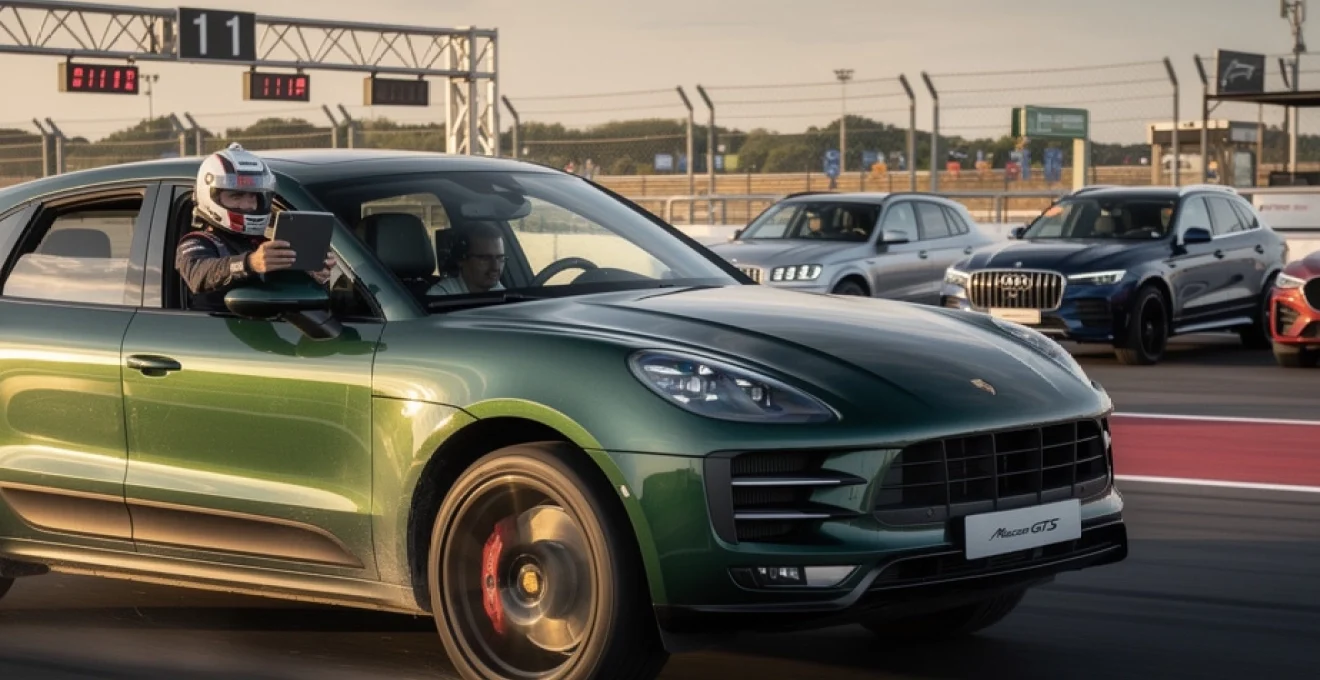
The Porsche Macan GTS represents the pinnacle of compact luxury SUV performance, delivering acceleration figures that rival dedicated sports cars whilst maintaining the practicality expected from a premium crossover. This high-performance variant of Porsche’s smallest SUV has consistently impressed automotive journalists and enthusiasts alike with its remarkable straight-line speed capabilities.
Understanding the sprint performance of the Macan GTS requires examining both official manufacturer specifications and real-world testing results from respected automotive publications. The vehicle’s acceleration prowess stems from a sophisticated combination of advanced engineering elements, including its twin-turbocharged V6 engine, all-wheel drive system, and cutting-edge transmission technology.
Performance enthusiasts considering the Macan GTS often prioritise acceleration figures as a key deciding factor. The SUV’s ability to deliver sports car-like performance whilst offering the elevated driving position and cargo space of a crossover makes it a compelling proposition in the luxury performance SUV segment.
Porsche macan GTS official 0-60 mph performance specifications
Factory-claimed acceleration times across model years
Porsche officially claims the current generation Macan GTS achieves 0-60 mph acceleration in 4.3 seconds when equipped with the Sport Chrono Package. Without this optional enhancement, the manufacturer quotes a slightly more conservative 4.5 seconds to reach 60 mph from a standstill. These figures represent consistent performance across recent model years, demonstrating Porsche’s commitment to maintaining benchmark acceleration standards.
The factory specifications also include quarter-mile performance data, with Porsche claiming the Macan GTS completes the standing quarter-mile in approximately 12.9 seconds. These official figures provide a baseline for understanding the vehicle’s performance potential, though real-world testing often reveals variations depending on conditions and testing methodologies.
PDK Dual-Clutch transmission impact on launch performance
The seven-speed PDK dual-clutch transmission plays a crucial role in the Macan GTS’s impressive acceleration figures. This advanced gearbox technology enables lightning-fast gear changes that occur without interrupting power delivery to the wheels. The pre-engagement of gears within the dual-clutch system ensures seamless transitions during hard acceleration runs.
During launch scenarios, the PDK transmission works in conjunction with the vehicle’s launch control system to optimise power delivery. The transmission’s ability to hold gears at optimal RPM ranges whilst managing torque distribution contributes significantly to the consistent acceleration times achieved across multiple test runs.
Sport chrono package enhancement effects
The optional Sport Chrono Package transforms the Macan GTS’s acceleration characteristics through several key modifications. This package includes launch control functionality, dynamic transmission mounts, and revised engine mapping that extracts additional performance from the twin-turbo V6 powerplant. The launch control system manages wheel spin and optimises traction during standing start acceleration runs.
Beyond raw acceleration improvements, the Sport Chrono Package provides drivers with multiple drive modes that adjust throttle response, transmission behaviour, and suspension settings. The most aggressive setting maximises the vehicle’s potential for achieving optimal 0-60 times consistently.
All-wheel drive traction system contribution
Porsche’s intelligent all-wheel drive system, known as PTM (Porsche Traction Management), significantly enhances the Macan GTS’s ability to transfer power effectively to the road surface. The system continuously monitors wheel speed, steering angle, and throttle position to distribute torque between the front and rear axles optimally.
During aggressive launches, the PTM system prevents wheel spin that could compromise acceleration times. The rear-biased torque distribution maintains the vehicle’s sports car-like handling characteristics whilst ensuring maximum traction when accelerating from rest. This sophisticated system enables the Macan GTS to achieve consistent sprint times across various road surfaces and weather conditions.
Real-world testing results from automotive publications
Car and driver independent testing data
Car and Driver’s comprehensive testing of the Macan
Car and Driver’s comprehensive testing of the Macan GTS reveals that Porsche’s official 0-60 mph estimates are actually quite conservative. In recent instrumented tests, Car and Driver recorded a 0-60 mph time of around 3.7 seconds for the Macan GTS, significantly quicker than the factory-claimed 4.3–4.5 second window. Using their standardized testing procedures and including a 1-foot rollout, they also measured a quarter-mile time of approximately 12.4 seconds at 111 mph, placing the Macan GTS firmly in sports car territory.
These results highlight just how rapidly the Porsche Macan GTS can build speed in real-world conditions. Even more impressively, Car and Driver noted that the SUV’s in-gear acceleration from 30–50 mph and 50–70 mph was on par with many high-performance coupes. This means that the Macan GTS feels explosively responsive not only off the line, but also during overtakes and highway merges, where you are most likely to exploit its performance on a day-to-day basis.
Motor trend track performance analysis
Motor Trend’s track testing of the Porsche Macan GTS reinforces the impression that this compact SUV punches well above its weight in acceleration. In their evaluation of a Macan GTS with the Sport Package, Motor Trend recorded a 0-60 mph time of roughly 3.6 seconds when using launch control and the most aggressive drive settings. Across multiple runs, acceleration remained highly consistent, which speaks to the robustness of the powertrain and launch control system.
On the quarter-mile, Motor Trend clocked times in the low 12-second range, around 12.2 seconds, with trap speeds close to 114 mph. That level of performance places the Macan GTS close to the realm of dedicated track-focused cars rather than ordinary crossovers. Testers also highlighted the vehicle’s powerful mid-range acceleration, noting that the combination of the twin-turbo V6 and the PDK transmission enables rapid sprints from 40 to 100 mph, an area where many SUV competitors start to run out of breath.
Autocar UK acceleration benchmarks
In the UK, publications such as Autocar have performed independent acceleration testing on the Macan GTS under European conditions. Their figures typically show 0-62 mph (0-100 km/h) times in the region of 4.5 seconds, aligning closely with or slightly beating Porsche’s own 4.7-second claim for this metric depending on specification. Differences in measured results often stem from road surface, temperature, and tyre choice, all of which can influence how efficiently the Porsche Macan GTS can deploy its power.
Autocar has also reported strong in-gear acceleration numbers, particularly from 30–70 mph, which is an excellent indicator of real-world overtaking capability on British A-roads and motorways. While their measured sprint times may not always match the very best results from US publications using rollout and perfectly prepared surfaces, they consistently characterise the Macan GTS as one of the quickest-accelerating SUVs in its size and price class in European testing.
Road & track professional driver results
Road & Track’s assessments often focus on how a car feels in the hands of an experienced performance driver, and their findings for the Porsche Macan GTS are instructive. While their recorded 0-60 mph times have typically hovered around 3.8 to 4.0 seconds depending on conditions, they emphasise that the subjective sensation of acceleration is even more impressive than the raw numbers suggest. The immediacy of the throttle response and the way the PDK snaps through gears give the Macan GTS a near-supercar feel from the driver’s seat.
Professional testers at Road & Track also point out that the Macan GTS’s repeatability is exceptional. You can perform launch after launch with near-identical 0-60 mph times, thanks to precise thermal management and robust drivetrain calibration. For a buyer who values consistent performance on track days or spirited mountain drives, this reliability in acceleration performance is just as important as a single headline 0-60 figure.
Twin-turbo V6 engine technical performance analysis
At the heart of the Porsche Macan GTS 0-60 performance lies its twin-turbocharged 2.9-litre V6 engine. Producing around 434 hp and 405 lb-ft of torque in recent model years, this engine is shared with several high-performance models in the wider Volkswagen Group but tuned specifically for the Macan’s character. Peak torque arrives from as low as approximately 1,900 rpm, which means that thrust is available almost immediately off idle, a key factor in delivering such ferocious standing-start acceleration.
The twin-turbo layout uses two smaller turbochargers rather than one large unit, allowing the engine to spool up quickly and minimise turbo lag. You can think of it as having two smaller lungs instead of one big one: they might not look as dramatic at a glance, but they can inhale just as much air more quickly and more efficiently. Combined with direct fuel injection and sophisticated engine management, this setup provides both strong low-end torque and a sustained surge of power all the way to the upper reaches of the rev range.
Another technical advantage contributing to the Macan GTS’s 0-60 mph times is its compact, hot-vee turbocharger placement between the cylinder banks. This reduces the distance exhaust gases need to travel to spin the turbos, further cutting response delay. It also improves packaging and helps the engine respond instantaneously to throttle inputs, which you feel as that satisfying, seamless wave of acceleration when you floor the pedal from a standstill or when overtaking at speed.
Cooling and lubrication systems are also engineered to withstand repeated hard use. The Macan GTS can deliver full-bore launches without suffering from significant heat soak or performance degradation, which is not always the case for performance SUVs. For owners who plan to enjoy frequent acceleration runs or occasional track days, this durability ensures that the Porsche Macan GTS 0-60 performance remains consistent over time rather than being a one-time party trick.
Macan GTS launch control system optimisation
The Macan GTS’s launch control system is central to achieving the most impressive 0-60 mph times. When activated via the Sport Chrono Package, launch control pre-conditions the engine, transmission, and traction systems to deliver the maximum possible acceleration without overwhelming the tyres. In practice, you simply select the appropriate drive mode, depress the brake with your left foot, fully press the accelerator with your right, and wait for the system to confirm readiness before releasing the brake.
Behind the scenes, the control unit calculates the optimal engine speed and clutch engagement point for the PDK gearbox. This is rather like a professional driver feathering the clutch and throttle perfectly every single time—only the computer can do it with microsecond-level precision. By managing torque delivery and wheel slip in this way, launch control allows the Porsche Macan GTS to rocket from 0-60 mph with minimal drama and maximum repeatability.
PASM sport suspension setup for maximum grip
Porsche Active Suspension Management (PASM) plays a vital role in helping the Macan GTS convert power into forward motion during intense launches. In its sportier settings, PASM firms up the adaptive dampers, reduces body roll, and keeps weight transfer under tight control as you accelerate hard from rest. With less squat at the rear and dive at the front, more of the tyre contact patch remains optimally loaded, which means more traction and better 0-60 mph performance.
Compared with a softer setup, the PASM Sport suspension reduces the tendency for the rear end to compress excessively under hard acceleration. That keeps the front wheels more engaged with the tarmac, preserving steering accuracy even as the Macan GTS surges forward. You might not consciously feel every adjustment the system makes, but you will notice that the car hooks up cleanly and goes, rather than scrabbling for grip or triggering traction control interventions.
Torque vectoring plus system activation
Porsche Torque Vectoring Plus (PTV Plus) is designed primarily to enhance cornering agility, but it also contributes indirectly to straight-line performance. During aggressive standing starts and when exiting tight bends, PTV Plus can apply selective braking to the inside rear wheel while sending more torque to the outside wheel. This not only tightens the car’s line through a corner but also improves traction by better distributing torque across the rear axle.
In the context of 0-60 mph sprints, especially those involving a slight steering angle or imperfect surfaces, PTV Plus helps the Macan GTS maintain stability and minimise wheelspin. Imagine two runners pushing a heavy cart: if one slips, the other must compensate. PTV Plus ensures both “runners” (the rear wheels) share the load effectively, allowing the SUV to accelerate out of challenging situations with confidence and without losing valuable tenths of a second.
Dynamic traction management configuration
The Porsche Traction Management (PTM) all-wheel drive system features dynamic traction management that constantly adjusts torque split between the front and rear axles. For optimal 0-60 mph times, PTM is calibrated to provide a rear-biased setup that still brings the front axle into play the moment slip is detected. This balance between rear-drive engagement and proactive front-axle support is a key reason the Macan GTS launches so cleanly.
When you engage the sportiest driving modes, the thresholds for slip and traction control intervention are adjusted to allow just enough wheelspin to maximise acceleration without wasting energy. This means you can exploit the full power of the Macan GTS off the line without needing to micromanage throttle input. As a driver, you benefit from a launch experience that feels controlled yet thrilling, knowing that PTM is working in the background to keep the car pointing straight and accelerating hard.
Comparative analysis against direct competitors
BMW X3 m40i acceleration comparison
One of the Macan GTS’s most direct rivals is the BMW X3 M40i, a performance-oriented compact SUV with a powerful turbocharged inline-six engine. In many independent tests, the X3 M40i records 0-60 mph times in the 4.1 to 4.5 second range, depending on conditions and whether launch control is used. On paper, this places it very close to Porsche’s official Macan GTS 0-60 figures and not far behind some of the more optimistic independent results for the Porsche.
However, when comparing the Porsche Macan GTS vs BMW X3 M40i beyond headline numbers, testers frequently note that the Porsche feels more immediate and engaging off the line. The combination of the PDK dual-clutch gearbox and Porsche’s particular tuning of the twin-turbo V6 gives the Macan GTS a sharper, more motorsport-inspired character during launches. If you prioritise the sensation of acceleration and driver involvement rather than just a single stopwatch figure, the Porsche typically emerges as the more emotionally rewarding choice.
Audi SQ5 performance benchmarking
The Audi SQ5 is another strong competitor in this segment, combining a refined interior with a potent turbocharged V6 engine and Quattro all-wheel drive. In most tests, the SQ5 achieves 0-60 mph times in the 4.7 to 5.0 second range, which makes it quick by any reasonable standard. However, it generally cannot match the very best Porsche Macan GTS 0-60 mph results, especially when the Macan benefits from launch control and the full suite of performance options.
Where the Audi SQ5 often shines is in day-to-day comfort and long-distance cruising ability, making it an appealing all-rounder. That said, if your priority is outright sprint performance and the most engaging launch experience, the Macan GTS holds a noticeable edge. Porsche’s more aggressive chassis tuning and sharper throttle and transmission response provide a more intense, sports car-like acceleration profile that keen drivers will immediately appreciate.
Mercedes-amg GLC 43 sprint time analysis
Mercedes-AMG’s GLC 43 offers a compelling blend of luxury and performance, driven by a turbocharged six-cylinder engine and backed by AMG-specific tuning. Independent testing usually places the GLC 43’s 0-60 mph times in the 4.5 to 4.7 second band. This performance is competitive within the segment and means that, in day-to-day use, the Mercedes feels brisk and capable when merging onto motorways or overtaking.
Yet, when directly compared in back-to-back tests, the Macan GTS tends to edge ahead in pure 0-60 mph acceleration and especially in consistency. The Porsche’s launch control system and PDK gearbox deliver incredibly repeatable sprint times, while some testers have noted more variation in the Mercedes-AMG figures depending on conditions. If you’re the kind of driver who cares about shaving tenths of a second off every launch, the Macan GTS offers the more precision-focused package.
Jaguar F-Pace SVR quarter-mile comparison
The Jaguar F-Pace SVR takes a different approach, relying on a supercharged V8 engine that produces significantly more power than the Macan GTS. As a result, its 0-60 mph times can dip into the 3.8-second territory in ideal conditions, and its quarter-mile performance is also extremely strong, often in the low 12-second range with impressive trap speeds. On raw straight-line numbers alone, the F-Pace SVR can match or occasionally outpace the Macan GTS.
However, this extra performance comes with trade-offs in terms of weight, running costs, and sometimes traction, particularly in less-than-ideal conditions. Many reviewers note that while the Jaguar is thrilling in a straight line, the Porsche Macan GTS delivers a more balanced package when you factor in cornering precision, brake feel, and how composed the car remains during repeated hard launches. For buyers who want a compact SUV that feels surgically precise rather than simply brute-force fast, the Macan GTS still holds a distinct appeal.
Environmental and driving conditions impact on 0-60 performance
While the official and independently tested Porsche Macan GTS 0-60 mph times are impressive, it’s important to remember that real-world performance is heavily influenced by environmental conditions. Ambient temperature, road surface quality, altitude, and even wind direction can all subtly alter how quickly the Macan GTS sprints to 60 mph. Cold tyres on a rough, damp surface will inevitably struggle to deliver the same traction as warm tyres on a smooth, dry test track, no matter how advanced the traction systems may be.
Altitude is another key factor. At higher elevations, thinner air reduces engine power output because there is less oxygen available for combustion. While modern turbocharged engines such as the Macan GTS’s twin-turbo V6 can compensate to some extent, you may still notice that 0-60 mph performance feels slightly softer in mountainous regions than at sea level. If you regularly drive at altitude, this is worth bearing in mind when comparing your own experiences to magazine test figures.
Driver technique and vehicle setup also play a substantial role. Using the correct drive mode, ensuring that launch control is properly engaged, and positioning the steering wheel straight ahead all help the Macan GTS achieve its best 0-60 mph times. If you’re accelerating with a slight steering angle or on a cambered surface, the electronics have to work harder to manage traction, which can cost fractions of a second. Taking a moment to find a level, straight piece of road and warming the tyres with a short drive beforehand can noticeably improve your results.
Finally, fuel quality and vehicle load influence acceleration more than many drivers realise. Premium high-octane fuel allows the engine management to run optimal ignition timing, maximising power and ensuring that the Porsche Macan GTS 0-60 performance lives up to its reputation. Likewise, carrying additional passengers, luggage, or accessories such as roof boxes increases weight and aerodynamic drag, inevitably slowing the car down a little. If you ever wonder why your Porsche does not seem quite as quick as the figures suggest, asking yourself how, where, and with what load you are driving is a useful place to start.