# Porsche 911 GT2 RS: Specs and Performance
The Porsche 911 GT2 RS represents the absolute pinnacle of rear-wheel-drive performance engineering within the Stuttgart manufacturer’s iconic sports car lineage. As the most powerful and fastest production 911 ever conceived, this machine transcends conventional supercar boundaries through a meticulous combination of forced induction technology, lightweight construction principles, and motorsport-derived chassis dynamics. With an output figure exceeding 690 horsepower from its twin-turbocharged flat-six engine and a kerb weight barely surpassing 1,470 kilograms, the GT2 RS delivers a power-to-weight ratio that challenges even purpose-built racing machinery. This achievement isn’t merely about raw statistics—it’s about creating a road-legal vehicle capable of establishing lap records at the world’s most demanding circuits whilst remaining surprisingly tractable for everyday use.
Twin-turbocharged 3.8-litre Flat-Six engine architecture and output
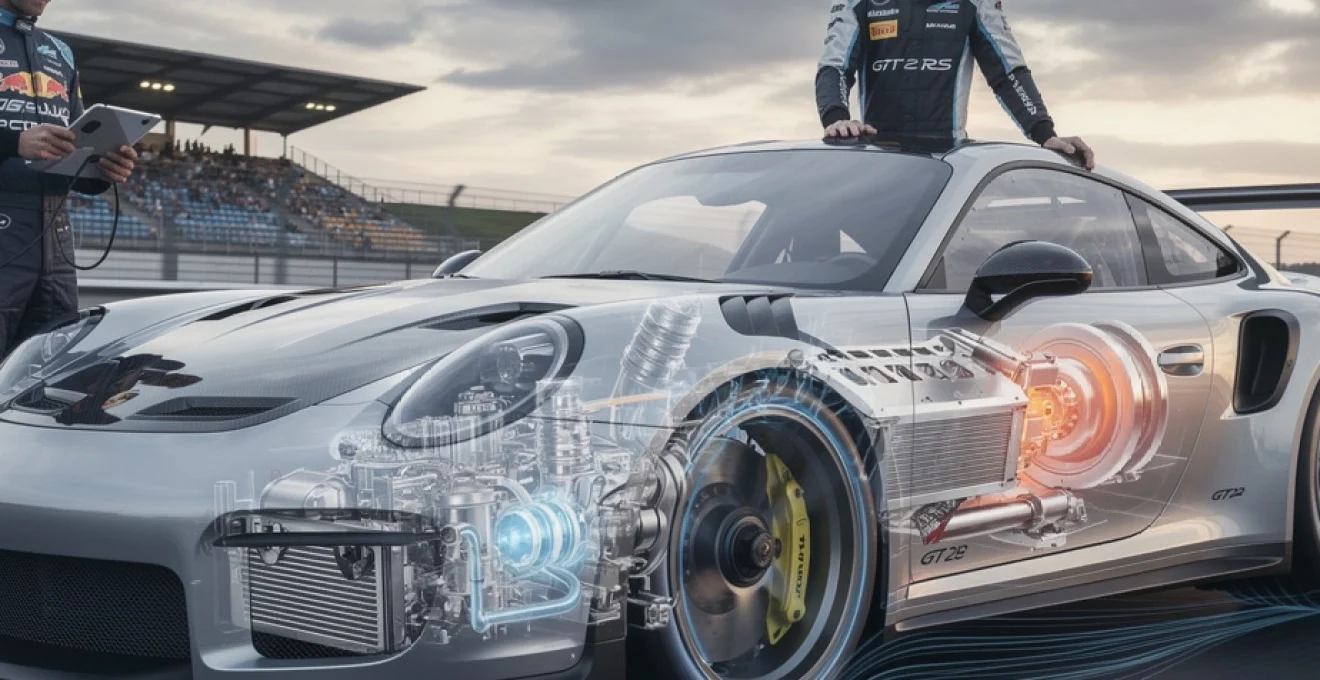
At the heart of the GT2 RS lies a comprehensively re-engineered version of Porsche’s renowned boxer engine configuration. The 3.8-litre displacement represents the optimal balance between specific output and mechanical durability, with each cylinder fed by two turbochargers featuring variable turbine geometry technology. This sophisticated induction system allows Porsche’s engineers to extract extraordinary performance whilst maintaining the throttle response characteristics typically associated with naturally aspirated powerplants. The engine block itself employs a vertically split crankcase constructed from pressure-cast aluminium alloy, housing a crankshaft running in eight bearings for exceptional rigidity under extreme loading conditions.
The combustion chamber design incorporates Nikasil-coated aluminium cylinder liners that reduce friction whilst improving heat dissipation—a critical consideration when operating at sustained high boost pressures. Porsche’s VarioCam Plus valve timing system continuously optimises intake and exhaust valve lift and duration across the entire rev range, ensuring maximum volumetric efficiency whether you’re navigating urban traffic or extracting maximum velocity on a racing circuit. This technological integration demonstrates how modern forced induction engines can deliver both flexibility and ferocious top-end performance without compromise.
700 PS power delivery and 750 nm torque characteristics
The GT2 RS generates a maximum output of 700 metric horsepower (691 bhp) at 7,000 rpm, representing an impressive specific output of 172 horsepower per litre of displacement. Even more significant for real-world performance is the torque delivery: 553 lb-ft (750 Nm) arrives at just 2,500 rpm and sustains through to 4,500 rpm, creating an extraordinarily broad powerband. This torque plateau transforms the driving experience, providing relentless acceleration from virtually any engine speed in any gear. The engine continues pulling with undiminished enthusiasm to its 7,200 rpm redline, delivering the high-revving character that enthusiasts demand from a flagship Porsche whilst capitalising on modern turbocharging efficiency.
What distinguishes this power unit from previous turbocharged 911 variants is the near-total elimination of turbo lag. Through precise calibration of the variable turbine geometry and sophisticated engine management strategies, throttle inputs receive immediate responses that feel remarkably linear and predictable. You’ll discover that the engine builds boost pressure with such rapidity that the traditional turbocharged sensation of waiting for power delivery simply doesn’t exist—instead, you experience a savage punch of acceleration that intensifies as the rev counter climbs towards the redline.
Variable turbine geometry turbochargers with larger compressors
The twin turbochargers employ variable turbine geometry (VTG) technology, a sophisticated system that adjusts the angle of guide vanes within the turbine housing to optimise exhaust gas flow across all operating conditions. At lower engine speeds, the vanes close to increase exhaust gas velocity, spinning the turbine wheel more rapidly and building boost pressure quickly. As engine speed increases, the vanes progressively open to accommodate greater exhaust flow whilst maintaining optimal boost levels. This adaptability provides the responsiveness of a small turbocharger combined with the high-rpm breathing capacity of a larger unit—traditionally contradictory objectives that VTG technology resolves
on the GT2 RS. Compared with other 911 Turbo engines, the turbochargers in this model feature enlarged compressors and reinforced turbine housings to withstand higher boost pressures approaching 1.6 bar in overboost conditions. The result is a substantial increase in mass airflow without sacrificing durability, a key factor in achieving both the 700 PS peak output and the sustained 750 Nm torque plateau. For the driver, this translates into power that feels inexhaustible on a fast circuit, with the engine continuing to pull hard well beyond the point where many traditional turbocharged units start to taper off.
To manage the additional thermal and mechanical loads generated by these higher boost levels, Porsche integrates uprated intercoolers with improved flow characteristics and a more efficient radiator package. The charge-air coolers feature a greater core depth and optimised end-tank geometry, improving cooling efficiency by around 15 percent compared with earlier GT2 iterations. This ensures that intake air temperatures remain consistent over prolonged high-speed running, which is essential not just for performance but also for engine longevity. In practical terms, you can repeatedly access the full performance of the Porsche 911 GT2 RS on track days without feeling the car fade as heat builds up.
Water injection system for charge air cooling
To further stabilise intake temperatures under extreme conditions, the Porsche 911 GT2 RS employs an advanced water injection system integrated into the charge-air cooling circuit. Under high load and elevated intake temperature thresholds, atomised water is sprayed into the charge-air path, absorbing heat as it evaporates and thereby reducing the temperature of the mixture entering the combustion chambers. Cooler intake air is denser, allowing more oxygen to be packed into each cylinder, which in turn supports higher combustion pressures and more aggressive ignition timing without inducing detonation. The outcome is a more consistent delivery of the GT2 RS’s 700 PS output, even during prolonged high-speed runs or hot-climate driving.
This approach is similar in principle to systems used in endurance racing and aviation, where controlling charge temperatures is vital to sustaining maximum power over long periods. You can think of it as a supplementary safety net, stepping in when traditional air-to-air intercooling approaches its thermal limit. The water injection system is governed by the engine control unit, which constantly monitors variables such as intake air temperature, engine speed and load to determine when intervention is necessary. Because operation is fully automatic, the driver benefits from the stability and repeatability of performance without having to manage any additional controls, preserving the deceptively simple driving experience of the Porsche 911 GT2 RS.
Titanium connecting rods and forged pistons engineering
Inside the engine, the Porsche 911 GT2 RS relies on a suite of lightweight, high-strength components designed to cope with the immense cylinder pressures generated by its 3.8-litre twin-turbo flat-six. Titanium connecting rods reduce reciprocating mass compared with conventional steel items, allowing the engine to spin more freely towards its 7,200 rpm redline while also lowering the loads exerted on the crankshaft and bearings. Less rotating inertia means sharper throttle response and improved efficiency, as the engine expends less energy accelerating its own internal components. For a driver, the effect is subtle yet tangible—the revs rise and fall with a crispness more reminiscent of a naturally aspirated GT3 than a traditional turbocharged 911.
Complementing the titanium rods are forged aluminium pistons housed within Nikasil-coated liners. Forging increases material density and strength, giving each piston the resilience to withstand high peak pressures and temperatures without deformation. The piston crowns are carefully contoured to promote efficient combustion and controlled flame propagation, while the ring packs are optimised to reduce friction and oil consumption at high rpm. Together, these engineering choices contribute not only to the headline figures of 700 PS and 750 Nm, but also to the long-term durability expected from a flagship Porsche engine that may see extensive use on track.
Seven-speed PDK transmission and rear-wheel drive dynamics
The powertrain of the Porsche 911 GT2 RS is anchored by a seven-speed Porsche Doppelkupplung (PDK) dual-clutch transmission, calibrated specifically for this model’s extreme performance envelope. Unlike some earlier GT2 generations that favoured a manual gearbox, the 991.2 GT2 RS adopts PDK to deliver consistently rapid shift times and to maximise acceleration potential. Shorter gear ratios ensure that the engine remains within its most potent band of torque and power, while the dual-clutch architecture enables near-seamless upshifts and downshifts under full load. This synergy between engine and gearbox is essential for achieving the car’s claimed 0–60 mph time of around 2.7 seconds and its ferocious in-gear acceleration.
Equally significant is the decision to retain a purely rear-wheel-drive layout despite the engine’s towering output. With 325-section rear tyres and the weight of the flat-six over the rear axle, the GT2 RS enjoys enormous traction on dry surfaces, exploiting its 3.97 final drive ratio to full effect. At the same time, this configuration preserves the classic 911 dynamic character: a sense of agility and adjustability that skilled drivers can exploit on both road and track. The result is a car that feels more alive and engaging than many all-wheel-drive rivals, but one that also demands respect when its full performance capability is unleashed.
Porsche doppelkupplung gearbox ratios and shift times
The seven-speed PDK transmission in the Porsche 911 GT2 RS is derived from the system used in the 918 Spyder, albeit with bespoke ratios and software mapping. Lower gears are deliberately short, enabling the engine to reach its optimal boost and power band almost instantaneously and providing the kind of explosive acceleration typically associated with high-end hypercars. Higher gears are slightly longer, aiding top-speed stability and maintaining a more relaxed cruising rpm on motorways. This carefully judged spread of ratios allows the GT2 RS to feel razor-sharp on a tight mountain pass yet composed and efficient during longer journeys.
Shift times are measured in milliseconds, with the PDK offering both full automatic and manual modes controlled via steering-wheel-mounted paddles. In the most aggressive settings, gear changes are accompanied by a pronounced mechanical immediacy and, under heavy throttle, a notable exhaust crack as fuel delivery is momentarily adjusted. You might liken it to a racing car’s sequential gearbox, yet with the smoothness and reliability expected of a road-legal Porsche. For track use, the advantage is clear: you can focus entirely on braking points, steering inputs and throttle modulation, while the PDK executes perfectly timed shifts without interrupting the GT2 RS’s massive forward thrust.
Rear-axle steering system integration at speed
To tame and exploit the immense performance of the GT2 RS, Porsche equips the car with an active rear-axle steering system. At lower speeds, the rear wheels steer in the opposite direction to the fronts, effectively shortening the car’s wheelbase and enhancing agility in tight corners or during urban manoeuvres. Once speed increases, the system transitions to steering the rear wheels in the same direction as the fronts, improving stability during high-speed lane changes and fast, sweeping bends. The integration of rear-axle steering is subtle; you won’t feel the system operating in isolation, but you will notice the car’s remarkable ability to pivot into a corner and then settle with composure as speeds rise.
On a technical circuit such as the Nürburgring Nordschleife, this technology allows the Porsche 911 GT2 RS to change direction with a fluidity that belies its wide track and substantial tyre footprint. The rear-axle steering works in concert with the car’s electric power-assisted steering and PASM adaptive dampers, meaning that each small input you make is amplified by a network of finely tuned systems. The outcome is a car that can feel almost preternaturally responsive—like a much smaller, lighter machine—but without sacrificing the rock-solid stability needed when exploiting 700 PS on fast straights and high-speed sections.
Mechanical rear differential lock performance
To ensure that the GT2 RS’s rear tyres can effectively transmit its 750 Nm of torque to the tarmac, Porsche fits a mechanical rear differential lock with asymmetric locking characteristics. Under acceleration, the diff can provide up to around 28 percent lock, helping both rear wheels to share the load and preventing a single spinning wheel from squandering precious traction. In overrun conditions, the locking effect can increase to approximately 40 percent, stabilising the car’s rear end when you lift off the throttle or trail-brake into a corner. This nuanced behaviour gives experienced drivers a valuable tool for manipulating the car’s attitude mid-corner, especially with stability control in its more permissive settings.
On the road, the presence of a mechanical differential is most noticeable in the GT2 RS’s unwavering traction out of tight hairpins and junctions, even when the surface offers less than ideal grip. On track, it becomes instrumental in allowing you to deploy full throttle earlier at corner exit, knowing that the limited-slip action will apportion torque effectively between the rear wheels. As with many aspects of the Porsche 911 GT2 RS’s chassis, the diff is tuned to reward precise inputs: if you are smooth with steering and throttle, the car responds with rapid, controlled acceleration rather than sudden oversteer.
Launch control and sport chrono package functions
The Porsche 911 GT2 RS comes equipped with the Sport Chrono Package, which adds several performance-oriented functions, most notably Launch Control. When activated with the car in its most aggressive PDK and stability-control settings, Launch Control allows the GT2 RS to deliver repeatable, optimum-traction starts. The system holds the engine at a pre-determined rpm and modulates clutch engagement and wheel slip to achieve the best possible acceleration, helping the car reach 60 mph in around 2.7 seconds. For owners interested in drag-strip runs or simply exploring the car’s capabilities in a controlled environment, Launch Control offers a straightforward way to access maximum performance.
Beyond this, the Sport Chrono Package introduces selectable driving modes that adjust throttle mapping, PDK shift logic, damping, and stability control thresholds. A steering-wheel-mounted rotary selector allows you to switch between modes on the fly, tailoring the GT2 RS to suit everything from wet-road commuting to flat-out circuit driving. There is also an integrated performance display for lap timing, which can be a valuable tool when you’re looking to improve your consistency and pace on track days. Crucially, despite all this sophistication, the system remains intuitive—after a few drives, you’ll know instinctively which settings best match the conditions and your driving style.
Carbon fibre reinforced polymer chassis and weight reduction
A core pillar of the Porsche 911 GT2 RS’s performance philosophy is relentless weight reduction, achieved through extensive use of carbon fibre reinforced polymer (CFRP) and other lightweight materials. Although the fundamental platform shares its architecture with the broader 991 family, the GT2 RS is effectively re-engineered to shed unnecessary mass while enhancing structural rigidity. CFRP is strategically deployed on high-mounted and non-structural panels, where its low weight and excellent stiffness yield the greatest benefit for handling and overall dynamics. The goal is simple: reduce inertia, particularly in the vertical and rotational planes, so that the car responds more quickly and precisely to every driver input.
Porsche’s GT department approaches weight savings with a holistic mindset. It is not just about swapping a steel panel for carbon fibre; it involves rethinking components, trimming sound insulation, and even redesigning interior elements such as door panels and bucket seats. This attention to detail brings the Porsche 911 GT2 RS’s kerb weight down to approximately 1,470 kg in standard form, which can be reduced further with the optional Weissach Package. In a world where many supercars continue to grow heavier due to increasing comfort and safety equipment, the GT2 RS stands out as a focused driver’s machine that prioritises performance without entirely sacrificing usability.
CFRP bonnet, roof, and wing construction
Among the most visually striking elements of the Porsche 911 GT2 RS are its carbon fibre bonnet, roof panel and rear wing. These CFRP components do more than signal intent; they meaningfully reduce mass at the very top of the car, lowering the centre of gravity and improving response to lateral and longitudinal weight transfer. The carbon bonnet incorporates additional ducting for brake and radiator cooling, while remaining significantly lighter than even the aluminium items used on lesser 911 models. By trimming weight from the nose, Porsche also helps sharpen turn-in, giving the GT2 RS an almost hyperactive eagerness to change direction compared with more comfort-oriented 911 variants.
The full-width rear wing, constructed from CFRP with integral endplates, serves a dual purpose. It not only generates substantial downforce at speed but also remains exceptionally rigid, ensuring aerodynamic stability even at the GT2 RS’s 211 mph top speed. Using carbon fibre rather than aluminium or steel keeps the unsprung and high-mounted mass to a minimum, helping the suspension work more effectively over uneven surfaces. You might compare it to a professional racing cyclist choosing a carbon frame: the weight saving alone is beneficial, but the resulting stiffness and responsiveness are what truly elevate performance.
1,470 kg kerb weight through lightweight materials
The quoted kerb weight of around 1,470 kg for the Porsche 911 GT2 RS is the result of a disciplined weight-saving strategy applied across every component category. High-strength steels are used judiciously in critical safety structures, but wherever feasible, aluminium, magnesium and CFRP take their place. The doors, for example, employ a lightweight construction with minimal sound insulation, while the rear windows and, in some markets, rear screen use thinner glass or polycarbonate to reduce mass over the rear axle. The cabin’s full bucket seats, made from carbon fibre reinforced plastic, offer electric height adjustment but do without bulky multi-way adjustment mechanisms, trimming further kilos.
Even seemingly minor components are optimised. Wiring looms are routed efficiently to minimise length, lightweight carpeting replaces plusher materials, and the exhaust system is constructed largely of titanium. When you add up dozens of such measures, the result is a significant reduction in overall mass compared with a standard 911 Turbo. For you as a driver, this means more immediate responses to throttle, brake and steering inputs, shorter stopping distances, and less tyre and brake wear during sustained track use. In effect, the GT2 RS feels like a distilled version of the 911 concept—leaner, sharper and more focused.
Magnesium roof panel and titanium exhaust system
In addition to carbon fibre, the GT2 RS makes strategic use of magnesium and titanium to reduce weight without compromising durability. The optional Weissach Package replaces the standard CFRP roof with an even lighter magnesium panel, further lowering the centre of gravity and reducing roll inertia. This change may only account for a handful of kilograms, but when it is removed from the highest point of the vehicle, the dynamic benefits are amplified—particularly noticeable in quick left-right transitions where the car feels more eager to rotate. Magnesium also offers excellent vibration-damping characteristics, contributing subtly to the car’s impressive refinement for day-to-day driving.
The titanium exhaust system is another showcase of Porsche’s materials engineering. By switching from stainless steel to titanium, engineers cut the weight of the rear mufflers and pipework by roughly half, saving several kilograms at the rear overhang. This not only helps with weight distribution but also plays a role in shaping the GT2 RS’s dramatic exhaust note. With the valves open, the system is effectively a straight-through design, producing a deep, motorsport-inspired boom overlaid with turbo whooshes and cracks on overrun. From a performance standpoint, the freer-flowing exhaust reduces back pressure, enabling the 3.8-litre flat-six to breathe more easily and deliver its full 700 PS without restriction.
Acceleration metrics and nürburgring nordschleife lap record
Performance figures for the Porsche 911 GT2 RS read like those of a dedicated track car rather than a road-legal 911. Officially, the car sprints from 0–60 mph in approximately 2.7 seconds and reaches 124 mph (200 km/h) in less than 9 seconds, with a top speed of around 211 mph (340 km/h). These numbers place the GT2 RS firmly in hypercar territory, rivalling and in some cases surpassing contemporary exotics from McLaren and Lamborghini. What is even more remarkable is the car’s ability to repeat these feats consistently, thanks to the robust thermal management of its powertrain and the intelligent calibration of its Launch Control and traction systems.
However, it is on a proper circuit that the Porsche 911 GT2 RS truly asserts its dominance. In 2017, the model set a Nürburgring Nordschleife lap time of 6 minutes 47.3 seconds in the hands of Porsche test driver Lars Kern, making it the fastest road-legal production car at the time. Perhaps more telling than the headline lap is the consistency with which the GT2 RS performed: according to Porsche, multiple laps during the same session dipped below the 6:50 mark, indicating not a single “hero run” but a repeatable level of performance. For enthusiasts, this means the GT2 RS is not just theoretically quick—it is engineered to deliver that pace lap after lap, provided the driver is up to the task.
Aerodynamic package and downforce generation
To achieve stability and grip commensurate with its straight-line performance, the Porsche 911 GT2 RS employs a highly developed aerodynamic package that generates substantial downforce without excessive drag. The design might appear aggressive—with its large rear wing, extended front splitter and prominent side intakes—but every element serves a functional purpose rooted in motorsport experience. At high speed, the GT2 RS produces markedly more downforce than a GT3 RS, pressing the car into the tarmac and allowing its Michelin Pilot Sport Cup 2 tyres to work at their optimum. This balance of downforce and drag is critical for a car that regularly sees speeds north of 180 mph on track.
The aerodynamic development extends beyond visible add-ons to include a carefully sculpted underbody and detailed airflow management around the wheels and radiators. For example, vents in the front bonnet evacuate hot air from the central radiator while also reducing front-end lift, and small fins and deflectors manage airflow around the front wheels to minimise turbulence. You can think of the GT2 RS as an aircraft wing inverted and then fine-tuned for road use: its body does not merely cut through the air, it actively manipulates it to deliver greater grip, cooling and stability across a wide range of speeds.
Adjustable rear wing with GT2-specific profiles
The centrepiece of the GT2 RS’s aero package is its large, manually adjustable rear wing. Constructed from CFRP and mounted on robust aluminium uprights, the wing features GT2-specific profiles designed to generate significant rear downforce while controlling drag. Owners can adjust the wing’s angle of attack to favour either higher top speed on fast circuits or greater downforce for tighter, more technical tracks. In its more aggressive settings, the wing contributes heavily to the GT2 RS’s ability to remain planted through high-speed corners, giving you the confidence to carry more speed than you might initially believe possible.
Beyond its functional role, the wing also integrates a pair of ram-air intakes in the endplates, which help channel fresh air towards the engine bay. This design mirrors solutions seen in GT racing, where every square centimetre of bodywork must justify its presence. Because the wing is mounted high in clean airflow, it maintains its effectiveness even when the car is running close behind another vehicle, a common scenario during track days or time-attack events. The net effect is that the Porsche 911 GT2 RS feels almost welded to the tarmac at speed, allowing its ceramic brakes and sticky tyres to be exploited to their fullest.
Front splitter and side blade design
At the front, the GT2 RS features an extended splitter that projects further than that of a standard 911, working in tandem with carefully shaped side blades and air dams. The splitter helps to reduce lift by creating a high-pressure region above and a low-pressure region beneath the nose of the car, thereby pushing the front axle down at speed. The side blades guide air around the front wheels, reducing turbulence in the wheel arches and helping to maintain laminar flow along the car’s flanks. These elements might look like stylistic embellishments, but they are the result of extensive wind-tunnel testing and computational fluid dynamics simulations.
For drivers, the benefit of this front-end aero work is most apparent in the GT2 RS’s exceptional turn-in bite and mid-corner stability. Even on undulating or imperfect surfaces, the car’s nose remains keyed into your chosen line, with the steering delivering clear feedback about available grip. Porsche has also engineered the splitter with sufficient ground clearance and structural integrity to withstand real-world use; despite its aggressive geometry, road testers have noted how seldom it scrapes, even on demanding mountain passes. This underlines a recurring theme with the GT2 RS: extreme capability wrapped in a package that remains usable beyond the confines of a perfect racetrack.
Underbody diffuser and air management
Hidden from casual view, the underbody of the Porsche 911 GT2 RS plays a crucial role in its aerodynamic performance. Smooth undertrays reduce drag by preventing airflow from becoming turbulent beneath the car, while a rear diffuser helps to accelerate air as it exits the underfloor region. This creates a low-pressure area at the back of the car, effectively “sucking” the GT2 RS down into the road surface and complementing the downforce produced by the rear wing. Additionally, carefully placed vents manage heat extraction from the brakes and engine bay, ensuring that cooling performance keeps pace with the car’s formidable speed potential.
Air management also extends to functional details such as the louvred openings ahead of the front bootlid and the side intakes feeding the intercoolers. These elements channel high-pressure air to exactly where it is needed, whether that is for cooling or downforce generation, and then guide it cleanly away to minimise drag. For owners who plan regular track use, this means the GT2 RS can maintain stable temperatures and predictable aerodynamics even during long sessions. When you are lapping at the limit, knowing that the car’s behaviour will remain consistent as the laps mount up is a huge confidence booster.
Ceramic composite brakes and suspension calibration
To match its towering performance, the Porsche 911 GT2 RS is equipped as standard with Porsche Ceramic Composite Brakes (PCCB) and a motorsport-inspired suspension setup. The brake discs measure 410 mm at the front and 390 mm at the rear (roughly 16.1 and 15.4 inches respectively), clamped by six-piston calipers up front and four-piston units at the rear. The ceramic composite material offers several advantages: significantly reduced unsprung mass compared to steel discs, exceptional resistance to fade, and outstanding durability under repeated high-temperature cycles. On a demanding track, this translates into consistent pedal feel and stopping distances lap after lap, even when bringing the 1,470 kg GT2 RS down from over 180 mph.
The suspension employs a combination of MacPherson struts at the front and a multi-link layout at the rear, augmented by Porsche Active Suspension Management (PASM) with model-specific tuning. In its softer settings, PASM allows enough compliance for the car to cope with everyday road imperfections, making the GT2 RS surprisingly usable for commuting or long-distance touring. Switch to the firmer modes, and the system tightens body control to a level approaching that of a pure race car, allowing you to attack kerbs and compressions with confidence. Anti-roll bars and spring rates are tuned to deliver a neutral yet adjustable balance, meaning you can fine-tune the car’s behaviour through tyre pressures, alignment changes or simply your driving technique.
For those who want to extract every last tenth on circuit, the GT2 RS’s suspension geometry offers scope for detailed setup work. Camber, toe and ride height can be adjusted to suit specific tracks or driving preferences, much like a dedicated GT racing car. Combined with the electro-mechanical limited-slip differential, rear-axle steering and PCCB system, the suspension calibration makes the Porsche 911 GT2 RS one of the most capable and confidence-inspiring track tools available with number plates. Whether you are chasing personal bests at the Nürburgring or enjoying a spirited drive on your favourite B-road, the car’s chassis continually underlines that its phenomenal straight-line speed is matched by equally impressive stopping power and cornering prowess.