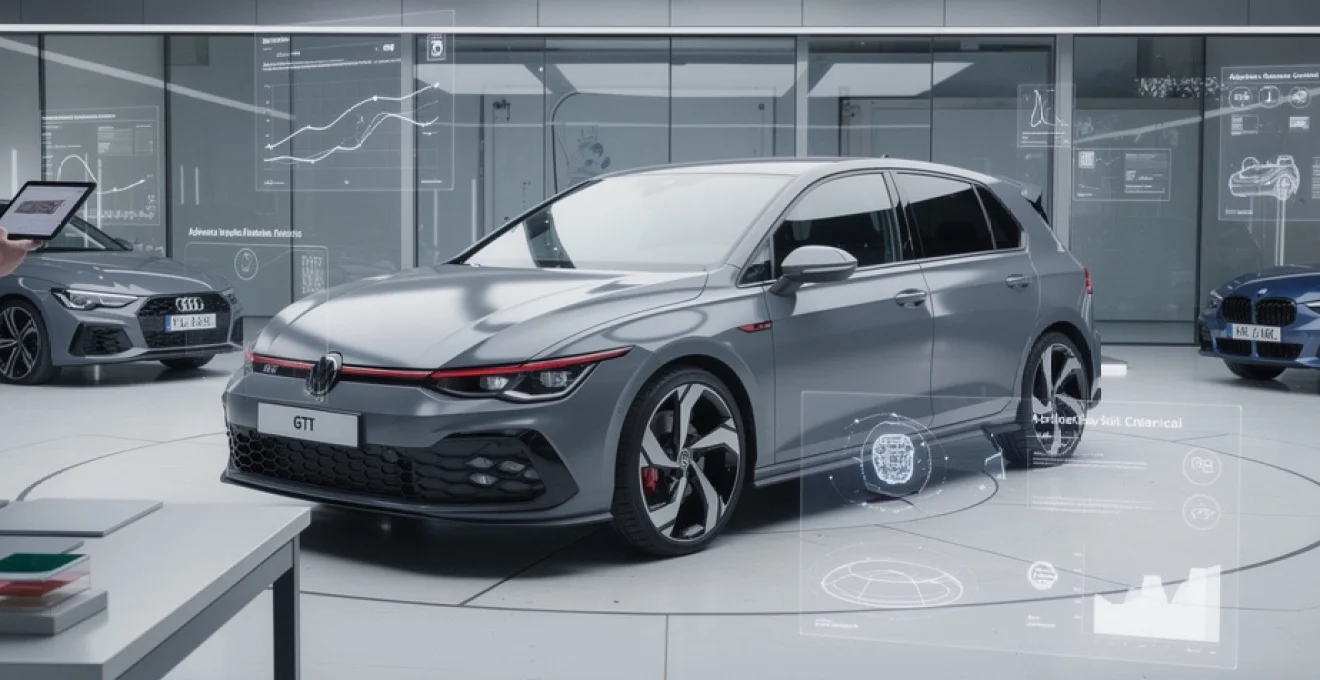
The Nardo grey Golf GTI represents a fascinating intersection of automotive heritage and contemporary performance engineering. This distinctive colour finish, originally developed by Audi for their high-performance vehicles, has found its way onto Volkswagen’s iconic hot hatch, creating one of the most visually striking and technically sophisticated variants in the Golf GTI lineup. The combination transforms the already impressive Mk8 Golf GTI into a statement piece that bridges the gap between understated elegance and aggressive performance aesthetics.
Beyond its visual appeal, the Nardo grey finish embodies advanced paint technology that requires precise application techniques and quality control standards. When paired with the Golf GTI’s refined engineering, particularly in models like the Edition 50 with its enhanced 325 PS power output, this colour option elevates the vehicle’s market positioning significantly. The metallic grey hue creates a sophisticated contrast against the GTI’s signature red brake callipers and honeycomb grille detailing, resulting in a vehicle that commands attention while maintaining the understated confidence that defines premium European automotive design.
Nardo grey paint technology and volkswagen’s exclusive colour development
Audi’s original nardo grey formula and licensing to volkswagen group
The origins of Nardo grey trace back to Audi’s collaboration with the Nardo test facility in Italy, where high-speed vehicle testing demanded a colour that would remain visually consistent under various lighting conditions. Audi’s paint engineers developed this specific shade to provide optimal visibility during high-speed runs whilst maintaining aesthetic appeal for production vehicles. The formulation required extensive research into pigment stability and light reflection properties, resulting in a colour that appears different depending on ambient lighting conditions yet maintains its fundamental character.
Within the Volkswagen Group structure, paint technologies developed by one brand often become available across the entire portfolio through internal licensing agreements. This collaborative approach allows Volkswagen to offer premium colour options like Nardo grey on the Golf GTI without developing entirely new formulations. The transfer process involves adapting the original Audi specifications to suit Volkswagen’s production facilities and quality standards, ensuring consistency across different manufacturing locations whilst maintaining the colour’s distinctive properties.
Paint composition analysis: metallic particles and UV-Resistant coating properties
The Nardo grey finish incorporates a sophisticated blend of aluminium flake particles suspended within a polyurethane base coat system. These metallic particles measure between 10-15 microns in diameter and are precisely oriented during the application process to achieve optimal light reflection characteristics. The particle density remains consistent at approximately 8-12% by volume, creating the signature depth and lustre that distinguishes Nardo grey from standard metallic finishes.
UV protection forms a critical component of the paint system, utilising advanced benzotriazole and hindered amine light stabiliser compounds. These additives prevent colour degradation and maintain the paint’s original appearance for extended periods, even under intense sunlight exposure. The clear coat layer incorporates additional ceramic nanoparticles that enhance scratch resistance whilst providing superior chemical resistance against environmental contaminants such as bird droppings, tree sap, and industrial fallout.
Application process: Three-Stage paint system and quality control standards
Volkswagen’s paint application process for Nardo grey follows a rigorous three-stage system that begins with electrophoretic primer application. The Golf GTI body shells undergo thorough preparation, including phosphate treatment and cathodic electrocoat priming, creating an optimal foundation for paint adhesion. Environmental conditions within the paint booth must maintain strict parameters: temperature between 20-25°C, humidity levels below 65%, and air filtration to Class 1000 cleanroom standards.
The base coat application utilises robotic spray systems programmed with specific parameters for Nardo grey, including spray gun pressure settings, fluid flow rates, and booth ventilation patterns. Each vehicle receives multiple thin coats rather than single heavy applications, allowing proper metallic particle orientation and preventing colour variation. Quality control inspectors examine each painted surface under standardised lighting conditions, measuring colour accuracy using spectrophotometric equipment calibrated to Volkswagen’s internal colour standards.
Colour code LB7Z and paint thickness specifications
The official Volkswagen colour code for Nardo grey is LB7Z
and it is typically paired with a total paint thickness of 110-140 microns across the body panels. This specification combines approximately 20-30 microns of electrocoat primer, 25-35 microns of base coat, and 50-70 microns of clear coat. Thickness is measured at multiple reference points using non-destructive eddy current gauges, ensuring consistent coverage on critical areas such as door edges, bonnet surfaces, and roof panels. For owners, this consistent paint thickness not only improves long-term durability but also makes future paint correction and detailing processes more predictable and safer.
From a practical standpoint, knowing the LB7Z code is invaluable if you ever need touch-up paint or panel refinishing on your Nardo grey Golf GTI. Professional body shops can use the code as a baseline, then fine-tune the mix using spectrophotometric readings to match ageing or minor variation caused by environmental exposure. This attention to detail helps preserve the car’s factory appearance, which is particularly important for buyers who see the Nardo grey Golf GTI as a potential collector’s piece or long-term keeper.
Mk8 golf GTI performance engineering and nardo grey integration
EA888 2.0 TSI engine specifications and power output characteristics
Under the bonnet, the Nardo grey Golf GTI is powered by the latest evolution of Volkswagen’s EA888 2.0 TSI engine, a unit renowned for its balance of efficiency and performance. In standard Mk8 GTI form, this turbocharged four-cylinder delivers around 245 PS and 370 Nm of torque, while special editions such as the Golf GTI Edition 50 push output up to 325 PS. The engine uses a combination of high-pressure direct injection, variable valve timing, and an integrated exhaust manifold to deliver strong mid-range torque and rapid throttle response. For everyday driving, this means you can cruise smoothly at low revs yet access instant power when you need to overtake or join a motorway.
From a technical perspective, the EA888 incorporates a twin-scroll turbocharger that minimises lag by optimising exhaust gas flow to the turbine wheel. Think of it as a finely tuned air pump: the harder you ask it to work, the more efficiently it delivers compressed air to the combustion chambers, provided you stay within its operating sweet spot. The compression ratio, typically around 9.3:1 in higher-output versions, strikes a careful balance between power and detonation resistance when using premium unleaded fuel. For owners of a Nardo grey Golf GTI, this engine setup provides a compelling mix of day-to-day usability and track-capable performance that visually matches the purposeful look of the paint.
One aspect often overlooked is how the engine’s calibration complements the car’s aesthetic character. In Sport mode, throttle mapping, boost pressure control, and ignition timing are adjusted to deliver a more aggressive response, which makes the car feel as sharp as it looks. At the same time, eco-oriented modes soften throttle inputs and prioritise fuel efficiency, allowing you to enjoy the distinctive Nardo grey Golf GTI styling without paying a constant penalty at the fuel station. This dual nature is key to the GTI’s appeal: it is as comfortable on a long commute as it is on a twisty B-road.
DCC adaptive chassis control and vehicle dynamics profile
The Mk8 Golf GTI’s DCC (Dynamic Chassis Control) system plays a crucial role in translating its power into controlled, confidence-inspiring performance. Using electronically controlled dampers, DCC continuously adjusts suspension stiffness based on road conditions, driving style, and selected driving mode. Sensors monitor wheel travel, steering angle, yaw rate, and acceleration forces, allowing the system to fine-tune damping rates in milliseconds. In practice, this means your Nardo grey Golf GTI can glide comfortably over rough city streets yet tighten up immediately for enthusiastic driving on country roads.
Vehicle Dynamics Manager, an overarching control system, coordinates DCC with the electronic differential lock (XDS), steering, and stability control systems. If you imagine the car as an orchestra, Vehicle Dynamics Manager is the conductor, ensuring each subsystem plays in harmony to create a stable yet agile driving experience. In a fast corner, for example, it can soften the rear dampers slightly for better grip while applying subtle brake pressure to the inside wheel to reduce understeer. For Nardo grey GTI owners who value a car that feels as precise as it looks, this integrated approach to chassis control is a major part of what makes the package special.
Through the driving profile selector, you can customise how the car behaves, with profiles such as Comfort, Sport, Eco, and Individual. In Individual mode, DCC settings can be adjusted across a broad spectrum, allowing you to fine-tune ride stiffness independently of drivetrain response or steering weight. This level of control turns the Nardo grey Golf GTI into a genuinely versatile tool: one minute it is a comfortable daily driver, the next it transforms into a sharp, track-ready hatchback. The visual drama of the Nardo grey paint only reinforces this dual nature, hinting at the hidden depth of engineering beneath the surface.
Brake-by-wire technology and performance brake package compatibility
The Mk8 Golf GTI introduces brake-by-wire technology, where an electronic control unit mediates the connection between the brake pedal and the hydraulic braking system. Rather than relying solely on mechanical linkages, sensors measure pedal travel and pressure, then translate these inputs into hydraulic pressure via an electric pump and control valves. This approach allows for more precise modulation of braking force and seamless integration with driver-assistance systems such as adaptive cruise control and autonomous emergency braking. For you as the driver, the result is a consistent, reassuring pedal feel, whether you are navigating city traffic or pushing hard on a circuit.
Brake-by-wire also simplifies the integration of performance brake packages for higher-output variants like the Golf GTI Edition 50. Larger diameter discs, multi-piston calipers, and upgraded pad materials can be fitted while maintaining a consistent pedal response through software calibration. Picture it as adjusting the sensitivity of a high-end gaming controller: the underlying hardware becomes more capable, but the user experience remains intuitive and predictable. For a Nardo grey Golf GTI, pairing the dramatic aesthetics with an uprated brake system ensures that stopping performance matches the engine’s strong acceleration.
An additional benefit of brake-by-wire is its contribution to energy efficiency and stability control. Because the system can modulate braking force at each wheel with high precision, it enhances the effectiveness of traction control and torque vectoring functions, particularly in challenging conditions. In wet or cold weather, where grip is reduced, the car can apply subtle corrections long before you sense instability through the steering wheel. This enhances confidence when driving a powerful, visually assertive car like the Nardo grey Golf GTI, where expectations of performance and safety are understandably high.
Limited slip differential calibration for enhanced traction management
To put its power down effectively, the Mk8 Golf GTI uses an electronically controlled limited slip differential (often referred to as VAQ in Volkswagen terminology). Unlike traditional mechanical LSDs that rely purely on clutch plates and ramp angles, this system uses a multi-plate clutch pack actuated by an electric motor and hydraulic pump. The control unit can actively vary the locking effect between the front wheels, sending more torque to the wheel with greater grip. On a dry road, this allows you to accelerate out of tight corners with confidence, while on a damp surface it greatly reduces inside-wheel spin.
The calibration of the limited slip differential is closely integrated with the Vehicle Dynamics Manager and the selected driving profile. In Comfort or Eco modes, the system intervenes gently, prioritising stability and smoothness over outright cornering speed. Switch to Sport or a more aggressive Individual setup, and the calibration allows higher slip angles and more proactive torque transfer, giving the car a more dynamic, playful character. For many enthusiasts, this is where the Nardo grey Golf GTI truly comes alive, as the chassis lets you explore the limits of front-wheel-drive traction without feeling nervous or unpredictable.
On a technical level, the LSD can apply up to several hundred newton-metres of locking torque across the front axle, effectively simulating the behaviour of a more complex all-wheel-drive setup in many real-world scenarios. This is particularly valuable on twisty roads or when exiting roundabouts under power, where traditional hot hatches may struggle to maintain clean, controlled acceleration. When your car wears the bold yet minimalist Nardo grey finish, this hidden layer of sophistication gives you more confidence to exploit the GTI’s performance, knowing that the electronics are working in the background to manage traction intelligently.
Market positioning against audi RS3 nardo grey and BMW M performance models
In the broader performance car landscape, the Nardo grey Golf GTI finds itself positioned between premium hot hatches and entry-level performance saloons. Audi’s RS3, often seen in Nardo grey as well, delivers significantly more power with its five-cylinder engine and quattro all-wheel drive, but it also commands a substantially higher price point. BMW’s M Performance models, such as the M135i or M240i, similarly offer compelling performance and prestige, yet they move into a different cost bracket and often incur higher running expenses. This creates a niche where the Nardo grey Golf GTI can stand out as a more accessible yet still highly desirable option.
From a visual standpoint, the shared Nardo grey colour creates an interesting parity between the Golf GTI and more expensive models like the RS3. To a casual observer, a well-specified Nardo grey GTI with larger alloy wheels and performance styling packs can appear every bit as purposeful as its premium siblings. You benefit from the aesthetic language of high-end performance cars without the same financial commitment, making the Nardo grey GTI particularly attractive to buyers who value image and engineering but remain cost-conscious. In many urban environments, this visual equality is as important as the underlying performance figures.
When comparing driving dynamics, the Nardo grey Golf GTI offers a unique front-wheel-drive character that contrasts with the all-wheel-drive bias of many Audi RS and BMW xDrive models. Some enthusiasts prefer the more interactive, throttle-adjustable behaviour of a powerful front-driver with a sophisticated limited slip differential, especially on tight roads where outright power is less important than balance and feedback. The GTI’s lighter front end can feel more eager to change direction, giving the car a playful personality that aligns well with its hot hatch heritage. For buyers cross-shopping between Nardo grey performance models, these subtleties in driving feel can be decisive.
Financially, the Golf GTI generally offers lower insurance costs, more favourable fuel consumption, and reduced maintenance expenses compared to many RS and M Performance cars. Over a typical three- to five-year ownership period, total cost of ownership becomes a significant factor, particularly if you use the car as a daily driver. This is where the Nardo grey GTI shines: it delivers a premium look with strong performance, yet remains relatively practical to own. In markets where taxation is linked to emissions or engine size, the 2.0 TSI powertrain can also offer advantages over larger or more powerful units used by German rivals.
Production numbers and configurator availability across european markets
Unlike some limited-run paint finishes that are restricted to specific models, Nardo grey availability for the Golf GTI can vary significantly by market and model year. In certain European countries, the colour is offered as a paid premium option through the standard configurator, while in others it may be tied to special editions such as the Golf GTI Edition 50 or Black Edition trims. This fragmented approach contributes to a perception of rarity, particularly in regions where the majority of GTIs are ordered in traditional shades like Pure White, Deep Black, or Tornado Red. When you spot a Nardo grey Golf GTI in the wild, it often stands out precisely because so few have been configured in that way.
Exact production numbers for specific colours are rarely published by manufacturers, but industry analysts and enthusiast communities often estimate relative rarity based on registration data and dealer allocation. In some Western European markets, anecdotal data suggests that grey and silver tones collectively account for over 25-30% of new car registrations, yet highly specific shades like Nardo grey represent only a small fraction of that total. This means that a Nardo grey Mk8 Golf GTI is likely to be less common than more traditional finishes, adding an extra layer of desirability. For buyers who want a car that feels a little more bespoke without venturing into custom or aftermarket resprays, this can be a compelling reason to choose the colour.
The online configurators used across Europe also influence how many Nardo grey Golfs are ultimately built. If a colour is prominently showcased in marketing material or appears in default press imagery, more buyers are likely to select it. Conversely, if it is buried deep within option menus, take-up can be surprisingly low. In the case of the Nardo grey Golf GTI, the colour is often highlighted in promotional content for special editions, but may not be default for mainstream trims. As a result, we tend to see concentrations of Nardo grey cars in regions where dealers actively promote the option or where enthusiast buyers are more aware of its significance.
Another factor is lead time and allocation. Some dealers receive limited slots for cars with certain premium paint finishes, particularly if those finishes require additional production steps or longer paint booth cycles. If you are ordering a Nardo grey Golf GTI, it is worth asking about production scheduling and potential delays, especially during peak order periods. While the wait can be slightly longer than for a standard colour, many owners feel the exclusive look and potential long-term value of a Nardo grey specification more than justify the extra time.
Resale value analysis and collector car potential assessment
When considering the long-term appeal of a Nardo grey Golf GTI, resale value is a key factor. Historically, limited or highly desirable colours have tended to support stronger residual values, particularly when paired with popular performance trims. Data from used car marketplaces often shows that well-specified GTIs in sought-after finishes command a price premium of several percent over more common colours, provided condition and mileage are comparable. Nardo grey, with its strong association to high-end Audi RS models and special edition Volkswagens, is increasingly recognised as one of those “desirable” choices by informed buyers.
Why does colour matter so much when it is time to sell? For many used buyers, a car like the Golf GTI is as much an emotional purchase as it is a rational one. The right colour can make a listing stand out in crowded search results, generating more enquiries and reducing time on the market. A Nardo grey Golf GTI photographs particularly well, its flat yet subtly metallic surface highlighting the car’s sharp body lines in both natural and artificial light. This visual advantage often translates directly into stronger interest and, ultimately, firmer pricing when negotiating with potential buyers.
In terms of collector potential, special edition variants such as the Golf GTI Edition 50 in Nardo grey are the ones most likely to attract attention in the long run. Collectors typically seek combinations of limited production, distinctive specification, and strong historical significance. If the Edition 50 models are produced in relatively low numbers and a meaningful portion of them are finished in Nardo grey, these cars could become particularly appealing on the enthusiast market in 10 to 20 years’ time. The association between the colour and milestone models within the GTI lineage will play an important role here, much like iconic hues have done for classic 911s or BMW M cars.
That said, not every Nardo grey Golf GTI is guaranteed to become a high-value collectible. Condition, service history, originality, and mileage will always be critical. Owners who are thinking about long-term value should prioritise proper maintenance, use high-quality detailing products to protect the advanced paint system, and avoid irreversible modifications that might deter future buyers. Regular paint inspections, occasional professional correction, and the use of ceramic coatings can help preserve the factory finish, ensuring that the Nardo grey retains its distinctive depth and gloss.
For most buyers, the true appeal of a Nardo grey Golf GTI lies in its ability to combine everyday usability with a sense of exclusivity and future-proof desirability. You are not just choosing a trending shade; you are investing in a specification that aligns with the car’s engineering depth and performance credentials. Whether you plan to keep the car for three years or fifteen, the combination of advanced paint technology, strong mechanical fundamentals, and relative colour rarity gives the Nardo grey Golf GTI an advantage that goes beyond first impressions. In a market where individuality and long-term value increasingly matter, that makes it a particularly smart and satisfying choice.