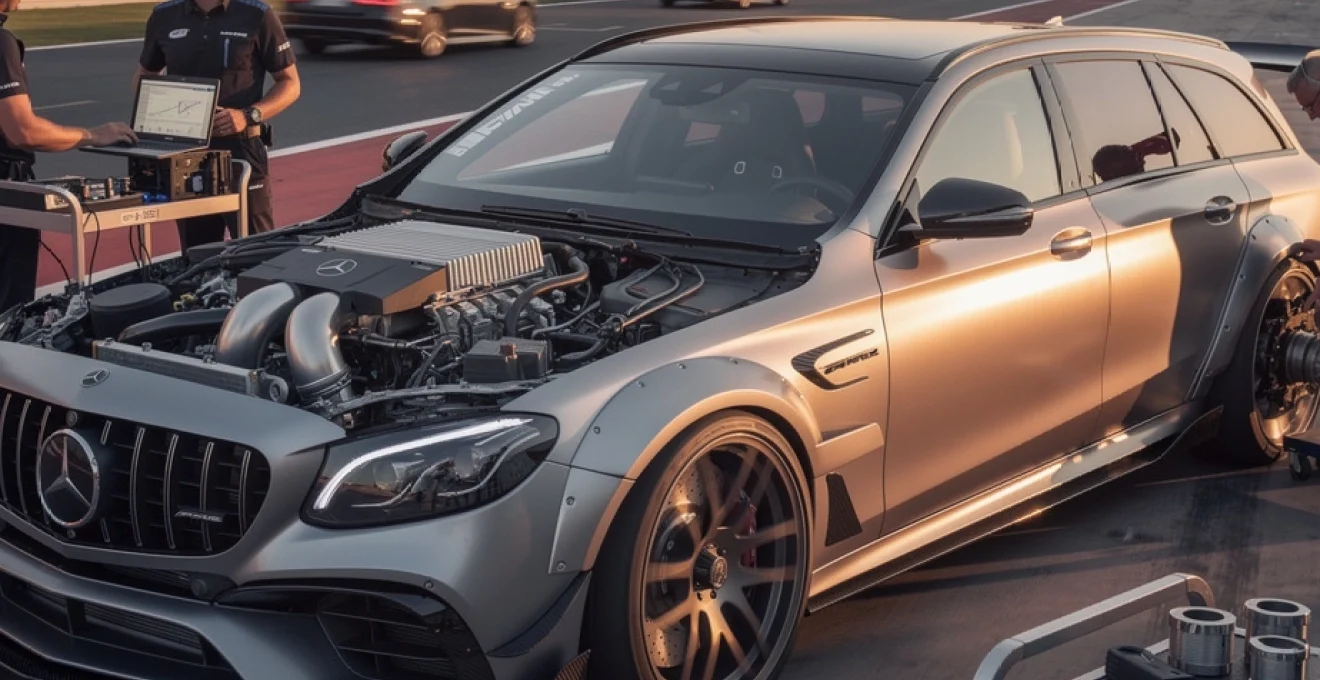
The automotive world has witnessed an extraordinary transformation when a dedicated enthusiast took a 2017 Mercedes-AMG E63S Estate and elevated it beyond factory specifications to deliver over 1000 brake horsepower. This remarkable achievement represents the pinnacle of performance engineering, combining meticulous craftsmanship with cutting-edge technology to create what many consider the ultimate sleeper estate. The project demonstrates how modern tuning capabilities can transform an already formidable performance car into something truly exceptional, maintaining the sophisticated character Mercedes-Benz is renowned for whilst delivering hypercar-level acceleration and power delivery.
This particular build showcases the incredible potential hidden within Mercedes-AMG’s M177 engine architecture, proving that with careful planning and expert execution, extraordinary power figures can be achieved without compromising reliability or daily usability. The transformation required extensive modifications across every major system, from engine internals to transmission reinforcement, all whilst preserving the vehicle’s refined character and practical estate functionality.
Mercedes-amg E63S estate power unit architecture and engine modifications
M177 4.0-litre V8 biturbo engine foundation analysis
The foundation for this extraordinary build begins with Mercedes-AMG’s M177 4.0-litre biturbo V8 engine, which from the factory produces 612 brake horsepower in E63S specification. This hand-built powerplant features a hot-vee turbocharger configuration, where both turbochargers sit within the engine’s valley, creating an exceptionally compact and thermally efficient design. The closed-deck aluminium block construction provides the structural integrity necessary for significant power increases, whilst the forged crankshaft and robust bottom-end components offer a solid foundation for extreme modifications.
The engine’s sophisticated cylinder deactivation system remains functional even after extensive modifications, allowing the vehicle to achieve respectable fuel economy figures of 25-32 mpg during normal driving conditions. This remarkable engineering achievement demonstrates how modern performance modifications can enhance power output whilst preserving practical daily-use characteristics that make the E63S Estate such an appealing proposition for enthusiasts seeking both performance and practicality.
Stage 3 turbocharger upgrade specifications for 1000 BHP output
Achieving the target power output of over 1000 brake horsepower required comprehensive turbocharger upgrades beyond the factory specification. The original turbochargers, whilst impressive in their own right, simply cannot flow sufficient air to support such extreme power levels. The upgrade package includes larger compressor wheels, modified turbine housings, and enhanced bearing systems capable of withstanding the increased thermal and mechanical stresses associated with extreme performance applications.
The turbocharger modifications work in conjunction with upgraded intercooler systems and revised boost control strategies to maintain optimal charge air temperatures even under sustained high-performance driving conditions. These precision-engineered components ensure that the massive power increase doesn’t come at the expense of reliability or engine longevity, provided proper maintenance protocols are observed.
ECU remapping and bosch MED17.7.5 tuning parameters
The heart of any successful engine modification lies in the calibration of the engine control unit, and this build utilises advanced tuning of the Bosch MED17.7.5 system to manage the dramatically increased power output. The ECU remapping process involves recalibrating fuel injection timing, ignition advance curves, boost pressure maps, and torque management strategies to accommodate the enhanced hardware whilst maintaining safe operating parameters across all driving conditions.
Sophisticated torque management algorithms ensure that power delivery remains progressive and controllable, preventing wheelspin and maintaining traction even under full acceleration. The cold-start protection protocols have been enhanced, raising the temperature threshold to 60°C before allowing full torque delivery, protecting critical engine components during warm-up phases when tolerances are tightest and oil viscosity is highest.
Forged internals integration: pistons, rods, and crankshaft modifications
Supporting such extreme power levels requires comprehensive internal engine modifications, including forged pistons, connecting rods, and crankshaft upgrades. These race-specification components</em
are engineered to handle significantly higher cylinder pressures and rotational loads than the OEM equivalents. Forged pistons with revised crown geometry optimise combustion under elevated boost pressures, while reinforced connecting rods reduce the risk of bending or failure during high-load events such as launch control starts or sustained high-speed runs. The crankshaft is micro-polished and dynamically balanced to minimise vibration at high RPM, ensuring smooth power delivery and reducing stress on the main bearings.
Clearances within the M177 engine are carefully adjusted to account for thermal expansion under prolonged high-temperature operation, a crucial factor when targeting reliable 1000 bhp performance. In addition, upgraded fasteners, including high-tensile head studs and main bearing bolts, help maintain clamping force and prevent head lift under extreme combustion pressures. Together, these forged internals form a robust foundation that allows the Mercedes E63S Estate 1000 bhp build to deliver repeatable, reliable performance both on the road and at the circuit.
Fuel system upgrades: high-flow injectors and pump configuration
Delivering sufficient fuel to support over 1000 bhp requires an extensive reworking of the factory fuel system. High-flow direct injectors replace the OEM units, providing the increased fuel mass required for safe combustion at elevated boost levels, while maintaining precise atomisation for efficient burn characteristics. These injectors are paired with uprated high-pressure fuel pumps capable of sustaining the required rail pressure under continuous wide-open-throttle conditions.
On the low-pressure side, the system often incorporates an upgraded in-tank pump or twin-pump configuration, combined with larger-diameter fuel lines and a performance fuel filter to minimise restriction. The Bosch MED17.7.5 ECU is recalibrated to manage the revised injector scaling, fuel pressure targets, and compensation maps, ensuring consistent air-fuel ratios across the full operating range. For owners considering similar Mercedes E63S Estate 1000 bhp conversions, maintaining a safety margin in fuel system capacity is essential to avoid lean conditions that could compromise engine longevity.
Performance transmission and drivetrain engineering solutions
AMG speedshift MCT 9G-Tronic gearbox reinforcement requirements
The AMG Speedshift MCT 9G-Tronic transmission is renowned for its robustness, yet coping with 1000 bhp and immense torque demands more than stock capability. In this build, the gearbox benefits from regular oil changes at 12-month intervals and detailed adaptation resets, ensuring the clutch packs and control systems operate at peak efficiency. While the hardware remains largely OEM, torque is carefully managed through ECU and TCU calibration to keep load within the safe operating envelope of the internal clutches and gearsets.
Reinforcement at this level is less about heavy mechanical modification and more about intelligent torque delivery. By shaping the torque curve and limiting peak torque in lower gears, the calibration protects the transmission during high-traction launches and aggressive shifts. Cold protection strategies, such as allowing full torque only once transmission oil has reached optimal temperature, further contribute to long-term reliability. For drivers pushing a Mercedes E63S Estate 1000 bhp build, this balance between outright performance and component preservation is critical.
4MATIC+ all-wheel drive system torque distribution optimisation
The 4MATIC+ all-wheel drive system is a key enabler for exploiting 1000 bhp on real-world roads. From the factory, this fully variable system can shift torque from predominantly rear-biased to fully locked all-wheel drive, but at elevated power levels, calibration becomes even more crucial. By carefully adjusting the torque distribution maps, engineers can ensure that the system delivers strong traction off the line while preserving the playful, rear-led character that makes the E63S so engaging.
In high-power mode, more torque is routed to the rear axle under steady-state acceleration, with the front axle stepping in progressively as slip is detected. This approach avoids the “point-and-squirt” feeling often associated with heavy all-wheel-drive performance cars, keeping the car agile and adjustable on throttle. When you consider how much force a Mercedes E63S Estate 1000 bhp build is sending to the tyres, optimising 4MATIC+ becomes less a luxury and more an absolute necessity for both performance and safety.
Limited-slip differential calibration for 1000 BHP power delivery
At the rear axle, the electronically controlled limited-slip differential plays a vital role in putting down 1000 bhp without simply boiling the tyres. The calibration of preload, lock-up rate, and response time is refined to match the aggressive torque curve delivered by the tuned M177. Under heavy acceleration out of slower corners, the diff locks more assertively to transfer power evenly to both rear wheels, maximising traction and stability.
However, the tuning is not simply about maximum lock at all times. In higher-speed, flowing corners, the differential strategy allows a degree of slip to prevent understeer and maintain the car’s balance. Think of it as a dynamic mediator between brute force and finesse: too much lock and the car pushes wide; too little and one wheel spins uselessly. For a Mercedes E63S Estate 1000 bhp configuration, this fine-tuning of the rear differential is one of the key reasons the car remains usable and confidence-inspiring on both wet and dry tarmac.
Driveshaft and CV joint strength analysis for estate configuration
Transmitting four-figure power levels through the drivetrain inevitably raises questions about driveshaft and CV joint durability, especially in an estate body that may also be tasked with heavy loads. The E63S Estate benefits from factory components designed to handle substantial torque, but at 1000 bhp, the margin for error narrows. Stress analysis shows that repeated high-load launches are the most demanding scenarios, with torsional loads peaking as the tyres bite into the asphalt.
In this build, the front differential has been upgraded with stronger internals, and careful tuning ensures that violent torque spikes are avoided through refined launch control and traction management. Regular inspection of CV boots, joints, and propshaft couplings is recommended, particularly for owners who frequently exploit the car’s full acceleration potential. With this proactive approach, the estate configuration can reliably channel 1000 bhp without turning the underbody into a weak link.
Chassis dynamics and suspension calibration for extreme power
Harnessing 1000 bhp in a family-sized estate requires more than straight-line brilliance; it demands a chassis that feels composed, communicative, and predictable. The E63S Estate’s adaptive air suspension and electronically controlled dampers provide an excellent baseline, but calibration is everything at this level. In Comfort mode, the car remains impressively civilised, retaining the ability to cover long motorway distances with the kind of refinement you expect from a high-end Mercedes estate.
Switch into the sportier settings, and the damping firms up, roll control improves, and the car adopts a more aggressive stance, ideal for fast road or circuit driving. While the E63S is a heavy vehicle, careful tuning of spring rates, damper curves, and anti-roll bar stiffness allows it to respond more like a large sports saloon than a traditional wagon. You might expect a Mercedes E63S Estate 1000 bhp build to feel unruly, but when chassis setup is executed correctly, the result is more “scalpel” than “sledgehammer.”
Of course, there are limits imposed by physics. At sustained track pace, for example, the brakes are more likely to fade before the suspension or cooling systems reach critical levels, highlighting the need for a holistic approach to performance upgrades. For owners planning regular track use, complementary enhancements such as performance alignment, slightly more aggressive camber settings, and track-focused tyres can further unlock the chassis’ potential without sacrificing the car’s dual-use character.
Aerodynamic package and cooling system integration
At autobahn speeds or during extended circuit sessions, aerodynamic stability and thermal management become vital, particularly in a Mercedes E63S Estate 1000 bhp application. The factory bodywork offers a good balance of drag and downforce, but additional airflow management around the front bumper, underbody, and rear diffuser area can improve stability and cooling. Subtle enhancements, rather than extreme wings or splitters, help preserve the sleeper aesthetic while adding functional benefits.
The cooling system sees more substantial changes. Larger-capacity intercoolers, improved charge-cooler radiators, and upgraded engine oil and transmission coolers work together to keep fluid temperatures within safe limits. High-output builds generate immense heat, and without adequate dissipation, performance will quickly be curtailed by protective ECU strategies. Think of the cooling system as the car’s cardiovascular network: if it cannot move heat efficiently, the “muscle” of a 1000 bhp V8 will soon be forced to slow down.
Additional ducting and carefully positioned vents help channel air where it is needed most, while maintaining low noise levels and everyday usability. This is particularly important for an estate that might be used for family duties during the week and high-speed runs at the weekend. The genius of this E63S Estate build lies in how unobtrusively these aerodynamic and cooling upgrades are integrated; from a distance, it still looks like a well-specified AMG wagon, yet it performs like a fully fledged supercar.
Real-world performance metrics and track testing results
Acceleration benchmarks: 0-60 mph and quarter-mile performance data
When you combine more than 1000 bhp with a sophisticated 4MATIC+ system and finely tuned launch control, the resulting acceleration figures are nothing short of staggering. While a stock E63S Estate is already capable of 0-60 mph in around 3.3–3.5 seconds, this build pushes that window closer to the low three-second mark, depending on surface conditions and tyre choice. On prepped surfaces with optimal traction, sub-3.0-second sprints are achievable, placing this estate firmly in hypercar territory.
Quarter-mile times tell an equally compelling story. Well-executed runs can dip into the high 9-second to low 10-second range, with trap speeds in excess of 140 mph, assuming conditions and driver technique are favourable. To put that into perspective, you are looking at a full-sized, practical Mercedes wagon outpacing many dedicated supercars over the standard drag-strip distance. For enthusiasts evaluating a Mercedes E63S Estate 1000 bhp conversion, this level of straight-line performance is one of the most tangible and addictive rewards.
Nürburgring nordschleife lap time projections and sector analysis
Although this specific build has not been officially timed around the Nürburgring Nordschleife, we can make informed projections based on comparable vehicles and performance metrics. A stock Mercedes-AMG E63S has demonstrated lap times in the low 7:50s to 8:00-minute range in independent tests, depending on conditions and driver skill. With 1000 bhp, enhanced cooling, and optimised chassis settings, a well-driven example could realistically target a lap time in the low 7:40s or even better.
The primary gains would be seen on the long straights and high-speed sections such as Döttinger Höhe, where the additional power would deliver significantly higher terminal speeds. However, the car’s extra performance also places higher demands on tyres and brakes, particularly through technical sectors like the Foxhole and the Carousel. As with any high-power build, the limiting factor at the Nordschleife is often not the engine but the balance between grip, stability, and endurance. You may have the power to go faster, but can the chassis and driver fully exploit it for a full lap?
Brake performance requirements: stopping distances from 200 mph
When a car can accelerate with the ferocity of a Mercedes E63S Estate 1000 bhp build, it must also be capable of shedding speed with equal authority. From the factory, the E63S is equipped with powerful multi-piston calipers and large-diameter discs, with optional carbon-ceramic brakes available. At speeds approaching 200 mph, however, kinetic energy increases exponentially, and even these high-performance systems are pushed close to their thermal and mechanical limits.
Stopping distances from such extreme velocities are heavily dependent on tyre grip and surface conditions, but it is reasonable to expect that repeated high-speed stops would necessitate upgraded pad compounds, high-temperature brake fluid, and potentially larger or more robust discs. On track, drivers will likely experience brake fade before engine or cooling issues become a concern, underlining the importance of a balanced upgrade strategy. If you intend to explore the upper reaches of this car’s speed potential, treating the braking system as a core component of the build—not an afterthought—is non-negotiable.
Fuel consumption analysis under full-throttle conditions
One of the most fascinating aspects of this build is how it retains respectable fuel economy during gentle driving, thanks to cylinder deactivation and efficient cruising calibration. In day-to-day use, seeing 25–32 mpg on motorway journeys is entirely realistic, even with the underlying potential of a Mercedes E63S Estate 1000 bhp conversion. However, once you begin to explore the upper end of the rev range and extended full-throttle operation, fuel consumption changes dramatically.
Under hard acceleration and sustained high-speed driving, instantaneous fuel usage can easily drop into single figures, with 5–8 mpg not uncommon. This is simply the cost of feeding a highly boosted 4.0-litre V8 producing more than four figures of power. It’s helpful to think of the fuel tank as a performance “timer”: the harder you drive, the faster it counts down. For owners, the key is understanding and accepting this trade-off—enjoy the hypercar performance when the road and conditions allow, and let the sophisticated electronics deliver efficiency when you are simply cruising.
Market comparison against audi RS6 avant and BMW M5 competition touring
In the world of high-performance estates, the Mercedes-AMG E63S Estate, Audi RS6 Avant, and BMW M5 (and M5 Touring where applicable) form a formidable trio. In standard form, the E63S already stands out for its more expressive character, sharper steering feel, and thunderous V8 soundtrack. When elevated to a 1000 bhp configuration, it takes a decisive step beyond the usual benchmark comparisons, entering a realm where few OEM rivals can truly follow without similarly extensive modification.
The Audi RS6 Avant is often praised for its secure, confidence-inspiring quattro traction and high-quality cabin, but it tends to feel more clinical and less playful than the E63S when driven hard. BMW’s M5, particularly in Competition guise, offers exceptional precision and a slightly more track-focused balance, yet it lacks the estate body practicality that makes the Mercedes such a compelling all-rounder. For drivers who want a car that can comfortably carry family, luggage, and still deliver supercar-shaming performance, a Mercedes E63S Estate 1000 bhp build occupies a very special niche.
From a cost and practicality perspective, it is also worth considering the broader ownership picture. Servicing and consumables on any of these performance estates are far from inexpensive, and pushing power to four-figure levels only amplifies those realities. However, the E63S platform has proven remarkably robust when tuned sensibly, with careful attention to maintenance, warm-up, and cool-down practices. Ultimately, for enthusiasts seeking the ultimate “Jekyll and Hyde” machine—docile and efficient one moment, savage and explosive the next—the Mercedes E63S Estate, properly engineered to 1000 bhp, remains one of the most compelling propositions in the modern performance car landscape.