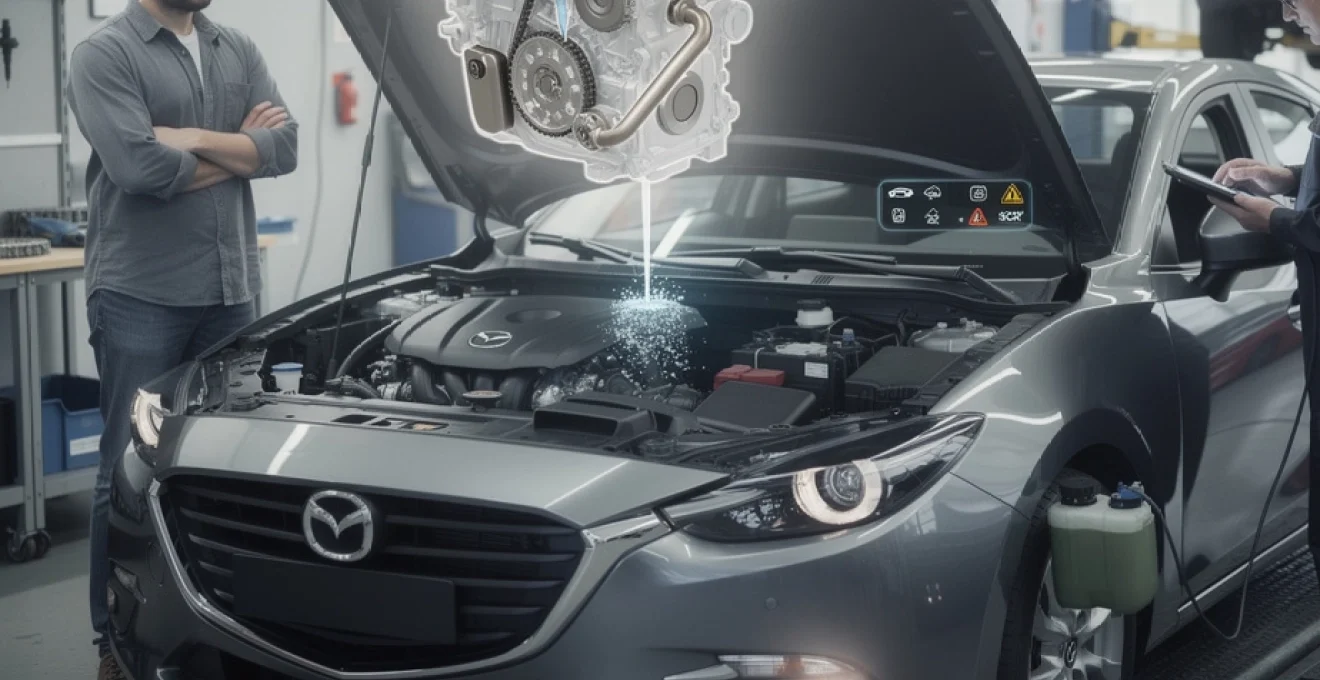
The Mazda 2.2 SkyActiv-D engine represents an ambitious engineering achievement, combining reduced compression ratios with innovative turbocharging technology to deliver impressive fuel efficiency. However, like many modern diesel powerplants subjected to stringent emissions regulations, this engine has developed a reputation for specific reliability concerns that have frustrated owners across Europe and beyond. Understanding these common problems is essential for current owners and prospective buyers alike, particularly as the secondary market becomes increasingly populated with these vehicles approaching higher mileage intervals.
Despite Mazda’s engineering innovations—including the revolutionary 14:1 compression ratio, dual-stage turbocharging, and integrated exhaust manifold design—the 2.2 SkyActiv-D has encountered challenges typical of sophisticated diesel engines operating under real-world conditions. These issues range from diesel particulate filter complications to mechanical wear patterns that weren’t anticipated during the development phase. With production spanning from 2012 onwards across the Mazda 6, CX-5, and other models, a substantial volume of vehicles now exhibit predictable failure patterns that warrant serious consideration.
DPF regeneration failures in mazda 2.2 Skyactiv-D engines
The diesel particulate filter system in the 2.2 SkyActiv-D represents one of the most persistent sources of owner dissatisfaction. This emissions control device traps soot particles from the exhaust stream, requiring periodic regeneration cycles to burn off accumulated deposits. When these regeneration cycles fail to complete properly, a cascade of problems develops that can ultimately result in expensive component replacement and significant downtime.
The fundamental challenge stems from the engine’s design philosophy. While the reduced compression ratio delivers exceptional efficiency and refinement, it also creates conditions where exhaust temperatures remain lower than traditional diesel engines. This characteristic, combined with real-world driving patterns that don’t align with manufacturer assumptions, creates an environment where successful regeneration becomes increasingly difficult as the vehicle ages and accumulates mileage.
Blocked diesel particulate filter symptoms and warning lights
When your DPF begins to reach saturation levels, you’ll typically notice several telltale symptoms before the dashboard warning light illuminates. Many owners report a subtle but progressive loss of power, particularly during acceleration from standstill or when overtaking. The engine may feel sluggish, and fuel consumption often increases noticeably—sometimes by 15-20% compared to normal operation. You might also detect a distinct smell from the exhaust, different from normal diesel odour, indicating incomplete combustion processes.
The dashboard warning system provides graduated alerts as the situation deteriorates. Initially, a DPF warning light may illuminate intermittently, typically during or immediately after short journeys. If ignored, this progresses to a constant warning light, followed by additional alerts including the check engine light and potentially a restrictive message limiting vehicle speed. At advanced stages of blockage, the engine management system may impose limp mode restrictions, limiting power output to protect the engine from damage caused by excessive back pressure in the exhaust system.
Short journey driving patterns causing incomplete DPF cycles
The relationship between driving patterns and DPF health cannot be overstated for the 2.2 SkyActiv-D engine. Regeneration cycles require sustained periods of elevated exhaust temperatures—typically achieved during motorway driving or extended journeys at steady speeds above 50 mph. When you predominantly undertake short urban journeys, the engine simply cannot maintain the 600°C exhaust temperatures needed for approximately 15-20 minutes to complete a successful regeneration cycle.
Statistics from Mazda service centres suggest that vehicles accumulating fewer than 12,000 miles annually, or those used primarily for journeys under 10 miles, experience DPF-related issues at rates three to four times higher than vehicles driven predominantly on longer routes. This pattern creates a self-reinforcing problem: incomplete regenerations leave residual soot in the filter, which increases back pressure, which in turn makes subsequent regeneration attempts even more difficult. Within 30,000-50,000 miles, vehicles subjected to this usage pattern may require forced regeneration procedures or complete DPF replacement.
EGR valve
On the Mazda 2.2 SkyActiv-D, the EGR (exhaust gas recirculation) valve plays a surprisingly central role in both emissions control and DPF health. By feeding a measured quantity of exhaust gas back into the intake, it lowers combustion temperatures and reduces NOx emissions. The downside is that soot, oily vapours, and carbon deposits build up on the EGR valve and associated passages over time, especially on engines that see a lot of short-trip, low-load use. As the EGR valve sticks or the passages narrow, airflow and exhaust temperature profiles change, often in ways that make successful DPF regeneration even less likely.
Typical symptoms of EGR contamination on the 2.2 SkyActiv-D include rough idle, hesitation at low revs, and occasional stalling when coming to a stop. You might also see an illuminated check engine light with stored fault codes related to EGR flow performance, airflow discrepancies, or mixture control. Because the engine management system relies on accurate EGR operation to predict exhaust temperatures, a heavily contaminated EGR system can trigger a vicious circle of incomplete regens, rising soot loading, and eventually a blocked diesel particulate filter. Regular inspection and cleaning of the EGR valve and cooler around the 60,000–80,000 mile mark can significantly reduce the likelihood of DPF problems in these engines.
Forced regeneration procedures and dealer intervention requirements
Once the DPF in a Mazda 2.2 SkyActiv-D reaches a certain saturation threshold—typically around 80–90% soot loading—the engine control unit will usually disable automatic regeneration attempts. At this point, you may see multiple warning lights, reduced engine performance, and, in more severe cases, limp mode activation. When the system has logged an excessive number of failed regens or detected critical back pressure, the only safe way forward is a forced regeneration carried out with dealer-level diagnostic equipment. This process commands the engine to run a specific high-temperature cycle while the vehicle is stationary or driven under controlled conditions.
Forced regeneration procedures are not without risk. Because exhaust gas temperatures can exceed 600–650°C for an extended period, any underlying issues—such as oil consumption, injector imbalance, or small exhaust leaks—may be exacerbated. Dealers will generally perform a pre-check, reading fault codes, measuring differential pressure across the DPF, and verifying oil level and condition before proceeding. If the soot loading is too high or ash accumulation is excessive (often at higher mileages), technicians may recommend DPF removal for specialist cleaning or outright replacement instead. As an owner, it’s vital to treat the first forced regen as a warning sign and to review your driving patterns and maintenance regime to avoid repeat interventions within a short timeframe.
Timing chain stretch and premature wear concerns
While much online discussion around the Mazda 2.2 SkyActiv-D focuses on DPF regeneration, timing chain reliability is another critical area that prospective buyers should investigate. Early versions of this engine, particularly those produced before Mazda’s running revisions around 2015–2016, developed a reputation for timing chain stretch and associated wear on guides and tensioners. Unlike a timing belt, a chain is designed to last the life of the engine under ideal conditions; however, poor oil quality, extended service intervals, and fuel dilution can compromise its longevity.
Symptoms of timing chain issues include rattling noises at cold start, difficulty maintaining accurate cam timing, and, in more advanced cases, fault codes related to camshaft/crankshaft correlation. Left unchecked, severe chain stretch can lead to valve timing drift, loss of performance, poor fuel economy, and even catastrophic mechanical failure if the chain jumps teeth. Because the Mazda 2.2 SkyActiv-D also integrates balance shafts and a sophisticated valve control system, timing integrity is even more vital than on simpler diesel engines. Owners of pre-2016 cars should pay particular attention to chain noise and oil condition, as these are often the first clues that corrective work may be needed.
SH-VPTS variable valve timing system malfunctions
The SH-VPTS (SkyActiv High-Performance Valve Timing System) fitted to certain 2.2 SkyActiv-D variants adds another layer of complexity to the valve train. This system uses variable exhaust valve lift and timing to control internal EGR, improve cold start performance, and optimise combustion over a wide operating range. When everything is in spec, it’s an elegant way to reduce emissions and improve drivability. However, it also means that any timing chain stretch or actuator malfunction can have a more pronounced impact on how the engine runs.
Malfunctions in the SH-VPTS setup may present as rough running during warm-up, misfires at low revs, or intermittent hesitation that’s hard to replicate during a short test drive. The engine control unit monitors camshaft position closely; discrepancies can trigger diagnostic trouble codes such as “camshaft position – timing over-retarded/advanced.” Over time, if the chain has stretched or the phaser mechanisms become gummed up with sludge from oil that’s been diluted by fuel, the system’s adjustment range can be compromised. Addressing these problems usually involves a combination of software updates, oil and filter changes at shorter intervals, and, in more serious cases, mechanical repair to restore correct timing and phaser function.
Rattling noises during cold start diagnostics
One of the most talked-about timing-related symptoms on early 2.2 SkyActiv-D engines is a distinctive rattling or clattering noise during the first few seconds after a cold start. While some diesel clatter is normal, an excessively metallic rattle that quickly fades as oil pressure builds can indicate a slack timing chain or a tired tensioner. Think of the chain like a bicycle chain that’s been left out in the rain—once it stretches and the tensioner reaches the end of its travel, it will slap and rattle until load and lubrication quieten things down.
Diagnosing this correctly is important, because other components—such as the dual-mass flywheel or ancillary belt-driven accessories—can also create noises that mimic chain problems. A competent workshop will typically perform a cold-start listening test, use a mechanic’s stethoscope to localise the sound to the timing cover area, and check for related fault codes. In some cases, Mazda dealers have updated engine software to alter oil pressure management and reduce start-up noise, but persistent or worsening rattles usually warrant a physical inspection. Ignoring clear signs of chain noise on a 2.2 SkyActiv-D can be a false economy, especially given the potential cost of internal engine damage if the chain fails completely.
Chain tensioner failure patterns in pre-2016 models
Chain tensioner design has evolved over the production life of the Mazda 2.2 SkyActiv-D, with earlier engines more prone to premature wear and loss of hydraulic pressure. On pre-2016 models, the tensioner’s ability to maintain correct chain tension could be compromised by sludge, varnish, or aerated oil—conditions often linked to extended oil change intervals or high levels of fuel dilution. Once the tensioner can no longer keep the chain taut, wear accelerates rapidly, much like a loose belt shredding itself faster than one that’s correctly tensioned.
Owners and independent specialists have reported a pattern where tensioner and chain issues show up between 60,000 and 100,000 miles, particularly on vehicles with incomplete service histories. Mazda addressed some of these concerns with revised parts and updated servicing guidance, including a stronger emphasis on oil quality. If you’re considering a used Mazda 6 or CX-5 with the 2.2 SkyActiv-D from this era, verifying whether the timing chain or tensioner has already been replaced can be a valuable bargaining point. Proactive replacement of these components, while not inexpensive, is far cheaper than dealing with the aftermath of timing failure.
Mazda TSB 01-002/18 technical service bulletin analysis
Mazda’s Technical Service Bulletin 01-002/18 (referenced by many dealers and independent garages) addressed several concerns related to timing chain noise, oil dilution, and cold-start performance on SkyActiv-D engines. Although the exact wording of TSBs varies by region, the core message was consistent: certain early engines might exhibit abnormal timing-related noise or performance issues due to chain stretch and oil contamination, and updated parts and calibration strategies were made available. For affected vehicles within warranty, dealers often carried out inspections and, where necessary, replaced chains, tensioners, and related components.
From an owner’s perspective, the existence of such a TSB is a clear signal that Mazda acknowledged recurring issues in real-world use. If you have a service history for your car, check whether any work referencing this bulletin—or similar timing-chain-related campaigns—has been completed. For cars outside the original warranty window, dealers may still be able to consult internal records and advise whether your VIN falls within the affected range. When negotiating on a used Mazda 2.2 SkyActiv-D, being able to discuss TSB 01-002/18 and ask targeted questions can set you apart as an informed buyer and reduce your exposure to unexpected timing chain repair bills.
Adblue system malfunctions and SCR catalyst degradation
Later Euro 6-compliant versions of the Mazda 2.2 SkyActiv-D introduced an SCR (Selective Catalytic Reduction) system using AdBlue to further reduce NOx emissions. While this technology is effective when maintained properly, it adds another layer of complexity and potential failure points. The AdBlue system consists of a tank, pump, injector, NOx sensors, and the SCR catalyst itself—all of which must work in harmony with the engine management system. Malfunctions in any part of this chain can lead to warning lights, reduced performance, and even countdown-to-no-start conditions if emissions limits are not being met.
One challenge is that SCR-related issues don’t always manifest as obvious drivability problems at first. You might receive an “emissions system fault” message or an AdBlue warning on the instrument cluster long before you feel any change in how the engine pulls. However, leaving these warnings unchecked can eventually trigger stricter protective measures, including limp mode and enforced AdBlue refill or system servicing. As with DPF and timing chain concerns, early diagnosis and intervention are key to avoiding more extensive and costly repairs down the line.
Nox sensor failures triggering limp mode conditions
NOx sensors are a critical feedback component in the Mazda 2.2 SkyActiv-D’s SCR system, constantly measuring nitrogen oxide levels upstream and downstream of the catalyst. This allows the ECU to fine-tune AdBlue dosing and ensure compliance with emissions regulations. Unfortunately, NOx sensors are exposed to extreme temperature cycles and harsh exhaust conditions, and failures are relatively common not only on Mazdas but across many modern diesel vehicles. When a sensor fails or drifts out of calibration, the system can no longer verify that NOx emissions are under control.
On the dashboard, a faulty NOx sensor often triggers an engine management light and an AdBlue or emissions warning, sometimes accompanied by a message indicating reduced performance or a mileage countdown to restricted operation. Many owners first notice a loss of power at motorway speeds, as the ECU enters a protective limp mode to prevent potential emissions breaches. Replacement NOx sensors are not cheap, and their location can make labour costs significant. However, replacing them promptly is essential; attempts to ignore or bypass NOx sensor faults can lead to MOT/inspection failures and, in some regions, legal penalties for emissions non-compliance.
Adblue injector crystallisation and blockage prevention
Another common weak point in the AdBlue system is the injector nozzle itself, which meters the urea solution into the exhaust stream. Over time, especially if the system isn’t used regularly or if low-quality AdBlue is employed, crystallised deposits can form around the injector tip and inside the dosing line. Imagine leaving sugar water in a kettle; as the liquid evaporates, crystals form and eventually restrict flow. The same principle applies here, leading to under-dosing, over-dosing, or irregular spray patterns that compromise SCR performance.
Preventing AdBlue injector crystallisation largely comes down to good housekeeping and usage patterns. Always use AdBlue that meets ISO 22241 standards, store it correctly, and avoid running the tank dry, as repeated empty-refill cycles can exacerbate deposit formation. Periodic inspection of the injector and, where necessary, professional cleaning or replacement can restore proper function before more serious SCR faults develop. If you notice repeated AdBlue-related warnings despite having topped up the tank, it’s wise to have the injector and lines checked rather than simply adding more fluid and hoping for the best.
SCR catalyst contamination from oil consumption issues
The SCR catalyst itself is designed to last for many years, but it can be damaged or contaminated by upstream engine problems—particularly those that cause excessive oil consumption or unburned fuel to reach the exhaust. In a Mazda 2.2 SkyActiv-D that’s burning oil (for example, due to worn turbo seals or ring issues), the fine metal coatings on the catalyst substrate can become coated with ash and deposits, reducing its ability to convert NOx effectively. Over time, this can lead to persistent emissions faults even if the AdBlue and NOx sensor systems are functioning correctly.
Once an SCR catalyst has been significantly contaminated, cleaning options are limited and replacement is often the only reliable fix—an expensive proposition. This is why monitoring oil levels and addressing blue smoke or burning smells promptly is so important on these engines. If you’re seeing AdBlue or NOx-related error messages at the same time as signs of oil consumption, it’s worth raising this combination of symptoms with your mechanic. Tackling the root cause of oil ingress early can protect both the DPF and SCR systems, saving you from a chain reaction of costly emissions-component replacements.
Turbocharger actuator and boost pressure irregularities
The 2.2 SkyActiv-D relies on a sophisticated two-stage turbocharger arrangement to deliver strong torque across the rev range. A smaller, high-pressure turbocharger provides quick response at low rpm, while a larger, low-pressure unit takes over at higher engine speeds. To coordinate this handover smoothly, Mazda uses an electronically controlled turbo actuator and a network of vacuum lines and valves. When everything works correctly, you enjoy seamless acceleration and impressive fuel economy. But when actuators or control systems go wrong, the result can be erratic boost, flat spots, and warning lights.
Common symptoms of turbo actuator or boost control issues include hesitation around 1,500–2,000 rpm, sudden loss of power under load, and fault codes related to underboost or overboost conditions. You might feel as if the engine is “holding back” or surging unpredictably, especially when overtaking or climbing hills. In some cases, the actuator’s mechanical linkage can seize or stick due to soot and corrosion, while in others the electronic control module fails. Because these components are closely linked to exhaust back pressure and DPF status, unresolved regeneration problems can accelerate actuator wear. Regular checks of vacuum hoses, boost pipes, and actuator movement, combined with proper DPF maintenance, can help keep the turbo system operating as intended.
Engine oil dilution through fuel contamination
One of the most serious underlying issues affecting Mazda 2.2 SkyActiv-D reliability is engine oil dilution caused by diesel fuel contamination. During active DPF regeneration, extra fuel is injected late in the combustion cycle to raise exhaust gas temperatures. If these regens are interrupted or occur too frequently—common in cars driven mainly on short trips—some of that additional fuel can wash past the piston rings and accumulate in the sump. Over time, the engine oil level can actually rise on the dipstick, but the lubricant itself becomes thinner and less effective, much like adding solvent to motor oil.
Oil dilution has a direct negative impact on critical components such as the timing chain, turbocharger bearings, and crankshaft journals. A diluted oil film cannot provide adequate protection under high loads, leading to accelerated wear, noisy operation, and, in extreme cases, engine failure or runaway conditions where the engine starts to burn its own oil-fuel mixture. Mazda issued several software updates to better manage regeneration frequency and to warn drivers when oil levels become excessive, but owners still need to remain vigilant. Checking oil level regularly and paying attention to any sudden increase—rather than just low levels—can provide an early warning. Adopting shorter oil-change intervals, especially if you mainly drive in urban conditions, is one of the most effective ways to mitigate this risk.
High-pressure fuel pump failures and injector coking
The common-rail injection system on the Mazda 2.2 SkyActiv-D operates at extremely high pressures, enabling precise fuel metering and multiple injections per combustion cycle. The high-pressure fuel pump (HPFP) is the heart of this system, and any degradation can have far-reaching consequences for performance, emissions, and engine longevity. While outright HPFP failures are less common than DPF or timing chain issues, they do occur, particularly on higher-mileage vehicles or those that have seen poor-quality fuel or lax maintenance. Symptoms can include hard starting, uneven idle, reduced power, and a variety of fuel-rail pressure-related fault codes.
Injector coking is another concern that tends to emerge as these engines age. Over time, tiny deposits build up on injector nozzles, disrupting the fine spray pattern that’s essential for clean combustion. The result can be rough running, increased smoke (especially under load), and higher fuel consumption. In severe cases, coked injectors can contribute to localised hot spots in the combustion chamber, raising the risk of piston damage. Regular use of high-quality diesel and, where appropriate, periodic fuel system cleaning treatments can help slow deposit formation. If you notice persistent misfires, uneven idle, or excessive smoke, having the injectors tested and, if needed, refurbished or replaced is an investment that can restore both performance and reliability in your Mazda 2.2 SkyActiv-D.