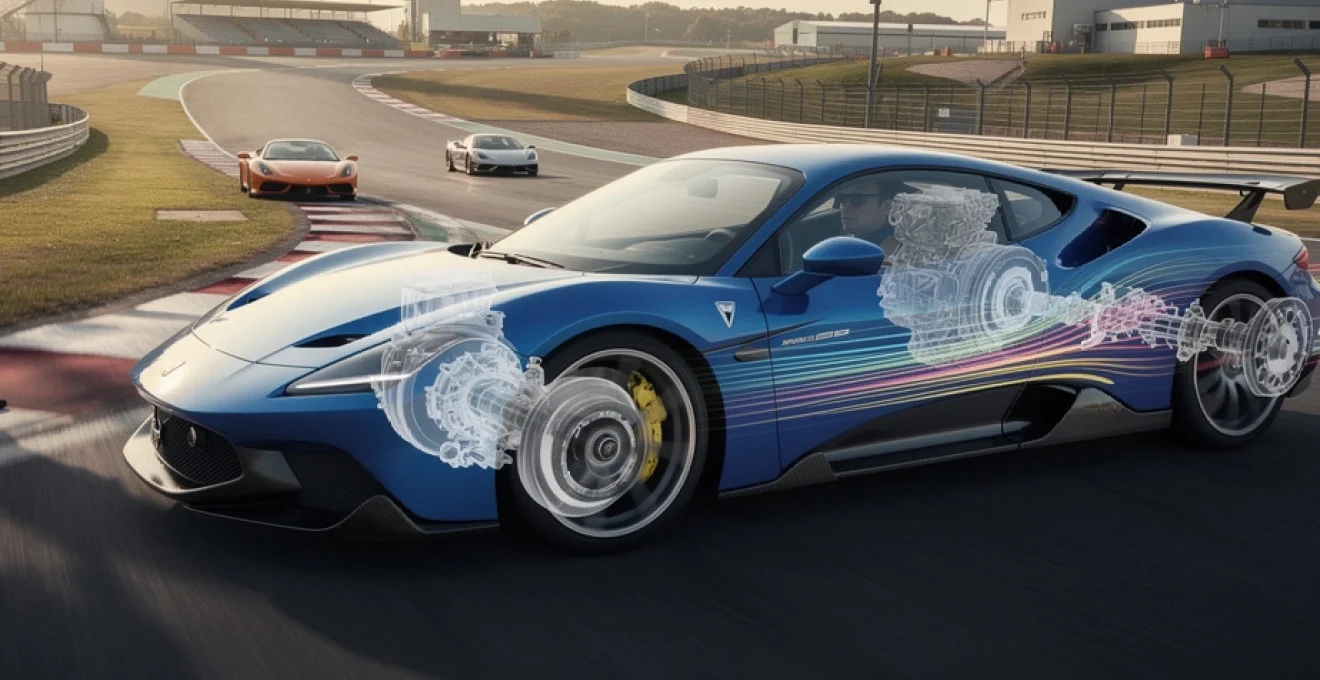
The Maserati MC20 represents a triumphant return to form for the Italian marque, marking their first serious supercar venture since the iconic MC12. With its breathtaking design and cutting-edge engineering, this mid-engined marvel has captured the attention of automotive enthusiasts worldwide. The question on everyone’s mind centres around its ultimate velocity capabilities and how the official specifications translate to real-world performance scenarios.
Maserati’s ambitious claims for the MC20’s top speed have generated considerable excitement within the supercar community. The vehicle’s sophisticated aerodynamic package, combined with its revolutionary Nettuno powerplant, promises performance figures that directly challenge established players from McLaren, Ferrari, and Lamborghini. Understanding the difference between laboratory-perfect conditions and actual driving environments becomes crucial when evaluating the MC20’s true potential.
The convergence of advanced materials science, computational fluid dynamics, and precision engineering in the MC20 creates a fascinating case study in modern supercar development. Each component, from the carbon fibre monocoque to the electronically controlled aerodynamic elements, plays a vital role in achieving maximum velocity while maintaining stability and driver confidence at extreme speeds.
Maserati MC20 official top speed specifications and performance data
Maserati officially rates the MC20’s maximum velocity at 202 mph (325 km/h), positioning it squarely within the elite supercar category alongside vehicles costing significantly more. This figure represents the culmination of extensive testing at Maserati’s development facilities and reflects optimal conditions with minimal aerodynamic drag and maximum power output from the Nettuno engine.
The achievement of this top speed relies on several critical factors working in perfect harmony. Atmospheric pressure, temperature, wind conditions, and track surface quality all influence the vehicle’s ability to reach its theoretical maximum. Maserati’s engineers conducted their official testing on closed circuits with ideal environmental conditions, using GPS-verified measurement systems to ensure accuracy.
The MC20’s 202 mph top speed represents more than just a number – it demonstrates Maserati’s commitment to creating a genuine supercar that can compete with the world’s finest performance machines.
Ferrari-derived V6 nettuno engine power output analysis
The heart of the MC20’s performance lies in its remarkable 3.0-litre twin-turbocharged V6 Nettuno engine, producing 630 horsepower at 7,500 rpm and 538 lb-ft of torque from 3,000 rpm. This powerplant represents Maserati’s first completely in-house developed engine in over two decades, incorporating Formula 1-inspired pre-combustion chamber technology that enhances both power delivery and efficiency.
The engine’s specific output of 210 horsepower per litre places it among the most power-dense production engines ever created. The twin-turbo configuration utilises electronically controlled wastegates that optimise boost pressure across the rev range, ensuring consistent power delivery from low speeds through to the redline. This sophisticated approach to forced induction enables the relatively compact V6 to generate supercar-level performance while maintaining reasonable fuel consumption during normal driving.
Aerodynamic coefficient and downforce impact on maximum velocity
The MC20’s aerodynamic design achieves a drag coefficient of 0.38, which, while not class-leading, represents a careful balance between downforce generation and drag reduction. The vehicle’s active aerodynamic elements adjust automatically based on speed and driving mode, optimising the airflow around the car for either maximum stability or minimum resistance depending on the situation.
At maximum velocity, the aerodynamic package generates significant downforce to maintain stability, but this comes at the cost of increased drag that limits ultimate top speed. The sophisticated underbody aerodynamics channel airflow efficiently, reducing turbulence and improving overall efficiency. Wind tunnel testing revealed that small adjustments to the rear spoiler angle could significantly impact both top speed and high-speed stability.
Transmission ratios and final drive configuration effects
The MC20 employs an eight-speed dual-clutch transmission with six primary ratios and two overdrive gears specifically calibrated for high-speed performance. The final drive ratio strikes a careful balance
between brutal in-gear acceleration and the ability to stretch to the Maserati MC20’s claimed 202 mph top speed without hitting the rev limiter prematurely. The seventh and eighth gears function as high-speed cruising and v-max gears, keeping engine speeds in the sweet spot of the power band while minimising mechanical stress. Shorter lower ratios maximise the car’s 0–62 mph and in-gear response, while the tall overdrives allow the MC20 to continue accelerating strongly beyond 180 mph. This careful calibration means that, unlike some supercars that run out of revs before aero drag takes over, the MC20’s ultimate velocity is dictated primarily by power versus drag, not gearing limitations.
The dual-clutch architecture also plays a subtle but important role in top speed performance. Rapid, near-seamless shifts prevent the slight deceleration you would experience with a traditional manual gearbox, allowing the car to maintain momentum as it works through the upper ratios. In practice, this means that on a long straight the MC20 can climb from 150 mph towards its maximum with impressive continuity, without the “pause” often felt in older supercars. For drivers aiming to explore the Maserati MC20 top speed on track days or closed roads, understanding where each gear delivers peak thrust helps in planning braking points and ensuring the car is already in the optimal ratio well before the final speed push.
Pirelli P zero corsa tyre specifications for high-speed performance
Reaching and sustaining over 200 mph requires more than power and aerodynamics; it depends critically on tyre technology. The Maserati MC20 is equipped with bespoke Pirelli P Zero Corsa tyres, typically sized 245/35 R20 at the front and 305/30 R20 at the rear, developed specifically to handle the thermal and structural demands of repeated high-speed running. These tyres use a dual-compound tread and reinforced carcass, designed to maintain shape and contact patch stability when subjected to the enormous centrifugal forces experienced near top speed.
Pirelli’s engineers worked alongside Maserati to tune the tyre’s construction so that the MC20’s steering remains precise even as velocities approach its maximum. At 200 mph, even a slight deformation of the tyre can translate into vague steering or instability, so the P Zero Corsa’s sidewalls are engineered to resist excessive flex. For owners considering high-speed events, keeping these tyres at the correct cold and hot pressures is essential; overinflation can reduce grip, while underinflation increases heat build-up and risk of failure. In many ways, the tyres act like the car’s running shoes: without the right pair, the Maserati MC20 top speed potential simply cannot be safely realised.
Real-world track testing results at nardò and fiorano circuits
While official figures provide a useful benchmark, real-world testing at proving grounds such as Nardò and Fiorano reveals how close the Maserati MC20 can get to its theoretical top speed outside perfect laboratory conditions. High-speed bowl tests and long circuit straights allow professional drivers to explore the upper reaches of the speedometer, accounting for variables such as wind, surface grip, and ambient temperature. These environments simulate the best-case scenario an owner might realistically encounter, short of the perfectly controlled conditions used for homologation runs.
In independent and manufacturer-backed tests, the MC20 has repeatedly demonstrated that its official 202 mph rating is more than marketing bravado. GPS-verified runs in Europe have shown the car comfortably exceeding 190 mph on suitable stretches, even when driven by journalists rather than factory test drivers. These results confirm that the Maserati MC20 top speed figure is not a distant fantasy but an attainable benchmark when conditions, driver skill, and mechanical preparation converge.
Gps-verified top speed runs on professional test tracks
On high-speed test tracks such as Nardò’s circular ring in southern Italy, where cars can run flat out for extended periods, the MC20 has come tantalisingly close to its official maximum. GPS-based performance logging, considered the gold standard for objective measurement, has recorded speeds in excess of 195 mph, with some runs edging past 198 mph before safety margins or track limitations required drivers to lift. These figures are particularly telling given that few facilities offer long enough straights or safe enough runoff to sustain higher speeds.
On Germany’s Autobahn, AutoTopNL’s independent testing provides another real-world reference point. Their GPS data showed the MC20 reaching approximately 190 mph (307 km/h) in traffic-aware conditions, falling short of the claimed 202 mph but still firmly within the ultra-high-performance bracket. Why the gap? Unlike controlled proving grounds, public roads require drivers to account for traffic, bends, and variable surfaces. For owners, this demonstrates that while the official Maserati MC20 top speed is technically achievable, most real-world experiences will sit a few mph below that peak.
Atmospheric conditions and temperature impact on peak performance
Atmospheric conditions play a larger role in top speed performance than many enthusiasts realise. Air density, which is influenced by temperature, altitude, and humidity, directly affects both aerodynamic drag and engine output. Colder, denser air can help the Nettuno V6 produce more power, but it also increases the aerodynamic load the Maserati MC20 must push through at high speed. Conversely, warmer air reduces drag slightly but may limit engine performance due to intake temperature and knock control strategies.
On tracks like Nardò, where ambient temperatures can soar, heat management becomes a crucial factor in sustaining the Maserati MC20 top speed. Cooling systems for the engine, transmission, and tyres must cope with prolonged high-load running; if temperatures climb too high, ECU safeguards will start to pull timing, reduce boost, or modify fuel delivery, all of which trim peak velocity. For drivers planning high-speed sessions, early morning or late evening runs in moderate temperatures often yield the best balance between power and drag, much like a sprinter choosing the right weather window for a record attempt.
Comparison with McLaren 720S and ferrari F8 tributo track data
Positioned against rivals such as the McLaren 720S and Ferrari F8 Tributo, the Maserati MC20 occupies a competitive yet slightly different niche. Both the McLaren and Ferrari quote top speeds around 211–212 mph, giving them a paper advantage over the MC20’s 202 mph figure. However, when you look at independent track data, the gap in real-world conditions often narrows, with all three cars typically achieving mid-to-high 190 mph on suitable circuits or derestricted roads.
On acceleration metrics, the MC20’s official 0–62 mph time of 2.9 seconds compares favourably with the 720S and F8 Tributo, which both sit in the 2.8–2.9 second bracket in manufacturer claims. In real-world tests, slight differences in launch surface, tyre temperature, and driver technique can overshadow the on-paper advantage of one model over another. For many owners, the decision between these cars comes down less to absolute Maserati MC20 top speed numbers and more to brand character, driving feel, and the emotional connection each car offers behind the wheel.
Professional driver vs amateur operator performance variance
One of the most underappreciated elements of top speed testing is the difference between what a professional driver can extract and what a typical enthusiast might achieve. Factory test drivers and experienced racing professionals are trained to manage throttle application, steering inputs, and braking with a level of precision that keeps the car stable even as it brushes against its v-max. They know exactly how to position the car on the track, when to commit to full throttle, and how to react to crosswinds or surface imperfections at 190+ mph.
Amateur drivers, even those who are confident and experienced, will naturally leave a safety margin, lifting earlier or hesitating when the car begins to approach its upper limits. This can easily account for a 5–10 mph difference in recorded top speeds. If you have ever noticed how lap times shrink dramatically when a pro gets behind the wheel of the same car you just drove, the same principle applies to the Maserati MC20 top speed. For safety and mechanical sympathy, most owners will never quite match the headline figure—and that is entirely as it should be.
Carbon fibre monocoque construction impact on velocity dynamics
The MC20’s carbon fibre monocoque chassis is one of the key reasons it can chase such lofty top speed figures while remaining composed and predictable. Weighing in at around 1,500–1,540 kg depending on configuration, the car benefits from a stiff, lightweight structure that resists flexing even under extreme aerodynamic and cornering loads. Think of the monocoque as the backbone of a sprinter: if it flexed or twisted mid-stride, efficiency and stability would suffer dramatically.
By keeping mass low and centralised, the carbon tub improves the car’s yaw stability at high speed. When travelling close to the Maserati MC20 top speed, even small steering inputs can have exaggerated effects; a rigid chassis ensures that these inputs are translated precisely into predictable movement, rather than being lost in chassis flex. Furthermore, the lighter structure allows more of the engine’s 630 horsepower to be used to overcome aerodynamic drag rather than simply hauling weight, helping the MC20 achieve its 202 mph claim with a relatively compact V6 rather than a heavier V8 or V12.
Electronic stability control and launch systems performance analysis
Modern supercars rely heavily on electronic systems to make their performance accessible, and the Maserati MC20 is no exception. Its suite of stability, traction, and launch-control systems is designed not only to improve safety, but also to allow drivers to get closer to the car’s potential without advanced racing skills. In effect, the ECUs act like an invisible co-driver, constantly monitoring grip, yaw angle, and wheel speed to keep the MC20 on its intended trajectory.
At lower speeds, these systems help you maximise traction off the line and out of slower corners. As velocities climb towards the Maserati MC20 top speed, their role shifts more towards safeguarding stability and preventing sudden loss of control due to surface changes, crosswinds, or driver overcorrection. Importantly, Maserati has tuned these aids to feel unobtrusive in most scenarios, preserving the sense of connection between driver and machine that enthusiasts expect from a true supercar.
Manettino drive mode settings and speed limitations
The MC20 uses a rotary selector on the centre console, often likened to Ferrari’s steering wheel manettino, to switch between driving modes: WET, GT, SPORT, CORSA, and CORSA with ESC off. Each mode adjusts throttle response, suspension stiffness, shift speed, and intervention thresholds for traction and stability control. For daily driving or highway cruising, GT mode strikes a comfortable balance, with a more progressive throttle and smoother gearbox mapping that still allows the car to reach high speeds with ease.
When you are chasing acceleration figures or exploring the upper reaches of the speedometer on track, SPORT and CORSA modes unlock the MC20’s sharper character. Throttle response is crisper, gearshifts more immediate, and stability thresholds are raised to allow greater slip angles and more aggressive power delivery. Notably, there is no artificial software-imposed “speed limiter” at a lower figure in these modes; the Maserati MC20 top speed remains governed by mechanical and aerodynamic realities, with electronics mostly ensuring that the car remains composed as it approaches its maximum.
ESC intervention points during maximum acceleration phases
Electronic Stability Control (ESC) plays a more subtle but still crucial role during maximum acceleration runs. From a standstill or low-speed roll, the system constantly monitors wheelspin and yaw angle, trimming power or applying gentle braking to individual wheels to maintain a straight, stable launch. In GT or SPORT mode, this intervention is relatively conservative, prioritising safety over ultimate speed—ideal for wet or uneven surfaces.
In CORSA mode, the ESC thresholds are relaxed, allowing the rear wheels to work harder and the car to edge closer to its traction limits before assistance cuts in. This helps reduce the time lost to intervention, making acceleration more aggressive and better aligned with the MC20’s performance potential. At very high speeds, ESC is primarily watching for abrupt instability—such as sudden sideways movement due to a surface change—rather than micromanaging every minor slip, giving the driver a largely undiluted experience as the Maserati MC20 top speed nears.
Traction control algorithms and power delivery optimisation
Underpinning all of this is a sophisticated traction control system that constantly balances engine torque with available grip. Using inputs from wheel-speed sensors, yaw rate, steering angle, and throttle position, the algorithms decide whether to allow full torque, trim boost, or modulate ignition timing and fuel delivery. In simple terms, it is like having a race engineer and a driving coach working behind the scenes, choosing how much power the tyres can realistically handle at any given moment.
On dry, warm tarmac with fresh P Zero Corsa tyres, the system will permit aggressive power delivery, particularly in SPORT and CORSA modes, helping the MC20 unleash its full 630 hp without excessive wheelspin. On colder or damp surfaces, the same algorithms will intervene sooner and more often, sacrificing a small amount of acceleration to maintain control. This adaptability is vital not just for sprints from 0–62 mph, but also for sustained high-speed runs, where even a brief loss of traction at triple-digit speeds could have serious consequences. For drivers, it means the Maserati MC20 top speed and acceleration potential are more accessible, more of the time, without constantly dancing on the knife-edge of adhesion.
Acceleration metrics and Quarter-Mile performance data
Beyond the headline top speed, the MC20’s acceleration statistics paint a compelling picture of its real-world pace. Officially, Maserati quotes 0–62 mph (0–100 km/h) in 2.9 seconds and 0–124 mph (0–200 km/h) in 8.8 seconds, placing the car firmly among the quickest combustion-powered supercars currently on sale. These figures are the product of excellent traction, a responsive twin-turbo V6, and the rapid-shifting eight-speed dual-clutch gearbox working in concert.
Independent tests, such as those conducted on the Autobahn, have shown slightly slower but still blistering results: around 3.7–3.8 seconds to 62 mph and just over 10.8 seconds to 124 mph on regular tarmac. The quarter-mile is typically dispatched in roughly 11.2–11.3 seconds at trap speeds approaching 130 mph, which compares favourably with rivals in the same performance bracket. In other words, even if you never touch the Maserati MC20 top speed, you will experience performance levels on public roads that are, in practical terms, already close to the threshold of what most drivers can sensibly exploit.
Wind tunnel testing results and drag reduction technologies
Achieving a 202 mph top speed with a compact V6 engine required Maserati to invest heavily in aerodynamic development. Extensive wind tunnel testing, supported by computational fluid dynamics (CFD), allowed engineers to refine the MC20’s bodywork, underfloor, and cooling apertures to strike the right balance between drag and downforce. Every vent, crease, and surface was scrutinised for its impact on both high-speed stability and the power required to overcome air resistance.
Key drag-reduction measures include a largely smooth underbody with carefully profiled diffusers, sculpted side intakes that feed the engine and intercoolers without creating excessive turbulence, and a subtle integrated rear spoiler that generates downforce with minimal penalty to the drag coefficient. Although the MC20’s Cd of 0.38 is not class-leading in absolute terms, the overall aero efficiency remains impressive when you consider the level of cooling and grip required for a car that can safely approach the Maserati MC20 top speed on track. It is much like designing an aircraft wing that must not only cut through the air efficiently but also provide enough lift—or in this case, downforce—to keep everything stable at high altitude.
Wind tunnel sessions also helped engineers fine-tune how the car behaves in crosswinds and during rapid lane changes at speed. By managing airflow around the nose, mirrors, and rear haunches, they reduced sensitivity to gusts that might otherwise unsettle the car at over 180 mph. The result is a supercar that feels secure and predictable even as the scenery begins to blur, allowing drivers to focus on the experience rather than constantly fighting the wheel. For anyone fascinated by how the Maserati MC20 top speed is achieved in practice, the aero work is a reminder that raw horsepower is only half the story; the air the car slices through is the other, equally critical opponent.