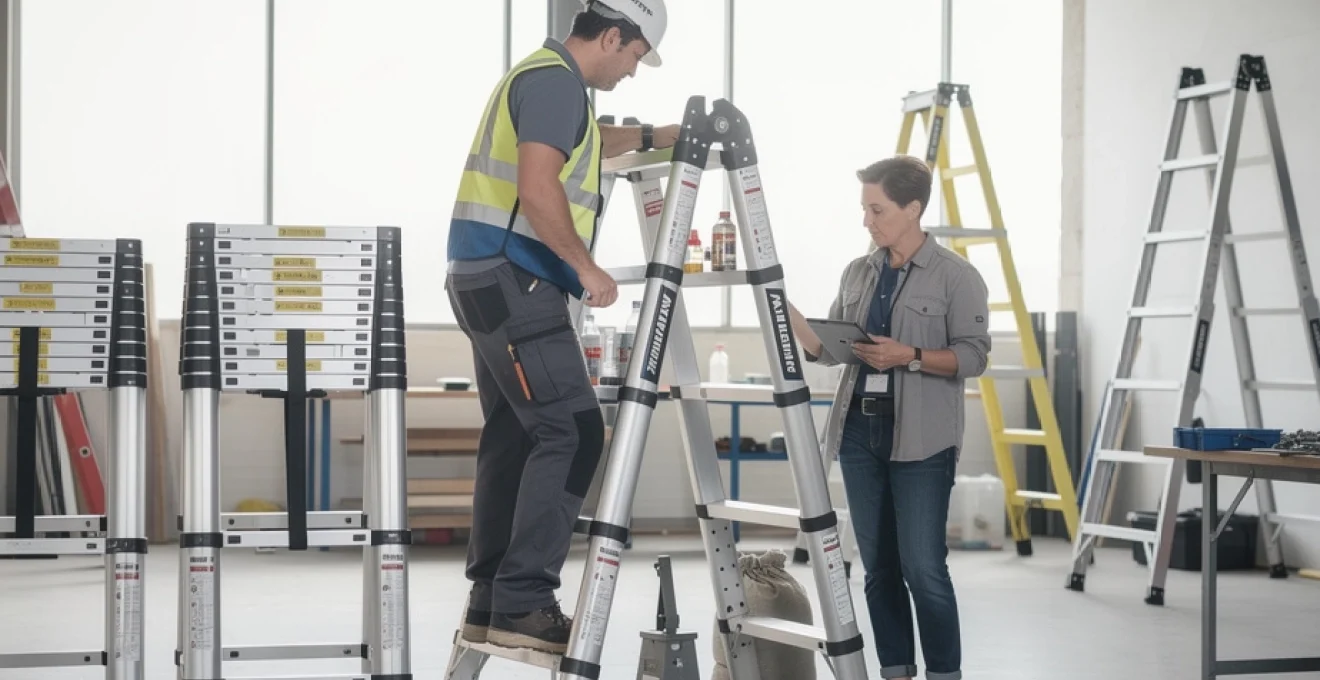
When you’re searching for a telescopic ladder that balances affordability with functionality, Mac Allister inevitably appears on your shortlist. Sold exclusively through B&Q, this brand has carved out a reputation as the middle-ground option between budget Amazon unknowns and premium brands like Zarges or Xtend+Climb. But does this positioning translate into genuine value, or are you simply paying for brand recognition without the performance to match? The telescopic ladder market has become increasingly competitive, with safety concerns rising alongside demand for compact storage solutions. Understanding what Mac Allister actually delivers—from build quality to certification standards—requires looking beyond star ratings and delving into the engineering specifics that determine whether you’ll feel confident at height or anxious every time you extend another rung.
Mac allister telescopic ladder product range: model specifications and construction quality
The Mac Allister telescopic ladder lineup comprises three primary models, each targeting different user requirements and working heights. The brand positions itself as accessible professional-grade equipment rather than purely DIY-focused products, though real-world usage patterns suggest considerable crossover. Each model shares fundamental design principles whilst incorporating specific features that justify their respective price points.
MTDL225 2.25m Multi-Purpose ladder: aluminium alloy frame analysis
The entry-level MTDL225 extends to 2.25 metres, making it suitable for basic domestic applications such as gutter cleaning, changing bulbs, and accessing loft spaces. The aluminium alloy construction employs 6061-T6 specification material, which offers a reasonable strength-to-weight ratio of approximately 3.2kg total mass. This particular alloy contains magnesium and silicon as primary alloying elements, providing enhanced corrosion resistance compared to pure aluminium whilst maintaining malleability during the manufacturing process. However, the wall thickness of the telescopic tubes measures just 1.2mm on this model, which becomes perceptible when you’re working near maximum extension—there’s a subtle flex that more experienced users notice immediately.
The rung spacing on the MTDL225 follows the standard 300mm configuration, though the actual usable working height sits considerably below the maximum extension due to the necessary overlap when leaning against structures. When positioned at the recommended 75-degree angle, your effective reach height drops to approximately 1.8 metres, which places limitations on applications beyond ground-floor work. The retracted length of 680mm makes boot storage genuinely practical, particularly in smaller vehicles where traditional extension ladders simply won’t fit.
MTDL325 3.25m extension ladder: load capacity and EN131 certification standards
Stepping up to the MTDL325 brings you into more versatile territory with 3.25 metres of extension. This model carries EN131 certification, which mandates specific structural testing protocols including static load distribution, rung strength under eccentric loading, and stiffness requirements measured through deflection testing. The certification requires that ladders withstand 150kg applied at the centre of any rung without permanent deformation exceeding 1mm—a standard that Mac Allister achieves through increased tube wall thickness of 1.5mm and reinforced connection points at each telescopic joint.
What’s particularly interesting about the MTDL325 is the jump in weight to 9.2kg, representing a 187% increase over the MTDL225 despite only 44% additional height. This disproportionate mass gain reflects the engineering reality of maintaining rigidity at greater extensions; the lower sections must accommodate significantly higher compressive loads. The load capacity remains certified at 150kg, though professional users often apply the “working at two-thirds” principle, which suggests treating 100kg as the practical maximum when working at full extension. This conservative approach accounts for dynamic loading—the additional forces generated by movement, tool usage, and shifting your centre of gravity whilst elevated.
MTDL380 3.8m professional grade: locking mechanism and finger trap protection
The flagship MTDL380 represents Mac Allister’s attempt to compete directly with established trade brands. At 3.8 metres fully extended, this model incorporates several features absent from cheaper alternatives, most notably the
inclusion of a dual-action locking mechanism designed to mitigate two of the biggest complaints levelled at cheaper telescopic ladders: rung creep and finger trapping. Each rung on the MTDL380 engages with a pair of opposing spring-loaded pins that slot into precision-machined apertures on the stiles. This creates an audible and tactile “click” at every stage of extension, giving you immediate feedback that the section is locked. Crucially, the retraction sequence is staged, so the rungs descend in a controlled manner rather than free-falling onto one another, significantly reducing the risk of crushed fingers—an issue widely documented with no-name imports.
Mac Allister also adds a wider stabiliser bar to the base of the MTDL380 compared with the smaller models, increasing the lateral footprint and reducing the likelihood of side tipping when you’re working off-centre. In practice, users report a noticeable improvement in torsional rigidity compared with the MTDL325, particularly when the ladder is leaned against uneven masonry or soffits. At around 11–12kg, this model is undeniably hefty for one-person handling, but that extra mass is largely a result of thicker tube walls and reinforced end caps, both of which contribute to stability at full height. If you’re the kind of user who regularly finds themselves at second-storey window height, the additional peace of mind is worth the trade-off in portability.
Anodised aluminium construction versus competitor materials
Across the range, Mac Allister employs anodised aluminium for the primary ladder sections rather than leaving the metal raw or simply clear-coated. Anodising creates a controlled oxide layer on the surface of the aluminium, improving corrosion resistance and surface hardness while giving a slightly satin finish that’s less prone to showing fingerprints and minor scuffs. This is particularly relevant for telescopic ladders because each tube slides inside another; increased surface hardness means reduced galling and smoother extension over time. In other words, the ladder is less likely to feel “gritty” or start binding after a few months of real-world use.
By contrast, many budget telescopic ladders use softer, non-anodised aluminium or lower-grade 5000-series alloys. These materials may look similar out of the box but tend to pick up scratches and dents more easily, and fine debris can accumulate inside the tubes, compromising the locking mechanism. Higher-end competitors like Zarges and Xtend+Climb also use anodised or high-spec alloys, often combined with nylon or fibreglass inserts at wear points, which can further reduce friction and noise during operation. Mac Allister sits somewhere between these extremes, offering a material specification that is a clear step up from most anonymous Amazon brands yet still short of the bespoke extrusions and hybrid materials used by premium trade-only models.
Telescopic ladder safety features: BS2037 class 1 compliance assessment
Safety is where telescopic ladders live or die in terms of buyer confidence, and it’s also where marketing claims can quickly outpace engineering reality. Mac Allister positions its telescopic range as compliant with EN131 for portable ladders, and some marketing materials reference performance comparable to the now-superseded BS2037 Class 1 standard (which historically denoted industrial-grade ladders). While you should always check the product label and instructions for the exact standard applied to your specific model, the overall design and testing regime are aimed at professional as well as domestic users. The underlying question for you is straightforward: do these telescopic designs behave in a way that feels as secure as a traditional two- or three-section ladder when you’re actually on the second or third rung from the top?
To answer that, we need to break safety down into its constituent elements: how each rung locks, how the ladder grips the ground, how it handles static and dynamic loads, and how safely it stores and deploys. Think of it like a chain—each safety feature is a link, and your actual risk level is determined by the weakest one. A beautifully engineered locking system is worth little if the feet are sliding on smooth paving, and vice versa. Mac Allister’s approach is to offer mid-market engineering that borrows proven ideas from top-tier brands without pushing costs to the same level, and that is most evident when you look closely at the details.
Individual rung locking system: Spring-Loaded pin technology
One of the defining features that separate safer telescopic ladders from the rest is the presence of a reliable individual rung locking system. On the MTDL325 and MTDL380, Mac Allister uses a spring-loaded pin design, where each rung has two independent steel pins that engage with recesses in the outer tube. This dual-pin approach provides redundancy; if one pin were to be partially obstructed by debris, the other should still fully engage, reducing the chances of a catastrophic rung collapse. The audible click when each section locks helps you verify engagement without having to visually inspect every joint, which is particularly useful in bright outdoor conditions or awkward access situations.
Cheaper telescopic ladders often rely on plastic latch mechanisms that share both the structural and locking function, which can deform over time or crack under impact. By separating the structural tube from the steel locking components, Mac Allister improves long-term reliability and makes the ladder more tolerant of everyday knocks and scrapes. That said, spring-loaded pins are not maintenance-free; they depend on remaining clean and free-moving, so you should periodically wipe down the tubes and avoid using lubricants that attract dust. A good rule of thumb is to treat your telescopic ladder like a piece of safety-critical sporting equipment—if a rung does not lock with a clear click, do not climb until you’ve inspected and resolved the issue.
Non-slip rubber feet and stabiliser bar performance
Mac Allister fits its telescopic ladder range with broad, ribbed rubber feet designed to maximise contact with typical domestic surfaces such as concrete, paving slabs, and internal flooring. The compound is relatively soft, which allows the feet to deform slightly and grip minor surface irregularities. From a safety perspective, this softness is advantageous on smooth or dusty surfaces, though it does mean that feet are consumable items that will gradually wear down with regular use. Periodic inspection for rounding-off or tearing is essential, because losing the defined leading edge can significantly reduce friction and increase the risk of heel slip, particularly at shallow ladder angles.
The inclusion of a stabiliser bar on the MTDL380, and on some newer revisions of the MTDL325, is arguably one of the most meaningful upgrades for real-world safety. By increasing the ladder’s base width by 200–300mm, the stabiliser dramatically improves lateral stability when you lean sideways or work with one hand. It’s the equivalent of widening the stance of a tripod—small on paper, but very noticeable in use. Users switching from older, narrower telescopic ladders often comment that the ladder feels less “twitchy” when stepping onto or off the first rung, which is exactly when many accidents occur. If you intend to use the ladder on uneven ground, pairing the stabiliser bar with a quality anti-slip ladder mat or wedge under the lower end further reduces the chance of the feet skidding or sinking.
Maximum working load: 150kg static weight distribution testing
All current Mac Allister telescopic models are rated to a maximum working load of 150kg, which aligns with the EN131 standard for both Professional and Non-Professional use. This figure includes both your body weight and any tools or materials you’re carrying, so it’s wise to perform a quick mental calculation before climbing—especially if you’re wearing a heavy tool belt or carrying items like roof tiles or paint tins. In the factory, static load tests apply this weight centrally on a rung with the ladder set at the recommended angle, and sensors monitor deflection and any permanent deformation after load removal. Mac Allister’s published data indicates that deflection remains within the limits defined by EN131, but user feedback does acknowledge some flex at near-maximum extension, particularly on the 3.8m model.
Flex, however, does not automatically equal danger. Just as a well-engineered bridge is designed to flex under load rather than crack, a telescopic ladder will exhibit some elastic movement to absorb energy. The key is whether that flex feels controlled and predictable, or alarming and “springy.” In our experience and in many trade reviews, Mac Allister telescopic ladders sit in that middle ground: stiffer and more confidence-inspiring than most generic imports, but not quite as rock-solid as top-tier trade-only brands. If you are close to the top of the weight limit or regularly carry heavy loads up the ladder, adopting a conservative “two-thirds of rated capacity” rule provides an additional margin of safety and reduces long-term fatigue on the tubes and joints.
Compact storage dimensions: Space-Saving retraction ratio analysis
One of the main reasons you’re probably considering a Mac Allister telescopic ladder at all is its compact storage dimensions. The retraction ratio—the relationship between fully extended height and collapsed length—is typically around 4.5:1 for the MTDL325 and slightly higher for the MTDL380. In practical terms, that means a ladder capable of reaching first-floor windows can still fit in the boot of a small hatchback or stand upright in a hallway cupboard. For many DIYers and mobile trades, this solves the perennial problem of where to keep a full-length ladder without investing in roof racks or sacrificing half a garage bay.
However, this compactness comes with trade-offs. When fully collapsed, the ladder forms a dense, heavy block that can be awkward to manoeuvre through tight spaces or up stairs. The weight is concentrated, and there are fewer handholds than on a conventional ladder, so proper lifting technique matters to avoid back strain. On the plus side, once you arrive on-site, deployment is quick—you can have the ladder locked at the required height in under a minute. If you often work in urban environments, flats, or properties with limited exterior access, this space-saving capability can be the difference between taking a safe ladder or improvising with something unsuitable.
Mac allister performance benchmarking against werner MT-22 and youngman telescopic models
To understand whether a Mac Allister telescopic ladder is truly worth its asking price, it helps to compare it against well-regarded competitors like the Werner MT-22 and Youngman telescopic ranges. While the Werner MT-22 is technically a multi-position combination ladder rather than a pure telescopic, many buyers cross-shop these products because both promise flexibility and compact storage. The Werner typically offers greater overall height and multiple configurations (step ladder, extension, stair mode), but at the cost of increased bulk and less convenient boot storage. In contrast, a Mac Allister telescopic ladder wins decisively on collapsed size and “grab-and-go” simplicity, especially if you predominantly use it as a straight leaning ladder.
When benchmarked against Youngman telescopic models, Mac Allister’s strengths and weaknesses become more nuanced. Youngman ladders are widely praised in trade circles for their rigidity and long-term durability, backed by strong brand heritage and comprehensive testing. In side-by-side use, Youngman telescopic ladders typically feel slightly stiffer at maximum extension, with marginally better rung comfort thanks to rounded profiles and deeper treads. Mac Allister counters with aggressive pricing and broad B&Q availability, which means you can physically inspect and purchase one on the same day rather than waiting for delivery. For many users, especially serious DIYers, the performance gap to Youngman is acceptable given the cost savings.
Another factor is after-sales support and spare parts. Werner and Youngman have extensive professional distribution networks and well-established warranty processes, reflecting their focus on commercial users. Mac Allister, being a B&Q-exclusive brand, relies heavily on the retailer’s return and exchange policies. This setup works well within the initial warranty period but can be less flexible when it comes to sourcing individual replacement components such as feet or locking pins. If you foresee intensive, daily use where downtime has a direct cost, a Werner or Youngman ladder may justify its higher price; for mixed domestic and light trade use, Mac Allister’s performance-to-convenience balance remains compelling.
Real-world application testing: domestic DIY versus trade professional usage
On paper, standards and specifications tell part of the story, but how do Mac Allister telescopic ladders behave in everyday scenarios? For domestic DIY tasks—cleaning gutters, painting soffits, accessing loft hatches, or working on first-floor windows—the MTDL325 and MTDL380 generally perform more than adequately. Many homeowners appreciate being able to store the ladder behind a door or in a wardrobe and still have access to upper-level areas without borrowing or renting a larger setup. The integrated locking indicators and stabiliser bar (where fitted) provide a level of reassurance that is often missing from budget alternatives, particularly for users who are not naturally comfortable at height.
Professional tradespeople, however, tend to be more demanding. Electricians, telecoms installers, window cleaners, and general maintenance contractors often use telescopic ladders multiple times per day, in a wider variety of conditions. Feedback from this group suggests that Mac Allister ladders hold up well for light to moderate professional use but may start to show wear in the locking mechanisms and feet sooner than premium brands when subjected to intensive daily deployment. Think of Mac Allister as a capable estate car that can handle a builder’s gear if needed, whereas Zarges or Xtend+Climb are more like heavy-duty vans specifically designed for relentless commercial mileage.
This doesn’t mean Mac Allister telescopic ladders are unsuitable for trades; rather, you should match your expectations and maintenance habits to your usage profile. If you are a mobile tradesperson who uses a telescopic ladder as a secondary access solution—supplementing roof ladders, podium steps, or scaffold towers—Mac Allister offers a very practical middle ground. If, on the other hand, your telescopic ladder is your primary work platform, clocking up dozens of deployments per week, the incremental cost of a top-tier trade ladder may pay for itself in reduced downtime, higher perceived stability, and longer service life.
Price-to-performance ratio: B&Q retail pricing versus zarges and Xtend+Climb premium ladders
Price is where Mac Allister’s telescopic range stakes its boldest claim. Typically, you’ll find the MTDL325 and MTDL380 retailing at B&Q for substantially less than equivalent-height models from premium brands like Zarges and Xtend+Climb—often by 25–40%, depending on promotions. For many buyers, especially those outfitting a home workshop or small business, that difference is significant. When you factor in the ability to walk into a local store, inspect the ladder, and take it home immediately, Mac Allister’s value proposition becomes hard to ignore. The real question is not whether they’re cheaper, but whether they’re cheap for what they deliver.
Premium brands justify their higher pricing through several tangible features: thicker tube walls, more advanced locking mechanisms with built-in finger protection, superior rung ergonomics, and often longer warranties. They may also undergo more rigorous third-party testing or quality control, which can inspire additional confidence if you’re regularly working at the top of the ladder’s range. For example, an Xtend+Climb “aerospace grade” ladder is typically heavier and feels almost overbuilt, with very limited flex and extremely precise locking. The trade-off is cost and weight; you pay more up front and carry more mass to every job.
Mac Allister slots in just below this tier, offering perhaps 70–80% of the perceived solidity at a fraction of the premium price. For many users, that’s an attractive compromise. If your ladder sees intermittent use and spends much of its life stored in a shed or van, the incremental benefits of a Zarges or Xtend+Climb may not justify double the outlay. However, if you place a premium on absolute stability, are working at or near the ladder’s full extension on a regular basis, or simply want the psychological comfort of the very best equipment, the higher initial cost of a premium telescopic ladder can be viewed as an investment in both safety and longevity.
Long-term durability concerns: warranty coverage and component replacement availability
Durability is often the hidden part of the telescopic ladder equation. In the short term, almost any new ladder feels acceptable; the real test comes after months or years of use, exposure to the weather, and countless cycles of extension and retraction. Mac Allister telescopic ladders generally come with a limited warranty—typically 1 to 2 years—administered via B&Q. Within that period, manufacturing defects or early failures are usually handled through straightforward replacement rather than repair, which is convenient but can mask deeper questions about long-term serviceability. Once the warranty expires, your options start to narrow.
Premium brands often support their ladders with a more comprehensive ecosystem of spare parts: replacement feet, locking pins, end caps, and sometimes even individual section repairs. With Mac Allister, availability of such components can be more variable and may depend on current production runs and in-store stock. This doesn’t automatically mean the ladder will fail prematurely, but it does influence your risk profile if something does wear out or get damaged. For example, if a stabiliser bar or foot becomes irreparably worn and a direct replacement is not easily sourced, you may end up replacing the entire ladder sooner than you’d planned.
In day-to-day use, the main wear points on a Mac Allister telescopic ladder are the feet, the locking pins, and the sliding surfaces of the tubes. Regular visual inspections—checking for dented stiles, sticky or hesitant locks, excessive play in the joints, and perished rubber—go a long way towards catching issues before they become dangerous. Storing the ladder in a dry, sheltered location and avoiding prolonged exposure to corrosive environments (such as salty coastal air or chemical overspray) will also extend its useful life. If you’re prepared to treat your Mac Allister telescopic ladder as a mid-term investment—solid enough for several years of sensible use rather than a lifetime tool—it can absolutely justify its cost. But if your priority is a ladder that can realistically last a decade or more under daily professional use with full parts support, stepping up to a higher-end brand may be the more future-proof choice.