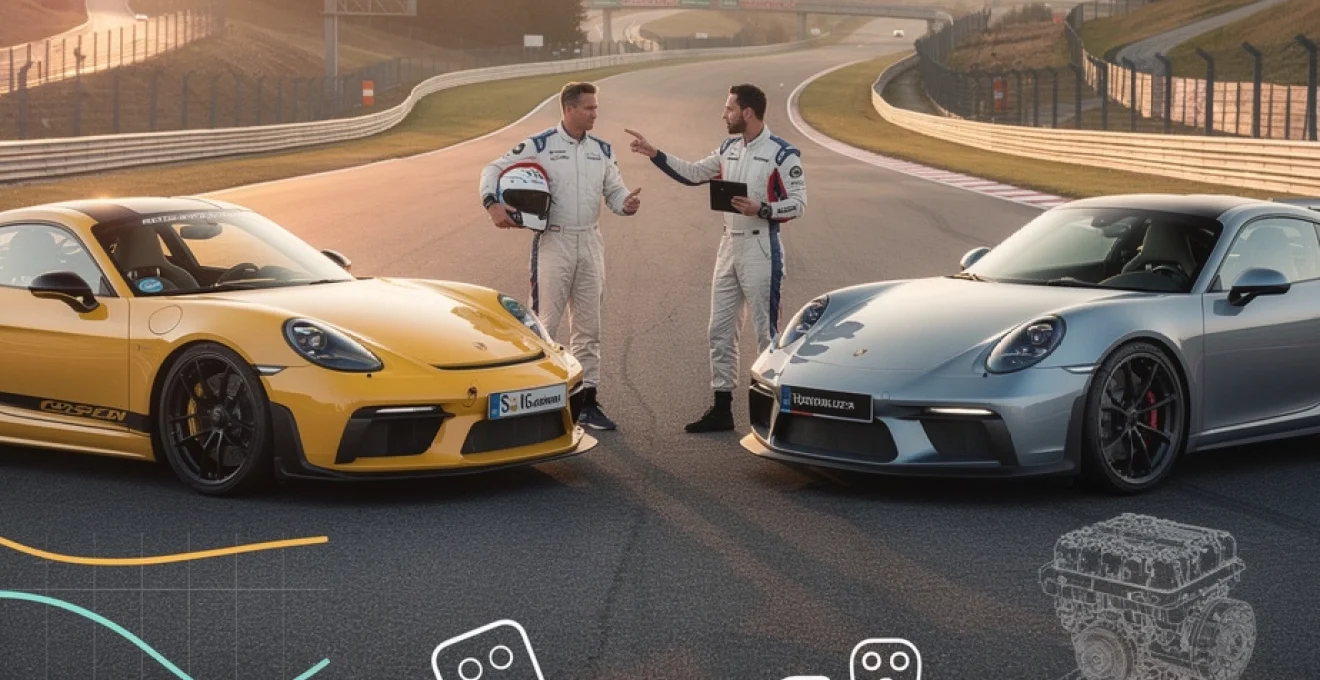
The eternal Porsche debate continues to divide enthusiasts worldwide: does the mid-engined 718 Cayman represent the pinnacle of Stuttgart engineering, or does the iconic 911’s rear-engined configuration still reign supreme? This comparison transcends mere specification sheets, delving into fundamental engineering philosophies that have shaped two distinct yet related sports cars. Both models share Porsche’s DNA yet offer dramatically different driving experiences, with each layout presenting unique advantages in handling dynamics, performance characteristics, and overall driver engagement. The question becomes increasingly relevant as modern technology bridges the gap between these configurations, making the choice more nuanced than ever before.
Porsche 718 cayman performance specifications analysis
The current 718 Cayman lineup demonstrates Porsche’s commitment to mid-engined excellence through carefully engineered performance specifications. The base model’s 2.0-litre turbocharged flat-four produces 300 horsepower, whilst the GTS 4.0 variant delivers 394 horsepower from its naturally aspirated flat-six configuration. Weight distribution stands at an optimal 45:55 front-to-rear ratio, providing the foundation for exceptional handling characteristics that define the mid-engined experience.
Naturally aspirated 4.0-litre Flat-Six engine characteristics
The 4.0-litre naturally aspirated flat-six engine represents the pinnacle of Cayman performance engineering. This powerplant, shared with the GT4 and GTS 4.0 variants, produces peak power at 7,000 rpm whilst delivering maximum torque of 317 lb-ft at 5,500 rpm. The engine’s high-revving nature encourages spirited driving, with power delivery that builds progressively throughout the rev range rather than relying on turbocharged torque peaks.
Throttle response in naturally aspirated configurations proves instantaneous, eliminating the lag characteristics often associated with forced induction systems. The flat-six’s boxer configuration maintains the car’s low centre of gravity whilst contributing to the distinctive Porsche soundtrack that enthusiasts cherish. Engine placement directly behind the driver creates an intimate connection between pilot and powerplant, enhancing the visceral driving experience through auditory and tactile feedback.
PDK Dual-Clutch transmission vs manual gearbox performance metrics
Porsche’s seven-speed PDK dual-clutch transmission offers lightning-fast shift times of just 60 milliseconds in Sport Plus mode, significantly outperforming traditional torque converter automatics. The system’s pre-selection capability ensures seamless power delivery during gear changes, maintaining momentum through challenging driving scenarios. Manual transmission options remain available across most Cayman variants, providing purists with direct mechanical engagement and precise control over power delivery.
Performance metrics demonstrate clear advantages for each transmission type depending on application. PDK-equipped Caymans achieve 0-62 mph acceleration approximately 0.3 seconds faster than manual counterparts, whilst manual transmissions offer superior driver engagement and mechanical simplicity. Weight savings of approximately 8 kilograms favour manual transmissions, contributing to improved power-to-weight ratios and enhanced agility in track-focused applications.
Porsche active suspension management (PASM) handling dynamics
PASM adaptive damping technology continuously adjusts suspension characteristics based on driving conditions and selected driving modes. The system monitors wheel movement, steering inputs, and acceleration forces to optimise damping rates in real-time. Three distinct modes – Normal, Sport, and Sport Plus – provide varying levels of firmness and responsiveness to suit different driving scenarios and personal preferences.
Track testing reveals PASM’s effectiveness in maintaining optimal tyre contact whilst minimising body roll during aggressive cornering manoeuvres. The system’s ability to transition between comfort-oriented highway cruising and track-ready precision demonstrates the technology’s sophistication. Response times of just 3 milliseconds ensure that suspension adjustments keep pace with rapidly changing driving conditions, maintaining vehicle stability across diverse terrain and driving styles.
Mid-engine configuration weight distribution advantages
The Cayman’s mid-engine layout positions the powerplant’s centre of mass directly between the
mass of the car, resulting in reduced polar moment of inertia. This configuration allows the 718 Cayman to rotate more readily around its vertical axis, translating steering and throttle inputs into immediate directional changes. In practical terms, the car feels as if it pivots around the driver’s hips, delivering a sense of agility that is difficult for front- or rear-engined competitors to replicate.
From a performance standpoint, this balanced weight distribution enhances both turn-in precision and mid-corner stability. Under braking, the Cayman maintains a stable platform with less forward pitch, helping the tyres operate within their optimal grip window. On corner exit, weight transfer to the rear axle occurs more progressively, enabling you to get on the power sooner without triggering abrupt oversteer. For drivers who prioritise confidence at the limit and a neutral chassis balance, the mid-engine configuration provides a compelling advantage over the 911’s rear-engine architecture.
Porsche 911 carrera engineering architecture breakdown
While the 718 Cayman leans on mid-engine purity, the Porsche 911 Carrera exemplifies the evolution of a rear-engined icon refined over six decades. Modern 911 engineering integrates advanced traction control systems, turbocharged flat-six engines, and sophisticated all-wheel drive technology to counteract the inherent challenges of a rear-biased layout. The result is a sports car that can deploy substantial power in real-world conditions whilst remaining approachable for a wide range of drivers.
The 992-generation 911 retains its trademark silhouette, but beneath the familiar shape lies a complex network of electronic aids and mechanical systems. These components work together to make the rear-engined sports car behave with composure comparable to many mid-engined rivals. For prospective buyers comparing the 718 Cayman versus the 911, understanding how Porsche has engineered the Carrera’s architecture helps explain why the 911 remains such a dominant force on road and track.
Rear-engine layout traction control systems
Placing the engine behind the rear axle creates a natural traction advantage under acceleration, as weight presses directly onto the driven wheels. However, this same layout can induce sudden oversteer if grip is exceeded, particularly in low-friction conditions. To address this, Porsche equips the 911 Carrera with highly calibrated traction control systems that continuously monitor wheel slip, steering angle, yaw rate, and throttle position. These systems trim power and selectively brake individual wheels to keep the car stable without feeling intrusive in normal driving.
In modern 911 models, the integration between mechanical grip and electronic oversight is remarkably seamless. Where older rear-engined cars could feel intimidating in the wet, the 992-generation 911 deploys its power with confidence-inspiring calm, even when driven enthusiastically. For drivers stepping up from a Cayman, the immediacy of rear-axle traction out of slower corners is particularly noticeable. It is this clever blend of physics and software that allows the 911 to remain exploitable for everyday users while still rewarding skilled drivers who are willing to explore its limits.
Turbocharged flat-six powerplant torque delivery
The heart of the current 911 Carrera range is a 3.0-litre twin-turbocharged flat-six engine, delivering outputs from around 379 bhp in the base Carrera to over 640 bhp in Turbo S form. Unlike the naturally aspirated 4.0-litre flat-six in the Cayman GTS 4.0 or GT4, the turbocharged 911 engine develops its torque much lower in the rev range. Peak torque typically arrives from around 2,000 rpm and sustains through the mid-band, providing effortless acceleration for overtakes and motorway merging.
This broad torque plateau changes the way you drive the car compared with a high-revving Cayman. Instead of chasing the red line to unlock performance, the 911 offers strong thrust even in higher gears at moderate rpm. For daily usability, commuting, and long-distance touring, this abundance of accessible torque makes the 911 feel more relaxed yet explosively fast when required. Some purists may miss the linear crescendo of a naturally aspirated engine, but for many buyers, the turbocharged flat-six powerplant represents the ideal balance of efficiency, performance, and refinement.
Porsche stability management (PSM) electronic intervention
Porsche Stability Management (PSM) acts as a safety net that underpins the 911’s dynamic repertoire. This electronic control system constantly evaluates sensor data to detect instability and intervenes by modulating brake pressure at each wheel and adjusting engine output. In everyday situations, PSM operates in the background, barely noticeable unless conditions become particularly slippery. However, when you push the 911 harder—especially on track—the sophistication of PSM becomes more apparent.
Importantly, Porsche allows configurable PSM modes and partial deactivation, giving experienced drivers the freedom to explore the chassis more fully. In Sport and Sport Plus modes, the thresholds for intervention are raised, permitting greater yaw before the system steps in. Compared with the 718 Cayman, where the inherently neutral balance does much of the work mechanically, the 911 relies more on PSM to keep the rear-engine layout docile. For many enthusiasts, this combination of mechanical character and smart electronics delivers a confidence-inspiring blend of fun and safety.
All-wheel drive coupling system efficiency
While entry-level 911 Carrera models remain rear-wheel drive, the Carrera 4, Carrera 4S, and Turbo variants deploy Porsche’s advanced all-wheel drive (AWD) coupling systems. Using an electronically controlled multi-plate clutch, the system can vary torque distribution between front and rear axles in milliseconds. Under normal conditions, the car behaves like a rear-wheel-drive sports car, preserving that classic 911 feel. When sensors detect slip at the rear, the system seamlessly routes power to the front axle, stabilising the car and aiding traction out of corners or on low-grip surfaces.
This AWD efficiency plays a significant role in real-world performance. In wet climates or during winter months, the 911 Carrera 4 and Turbo models can deploy their power with minimal wheelspin, enabling rapid progress when a rear-drive Cayman might require more restraint. For buyers who plan to use their Porsche year-round and value all-weather capability, the AWD 911 variants offer a compelling argument. The trade-off is a slight increase in weight and mechanical complexity compared with the simpler, lighter mid-engined Cayman platform.
Circuit performance comparison: nürburgring nordschleife data
When comparing whether the Cayman is better than the 911 from a pure performance standpoint, Nürburgring lap times provide a useful benchmark. The Nordschleife’s 20.8-kilometre layout combines high-speed sections, technical complexes, and dramatic elevation changes, making it a demanding test of chassis balance and power delivery. Historically, the more powerful 911 models have posted quicker times, but the gap between the best 718 Cayman and 911 variants is narrower than you might expect.
For context, recent-generation figures place the 718 Cayman GT4 RS in the low 7:10s around the Nordschleife, while the 911 GT3 in 992 form laps in the 6:59–7:00 region depending on specification and conditions. The difference of roughly ten to fifteen seconds over such a long circuit reflects both the GT3’s power advantage and its track-focused aero package. However, in intermediate trims such as the 718 Cayman GTS 4.0 versus the 911 Carrera S, the real-world pace is much closer. On many technical circuits, driver confidence and consistency in the Cayman can offset the raw power of the 911, especially for non-professional drivers.
It is also worth considering that Nordschleife records are typically set by expert drivers with perfect conditions and aggressive tyre choices. For most owners, the more relevant question is: which car allows you to access more of its performance on a typical track day? Here, the Cayman often feels more approachable, with its mid-engine balance and progressive breakaway characteristics encouraging you to edge closer to the limit. The 911, while objectively faster in ultimate lap time, can feel like it has deeper reserves of performance than you are willing—or able—to exploit regularly.
Real-world ownership cost analysis and depreciation curves
Beyond lap times and engineering theory, the decision between a Cayman and a 911 often comes down to long-term ownership costs. Initial purchase price, servicing, insurance, tyres, brakes, fuel consumption, and depreciation all shape the real cost of living with these cars. In the UK and many European markets, a new 718 Cayman GTS 4.0 typically undercuts an equivalently specified 911 Carrera by tens of thousands of pounds, immediately positioning the mid-engined car as the more accessible entry point into Porsche ownership.
Running costs also tend to favour the Cayman. Its lighter weight means reduced tyre and brake wear compared with the heavier, more powerful 911, particularly if you attend regular track days. Insurance premiums are often lower for Caymans as well, reflecting their lower purchase price and slightly less potent performance figures. Routine servicing intervals are comparable between the two models, but parts such as PCCB ceramic discs and wide-section rear tyres are notably more expensive on high-output 911 variants. For owners seeking a balance of performance and cost-effectiveness, the Cayman makes a compelling case as the more economical long-term partner.
Depreciation patterns add another layer of nuance. Historically, 911 models—especially special editions and GT variants—have demonstrated extremely strong residual values, sometimes even appreciating over time. The 718 Cayman range, while still holding value better than many rival sports cars, typically experiences a steeper initial depreciation curve. However, this steeper drop can be advantageous for used buyers: a three- to five-year-old Cayman GTS 4.0 or even a GT4 can represent exceptional value compared with an equivalent-age 911.
So which is the smarter financial choice? If you buy new and plan to keep the car for many years, the 911’s high residuals and broad desirability can offset its higher purchase price. If you are shopping on the used market or prefer to minimise capital outlay, a well-chosen Cayman can deliver 90% of the driving excitement for a significantly lower total cost of ownership. As always, your usage pattern—daily driving, occasional weekends, or dedicated track work—will determine which side of the Porsche divide makes the most sense for you.
Track-focused variants: GT4 versus GT3 capability assessment
At the sharp end of the Porsche catalogue, the 718 Cayman GT4 and 911 GT3 distil each platform’s philosophy into highly focused track weapons. Both share naturally aspirated 4.0-litre flat-six engines, aggressive aero packages, and extensive chassis upgrades derived from motorsport. However, the way they deliver their performance—and the type of driver they best suit—differs markedly. Comparing the GT4 versus GT3 provides one of the clearest windows into whether the mid-engined Cayman is truly better than the rear-engined 911 for serious track use.
The GT4 positions itself as a precision tool, with a slightly lower power output but outstanding balance and feedback. The GT3, by contrast, layers on additional power, higher cornering speeds, and more sophisticated suspension technology. While lap-time data usually favours the GT3, many drivers report that the GT4 feels more exploitable and less intimidating, especially for those still developing their circuit skills. Let us break down the key components that separate these two halo models.
Carbon fibre aerodynamic package effectiveness
Both the GT4 and GT3 employ carbon fibre extensively in their aerodynamic packages to increase downforce without adding excess weight. On the 718 Cayman GT4, the fixed rear wing, front splitter, rear diffuser, and underbody elements work together to generate significant downforce at speed, improving high-speed stability and cornering grip. The mid-engine configuration allows designers to balance this aero load more evenly front-to-rear, helping maintain the neutral handling character that defines the Cayman platform.
The 911 GT3, particularly in its more extreme iterations, takes aerodynamic efficiency a step further. With features such as a swan-neck rear wing, large front air intakes, and carefully sculpted underbody channels, the GT3 can achieve higher downforce figures while maintaining a relatively low drag coefficient. This additional downforce translates into higher cornering speeds and shorter braking distances on fast circuits. However, extracting these benefits requires a driver who is comfortable committing to higher entry speeds and trusting the aero grip—something that can feel intimidating if you are transitioning up from a standard Cayman or Carrera.
Michelin pilot sport cup 2 tyre performance differential
Tyre choice has a dramatic impact on how both the GT4 and GT3 perform on track, and Michelin Pilot Sport Cup 2 rubber is a common fitment for these models. Cup 2 tyres sit between road and full slick track tyres, offering exceptional dry grip with acceptable road manners and wet-weather capability if driven sensibly. On the 718 Cayman GT4, Cup 2s accentuate the car’s natural agility, allowing late braking, sharp turn-in, and high mid-corner speeds without feeling nervous. The relatively modest power output compared with the GT3 also means the rear tyres are less stressed on corner exit, lengthening their effective life.
On the 911 GT3, the same Cup 2 tyres are subjected to greater loads, both longitudinally and laterally. The GT3’s higher power output and higher achievable speeds mean that managing tyre temperatures becomes more critical, especially during extended track sessions. When the tyres are in their optimal window, the GT3 delivers astonishing grip and stability, but the performance envelope is narrower and more demanding. For track-day drivers who value predictability and a forgiving learning curve, the Cayman GT4 on Cup 2s often feels easier to keep in its sweet spot lap after lap.
Roll cage structural rigidity measurements
Both GT4 and GT3 models can be specified with factory roll cages as part of track-focused option packages. These cages, typically constructed from high-strength steel or, in some special packages, incorporating lightweight materials, significantly increase torsional rigidity. A stiffer chassis allows the suspension to work more effectively, improving steering precision and consistency of grip across a variety of track surfaces. In the Cayman GT4, the roll cage reinforces an already rigid mid-engined structure, resulting in a cockpit that feels rock-solid even under heavy lateral loads.
The 911 GT3, with its longer body and distinct rear-engine packaging, also benefits greatly from additional bracing. Torsional rigidity improvements help manage the substantial forces generated by the GT3’s wider tyres and more aggressive aero package. Objective rigidity measurements often show marginal gains for each model when equipped with roll cages, but the subjective difference for the driver can be considerable. You experience clearer feedback through the seat and steering wheel, and the car feels more cohesive when transitioning between braking, turn-in, and acceleration. For regular track users, opting for a roll cage in either GT4 or GT3 form is a compelling investment in both safety and performance.
Brembo carbon-ceramic brake system thermal management
Stopping power is another arena where the GT4 and GT3 showcase their track-ready engineering. Both can be equipped with Porsche Ceramic Composite Brakes (PCCB), developed in partnership with Brembo. These carbon-ceramic systems offer several advantages over traditional steel rotors: reduced unsprung mass, exceptional resistance to fade, and longer service life under high-temperature conditions. On the 718 Cayman GT4, PCCB brakes provide immense confidence during repeated hard stops, with a firm pedal feel and consistent modulation that helps you brake precisely to the apex.
In the 911 GT3, PCCB hardware is subjected to even more intense thermal loads due to higher speeds and greater vehicle mass. Here, the superior heat dissipation characteristics of carbon-ceramic discs become crucial for maintaining braking performance over extended sessions. While steel brakes on both platforms are more than adequate for occasional spirited driving, serious track enthusiasts will appreciate the margin of safety and consistency that PCCB offers. The main trade-off is cost: replacement PCCB components, particularly on the 911, can be significantly more expensive than steel equivalents.
Ultimately, whether the Cayman GT4 or 911 GT3 is “better” depends on how you prioritise approachability versus outright speed. The GT3 remains the faster, more capable machine in the hands of an experienced driver, but the GT4’s transparent feedback, lower running costs, and mid-engine poise make it an incredibly rewarding choice for those who value driver development and confidence as much as lap records.