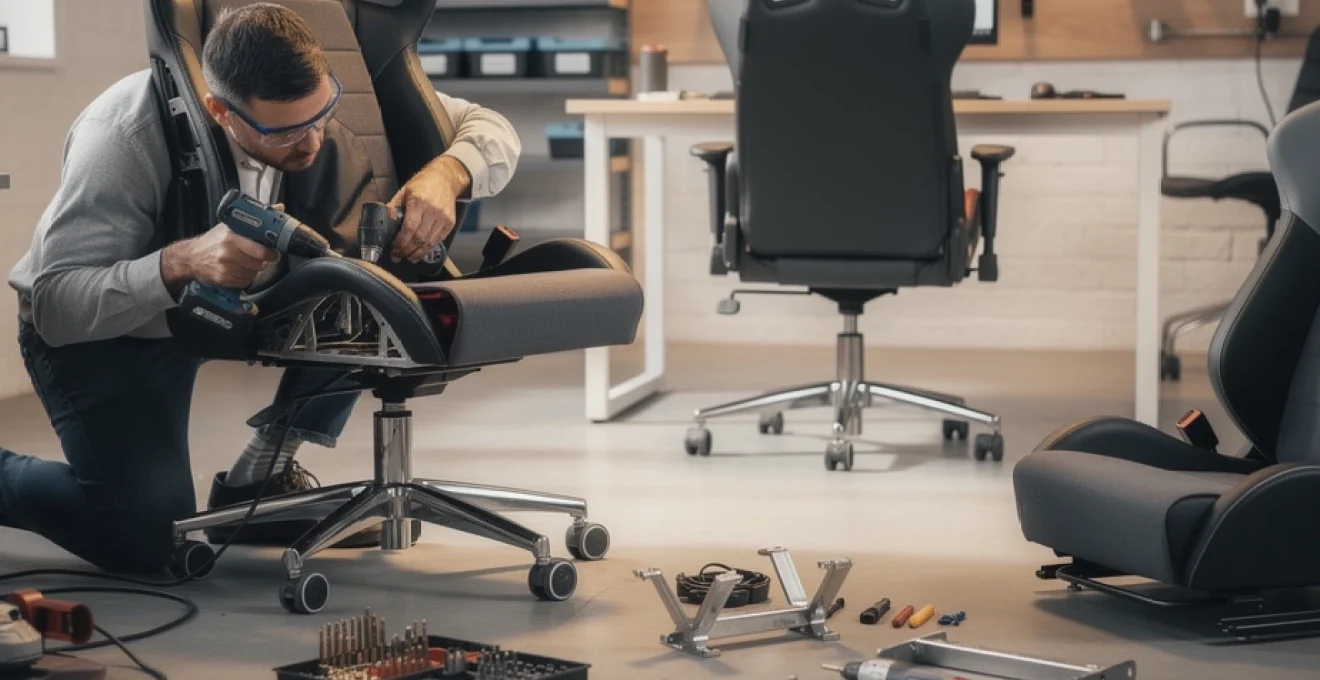
Converting automotive seating into ergonomic office furniture represents one of the most innovative approaches to workspace customisation available today. This transformation process combines automotive engineering excellence with workplace functionality, delivering superior comfort and durability compared to traditional office furniture. The practice has gained significant traction amongst professionals seeking enhanced lumbar support, adjustability features, and long-term value from their workspace investments.
Modern car seats incorporate advanced ergonomic design principles, premium materials, and sophisticated adjustment mechanisms that often surpass those found in conventional office chairs. The automotive industry invests billions in research and development to ensure driver comfort during extended periods, making these seats ideal candidates for office environments where professionals spend eight or more hours daily.
Car seat selection criteria for office chair conversion
Selecting the appropriate automotive seat forms the foundation of a successful conversion project. The choice significantly impacts both the functionality and aesthetic appeal of your final workspace solution. Understanding the various seat types, their ergonomic properties, and structural characteristics ensures optimal results from your investment of time and resources.
Manual adjustment seats offer several advantages over their electric counterparts during conversion projects. These mechanisms eliminate the need for complex wiring harnesses, battery systems, or power supplies, simplifying the installation process considerably. Manual seats also provide tactile feedback during adjustments, allowing users to fine-tune positioning with precision while maintaining mechanical reliability over extended periods.
Recaro sport seat ergonomic assessment and lumbar support analysis
Recaro sport seats represent the pinnacle of automotive seating engineering, featuring advanced lumbar support systems and multi-point adjustment capabilities. These seats incorporate high-density foam construction with strategic bolstering designed to support the natural curvature of the spine during dynamic driving conditions. The ergonomic benefits translate exceptionally well to office environments, providing superior postural support compared to traditional desk chairs.
The lumbar adjustment mechanism in Recaro seats typically features a four-way system allowing both vertical and horizontal positioning. This sophisticated approach enables users to precisely target the L3-L5 vertebrae region, reducing lower back strain during extended sitting periods. The seat cushion design promotes healthy circulation through its contoured shape and premium foam density specifications.
Bucket seat vs standard bench seat structural suitability
Bucket seats offer superior structural integrity for office chair conversions due to their integrated frame design and mounting point configuration. The monocoque construction provides enhanced stability when adapted to swivel base systems, whilst the ergonomic contours deliver targeted support for individual users. Standard bench seats, whilst more spacious, present challenges in terms of mounting consistency and may lack the personalised fit essential for prolonged office use.
The mounting point distribution in bucket seats typically follows a four-corner pattern with reinforced attachment areas designed to handle dynamic loads. This structural arrangement adapts readily to office chair base systems, ensuring secure installation and operational safety. Bench seats often feature centre-mounted attachment points that may compromise stability when adapted to swivel mechanisms.
Racing harness mounting point integration for swivel mechanisms
Racing seats equipped with harness mounting points present unique opportunities for enhanced functionality in office environments. These reinforced attachment points can accommodate additional accessories such as lumbar pillows, heating elements, or even laptop mounting systems. The structural reinforcement inherent in harness-equipped seats provides added confidence when adapting to office base systems.
Converting harness mounting points requires careful consideration of load distribution and user safety. The original mounting hardware can often be repurposed to secure cable management systems or desk accessories, adding practical value to your converted chair. Professional assessment of structural integrity remains essential when modifying any safety-related components.
OEM seat rail system compatibility with office base assemblies
Original Equipment Manufacturer (OEM) seat rails offer distinct advantages during conversion projects due to their precision engineering and standardised mounting configurations. These systems typically feature hardened steel construction with integrated adjustment mechanisms that can be preserved during the conversion process. Understanding rail compatibility enables retention of fore-aft adjustment capabilities in your finished office chair.
The standard mounting pattern for automotive seat rails varies by manufacturer but commonly follows industry-standard spacing. This consistency facilitates the design of universal mounting brackets that can accommodate multiple vehicle platforms. Rail preservation also maintains the original seat’s centre of gravity calculations, ensuring stability when mounted on office chair bases
When evaluating OEM rails, you should verify both the bolt spacing and the elevation they create between the seat base and the floor. Excessive rail height can place the centre of gravity above the optimal level for a swivel office chair, increasing the risk of tipping when you recline or lean. In many cases, retaining the original rails provides the best compromise between adjustability and stability, especially when combined with a purpose-built adapter plate or bracket system that interfaces directly with the office chair base.
Essential tools and hardware for professional seat conversion
Once you have selected a suitable car seat for office chair conversion, the next consideration is your tooling and hardware. A professional-grade tool set not only improves build quality but also enhances safety and repeatability if you intend to complete more than one conversion. At a minimum, you will require cutting tools, drilling equipment, fastening hardware, and a robust swivel base with a pneumatic or hydraulic height adjustment cylinder.
Before commencing any work, perform a thorough inspection of both the car seat and donor office base to identify structural members, material thicknesses, and potential interference points. This pre-planning phase allows you to determine whether light-duty tools will suffice or whether heavier fabrication equipment such as a MIG welder or metal brake will be necessary. Many successful conversions are completed with basic workshop tools, but higher-end equipment does deliver cleaner, more precise results.
Angle grinder and dremel rotary tool applications
The angle grinder is the primary cutting and shaping tool for most DIY office chair conversions. Fitted with an appropriate metal cutting disc, it can trim excess rail length, remove unwanted brackets, and cut stock steel for custom mounting plates. Due to the high-speed nature of angle grinders, users must wear appropriate eye, ear, and hand protection and maintain firm control of the tool at all times.
For finer work and tight clearances, a Dremel or similar rotary tool offers improved precision and control. These compact tools excel at deburring cut edges, enlarging mounting holes by small increments, and trimming plastic covers or cosmetic components without damaging surrounding material. Think of the angle grinder as a chainsaw and the rotary tool as a scalpel; using each where appropriate ensures a professional finish on your car seat office chair.
Heavy-duty drill bits and metal cutting disc selection
Drilling operations are fundamental when creating mounting points between the seat rails and office base. Heavy-duty drill bits designed for steel—typically cobalt or high-speed steel (HSS) with a split-point tip—provide clean, accurate holes and extended service life. Investing in a quality set within the 4mm to 12mm range allows you to accommodate most common bolt diameters used in automotive seats and office chair bases.
Equally important is selecting the correct metal cutting discs for your angle grinder. Thin, reinforced discs in the 1mm to 1.6mm range produce narrow kerfs and minimize heat build-up, reducing distortion in thin-gauge steel. Thicker discs may be suitable for heavier structural members but can remove more material than necessary. Regularly inspecting discs for wear and replacing them before failure is critical for safe and precise work when building your custom office chair from a car seat.
Welding equipment: MIG vs TIG for bracket fabrication
Where bolt-on solutions are not practical, welding may be required to fabricate custom brackets or reinforcement plates. MIG (Metal Inert Gas) welding is typically the most accessible and forgiving method for hobbyists converting car seats into office chairs. It handles mild steel in the 2mm to 6mm range with ease and delivers strong joints even when working with less-than-perfect fit-up.
TIG (Tungsten Inert Gas) welding offers superior control and cleaner, more aesthetically pleasing welds, making it ideal for visible bracketry or thin-gauge components where heat input must be minimized. However, TIG demands greater skill, cleaner material, and more time. If you do not have access to welding equipment, many of the structural interfaces in a car seat office chair can be achieved using bolted joints with appropriate grade hardware, washer plates, and locking fasteners.
Universal swivel base assemblies and pneumatic cylinder systems
The heart of any office chair is its swivel base and height adjustment mechanism. Universal swivel base assemblies designed for heavy-duty office use typically feature a five- or six-spoke base, reinforced hub, and casters rated for higher static and dynamic loads. When supporting a full automotive seat—with average weights between 20kg and 30kg—the base should have a weight rating that accounts for both the seat and user combined, typically exceeding 130kg.
Pneumatic cylinder systems provide the familiar gas-lift adjustment found in modern office chairs. For a car seat conversion, selecting a shorter-than-standard cylinder can help offset the additional cushion height of the automotive seat, restoring a comfortable desktop working posture. Some builders opt to shorten existing cylinders, but this involves releasing pressurized gas and should only be attempted with comprehensive safety precautions or by a qualified professional. When in doubt, purchasing a cylinder of the correct stroke length is safer and often more cost-effective.
Seat rail modification and base mounting procedures
With tools and components prepared, the core of the conversion process involves modifying the seat rails and mounting them securely to the office chair base. The objective is twofold: maintain seat adjustability where possible and ensure that the load path from the user to the floor remains stable and predictable. Poorly aligned or under-strength interfaces at this stage can compromise both comfort and safety.
The first step is to determine the optimal seat height for your work surface. You can simulate this by placing the car seat on stacked timber, boxes, or a workbench and adjusting until your elbows rest at approximately 90 degrees when typing. Once you establish this height, measure the distance from the bottom of the seat rails to the floor and compare it with the combined height of your office base and pneumatic cylinder. This calculation guides whether you must shorten the cylinder, remove OEM spacers, or fabricate low-profile brackets to meet ergonomic requirements.
Most automotive seats feature four primary mounting points on the rails. Begin by measuring the centre-to-centre spacing both front-to-back and side-to-side, then transfer these measurements to your proposed adapter plate or bracket. An effective approach involves using a rectangular steel plate or a framework of square tubing that bolts to the seat rails at the original points and, in turn, bolts to the office chair mechanism. By mirroring OEM mounting patterns, you preserve the structural design intent and avoid introducing unintended stress concentrations.
When positioning the seat on the base, pay particular attention to the fore-aft location of the centre of gravity. In practical terms, you should be able to lean back to the maximum recline angle without feeling that the chair wants to tip. If in doubt, temporarily clamp or loosely bolt the adapter to the base, sit in the assembly, and test dynamic movements before final tightening. Many builders discover they need to bias the seat slightly rearward relative to the base centreline to compensate for the heavier upper structure of automotive backrests.
After confirming alignment and balance, drill all required mounting holes using the heavy-duty bits mentioned earlier. Use at least grade 8.8 (or higher) metric bolts with large-diameter washers or backing plates to spread the load on thin sections. Nylon insert locknuts or thread-locking compounds help prevent loosening over time as the seat rotates and reclines. Treat all cut edges with primer or paint to prevent corrosion, particularly if you have removed any factory coatings during grinding operations.
Hydraulic height adjustment system integration
Integrating a hydraulic or gas-lift height adjustment system into a car seat office chair demands attention to both mechanical fit and functional range. Automotive seats are generally taller and more heavily cushioned than standard office chairs, meaning the effective seated height can increase by 50mm to 100mm if you simply bolt them onto a stock base. To maintain an ergonomic workstation, you will often need to reduce the net height contribution of the lift system.
The simplest approach is to select a gas-lift cylinder with a shorter stroke and compressed length designed for low-profile applications. Many commercial suppliers list dimensions and maximum load ratings, allowing you to choose a model that suits the added mass of the car seat. Matching the taper and diameter of the cylinder ends with your chosen base and tilt mechanism is crucial, as most systems use standardized mounting cones but differ in length and strength.
Some advanced builders may opt to physically shorten an existing cylinder, but this introduces significant risk because these units are typically charged with high-pressure nitrogen. If you decide to modify a gas-lift cylinder, you must release the pressure in a controlled manner, often by drilling a small vent hole while the cylinder is contained within a metal tube or shield. Even with such precautions, many professionals recommend replacement rather than modification, given the low cost of new cylinders compared to the potential hazards.
Once you have selected or adapted the height adjustment system, test its travel range with the car seat installed. At the lowest setting, your feet should rest flat on the floor with knees at approximately 90 degrees; at the highest setting, you should still be able to slide under your desk without contact between thighs and the underside of the work surface. If the range is excessive, physical limiters or travel stops can be added to the mechanism to prevent users from selecting unsafe heights.
It is also prudent to evaluate rotational smoothness under load. A heavy car seat can amplify any internal friction or play within the swivel mechanism, resulting in a “sticky” or uneven rotation. Lubricating moving parts with a suitable grease and ensuring that mounting bolts are tightened to the correct torque without overtightening can restore smooth operation. In some cases, incorporating a low-friction plastic washer between the seat adapter and tilt mechanism significantly improves rotational feel while reducing metal-to-metal wear.
Ergonomic positioning and workplace safety compliance
Transforming a car seat into an office chair is only half the story; the other half is ensuring that the finished product supports healthy posture and complies with basic workplace safety guidelines. While automotive seats are engineered for extended sitting, they assume a slightly reclined driving posture with legs extended forward. Your challenge is to adapt that geometry to an upright, desk-oriented position without sacrificing the comfort that made car seats attractive in the first place.
Start by adjusting seat height so that your hips are level with or slightly above your knees, which promotes circulation and reduces hip flexor strain. The backrest angle should typically be set between 95 and 110 degrees relative to the seat base, providing gentle recline without encouraging slouching. If your seat includes adjustable lumbar support, position it so that it sits in the natural curve of your lower back; you should feel firm but comfortable contact rather than a hard pressure point.
Desk ergonomics extend beyond the chair itself. Your forearms should rest parallel to the floor when typing, with wrists in a neutral position and shoulders relaxed. If your converted car seat is taller or deeper than a standard office chair, you may need to adjust desk height, add a footrest, or modify monitor positioning to maintain these principles. A key advantage of high-quality automotive seats—in particular those with multi-way lumbar and cushion tilt—is the ability to fine-tune these parameters for your body type.
From a safety compliance perspective, stability and fire resistance are the primary considerations. Most workplace regulations expect chairs to remain stable during normal use, including reaching, turning, and limited reclining. You can simulate this by performing a “tip test”: sit in the chair, lean to each side and rearward, and confirm that at least three casters remain in firm contact with the floor at all times. If tipping feels likely, reconsider the base size, caster layout, or seat placement relative to the swivel axis.
Fire safety standards for office furniture vary by region but often require upholstery materials to meet specific flame-retardant criteria. Many OEM automotive seats already comply with stringent flammability regulations, which can be an advantage over budget office chairs. However, if you have re-trimmed the seat or added aftermarket foam, you may wish to verify the material specifications. Documenting these characteristics, along with basic assembly drawings or photos, can be valuable if your converted chair is used in a commercial or shared workspace subject to inspection.
Cost analysis: DIY conversion vs herman miller aeron alternative
One of the driving motivations behind converting a car seat into an office chair is achieving premium comfort at a fraction of the cost of high-end commercial solutions. A Herman Miller Aeron, for example, often retails between $1,000 and $1,500 depending on configuration and region. By contrast, a well-executed car seat office chair can be built for significantly less, even when factoring in quality materials and professional-grade components.
Let us break down typical expenditure for a DIY conversion. A used but well-preserved car seat from a reputable brand might cost $100 to $300, depending on make, model, and whether it includes additional features such as heating or advanced lumbar adjustment. A robust office base with heavy-duty gas-lift and casters usually falls in the $80 to $150 range. Steel stock, fasteners, and finishing materials—paint, primer, and plastic end caps—might add another $50 to $100, while incidental tooling costs depend on what you already own.
In total, many enthusiasts complete a car seat office chair project in the $250 to $500 bracket, representing a substantial saving compared to premium ergonomic chairs. Of course, this calculation must also include your time investment, which can range from a single afternoon for a straightforward bolt-on build to several days for more complex welding and custom bracket fabrication. If you value the process as a rewarding DIY project, that time can be viewed as an added benefit rather than a cost.
However, cost is not the only dimension to consider. Chairs like the Herman Miller Aeron come with extensive ergonomic research, regulatory certifications, and manufacturer warranties—often 12 years or more. Your DIY car seat chair will lack this formal backing, placing responsibility for safety, maintenance, and adjustments squarely on you. For some professionals, particularly those in corporate environments or shared offices, the assurance and compliance documentation of a commercial chair may outweigh the potential savings of a custom build.
Ultimately, the decision between constructing a car seat office chair and purchasing a Herman Miller Aeron depends on your priorities. If you appreciate hands-on projects, desire a unique aesthetic—perhaps using a seat from a cherished vehicle—and are comfortable taking ownership of engineering and safety considerations, the DIY route offers excellent value and satisfaction. If you prefer a turnkey solution with guaranteed performance, standardized ergonomics, and long-term warranty support, investing in a premium office chair may be the more appropriate path. Both approaches aim at the same goal: creating a comfortable, supportive place to work for many hours each day.