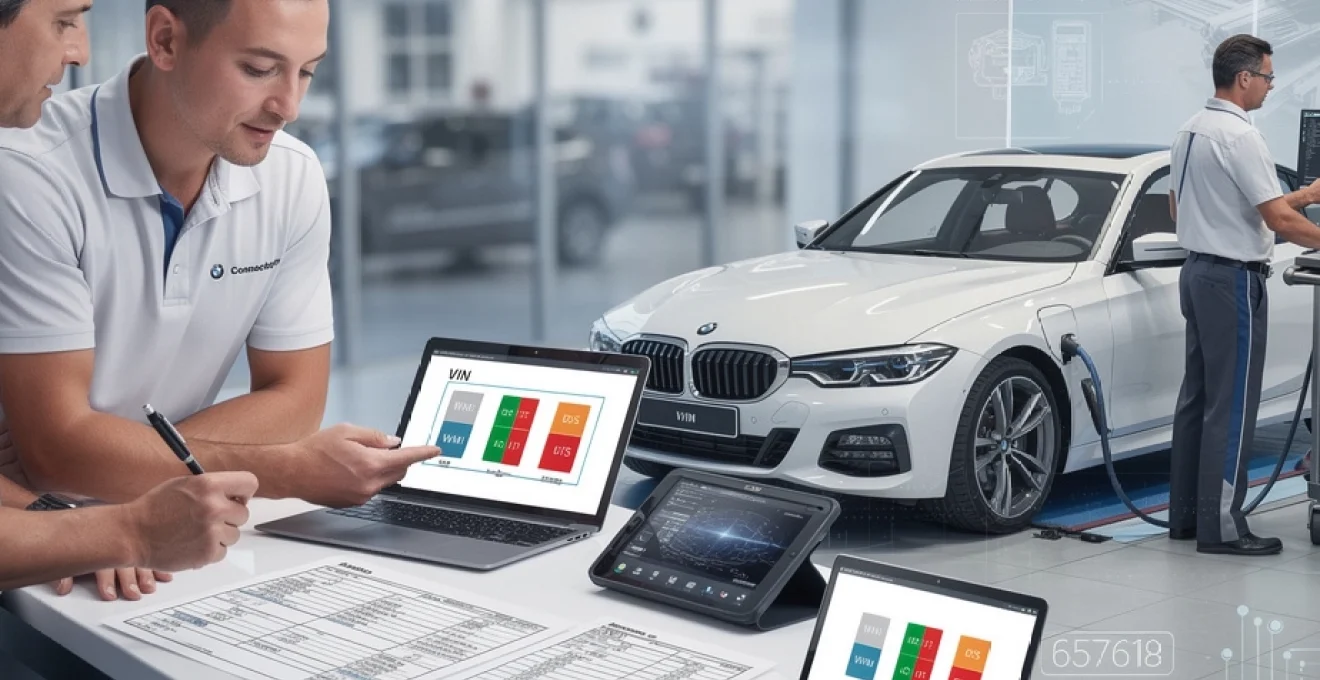
Understanding your BMW’s complete specifications and production details requires more than simply knowing the model name. Every BMW vehicle carries a unique Vehicle Identification Number that serves as a comprehensive fingerprint, containing encoded information about manufacturing location, engine specifications, trim levels, and production sequence. This 17-character alphanumeric code provides access to detailed build sheet information that reveals everything from factory-installed options to specific production codes.
Decoding a BMW build sheet through VIN analysis has become increasingly valuable for owners, buyers, and enthusiasts seeking to verify vehicle authenticity, understand original specifications, or research historical production details. The process involves understanding BMW’s specific encoding methodology, accessing appropriate decoding tools, and interpreting the various data sources that supplement basic VIN information with comprehensive build specifications.
BMW VIN structure and component analysis
BMW follows the international ISO 3779 standard for Vehicle Identification Numbers, creating a systematic 17-character code that divides into three distinct sections. Each section serves a specific purpose in identifying manufacturing details, vehicle characteristics, and production sequencing. Understanding this structure forms the foundation for successful build sheet decoding and ensures accurate interpretation of encoded information.
World manufacturer identifier (WMI) codes for BMW vehicles
The first three characters of every BMW VIN represent the World Manufacturer Identifier, which specifies both the manufacturing country and the specific BMW division responsible for production. Common WMI codes include WBA for BMW passenger vehicles manufactured in Germany, WBS for BMW M performance vehicles, and WBX for BMW X-series models. United States production facilities typically use 5UX, while BMW’s electric i-series vehicles often carry the WBY identifier.
These codes provide immediate insight into the vehicle’s origins and intended market positioning. For example, a VIN beginning with WBS immediately identifies an M-performance vehicle, while WBY indicates BMW’s commitment to sustainable mobility through their i-series lineup. Understanding these prefixes helps verify vehicle authenticity and provides context for subsequent character interpretation.
Vehicle descriptor section (VDS) character positioning
Characters four through nine comprise the Vehicle Descriptor Section, containing encoded information about body style, engine type, restraint systems, and model line. This section requires careful analysis as BMW uses specific coding patterns that vary by production year and market destination. The eighth character typically indicates engine family, while the sixth and seventh characters often specify body style and series designation.
The ninth character serves as a mathematical check digit, calculated using a specific algorithm to validate VIN authenticity. This security feature helps identify potentially fraudulent or incorrectly transcribed VINs. When the check digit calculation doesn’t match the ninth character, it suggests either transcription errors or potential tampering with the Vehicle Identification Number.
Vehicle identifier section (VIS) serial number decoding
The final eight characters form the Vehicle Identifier Section, beginning with the model year designation in the tenth position. BMW uses a rotating system of letters and numbers for model year encoding, with specific characters representing each production year. This system skips potentially confusing characters like I, O, and Q to prevent misinterpretation during manual transcription.
Characters eleven through seventeen contain the manufacturing plant code and sequential production number. The plant code identifies the specific BMW facility where final assembly occurred, while the production number indicates the vehicle’s position in the manufacturing sequence. This information proves valuable for determining production timing and understanding regional manufacturing strategies.
Check digit validation using ISO 3779 standards
The check digit validation process involves assigning numerical values to each VIN character and applying a mathematical formula to generate a verification digit. This process follows strict ISO 3779 standards and provides a reliable method for confirming VIN authenticity. Each character position receives a specific weight value, and the resulting calculation must match the ninth character for validation.
Understanding check digit validation helps identify data entry errors and potential fraud attempts. When performing manual VIN entry for build sheet retrieval, this validation step ensures accuracy and prevents wasted time on invalid number sequences.
BMW build sheet data extraction methods
Extracting complete build sheet information requires
Extracting complete build sheet information requires combining VIN structure knowledge with the right digital tools and data sources. While the VIN itself encodes high-level details such as model, engine family, and production sequence, the full BMW build sheet resides in BMW’s backend systems and associated databases. By using official BMW platforms, diagnostic software, and specialist catalogs, you can translate a basic VIN lookup into a detailed snapshot of how the car left the factory, including paint code, interior trim, option packages, and regional configurations.
In practice, you will often use multiple BMW VIN decoding methods together. For example, you might start with a free VIN decoder for a quick identity check, then move to BMW’s ConnectedDrive portal, ISTA, or ETK to retrieve precise SA option codes and production data. Treat the VIN as your master key: once you have confirmed it is valid using ISO 3779 standards, you can safely feed it into these systems to build a reliable, cross-checked BMW build sheet.
BMW ConnectedDrive portal integration techniques
For many modern BMWs, the ConnectedDrive portal provides a direct route to factory build information once you associate the vehicle with your account. After creating or logging into your BMW ConnectedDrive profile, you can add a vehicle by entering the 17-character VIN, at which point the system verifies the VIN against BMW’s central database. Once the car is linked, you may see specification summaries that mirror items from the build sheet, including model variant, engine output, paint color, production date, and some option packages.
To use ConnectedDrive as a practical BMW build sheet decoding tool, focus on cross-referencing what the portal shows with the VIN structure you have already decoded. Does the engine type shown in ConnectedDrive match the engine family implied by the VDS characters? Are the listed equipment features consistent with what you expect for that series and model year? While ConnectedDrive will not always display every SA option code, it offers an owner-friendly interface that confirms key build sheet elements and can help you spot inconsistencies before you rely on more technical sources.
ETK (electronic parts catalogue) cross-reference systems
BMW’s ETK (Electronic Parts Catalogue) is one of the most powerful tools for decoding a BMW build sheet from the VIN, especially if you want to understand exact part numbers and hardware configurations. When you enter a VIN into ETK, the catalog filters its entire parts database to show only components that apply to that specific vehicle, based on its production date, model code, and option configuration. This creates an indirect but highly detailed view of the build sheet, because you can see which braking system, suspension, interior trim, or electronic modules were installed from the factory.
Using ETK as part of your BMW VIN decoding process is particularly useful if you are planning repairs, restorations, or upgrades. By comparing the listed parts with typical configurations for your model, you can verify whether the car still carries its original equipment or if key systems have been retrofitted. Think of ETK like a parts-focused mirror of the build sheet: while it does not always present SA codes in plain language, the combination of part numbers and option-based filtering allows you to reconstruct the vehicle’s specification in great detail.
ISTA diagnostic software build data retrieval
BMW ISTA (Integrated Service Technical Application) is the diagnostic platform used by BMW dealerships and many independent specialists to interact with vehicle control units. When you connect ISTA to a BMW and run an identification or vehicle test, the software reads the VIN directly from the car’s modules and queries BMW servers for associated build and programming data. This process often returns precise production details, including build date, original software integration level, and option-dependent control unit configurations.
For decoding a BMW build sheet by VIN, ISTA is particularly valuable because it confirms what the car’s electronic architecture believes to be its identity and configuration. If the VIN stored in control units matches the physical VIN plate and the decoded ISO 3779 check digit, you can have greater confidence that the car has not been significantly tampered with. Additionally, ISTA’s control unit tree and measures plans can reveal option-specific modules—such as adaptive suspension controllers or advanced driver assistance systems—that correspond directly to SA option codes listed on the original build sheet.
Third-party VIN decoders: carfax and AutoCheck limitations
Third-party VIN decoders and history services like Carfax and AutoCheck can supplement your BMW build sheet research, but it is important to understand their limitations. These platforms excel at compiling registration events, mileage entries, accident records, and title statuses from multiple data sources, which is invaluable when assessing a used BMW. However, their build specification data is often limited to broad descriptors such as body style, engine displacement, and basic trim level, rather than complete SA option code listings.
When you are specifically trying to decode a BMW build sheet by VIN, treat Carfax and AutoCheck as supporting tools rather than primary specification sources. They can help you verify that the VIN has not been cloned, that the car has not been written off or reported stolen, and that its mileage history looks consistent with production year and usage. Still, for granular details like factory-fitted suspension packages, audio systems, or driver assistance options, you will generally need to rely on BMW’s own systems, specialist BMW VIN decoders, or an official build sheet obtained through a dealership.
BMW production code interpretation
Beyond the 17-character VIN, BMW uses internal production codes and plant identifiers that provide extra context about where and how a vehicle was built. These elements appear partly within the VIN (especially in the VIS section) and partly in BMW’s internal build records and option code listings. Understanding BMW production codes allows you to interpret the build sheet more precisely, distinguishing not just between models, but also between assembly lines, regional specifications, and special editions.
When you decode BMW production data from the VIN, you are essentially translating a compressed label into a timeline and geography. Which plant assembled the vehicle? Which model year coding scheme applies to the 10th character? How does the sequential production number relate to production batches or early and late builds within a generation? Answering these questions helps you move from simple decoding into a deeper understanding of the vehicle’s place within BMW’s broader production strategy.
Manufacturing plant identification codes
The manufacturing plant code is embedded in the VIS section of the BMW VIN, typically at position 11, and it plays a key role in interpreting the build sheet. Each letter or number corresponds to a specific assembly plant, such as Munich, Dingolfing, Regensburg, Spartanburg, or other regional facilities. When you map this character to BMW’s plant code list, you can confirm the actual origin of the car, which may differ from assumptions based solely on the WMI (for example, some X-series models built in the USA but marketed in Europe).
Why does this matter when decoding a BMW build sheet? Plant codes often correlate with subtle variations in equipment packages, local supplier choices, or regional compliance features. For instance, a BMW manufactured in Spartanburg may have different standard towing preparations compared with a sedan built in Germany, even if they share similar VIN descriptors. By combining plant identification with ETK or ISTA data, you can see how the build sheet reflects the specific capabilities and standards of that production facility.
Model year encoding in position 10
Position 10 of the BMW VIN contains the model year encoding, which is crucial for interpreting build sheets accurately. BMW follows the industry convention of rotating letters and digits to denote successive years, skipping confusing letters such as I, O, and Q. For example, a G might denote one specific model year, while an H denotes the next, and eventually the sequence shifts to numbers before cycling back. Accurate interpretation of this character ensures that you match the build sheet against the correct model year catalog and option structure.
When you decode the model year from the 10th character, you can immediately narrow down which SA codes and option packages were available at the time of production. This is particularly important for BMW, where feature content can change mid-cycle, sometimes even within a single model year. Think of the 10th character as the timestamp for your BMW build sheet: it anchors every other decoded element—engine calibration, infotainment generation, safety systems—to a specific point in BMW’s product evolution.
Sequential production number analysis
The final characters of the VIS section (typically positions 12 through 17) represent the sequential production number, and while they do not directly list options, they help contextualize the build sheet. This number indicates the order in which the vehicle passed through BMW’s assembly process within a specific plant and model configuration. Early numbers in a production run may be associated with launch specifications, while later numbers can reflect running changes, technical updates, or option package revisions.
How can you use sequential production numbers when decoding a BMW build sheet? When combined with plant codes and model year data, they let you identify whether your car is part of an early batch that might have unique equipment or software, or a later series that benefits from incremental improvements. In enthusiast circles, this information can also affect collectability, particularly for limited-production models where specific number ranges are especially sought after.
Special edition and M-Performance vehicle markers
BMW special editions and M-Performance models often include unique markers within their VIN and production codes, as well as distinctive SA option code bundles. While the WMI WBS is the most obvious flag for full M models, additional cues can appear in the VDS and VIS that correlate with M-Performance variants or limited-run editions. For instance, specific model codes and production codes may be reserved for Competition packages, anniversary editions, or exclusive market-only configurations.
When you decode a BMW build sheet for a vehicle that might be a special edition, look for clusters of performance and cosmetic SA codes that align with known packages, such as unique wheels, suspension calibrations, interior trims, or commemorative badging. Cross-referencing the VIN with ETK and official BMW documentation can confirm whether you are dealing with a genuine M-Performance or limited-edition car, rather than a standard model that has been cosmetically modified after purchase. This is where VIN decoding becomes a powerful protection against misrepresented vehicles in the used market.
BMW option code (SA code) decoding methodology
While the VIN establishes the framework of your BMW’s identity, the true depth of the build sheet comes from BMW’s SA (Sonderausstattung) option codes. These are alphanumeric identifiers, typically three digits, that describe specific factory-installed features such as sport seats, navigation systems, suspension packages, lighting upgrades, and driver assistance systems. Decoding SA codes transforms a generic description like “3 Series sedan” into a precise profile of your car’s original configuration.
To decode BMW SA codes from a VIN, you usually need access to systems that map VINs to option lists—either through BMW’s own databases, dealership tools, or specialist online services that query BMW’s back-end. Once you have the SA list, the process becomes similar to translating a technical language: each code, such as S704A for M Sport suspension or S609A for navigation system Professional, can be looked up in a code table or ETK notes. As you interpret each code, you gradually rebuild the full BMW build sheet, revealing exactly how the vehicle was ordered and produced.
One effective approach is to organize the decoded SA codes into logical categories: safety, chassis, powertrain, comfort, infotainment, and appearance. This mirrors how BMW itself structures option packages and helps you see patterns, such as sports-oriented builds with performance brakes and suspension, or luxury-oriented builds with advanced driver assistance and upgraded leather. When you compare this structured build sheet against the current condition of the car, you can quickly identify missing or retrofitted components and assess how faithfully the car reflects its original specification.
Build sheet verification through BMW dealership networks
Even with strong VIN decoding skills and access to online tools, one of the most reliable ways to obtain and verify a BMW build sheet is through the official dealership network. Authorized BMW dealers can access internal systems that link VINs to complete factory order data, including production date, market destination, package contents, and individual SA codes. In many cases, they can print or email a specification sheet that serves as an authoritative reference for your vehicle’s original configuration.
How do you leverage this in practice? You can contact your local BMW dealer with the VIN and request a copy of the vehicle’s original specification or build sheet, explaining that you are verifying equipment or researching the car’s history. Some dealerships will provide this as a courtesy, while others may require an appointment or proof of ownership. When you receive the official document, compare it line by line with the information you have decoded from ConnectedDrive, ETK, ISTA, or third-party tools. Any discrepancies could highlight retrofits, coding changes, or, in rare cases, issues with the vehicle’s identity.
Dealership verification also offers a practical advantage if you are planning to retrofit options that were available from the factory but not originally fitted to your car. By knowing exactly which SA codes are missing, you can discuss with the dealer or an independent specialist whether BMW supports official retrofits or software activation. In this way, the build sheet is not just a static historical document; it becomes a roadmap for future upgrades and maintenance decisions that are consistent with BMW’s engineering standards.
Common BMW VIN decoding challenges and solutions
Decoding a BMW build sheet by VIN is a powerful technique, but it is not without challenges. Older vehicles, gray imports, and heavily modified cars can all present obstacles to straightforward interpretation. Sometimes, you will encounter VINs that appear valid according to ISO 3779 rules but do not return complete data in modern systems, especially for pre-1981 vehicles or those produced for niche markets. In other cases, option codes may have changed meaning over time, or regional variations may cause confusion when you compare SA lists across different markets.
One frequent issue is the mismatch between what you see on the car and what the decoded BMW build sheet suggests. For example, the VIN and SA codes might indicate halogen headlights, yet the car currently has LED or xenon units. In such situations, ask yourself: has the car been upgraded with aftermarket parts, or was there a factory retrofit program that does not appear in the original build sheet? Cross-checking ETK part numbers, ISTA control unit configurations, and dealership records can help you separate genuine retrofits from potential misrepresentations.
Another common challenge arises when third-party VIN decoders provide incomplete or inconsistent information, particularly for complex BMW models with many overlapping option packages. The solution is to treat these tools as starting points rather than final authorities. Always validate the core VIN structure using check digit logic, confirm plant and model year codes, and then rely on BMW’s own systems or official dealer records for detailed SA code decoding. By approaching the process like assembling a puzzle—where each tool provides a different piece—you can overcome data gaps and build a coherent, accurate picture of your BMW’s original specification.
Finally, remember that decoding a BMW build sheet by VIN is both a technical and interpretive exercise. The VIN gives you a structured code, the BMW databases give you raw option listings, and your own analysis connects these elements into meaningful insight about the car’s history, value, and authenticity. When you combine logical VIN analysis, cross-referenced data sources, and, where necessary, expert confirmation from a BMW dealer or specialist, you can navigate challenges with confidence and unlock the full story hidden in your BMW’s 17-character identification number.