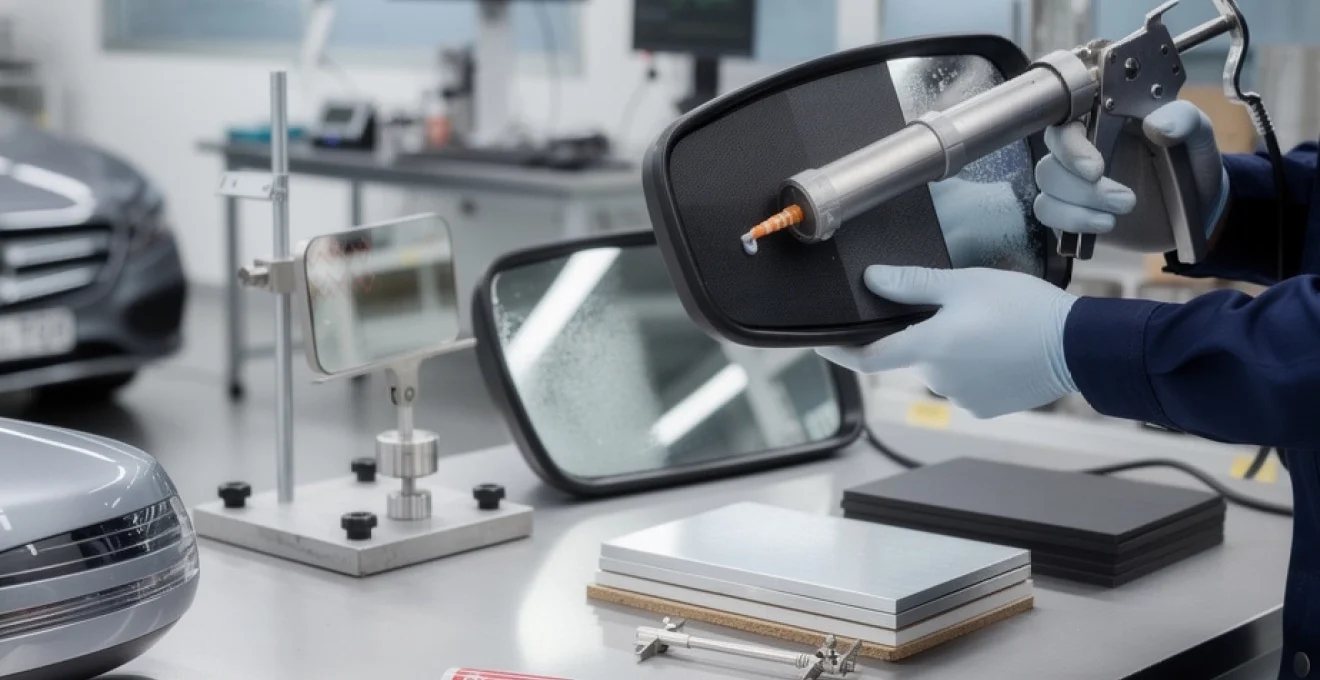
Wing mirror damage ranks among the most common automotive repairs UK drivers face, with an estimated 1.3 million wing mirror replacements performed annually across Britain. While the glass component itself may remain intact, the adhesive bond between the mirror glass and its backing plate frequently fails due to thermal stress, vibration, or moisture ingress. Selecting an appropriate adhesive for wing mirror reattachment requires understanding the complex interplay between chemical formulation, material compatibility, and environmental performance criteria. Modern automotive adhesives must withstand temperature extremes ranging from winter frost to summer heat, resist constant vibration from road surfaces, and maintain bond integrity despite exposure to rain, salt spray, and UV radiation. The engineering challenge becomes even more demanding when dealing with heated mirror elements, where thermal conductivity and electrical insulation properties must be carefully balanced. This comprehensive analysis examines the technical specifications, performance characteristics, and practical application methodologies that define professional-grade wing mirror adhesives, providing you with the knowledge to select the optimal bonding solution for your specific repair requirements.
Understanding polyurethane vs epoxy resin adhesive formulations for wing mirror glass
The fundamental chemistry underlying automotive adhesives determines their performance envelope and suitability for mirror glass applications. Two primary formulation families dominate the professional automotive sector: polyurethane-based systems and epoxy resin compounds. Each chemistry offers distinct advantages and limitations that directly impact bond durability, application methodology, and long-term reliability. Understanding these chemical distinctions enables you to match adhesive properties to the specific demands of your mirror repair scenario.
Chemical composition of Two-Part polyurethane adhesives
Two-component polyurethane adhesives consist of a polyol resin base and an isocyanate hardener that undergo exothermic polymerisation upon mixing. This reaction creates urethane linkages forming a cross-linked polymer matrix with exceptional elasticity and impact resistance. The flexible molecular structure of cured polyurethane provides outstanding vibration damping characteristics, absorbing the constant mechanical stress transmitted through wing mirror assemblies during vehicle operation. Modern polyurethane formulations typically achieve tensile strengths between 15-25 MPa and exhibit elongation at break values of 200-400%, allowing the bond to flex without fracturing under dynamic loading conditions. The mixing ratio between components critically influences cure rate and final properties, with most automotive-grade systems requiring precise 1:1 or 2:1 volumetric ratios. Polyurethane adhesives demonstrate superior performance in applications where flexibility and impact absorption take priority over absolute maximum strength.
Epoxy resin bonding strength and curing time specifications
Epoxy adhesives comprise epoxide resin molecules and polyamine or polyamide hardening agents that form rigid three-dimensional networks through addition polymerisation. This chemical architecture produces exceptionally high tensile and shear strengths, with premium automotive formulations achieving bond strengths exceeding 30 MPa on glass and metal substrates. The curing process typically progresses through distinct phases: an initial working time of 3-10 minutes, followed by handling strength at 30-60 minutes, and full cure completion between 24-72 hours depending on ambient temperature and formulation. Epoxy systems offer minimal shrinkage during cure—typically less than 2%—which preserves dimensional accuracy and reduces internal stress at the bond interface. However, the rigid molecular structure provides less vibration tolerance than polyurethane alternatives, making epoxy formulations most suitable for larger mirror assemblies where maximum bonding strength outweighs flexibility requirements. You should consider epoxy options when repairing premium vehicle mirrors with substantial glass surface areas or when bonding to aluminium backing plates.
Silicone-based adhesives and temperature resistance properties
Silicone adhesives utilise polydimethylsiloxane polymer chains that cure through moisture-initiated cross-linking or condensation reactions with metal catalysts. The silicon-oxygen backbone structure provides extraordinary temperature stability, maintaining bond integrity across operating ranges from -60°C to +250°C—far exceeding the thermal performance of polyurethane or epoxy alternatives. This thermal resilience makes silicone formulations particularly valuable for heated mirror applications where electrical elements generate localised temperature elevations. Silicone adhesives also demonstrate exceptional UV resistance and weathering stability, with minimal
loss of mechanical properties after prolonged UV exposure. Because cured silicone remains elastomeric rather than rigid, it can accommodate differential thermal expansion between the wing mirror glass and the backing plate without transmitting excessive stress to the adhesive line. The trade-off is that silicone-based wing mirror glass adhesive systems generally exhibit lower ultimate tensile strength than epoxy or polyurethane, with typical values in the 1-3 MPa range. For most external mirror applications, this is more than adequate when combined with the material’s excellent peel resistance and long-term flexibility. You should prioritise silicone when temperature extremes, UV stability, and a forgiving application process are more important than maximum structural strength.
Uv-resistant acrylic adhesive technologies for automotive applications
UV-resistant acrylic adhesives occupy a specialised niche in automotive mirror bonding, combining rapid curing with excellent adhesion to low surface energy plastics. These systems are often available as structural acrylics or as pressure-sensitive adhesives (PSAs) used in high-performance double-sided tapes. The core chemistry is based on methacrylate or acrylate monomers that polymerise into a robust network, offering shear strengths in the 8-20 MPa range depending on the formulation. When stabilised with UV absorbers and HALS (hindered amine light stabilisers), these acrylics maintain clarity and strength even after thousands of hours of outdoor exposure.
For wing mirror glass adhesive applications, UV-resistant acrylic formulations prove particularly valuable when bonding to polypropylene, polyethylene, or certain modified ABS plastics that are notoriously difficult for conventional epoxies to wet out. Many OEMs and tier-one suppliers employ acrylic foam tapes, such as 3M VHB, to mount mirror glass onto backing plates due to their combination of viscoelastic damping and long-term environmental resistance. While these tapes may look deceptively simple, their adhesive cores are engineered to handle significant loads, thermal cycling, and moisture without creep. If you require a clean, low-mess installation with immediate handling strength, a UV-stable acrylic tape or liquid structural acrylic can be an excellent choice, provided you follow the substrate preparation recommendations from the manufacturer.
Assessing adhesive compatibility with wing mirror backing plates and glass types
Choosing the best wing mirror glass adhesive is not just about chemistry in isolation; it is about how that chemistry interacts with specific substrates. Different backing plate materials, glass constructions, and mirror geometries introduce unique challenges that can make or break the bond over time. A formulation that works perfectly on a flat, unheated mirror may fail prematurely on a heated, aspheric lens bonded to a thin ABS carrier. To avoid such issues, you need to evaluate adhesive compatibility with both the backing plate and the glass type before committing to any product.
Aluminium and ABS plastic backing plate material requirements
Aluminium backing plates, common on premium and performance vehicles, offer excellent dimensional stability and heat dissipation but require careful surface preparation. The native oxide layer on aluminium can either aid or hinder adhesion depending on its thickness and contamination level. For epoxy or polyurethane wing mirror glass adhesive systems, light abrasion followed by degreasing with isopropyl alcohol typically yields a reliable surface, and some professionals go a step further with an adhesion-promoting primer. The key is to create a clean, slightly roughened surface that allows the adhesive to achieve both mechanical interlock and chemical bonding.
ABS plastic backing plates, widely used on mass-market wing mirrors, pose a different set of requirements. ABS is more flexible and has a lower surface energy than metals, which can reduce the wetting behaviour of rigid adhesives. Polyurethane and silicone adhesives tend to accommodate ABS movement better, reducing stress concentrations at the bond line during vibration and thermal cycling. When using acrylic or epoxy on ABS, an appropriate plastic primer or flame treatment can significantly improve adhesion. You should always confirm that the adhesive manufacturer explicitly lists ABS or the specific plastic blend used in the mirror housing as a compatible substrate, as many automotive parts are made from proprietary polymer formulations.
Heated mirror glass and adhesive thermal conductivity considerations
Heated wing mirrors introduce additional engineering constraints, as the adhesive must tolerate repeated heating cycles while preserving both electrical insulation and mechanical integrity. Heating elements bonded to the rear of the mirror glass typically operate in the 10-20 W range, raising the glass temperature to improve demisting performance. A suitable wing mirror glass adhesive for heated units needs to maintain stable properties across this temperature band, without softening, outgassing, or losing adhesion. Silicone and high-performance polyurethane formulations often excel here due to their broad service temperature ranges and resilience under dynamic thermal load.
Thermal conductivity is another subtle but important factor. While you do not want an adhesive that conducts electricity, you do want one that allows efficient heat transfer from the element to the glass surface. Excessively thick, low-conductivity adhesive beads can act like an insulating blanket, slowing demisting times and creating uneven temperature distributions that may stress the glass. A thin, continuous adhesive layer, applied in a controlled pattern, usually offers the best compromise between mechanical bonding and thermal performance. When working with heated mirrors, it is also vital to avoid adhesives that contain metallic fillers or conductive particles, as these can bridge electrical paths and risk short circuits.
Aspheric and convex glass surface preparation techniques
Aspheric and convex mirror glasses, designed to reduce blind spots and improve driver visibility, require more meticulous handling and preparation than simple flat panes. Their curved geometries mean that uniform adhesive distribution becomes critical; too much adhesive at one point can create high local stresses or even distort the optical surface. Before applying any wing mirror glass adhesive, you should thoroughly degrease the rear surface of the glass using a lint-free cloth and a compatible cleaner. Avoid harsh solvents such as acetone unless the adhesive manufacturer specifically approves them, as they can damage certain coatings or heating elements.
For best results, many professionals lightly abrade the backing plate rather than the glass, preserving the integrity of reflective and conductive layers while still providing a mechanical key for the adhesive. On curved glass, it is good practice to apply the adhesive in a network of thin beads or a lattice pattern, staying at least 8–10 mm from the outer edge to prevent squeeze-out. This approach promotes even stress distribution once the glass is pressed onto the backing plate. If you are re-bonding aspheric or convex glass by hand, consider using temporary alignment tabs or masking tape to prevent the glass from sliding out of position during the initial cure phase.
OEM specifications for Mercedes-Benz and BMW mirror adhesives
Original equipment manufacturers such as Mercedes-Benz and BMW specify stringent criteria for mirror bonding to ensure long-term safety and performance. Their engineering standards typically call for adhesives that pass internal validation tests covering vibration, corrosion resistance, and thermal cycling beyond what standard consumer products are required to achieve. While the exact formulations are often proprietary, many of these systems are based on modified polyurethanes, silane-terminated polymers (STPs), or high-performance silicones designed for automated application on production lines. When you see a factory-fitted mirror that remains secure after a decade of motorway driving, it is usually the result of such tailored adhesive technologies.
For aftermarket or repair scenarios, OEMs or their approved suppliers may offer service kits that match the chemical family used in production. For example, BMW and Mercedes-Benz dealerships often stock specific mirror adhesive pads or cartridges engineered to work with their aluminium and plastic backing plates, as well as their heated and auto-dimming glass assemblies. If you are working on a high-value vehicle where maintaining OEM standards is essential, checking the manufacturer’s technical documentation or consulting a dealer parts department can prevent costly mistakes. Although general-purpose wing mirror glass adhesive products can work, aligning with OEM specifications provides additional assurance that the bond will withstand the rigorous demands of premium vehicles.
Evaluating adhesive performance under automotive environmental stresses
Even the most carefully selected wing mirror glass adhesive will fail prematurely if it cannot endure the harsh conditions vehicles face in daily use. From constant vibration on rough roads to repeated freeze–thaw cycles and aggressive de-icing salts, the adhesive joint must perform like a miniaturised structural component. How can you be confident that your chosen product will cope with these stresses over the long term? The answer lies in understanding the standardised test methods and performance metrics that reputable adhesive manufacturers use to validate their products.
Vibration resistance testing standards ISO 16750-3
ISO 16750-3 provides the benchmark for assessing how automotive components behave under mechanical loads, including vibration and mechanical shock. For wing mirror glass adhesive systems, compliance with this standard indicates that the bonded assembly has been exposed to vibration profiles representative of real-world driving conditions on various road types. In laboratory tests, mirror assemblies are mounted to shaker tables and subjected to multi-axis vibration for extended durations, sometimes exceeding 24 hours, to simulate years of service. Adhesives that pass these tests demonstrate their ability to maintain bond integrity without cracking, delaminating, or creeping under cyclic loading.
When reviewing technical data sheets, look for references to vibration testing or explicit mention of ISO 16750-3 or equivalent internal protocols. Polyurethane and acrylic foam tape systems often exhibit excellent damping behaviour due to their inherent viscoelasticity, acting like miniature shock absorbers that dissipate energy before it reaches the glass. Epoxy-based wing mirror glass adhesive products can also perform well if they are formulated with toughening agents that reduce brittleness. If you drive frequently on poorly maintained roads or use your vehicle for commercial purposes, prioritising adhesives with proven vibration resistance is a wise investment in long-term durability.
Thermal cycling from -40°C to +80°C and bond integrity
Thermal cycling tests replicate the dramatic temperature swings a vehicle experiences throughout the year, especially in climates where winter mornings and summer afternoons can differ by over 50°C. Standard automotive qualification regimes subject adhesive joints to repeated transitions between low and high setpoints, often from -40°C up to +80°C or even higher for certain components. Each cycle causes the bonded materials and the adhesive to expand and contract, potentially generating shear and peel stresses at the interface. Over dozens or hundreds of cycles, inferior wing mirror glass adhesive formulations can develop microcracks, lose adhesion, or exhibit cohesive failure.
Silicone and polyurethane systems generally handle thermal cycling well due to their flexibility and ability to accommodate differential expansion between glass and plastic or metal backing plates. Rigid epoxies may require careful design of the bond line thickness to mitigate stress; a slightly thicker adhesive layer can act as a compliant buffer, much like a rubber gasket between two rigid parts. When comparing products, check whether the supplier publishes thermal cycling data, including the number of cycles completed and any observed degradation modes. For drivers in regions with severe winters or hot summers, prioritising adhesives with documented thermal cycling performance can prevent your wing mirror glass from debonding just when you rely on it most.
Moisture and salt spray exposure according to ASTM B117
Coastal environments and winter road treatments expose vehicles to salt-laden moisture that accelerates corrosion and can attack poorly protected adhesive joints. ASTM B117 salt spray testing is widely used in the automotive industry to evaluate how components withstand corrosive atmospheres over extended periods. In a typical test, bonded specimens are placed in a controlled chamber where they are continuously exposed to a fine mist of saline solution at elevated temperature. For a wing mirror glass adhesive, success means maintaining adhesion and cohesive strength without blistering, swelling, or allowing corrosion to creep under the bond line.
Metal backing plates, fasteners, and heating element terminations are particularly vulnerable to salt-induced corrosion if the adhesive absorbs moisture or fails to seal the interface effectively. Many high-performance polyurethane, silicone, and acrylic systems are formulated to be highly water-resistant, creating a barrier that helps protect underlying substrates. When examining candidate products, look for descriptors such as “salt spray resistant,” “marine-grade,” or explicit references to ASTM B117 performance. If you frequently drive on gritted roads in winter or live near the coast, opting for a wing mirror glass adhesive with proven corrosion protection will significantly extend the life of your repair.
UV degradation and weathering resistance metrics
Continuous exposure to sunlight can be as damaging to adhesives as it is to exterior plastics and paints. UV radiation can break down polymer chains, leading to embrittlement, loss of adhesion, and discolouration. To guard against this, many wing mirror glass adhesive formulations incorporate UV stabilisers and antioxidants, which slow the degradation process and extend service life. Weathering resistance is typically evaluated using accelerated ageing tests in xenon-arc or UV fluorescent chambers, where specimens undergo repeated cycles of light, heat, and moisture that simulate months or years of outdoor exposure.
In technical documentation, you may see results expressed in terms of hours to a defined level of degradation—for example, “no significant loss of adhesion after 1,000 hours of QUV-B exposure.” Silicone and UV-stable acrylic systems generally lead the pack in UV durability, while unmodified epoxies may yellow or chalk over time if not shielded from direct light. Because wing mirrors are constantly exposed to sunlight, especially on vehicles parked outdoors, it makes sense to favour adhesives with documented weathering resistance. Doing so reduces the risk that your carefully applied wing mirror glass adhesive will become brittle and fail just a few summers down the line.
Comparing commercial wing mirror adhesive products and brands
Armed with a solid understanding of adhesive chemistries, substrate compatibility, and environmental performance, you are now in a strong position to evaluate real-world products. The automotive aftermarket offers a wide array of wing mirror glass adhesive solutions, from consumer-grade kits to professional structural bonding systems used in OEM production. How do you decide which brand and product line best align with your specific repair task and vehicle type? Examining the technical specifications and application guidelines of market-leading products provides valuable clues.
Loctite SI 5399 silicone adhesive technical specifications
Loctite SI 5399 is a high-temperature, room-temperature vulcanising (RTV) silicone designed for sealing and bonding applications exposed to elevated heat. Its formulation offers continuous service temperature capability up to approximately +250°C, making it well suited to heated wing mirror glass assemblies. As a one-part, moisture-curing silicone, it simplifies application: you extrude it directly from the cartridge, position the mirror glass, and allow ambient humidity to drive the cure. Typical skin-over times are in the 10–20 minute range, with full cure achieved in 24 hours at standard temperature and humidity.
From a performance standpoint, Loctite SI 5399 provides good adhesion to glass, ceramics, metals, and many plastics without the need for a separate primer, although adhesion promoters can enhance bond strength on difficult substrates. Its tensile strength is modest compared with structural epoxies, but its elongation-at-break values—often in the 200–400% range—deliver excellent flexibility and vibration tolerance. For users seeking a reliable, temperature-resistant wing mirror glass adhesive that can be applied without specialised equipment, SI 5399 represents a robust, professional-grade option. Its red coloration also offers a visual cue during application, helping you to control bead size and placement.
3M Scotch-Weld DP8005 acrylic adhesive performance data
3M Scotch-Weld DP8005 is a two-part structural acrylic adhesive engineered specifically for bonding low surface energy plastics such as polypropylene and polyethylene. While these materials are not the most common backing plate substrates, they increasingly appear in weight-optimised mirror assemblies and housings where traditional adhesives struggle. DP8005 achieves strong bonds without the need for surface priming or chemical etching, relying instead on a specialised acrylic chemistry that can wet out and interact with these notoriously difficult plastics. If your wing mirror backing plate is identified as PP, PE, or a similar low-energy polymer, DP8005 immediately becomes a strong candidate.
In terms of performance, DP8005 offers lap shear strengths typically in the 7–12 MPa range on plastics, with a working time of around 3 minutes and handling strength in approximately 3 hours at room temperature. It retains significant strength after exposure to moisture and many automotive fluids, and its toughened acrylic backbone delivers good impact resistance. Because it is supplied in a dual-cartridge format, proper mixing via a static mixer nozzle is essential to achieve consistent curing. For professional workshops or experienced DIYers dealing with challenging backing plate materials, DP8005 provides a powerful solution where more conventional wing mirror glass adhesive products might fail.
Sika automotive bonding solutions for mirror assembly
Sika is a major supplier of structural adhesives to the global automotive industry, and its portfolio includes several products that are directly relevant to wing mirror glass bonding. SikaFlex polyurethane sealants and SikaForce structural adhesives are widely used for exterior trim, glass bonding, and mirror assembly operations on production lines. Many of these formulations are designed to work in combination with Sika’s specialised primers, which condition glass, metal, and plastic surfaces to enhance adhesion and long-term durability. The result is integrated bonding systems that meet strict OEM specifications for safety and longevity.
For aftermarket repairs, Sika offers one- and two-component polyurethane products that can double as high-performance wing mirror glass adhesive solutions. These materials typically exhibit tensile strengths in the 5–10 MPa range, elongation over 400%, and excellent resistance to weathering and road chemicals. Their ability to damp vibration and absorb impact makes them particularly attractive for vehicles that see heavy use on rough roads. While some Sika products require more careful surface preparation and primer application than simple consumer kits, the payoff is a bond line that closely mirrors OEM performance. If you are aiming for a repair that feels “factory-correct,” Sika’s automotive bonding solutions deserve serious consideration.
Teroson 8597 HMLC polyurethane adhesive application guidelines
Teroson 8597 HMLC is a high-modulus, low-conductivity (HMLC) polyurethane adhesive commonly associated with direct glazing and automotive glass bonding. Its low electrical conductivity makes it particularly suitable in areas where proximity to antennas, heating elements, or sensors could otherwise raise concerns about interference or stray currents. While primarily intended for windscreen and fixed glass installations, its mechanical and environmental properties also position it as a capable wing mirror glass adhesive when used within manufacturer guidelines. High modulus means it provides strong structural support, while its formulation still offers enough flexibility to withstand vibration and thermal movement.
When applying Teroson 8597 HMLC, strict adherence to the recommended primers and activators is crucial. The manufacturer typically specifies a dedicated glass primer and, where necessary, a metal or plastic primer for the backing plate to ensure optimal adhesion. Bead geometry and open time must also be respected, as the adhesive begins to skin over relatively quickly once extruded. After installation, cure times vary with temperature and humidity, but safe drive-away or handling times are often specified between 1 and 4 hours under standard conditions. For professional technicians who already use HMLC systems for windscreen replacement, leveraging Teroson 8597 as a wing mirror glass adhesive offers the advantages of familiar handling characteristics and proven automotive durability.
Application methodology and surface preparation protocols
The best wing mirror glass adhesive in the world will underperform if it is applied to a contaminated or poorly prepared surface. Effective bonding starts long before you open the adhesive cartridge; it begins with systematic cleaning, inspection, and mechanical preparation of both the glass and the backing plate. Think of this stage like laying foundations for a building: if the groundwork is weak, everything built on top is compromised. By following a disciplined methodology, you greatly increase the likelihood that your repair will last for the remaining life of the vehicle.
Begin by removing any residual adhesive, foam pads, or double-sided tape from the backing plate using a plastic scraper, taking care not to gouge the substrate or damage heating elements. For stubborn residues, a dedicated adhesive remover or a small amount of isopropyl alcohol can help, but always confirm compatibility with plastics and paints beforehand. Once the bulk material is gone, lightly abrade the bonding area with fine-grit sandpaper—around P320 to P600—to create a uniform, matte surface. This step enhances mechanical adhesion, especially for epoxies and polyurethanes, while also removing any surface gloss that may harbour oils or mould-release agents from manufacturing.
After abrasion, thoroughly clean both the backing plate and the mirror glass with a lint-free cloth and a recommended cleaner such as 70% or 99% isopropyl alcohol. Wipe in one direction rather than circular motions to avoid re-depositing contaminants, and allow the surfaces to dry completely. If your chosen wing mirror glass adhesive system includes a primer or activator, apply it now following the manufacturer’s instructions for coverage, flash-off time, and any required second coats. Primers can dramatically improve bond strength on metals and plastics, but only if they are applied sparingly and allowed to react properly with the substrate.
When it comes to actual adhesive application, consistency and bead geometry are key. For bead-applied products, run a continuous bead approximately 5–10 mm from the edge of the mirror glass, adjusting the diameter to the manufacturer’s recommendations. Interruptions or gaps in the bead can create leak paths for moisture or reduce the effective bonding area. On curved or aspheric mirrors, you might use a lattice or zigzag pattern within the central area to ensure complete coverage without excessive squeeze-out. Once applied, align the glass with the backing plate and press it firmly but evenly into position, avoiding point loads that could crack the glass or stress the heating elements.
To maintain alignment during the initial cure period, temporary supports are often necessary. Masking tape, small wedges of foam, or purpose-designed clamping fixtures can hold the glass in place without introducing additional tension. For many consumer-grade silicones and polyurethanes, a simple cross of masking tape over the mirror face, anchored to the housing, is sufficient to prevent sliding. Check that the mirror remains correctly aligned from the driver’s seat; a misaligned mirror may technically be bonded but will compromise safety and may not meet inspection standards. Once you are satisfied with the position, leave the assembly undisturbed for at least the minimum handling time specified in the adhesive’s datasheet.
Adhesive curing parameters and bond strength verification methods
Curing is the phase during which your wing mirror glass adhesive transitions from a liquid or paste into a solid, load-bearing material. It is tempting to assume that once the mirror “feels” secure, the job is done, but in reality the bond continues to develop strength long after the surface becomes tack-free. Understanding the curing parameters of your chosen adhesive—time, temperature, humidity, and joint thickness—helps you avoid premature loading that could weaken the bond. In practice, this means being patient and respecting manufacturer recommendations, even if the mirror appears stable to the touch.
Most one-part moisture-curing silicones and polyurethanes build strength from the outside in, with cure rates expressed in millimetres per 24 hours at a given temperature and humidity. If you apply a thick bead in a cool, dry environment, the inner regions may remain uncured for significantly longer than the datasheet’s nominal values. Two-part systems, such as epoxies and structural acrylics, cure through chemical reaction between components and are less dependent on ambient moisture, but their kinetics still change with temperature. As a rule of thumb, a 10°C drop in temperature can double the time required to reach a given strength, while a 10°C increase can halve it. Planning your repair in a controlled environment—such as a garage rather than an open driveway—helps you maintain consistent curing conditions.
How can you verify that your wing mirror glass adhesive has reached sufficient strength for safe use? In professional settings, technicians may use standardised mechanical tests on sample coupons or refer to published strength development curves that relate curing time to percentage of final strength. For DIY repairs, practical checks involve gently attempting to move the mirror after the recommended handling time, applying only light pressure. If you detect any creep or movement, extend the curing period before driving, especially at motorway speeds where aerodynamic forces on the mirror increase considerably. It is far better to wait an extra 12 hours than to risk the glass detaching on the road.
Some high-end adhesive systems also allow non-destructive evaluation through visual inspection of witness beads or through hardness testing on cured excess material. For example, you might leave a small blob of adhesive on a disposable surface next to the work area; once this sample is fully hardened and no longer deforms under firm fingernail pressure, the joint itself is likely to have reached a comparable cure state. In critical applications, technicians sometimes perform torque or peel tests on sacrificial assemblies built alongside the actual component to verify that targeted strength levels have been achieved before releasing the vehicle. While such methods may be beyond the scope of most home users, they illustrate the level of rigour applied in professional environments.
Ultimately, achieving a long-lasting wing mirror repair is a combination of choosing the right adhesive, preparing the surfaces correctly, and giving the bond enough time to develop. If you respect these curing parameters and, where possible, verify the bond’s integrity through careful inspection and gentle testing, you can have confidence that your wing mirror glass adhesive will perform reliably for years of daily driving.