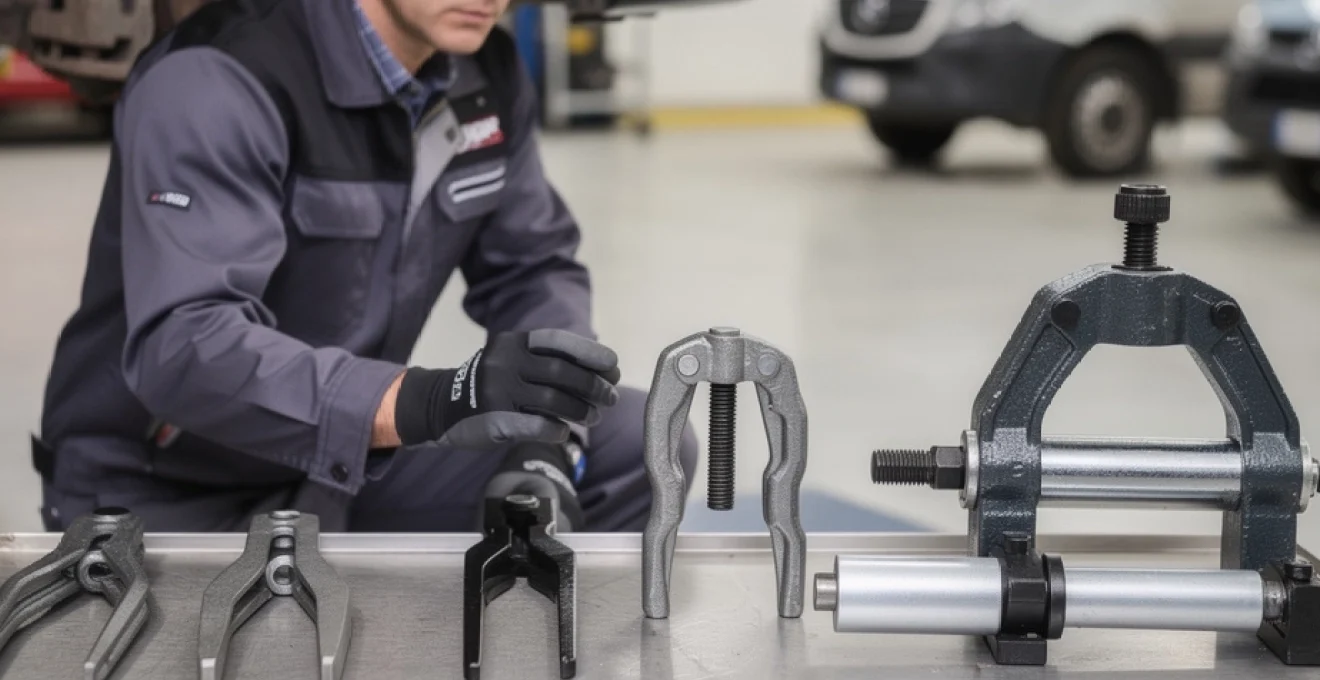
Separating ball joints ranks among the most challenging tasks in suspension and steering repairs, requiring specialized tools that can overcome significant mechanical resistance. Whether you’re tackling a weekend control arm replacement or running a professional garage, selecting the appropriate ball joint splitter determines the difference between efficient completion and hours of frustration. The automotive tool market offers numerous separator designs, each engineered for specific applications and force requirements. Understanding these variations enables you to invest wisely in equipment that matches your working conditions and vehicle specifications.
Screwfix stocks an extensive range of ball joint separators from manufacturers including Laser, Sealey, and Draper Expert, each presenting distinct mechanical advantages. The discussion forums reveal a common frustration: purchasing inadequate tools that fail when confronted with seized joints or insufficient clearance around modern suspension assemblies. This challenge affects both enthusiasts and professionals, as evidenced by the growing preference for hydraulic separation systems in commercial workshops. Making an informed choice requires examining design configurations, material specifications, and compatibility factors that directly impact your success rate.
Understanding ball joint separator design types available at screwfix
The fundamental approach to ball joint separation has evolved considerably, with modern tools reflecting decades of refinement in mechanical force application. Traditional methods involving hammers and chisels have given way to engineered solutions that protect surrounding components whilst delivering concentrated separating force. Screwfix offers three primary design categories, each addressing specific constraints imposed by vehicle architecture and joint configurations. Recognising these distinctions prevents the common mistake of purchasing tools incompatible with your intended application.
Fork-style ball joint splitters: laser 6057 and sealey SEP2 models
Fork-type separators represent the most accessible entry point for occasional mechanics, combining simplicity with effectiveness for standard applications. The Laser 6057 fork ball joint separator exemplifies this category, featuring a wedge-shaped blade that drives between the ball joint taper and its housing. These tools require impact force from a lump hammer to generate the wedging action that breaks the taper seal. Typical construction involves drop-forged steel hardened to withstand repeated impacts without deformation or fracturing.
The Sealey SEP2 variant offers enhanced versatility through multiple fork sizes within a single kit, addressing various joint diameters encountered across different vehicle platforms. Installation technique critically affects success rates—positioning the fork flush against both surfaces before striking ensures even force distribution. However, these tools inevitably damage rubber dust boots during separation, making them suitable only when replacing complete assemblies rather than preserving existing joints for reinstallation.
Pickle fork vs tapered wedge configurations
Within fork-style designs, subtle geometric variations significantly influence performance characteristics. Pickle forks feature parallel blade edges that maintain consistent thickness throughout their length, whilst tapered wedge configurations incorporate progressive thinning toward the insertion point. The tapered approach facilitates initial entry into tight gaps, particularly beneficial when working with corroded joints where rust accumulation reduces available clearance. Conversely, pickle forks distribute separating force across a broader contact area, reducing the risk of distorting softer aluminium suspension components.
Material thickness at the blade tip determines durability under repeated use. Thinner profiles (2-3mm) penetrate more easily but risk chipping when encountering hardened steel surfaces. Robust designs measuring 4-5mm at the tip withstand aggressive hammering but demand greater initial clearance. Professional mechanics frequently maintain both configurations, selecting tools based on visual inspection of available working space and component material composition.
Heavy-duty Scissor-Action ball joint separators: draper 58556 features
Scissor-type separators employ threaded force multiplication, eliminating impact requirements through gradual pressure application. The Draper 58556 model incorporates opposing jaws that clamp around the ball joint housing whilst a central screw drives a wedge between the taper surfaces. This controlled approach preserves dust boot integrity when separation proves necessary without component replacement. Force generation relies on mechanical advantage ratios typically ranging from 10:1 to 15:1, translating moderate wrench torque into substantial separating force.
Jaw geometry presents the critical specification when evaluating scissor tools. Opening capacity must accommodate the complete ball joint housing diameter
Jaw geometry presents the critical specification when evaluating scissor tools. Opening capacity must accommodate the complete ball joint housing diameter plus clearance for any dust boot lips or protective sleeves. On many modern vehicles, especially those with larger alloy hubs, a jaw that is even 2–3mm too narrow will simply not seat correctly, leading to slipped tools and potential damage. The Draper 58556 is designed with a deeper throat and wider jaw span than basic budget options, which makes it more suitable for typical passenger car and light van applications. When comparing ball joint splitters at Screwfix, you should always cross-check the stated jaw opening against measurements taken from the vehicle itself before purchase.
Hydraulic ball joint splitter systems for commercial applications
Hydraulic ball joint splitters occupy the top end of the market, aimed squarely at commercial workshops and fleet maintenance operations. These systems integrate a small hydraulic ram that converts hand-pump effort into several tonnes of linear separating force, often exceeding what is achievable with even the most robust scissor-type separator. In practice, you wind the tool into position mechanically, then engage the hydraulic section to deliver a sharp, controlled burst of pressure that breaks stubborn tapers free. This design dramatically reduces reliance on heavy hammer blows, which is crucial when you are working near sensitive components such as ABS sensors or aluminium hubs.
From a productivity standpoint, hydraulic ball joint splitter systems justify their higher purchase price when you are dealing with high vehicle throughput or heavily corroded suspensions typical of high-mileage vans and commercial 4x4s. Because the hydraulic ram does most of the work, operator fatigue is reduced and the risk of tool slippage is much lower than with manual wedge-based designs. You will also find that hydraulic splitters are better suited to repeated daily use, as the load is spread through a more substantial body and piston assembly rather than a single threaded screw. For independent technicians, investing in one high-quality hydraulic separator can replace several lighter-duty ball joint splitters that might otherwise fail under extreme loads.
Critical size and compatibility specifications for vehicle applications
Selecting the best ball joint splitter from Screwfix is not just about brand preference; it hinges on matching key size and compatibility specifications to your specific vehicle. Modern suspension layouts, particularly on compact cars and vans, pack components tightly together, leaving very limited access to the ball joint taper. If the separator cannot physically fit between the hub and the control arm, even the strongest tool becomes useless. This is why you should always evaluate jaw opening capacity, depth of throat, and clearance around MacPherson struts before committing to a purchase.
Another crucial consideration is thread pitch compatibility where separators bear against the ball joint stud or use adaptor cups. Using a ball joint splitter that does not match the stud size can strip threads, deform the taper, or even crack the hub carrier. To avoid these issues, many technicians keep a small reference sheet of common stud diameters and thread pitches—M10, M12, and M14—so they can quickly compare them with the specifications listed by Screwfix. By aligning these parameters, you ensure the tool applies force where intended and does not compromise the integrity of the steering or suspension components.
Jaw opening capacity: 19mm to 70mm range selection
Jaw opening is often the first figure quoted in product descriptions, and for good reason—it dictates which size of ball joint housing a splitter can safely engage. Smaller fork-style tools might only open to 19–22mm, which is adequate for light car steering arms but insufficient for larger lower ball joints or van suspension components. Heavy-duty scissor-action and hydraulic separators typically offer a broader range, sometimes up to 60–70mm, enabling them to straddle bulky hub carriers and reinforced control arm joints. Before ordering from Screwfix, measuring the target joint with vernier calipers or a simple ruler can save you the frustration of discovering a brand-new splitter is a few millimetres too small.
When you are working across mixed fleets—say, a combination of superminis, SUVs, and light commercials—it is often more economical to choose a ball joint splitter with a mid-to-wide jaw range rather than multiple narrow-range tools. However, bigger is not always better: excessively large jaws can struggle to grip smaller passenger car joints securely, leading to misalignment when force is applied. A useful analogy is choosing the right size spanner; one that is far too big might fit over the nut but cannot transmit torque efficiently. For most DIY users, a separator with a jaw opening of around 20–50mm covers the majority of home garage tasks, while workshops dealing with larger vans should look towards 30–70mm capacity.
Thread pitch compatibility with M10, M12, and M14 ball joint studs
Many scissor-action and hydraulic ball joint splitters apply force either directly to the top of the ball joint stud or through adaptors that engage with the stud threads. If the tool’s contact face or adaptor does not match the stud’s M10, M12, or M14 thread, you risk peening over the top of the stud or misaligning the pressure point. While this may not matter if you are discarding the joint, it becomes a serious problem when you intend to re-use components, such as separating a good-quality OE ball joint to service a hub bearing. In extreme cases, incorrect loading can even bend the stud, making alignment impossible during reassembly.
How can you ensure compatibility? First, verify the ball joint stud size in a workshop manual or manufacturer specification, then cross-reference with the ball joint splitter’s documentation. Some higher-end Sealey and Laser separators include interchangeable tips or cups sized for common metric threads, which gives you additional flexibility across different makes and models. Think of these adaptors like sockets in a ratchet set: having the correct size on hand prevents damage and speeds up the job. If a splitter does not clearly state its intended stud sizes, it is safer to assume it is for sacrificial use only, where the joint will be replaced after separation.
Clearance requirements for MacPherson strut suspension systems
MacPherson strut front suspensions, common on most modern hatchbacks and saloons, create unique access challenges that directly affect ball joint splitter selection. The lower arm ball joint is typically tucked up against the underside of the hub carrier, with the strut body and brake disc occupying the surrounding space. In this cramped environment, fitting a large fork or bulky scissor-type separator can be nearly impossible without removing additional components. This is where compact, low-profile ball joint splitters from Screwfix come into their own, as they are engineered to slip into narrow gaps without interfering with the strut or driveshaft.
When assessing clearance, you should consider not only the jaw opening, but also the overall height and depth of the splitter in its working position. A tool that looks suitable on the bench may not swing freely once it is wedged between the strut and the control arm. One practical approach is to offer up a cardboard template cut to the approximate dimensions of the chosen separator to the suspension assembly before purchase or use. Just as a carpenter checks a doorway before bringing in a large wardrobe, you can avoid wasted time by confirming there is enough space to operate the tool effectively. In situations where clearance is extremely tight, many mechanics still rely on the classic “two-hammer” method, using a splitter only as a backup when space allows.
Vehicle-specific fitment: ford transit vs mercedes sprinter considerations
Light commercial vehicles such as the Ford Transit and Mercedes Sprinter illustrate why vehicle-specific fitment matters when choosing a ball joint splitter. Both vans employ heavy-duty suspension components designed to carry significant payloads, meaning their ball joints are larger and more robust than those on standard passenger cars. As a result, a compact fork that works perfectly on a small hatchback may simply bounce off a Transit’s lower joint without achieving meaningful penetration. For these platforms, you will usually need a heavy-duty scissor or hydraulic separator with a large jaw opening and deep throat capable of straddling oversized hubs.
Additionally, the geometry of Transit and Sprinter front axles often leaves limited lateral room due to reinforced crossmembers and steering linkages. A ball joint splitter with a long handle or bulky screw head can end up fouling on the chassis, preventing you from winding it fully into position. When browsing Screwfix options for these vehicles, it is sensible to favour compact yet powerful tools with offset screws or side-entry jaws that better accommodate tight commercial underbodies. Some workshops even maintain different separators specifically labelled for “LCV use” to avoid the trial-and-error that wastes valuable ramp time. If you routinely service both cars and vans, planning your tool kit around these extremes ensures you are rarely caught out on awkward jobs.
Material construction and durability ratings
The longevity and reliability of a ball joint splitter are determined as much by its material construction as by its design. Under load, a separator must cope with enormous compressive and shear forces concentrated at the jaw tips and screw threads. Inferior steels can stretch, crack, or mushroom after only a few stubborn joints, leaving you with an unsafe tool and a half-finished repair. When comparing Screwfix listings, paying attention to whether a splitter is made from drop-forged carbon steel or higher-grade chrome vanadium alloy provides a useful indication of its likely service life.
Durability also depends on how the material has been heat-treated and finished. Proper hardening and tempering increase surface hardness to resist wear, while maintaining enough core toughness to prevent brittle fracture under impact. Surface coatings such as black oxide or zinc plating then protect against corrosion, which is particularly important in damp workshop environments or when tools are stored in vans. In practice, you will see the benefits of these enhancements as clean, undamaged threads and jaws even after years of seasonal use on rusted ball joints.
Drop-forged carbon steel vs chrome vanadium alloy performance
Most mid-range ball joint splitters at Screwfix are manufactured from drop-forged carbon steel, a process that compresses the grain structure and increases strength compared to cast components. For moderate DIY usage, this level of performance is usually adequate, especially on smaller passenger cars with less demanding suspension loads. However, under repeated high-torque applications—such as freeing seized 4×4 or van joints—standard carbon steel may begin to deform, particularly around the jaw tips and screw heads. You might notice subtle jaw spreading or threads that feel rough and notchy after heavy use.
Chrome vanadium (Cr-V) alloy offers improved tensile strength and fatigue resistance, making it the preferred material for professional-grade separators. Much like the difference between a budget spanner and a premium one, Cr-V splitters maintain their shape under higher loads and survive more frequent cycles of heavy use. If you are planning extensive restoration work or running a small garage, paying extra for a Chrome vanadium tool can actually reduce long-term costs by avoiding premature failures. For many users, a sensible strategy is to reserve Cr-V ball joint splitters for the toughest jobs while using more economical carbon steel forks for sacrificial or occasional use where boot damage is expected.
Heat treatment processes: rockwell hardness scale analysis
Beyond base material, the heat-treatment process defines how a ball joint splitter balances hardness and toughness. Manufacturers often quote hardness values using the Rockwell scale (commonly HRC), which indicates how deeply a diamond indenter penetrates the metal under load. Higher HRC values correspond to greater surface hardness, meaning the jaws and screw tips are less likely to wear or deform when forced against hardened ball joint tapers. For impact-based tools such as pickle forks, a moderately high hardness with good core toughness is ideal to withstand repeated hammer blows without chipping.
However, more hardness is not always better. If the entire tool is hardened to an excessively high HRC value, it can become brittle and prone to catastrophic cracking under shock loads. Quality manufacturers therefore carefully control heat treatment, often hardening only critical wear areas, such as jaw faces and screw tips, while leaving the body slightly softer and more ductile. When evaluating specifications—or reading reviews—you can think of this like choosing a knife: a razor-hard blade stays sharp longer but must be backed by a resilient spine to avoid snapping. For demanding workshop conditions, look for ball joint splitters that explicitly mention controlled hardening or tempered forging, as these are indicators of a more sophisticated manufacturing process.
Corrosion resistance coatings: black oxide vs zinc plating
Corrosion resistance may seem secondary when you are focused on raw separating force, but in real-world garages rust is one of the main culprits behind seized threads and sticking screws. Black oxide coatings offer a degree of oxidation protection while also reducing glare and improving the “feel” of the tool in oily hands. This finish is common on mid-range and professional ball joint splitters, where aesthetics and grip matter in addition to longevity. Although black oxide does not provide as robust a barrier as thick paint, it bonds closely to the steel surface and does not flake off under impact.
Zinc plating, on the other hand, delivers a bright, silvery appearance and stronger sacrificial corrosion protection, particularly useful if the tool is stored in damp environments such as unheated garages or service vans. The zinc layer corrodes preferentially to the underlying steel, preserving structural integrity even after surface discolouration appears. In practice, you will often see zinc-plated screws or nuts paired with black oxide bodies, combining the strengths of both finishes. Whichever coating you choose, regular cleaning and light lubrication after use will significantly extend the service life of your ball joint splitter and maintain smooth thread operation.
Professional-grade vs DIY ball joint splitter selection
Choosing between professional-grade and DIY ball joint splitters from Screwfix ultimately comes down to how often you use the tool and how demanding your typical jobs are. If you only tackle occasional suspension work on a single family car, an affordable fork-type splitter or basic scissor-action model may serve reliably for years. These DIY-focused tools prioritise ease of use and low entry cost over extreme durability, accepting that a damaged dust boot or occasional re-tightening is an acceptable trade-off. For many home mechanics, this balance of price and functionality makes perfect sense.
Professionals and serious enthusiasts face a different calculation. When you are billing by the hour or managing a restoration project with dozens of corroded joints, tool failure is more than just an inconvenience—it is a direct cost. Investing in heavy-duty Chrome vanadium scissor-action or hydraulic ball joint splitters, often with adjustable jaws and replaceable tips, provides the reliability needed for daily use. You also gain consistency: the same separator can handle a variety of vehicles with predictable results, reducing the need for improvised hammer techniques that risk collateral damage. As a rule of thumb, if you expect to separate ball joints more than a few times per year, stepping up at least one tier from the cheapest offering will usually pay dividends in both time saved and reduced frustration.
Force application methods and mechanical advantage ratios
The way a ball joint splitter applies force has a major impact on both effectiveness and ease of use. Impact-driven tools like pickle forks rely on momentum from a hammer blow, producing a sharp shock that helps overcome the friction of the tapered joint. This method can be very effective, but it demands good access and operator skill to avoid glancing blows that damage surrounding components. By contrast, scissor-action and hydraulic splitters generate force through mechanical advantage, converting modest input torque into high compressive loads that gradually “wind” the joint apart.
Mechanical advantage ratios, often in the 10:1 to 20:1 range for screw-based tools, explain why a relatively small spanner can free a stubborn joint without brute strength. The screw thread acts like a ramp; each turn advances the jaw a tiny distance while multiplying the force applied at the handle. Hydraulic systems take this further, using fluid pressure to achieve forces many times higher than manual effort alone. A practical way to visualise this is to think of using a long lever to lift a heavy rock: the longer the lever—or the finer the screw pitch—the more easily you can move the load. When choosing a ball joint splitter, consider whether you prefer the speed of impact tools or the controlled power of high mechanical advantage systems, especially if you often work in confined spaces where swinging a hammer is impractical.
Price point analysis: sealey vs laser vs draper expert tool ranges
Budget is an unavoidable part of selecting a ball joint splitter from Screwfix, and understanding the positioning of major brands helps you make a value-driven choice. Draper Expert typically offers competitive pricing aimed at serious DIY users and small workshops, providing solid performance without the premium cost of flagship professional lines. Their scissor-action and fork splitters often hit a sweet spot between quality and affordability, making them popular as “first upgrade” tools when moving beyond entry-level kits. For occasional use, a Draper Expert separator may deliver all the reliability you need without stretching your tool budget.
Laser and Sealey products frequently occupy the mid to upper tiers of the price spectrum, reflecting additional features such as adjustable jaws, multiple fork sizes in one kit, or compatibility with a wider range of vehicle platforms. Sealey, in particular, has a strong reputation in the trade sector, with many independent garages standardising on their hydraulic and heavy-duty mechanical splitters due to proven reliability. Laser’s offerings often focus on clever packaging and vehicle-specific solutions, which can be ideal if you know you will be working on a particular manufacturer’s platform. When comparing similar tools across these brands, consider not just the list price but the likely lifespan, the cost of replacement parts (such as screws or tips), and the value of time saved on difficult jobs.
So how should you decide where to invest? If you are a DIY mechanic dealing mainly with one or two vehicles, a well-made mid-range Draper Expert or entry-level Laser splitter will usually cover your needs without over-investment. If you are running a workshop or embarking on a full restoration involving multiple seized joints, stepping up to Sealey’s professional-grade separators—particularly hydraulic models—can reduce downtime and tool-related headaches. Ultimately, the right ball joint splitter is the one that matches your workload, your vehicle mix, and your tolerance for risk; spending a little more today on a tool that works every time is often cheaper than buying twice after a budget splitter fails on a critical job.