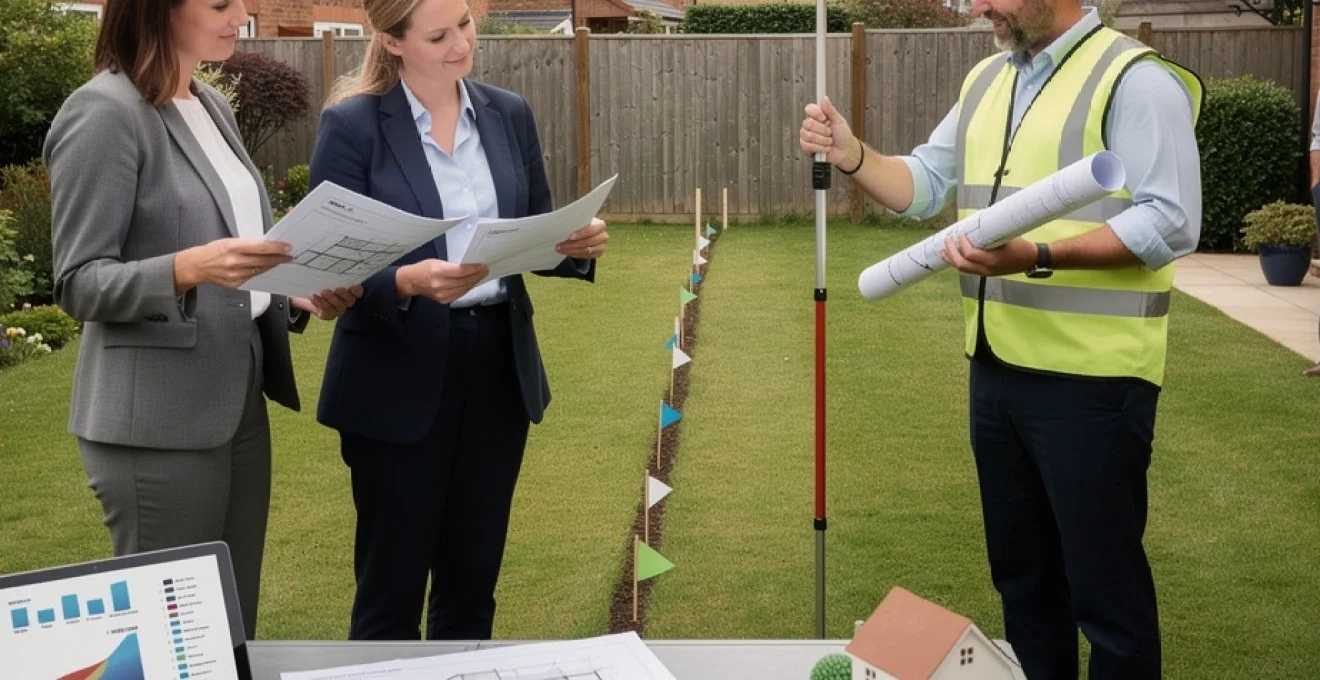
Purchasing garden land from a neighbour presents a unique opportunity for UK homeowners seeking to expand their property boundaries, enhance their living space, or pursue development potential. This type of transaction has become increasingly popular as urban land becomes scarcer and property prices continue to rise across England and Wales. Unlike traditional property purchases, acquiring a portion of your neighbour’s garden involves complex legal, financial, and practical considerations that require careful navigation through specialist property law frameworks.
The process differs significantly from standard residential conveyancing, involving intricate boundary determinations, planning considerations, and valuation methodologies specific to amenity land. Whether you’re looking to create additional parking space, extend your garden for family enjoyment, or explore development possibilities, understanding the comprehensive legal and financial implications ensures a successful transaction that benefits both parties involved.
Legal framework for purchasing garden land under UK property law
The legal foundation for purchasing garden land from neighbours rests upon well-established property law principles, primarily governed by the Land Registration Act 2002 and associated regulations. Garden land transactions require careful consideration of existing title structures, boundary definitions, and potential restrictions that may affect future use or development rights. The legal complexity often surprises first-time buyers, as these transactions involve creating new title documents and potentially altering existing property boundaries.
Property law distinguishes between different types of land ownership, with most residential gardens falling under freehold tenure where the owner holds absolute ownership rights. However, complications can arise when existing mortgages, charges, or restrictive covenants affect the land in question. Legal practitioners must conduct thorough due diligence to identify any impediments to the proposed transfer before proceeding with formal documentation.
Freehold vs leasehold considerations in garden land transactions
Freehold garden land transactions typically offer the most straightforward path for neighbouring property purchases, as the selling party holds absolute ownership rights subject only to statutory restrictions and registered encumbrances. Most residential properties with substantial gardens hold freehold title, allowing owners to sell portions of their land without requiring third-party consent, provided no restrictive covenants prohibit such divisions.
Leasehold complications present significant challenges when neighbours hold leasehold rather than freehold interests in their properties. Leasehold titles often contain specific clauses prohibiting land subdivision or requiring freeholder consent for any boundary alterations. In such cases, prospective purchasers may need to approach the ultimate freeholder directly or negotiate complex arrangements involving leasehold assignments for specific garden areas.
Land registry requirements for boundary extensions and plot divisions
HM Land Registry maintains strict protocols for registering new boundaries created through garden land divisions, requiring precise survey plans and detailed Transfer of Part (TP1) documentation. The Registry demands that all new boundaries are clearly defined using Ordnance Survey coordinates and professional surveying standards to prevent future boundary disputes. Registration fees vary depending on the land value, typically ranging from £40 to £910 for most residential garden transactions.
Professional survey plans must accompany all applications, showing both the land being transferred and the remaining property boundaries with mathematical precision. The Land Registry requires these plans to comply with specific technical standards, including proper scaling, coordinate referencing, and clear identification of both retained and transferred areas using distinctive colouring or hatching patterns.
Planning permission implications for change of use applications
Garden land purchases often trigger planning considerations, particularly when buyers intend to alter the land use beyond its current residential curtilage designation. Permitted development rights may allow certain improvements without formal planning applications, but significant changes typically require express planning consent from local planning authorities. Recent government policy changes have tightened restrictions on “garden grabbing” developments in many areas.
Change of use applications become necessary when purchased garden land will be used for purposes beyond typical residential amenity use, such as commercial activities, separate residential development, or intensive recreational facilities. Planning authorities assess these applications against local development plans, neighbourhood policies, and national planning frameworks that increasingly emphasize sustainable development and character preservation.
Restrictive covenants and title deed limitations on garden purchases
Historical restrictive covenants frequently affect garden land transactions, particularly in properties developed during the 20th century when developers commonly imposed restrictions on land use, building density, and architectural standards. These covenants may
restrict future building, require specific set-back distances, or even prohibit any further construction on the plot. Some covenants relate to the original estate layout and may, for example, prevent you from erecting separate dwellings, using the land for business purposes, or removing existing trees and hedgerows. Because restrictive covenants are usually binding on future owners, they can significantly limit what you can do with newly acquired garden land.
Your conveyancer will review the title register and title plan to identify any covenants and explain how they affect your intended use. In some cases, you may be able to negotiate a deed of release or variation with the party who has the benefit of the covenant, but this can be time-consuming and expensive. Alternatively, you might seek indemnity insurance where a minor risk exists but enforcement is considered unlikely. It is rarely sensible to proceed on the assumption that “no one will ever enforce it” – if your primary motive is to extend or develop, clarity over covenants is just as important as planning permission.
Valuation methods for residential garden land in england and wales
Determining how much garden land is worth is rarely as simple as applying a standard “price per square metre”. The valuation of amenity land between neighbours depends heavily on context: local market values, the configuration of the plots, potential uplift in value to the buyer’s property, and any loss of amenity or value to the seller’s home. In practice, surveyors often blend several methods to reach a fair market value that both parties can use as a starting point for negotiation.
From a buyer’s perspective, the key question is usually: how much value will this additional garden (or potential development plot) add to my property, and how does that compare with the price I am being asked to pay? For sellers, the focus is often on compensating for the loss of land and preserving future saleability. In many transactions, the most commercially realistic figure sits somewhere between those two positions and reflects both tangible value and the “marriage value” created when two adjoining parcels are combined.
RICS red book valuation standards for amenity land assessment
Professional valuers instructed to assess garden land will normally work to the Royal Institution of Chartered Surveyors (RICS) Red Book standards. These standards set out the principles and ethics that must be followed when preparing a formal valuation report, including independence, transparency, and a clear basis of valuation. For residential garden land, the valuation will typically be undertaken on a market value basis, assuming a willing buyer and willing seller in an arm’s-length transaction.
The surveyor will inspect the land, review the registered titles, and consider planning policy, access, services, and any physical constraints such as slopes, trees, or drains. They will then apply an appropriate valuation method, often supported by comparable evidence and, where relevant, a calculation of marriage value or development value. A formal Red Book valuation can be especially useful if the parties have very different expectations, or where the figure will be used for tax, probate, or matrimonial purposes as well as for negotiations between neighbours.
Comparable sales analysis using rightmove and zoopla data
For straightforward residential garden extensions, valuers often rely on comparable sales analysis. This involves looking at similar houses in the immediate area that already benefit from larger gardens, off-street parking, or side plots, and comparing their sale prices with properties that lack those features. Public portals such as Rightmove and Zoopla, together with Land Registry sold price data, provide a useful database of evidence for this purpose.
In practical terms, the valuer will analyse how much extra buyers have been willing to pay for similar improvements. For example, if houses with larger gardens or a double-width plot consistently sell for £20,000 more than comparable homes without that feature, and the neighbour’s garden land would give you a similar enhancement, that £20,000 uplift may form the upper limit of what the land could reasonably be worth. The final figure is then adjusted for site-specific issues such as shape, privacy, and any restrictions, rather than simply multiplying a generic “per square metre” rate.
Hope value calculations for potential development rights
Where there is a realistic chance of obtaining planning permission for a separate dwelling, outbuilding, or significant extension, the concept of hope value becomes relevant. Hope value represents the additional amount a rational buyer would pay today in the expectation of securing more valuable planning consent in the future. It sits somewhere between current amenity land value and fully consented development land value.
Calculating hope value usually involves a residual valuation: the valuer estimates the finished value of the proposed development, deducts construction and professional costs, finance costs, and a developer’s profit margin, then factors in the probability of obtaining planning consent. Because this process involves a number of assumptions, hope value assessments can vary significantly between surveyors. For that reason, it is wise to treat any “potential development” premium with caution, especially if local planning policy is restrictive or recent applications on nearby plots have been refused.
Local authority rating assessments and council tax band adjustments
Most residential garden land transfers between neighbours have only a limited impact on council tax banding, but it is still important to understand how local authorities may view the enlarged property. Council tax bands in England and Wales are linked to the overall value of the dwelling, which can be influenced by plot size, amenity provision, and development potential, not just the house itself. Where a garden extension substantially enhances the property’s value, the Valuation Office Agency (VOA) may review the band at the point of a later sale or after significant works.
That said, minor changes – such as acquiring a small strip of land to square off a garden or provide an extra parking space – are unlikely on their own to trigger an immediate re-banding. More often, a re-assessment occurs after a material change, like the construction of a new annex or a substantial extension on the newly acquired land. If you are concerned about the impact on council tax, you can seek informal guidance from the VOA or your local authority before committing to the purchase.
Conveyancing process for garden land transfer between neighbours
From a legal perspective, buying part of a neighbour’s garden is handled through a process known as a Transfer of Part, usually documented on a Land Registry form TP1. Although there is no estate agent and the distance between buyer and seller might be only a few metres, the conveyancing steps are very similar to a normal property transaction. Both parties should instruct their own conveyancers to avoid any conflict of interest and to ensure that each side receives independent advice.
The conveyancing process typically includes: checking title and covenants, agreeing the precise extent of land to be transferred, preparing and approving a compliant plan, obtaining any necessary mortgage lender consent, dealing with planning and access issues, and completing registration at HM Land Registry. Timescales are often shorter than for full house purchases – many garden land transfers complete within 4–8 weeks – but delays can still arise where lenders, management companies, or freeholders must be consulted.
Boundary determination and surveying requirements
Because buying garden land involves physically changing the shape of one or more plots, accurate boundary determination is crucial. Disputes over a few centimetres may sound trivial, but they can become surprisingly expensive and stressful if not properly managed from the outset. That is why most conveyancers will recommend instructing a suitably qualified surveyor to produce a clear, Land Registry-compliant plan showing both the land to be transferred and the land to be retained.
Getting the boundaries right at this stage is rather like laying solid foundations for a building: you may not think about them again for years, but if something is wrong, it can be very hard and costly to fix later. A precise plan and a clear written agreement between neighbours will help prevent future arguments if one party sells, fences are moved, or new structures are built.
Ordnance survey title plans vs physical boundary discrepancies
One of the first surprises many buyers encounter is that Land Registry title plans are based on Ordnance Survey mapping and usually show only general boundaries. In other words, the red line on your title plan does not guarantee the exact position of a fence, wall, or hedge on the ground. Over time, physical boundaries may have shifted, been rebuilt, or encroached slightly into a neighbour’s land, creating discrepancies between the plan and reality.
When transferring part of a garden, these discrepancies must be resolved. The surveyor will measure from fixed features such as buildings, road edges, and permanent markers, then prepare a scaled plan that aligns as closely as possible with both the Ordnance Survey base and the actual layout. Your conveyancer will then agree this plan with the other side, ensuring that both parties understand precisely where the new boundary will lie and who will be responsible for its maintenance.
Professional land surveyor RICS certification requirements
To minimise the risk of boundary disputes, it is advisable to use a surveyor who is a member of a recognised professional body, such as RICS or the Chartered Institution of Civil Engineering Surveyors (CICES). While Land Registry does not legally require a plan to be prepared by a chartered surveyor, using a suitably qualified professional helps ensure that technical standards are met and that any future challenge can be defended with robust evidence.
A professional surveyor will typically carry out a topographical survey, record measurements using modern equipment such as total stations or GPS, and prepare a plan that complies with Land Registry’s Practice Guide 40. They can also advise on practical matters such as setting out the new boundary on site, locating underground services, and accommodating existing features like trees and drains. Their involvement is a relatively modest cost in the context of a land purchase, but it can save substantial time and money in the long run.
Boundary agreement protocols under land registration act 2002
The Land Registration Act 2002 provides mechanisms for neighbours to record how they agree their boundaries should be interpreted. In addition to registering a Transfer of Part for the garden land itself, the parties can enter into a boundary agreement that clarifies the position and nature of the dividing feature. This agreement can be noted on the title registers of both properties, offering future buyers clear evidence of the boundary arrangement.
In practice, the boundary agreement will refer to the survey plan, describe any physical markers (such as a new fence line), and allocate maintenance responsibilities. Because it is a legally binding document, you should always ask your conveyancer to draft or review the wording. Taking this extra step is particularly sensible where the new boundary is irregular, runs close to buildings, or interacts with shared access ways or drainage routes.
Tax implications and HMRC considerations for garden land purchases
Tax treatment is an important, and sometimes overlooked, aspect of buying or selling garden land. On the buyer’s side, the main consideration is usually Stamp Duty Land Tax (SDLT) in England and Northern Ireland (or the equivalent devolved taxes in Scotland and Wales). SDLT may be payable if the purchase price exceeds the relevant threshold, and higher rates can apply if you own other residential properties and the land is treated as an interest in a dwelling.
For sellers, the key issue is often Capital Gains Tax (CGT). Where the land forms part of the garden or grounds of a main residence and the total area does not exceed the permitted limit (generally up to half a hectare, or more in some circumstances), Principal Private Residence Relief may exempt the gain from CGT. However, if the garden is very large, used partly for business, or already separated by fencing or access, the position can be more complex. Because HMRC rules are nuanced and subject to change, both parties should seek tailored advice from a tax adviser or accountant before exchanging contracts.
Financing options and mortgage implications for garden extensions
Funding a garden land purchase may be straightforward if you have sufficient cash savings, but many buyers prefer to use mortgage finance. If your existing home is mortgaged, your lender’s consent will almost certainly be required, whether you are the one buying or selling the land. From the seller’s perspective, the lender needs to be satisfied that releasing part of the security will not undermine the value of the remaining property. From the buyer’s side, the lender will want to ensure that the enlarged plot enhances, or at least maintains, the property’s value and marketability.
In practical terms, you might refinance your main mortgage to raise additional funds, take out a further advance, or use a separate loan secured on the property, depending on the lender’s criteria. Some lenders are more comfortable than others with non-standard security such as newly combined plots, so it is sensible to speak to a broker or your existing lender early in the process. Whatever route you choose, allowing time for valuation visits, underwriting checks, and consent to the new title arrangements will help keep the transaction on track and avoid last-minute surprises.