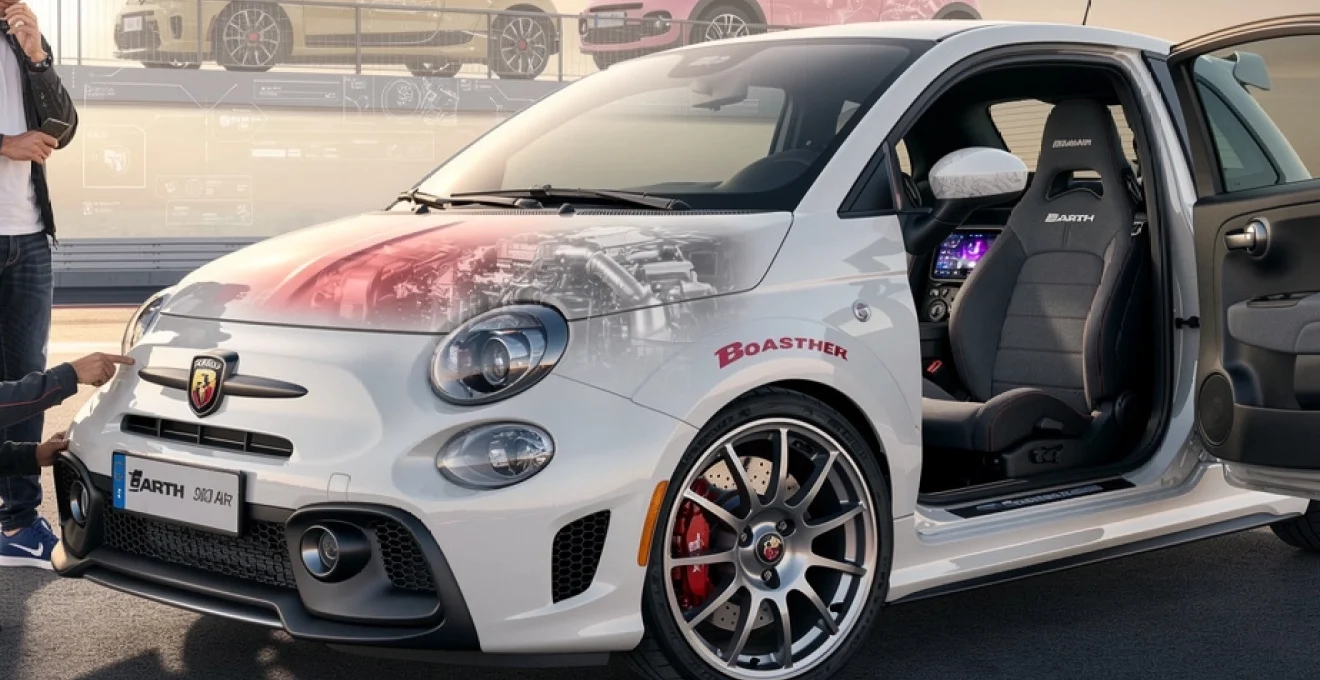
The Fiat Abarth 500 in white represents the perfect fusion of Italian automotive heritage and contemporary performance engineering. This diminutive powerhouse transforms the beloved Fiat 500 silhouette into a genuine hot hatch contender, whilst the pristine white finish accentuates every aerodynamic curve and aggressive styling cue. With its distinctive Scorpion badge gleaming against the pearl-white paintwork, the Abarth 500 commands attention whether parked in central London or carving through Alpine passes. The white variant particularly showcases the model’s sophisticated design language, from the pronounced front spoiler to the quad exhaust configuration, creating a visual statement that speaks to both performance enthusiasts and style-conscious drivers seeking something decidedly different from the mainstream hot hatch offerings.
Fiat abarth 500 design evolution and white paint specifications
The design evolution of the Fiat Abarth 500 represents a masterclass in automotive transformation, taking the charming city car aesthetic and infusing it with genuine motorsport-inspired aggression. The white paint option serves as the perfect canvas to highlight these design modifications, creating striking contrasts between shadow and light across the vehicle’s sculptured surfaces. This particular colour choice emphasises the muscular wheel arches and side skirts, whilst simultaneously softening the overall aggressive stance to maintain the model’s approachable charm.
The current generation Abarth 500 features significant aerodynamic enhancements over its predecessor, with computational fluid dynamics playing a crucial role in shaping every external component. The front fascia incorporates larger air intakes and a more pronounced chin spoiler, designed to improve cooling efficiency and reduce lift at higher speeds. These modifications become particularly striking when rendered in white, as the contrasting black plastic trim creates a two-tone effect that emphasises the functional nature of these aerodynamic elements.
Bossolo white metallic paint technology and UV protection
The Bossolo White Metallic finish available on the Abarth 500 utilises advanced paint technology that incorporates nano-ceramic particles to enhance durability and maintain colour consistency over extended periods. This three-layer paint system begins with a zinc-phosphate primer that provides exceptional corrosion resistance, followed by a high-build base coat that ensures uniform coverage across all body panels. The final clear coat contains UV-resistant polymers that prevent the yellowing and chalking commonly associated with white automotive finishes.
The metallic component within the Bossolo White finish consists of specially treated aluminium flakes that create subtle depth variations depending on viewing angle and lighting conditions. This sophisticated paint formulation requires a minimum curing temperature of 140 degrees Celsius and undergoes quality control testing that includes adhesion, hardness, and colour matching assessments. The result is a finish that maintains its pristine appearance even after years of exposure to harsh environmental conditions, making it an excellent choice for both daily driving and special occasions.
Aerodynamic body kit integration with front spoiler design
The aerodynamic body kit fitted to the Abarth 500 represents a significant departure from the standard model’s gentle curves, incorporating angular elements that serve both functional and aesthetic purposes. The front spoiler extends 45mm further forward than the standard bumper, featuring integrated air ducts that channel cooling air to the intercooler and brake components. Wind tunnel testing revealed that these modifications reduce front-end lift by 23% at motorway speeds, improving high-speed stability and steering precision.
Side skirts run the length of the vehicle, creating a visual connection between the front and rear aerodynamic elements whilst simultaneously reducing air turbulence around the door openings. The rear diffuser incorporates four outlets that work in conjunction with the twin exhaust pipes to manage airflow separation, reducing drag coefficient from 0.32 to 0.29 compared to the standard 500. These aerodynamic enhancements become particularly prominent in white, as the contrasting black trim pieces create a striking visual differentiation that highlights each functional element.
17-inch alloy wheel configurations and tyre specifications
The standard 17-inch alloy wheels fitted to the Abarth 500 feature a distinctive five-spoke design that maximises brake
cooling performance by allowing maximum airflow to the upgraded front disc brakes, which is essential during spirited driving or repeated high-speed stops. Wrapped in low-profile 205/40 R17 performance tyres, the Fiat Abarth 500 in white gains a broader footprint that enhances cornering grip and turn-in precision. Owners who frequently drive in mixed conditions may opt for high-performance all-season rubber, but for track days and summer use, a dedicated ultra-high-performance tyre compound will unlock the chassis’ full potential. In practical terms, the 17-inch configuration strikes a sensible balance between ride comfort and steering feel, avoiding the harshness often associated with larger wheels while still filling the arches with a purposeful stance.
The white bodywork visually amplifies the contrast between the dark alloy spokes and the ventilated brake discs nestled behind them. This contrast not only looks purposeful but also makes it easier to spot brake dust build-up, helping you stay on top of maintenance and keep the wheels looking factory-fresh. Many enthusiasts choose to powder-coat the alloys in anthracite or gloss black, which creates a striking monochrome effect against the Bossolo White Metallic paint. Whichever finish you choose, the 17-inch alloys remain a core part of the Fiat Abarth 500’s aesthetic identity, signalling that this is no ordinary city car.
Scorpion badge placement and chrome exhaust tip finishing
One of the most distinctive design signatures of the Fiat Abarth 500 in white is the carefully considered placement of the Scorpion badges. On the nose, the Abarth shield replaces the regular Fiat roundel, sitting proudly on the upper grille where it catches the light against the crisp white paint. Additional Scorpion logos appear on the front wings, often integrated into contrasting side stripes that echo classic Abarth racing liveries. At the rear, a dark titanium Abarth script stretches across the tailgate, standing out clearly on the white background and reinforcing the car’s performance credentials.
The exhaust system is equally important to the car’s visual drama. Standard models typically feature twin chrome exhaust tips, while higher-performance or special-edition trims adopt a quad-exit configuration integrated within the rear diffuser. These polished tips are not just decorative; they are made from corrosion-resistant stainless steel, ensuring that they retain their shine even after repeated heat cycles and exposure to road salt. On a white Abarth 500, the bright chrome stands out even more, drawing the eye to the rear and subtly signalling the performance potential that lies beneath the compact hatchback body.
From a design perspective, the combination of Scorpion badge placement and chrome exhaust finishing helps balance the Abarth 500’s proportions. The badges sit high on the body, while the exhaust tips occupy the lower visual plane, creating a vertical flow that makes the car appear lower and more planted. If you are considering mild customisation, opting for black-chrome or titan-style tips can create a stealthier, motorsport-inspired look while still complementing the Bossolo White finish. In either case, these small but deliberate details play a major role in turning the familiar Fiat 500 shape into a true performance icon.
Engine performance specifications and turbocharger technology
Underneath its compact bonnet, the Fiat Abarth 500 in white hides a serious performance package that belies its city-car origins. The core of this package is the turbocharged petrol engine, which transforms the lightweight chassis into a lively hot hatch capable of challenging far larger cars in real-world driving. Whether you are threading through urban traffic or attacking a twisty B-road, the Abarth’s engine is tuned to deliver strong mid-range torque and an addictive surge of acceleration. In many ways, it feels like a classic rally car distilled into a city-friendly footprint, combining characterful response with modern efficiency.
The turbocharger technology is central to this character. By compressing the intake air and forcing more oxygen into the combustion chambers, the Abarth 500’s engine can produce significantly more power than a naturally aspirated unit of the same displacement. Combined with sophisticated engine management and knock control, this allows the car to run higher boost pressures safely while maintaining reliability. For drivers, the result is a broad, flexible power band: you can cruise calmly at low revs when you want refinement, then tap into a rapid surge of performance with a flex of your right foot when the road opens up. It is this duality that makes the Fiat Abarth 500 such a compelling choice in the compact performance segment.
1.4-litre T-Jet MultiAir engine architecture
Most petrol-powered versions of the Fiat Abarth 500 in white are equipped with a 1.4-litre T-Jet or MultiAir four-cylinder engine, depending on model year and market. This compact in-line unit uses an iron block for durability and an aluminium cylinder head for improved heat dissipation, a combination that has proven robust in both road and motorsport applications. The 16-valve layout, with double overhead camshafts, ensures efficient breathing at high rpm, while the turbocharger provides strong torque from relatively low engine speeds. Power outputs typically range from around 145hp in entry-level Abarth 500 trims up to approximately 180hp in the most focused versions, such as the 595 Competizione or special Anniversary editions.
The MultiAir system, where fitted, takes this architecture a step further by using electro-hydraulic actuators to control the intake valves directly, rather than relying solely on a traditional throttle body. Think of it as a very fine-tuned way of letting the engine “breathe” only as much as it needs, in real time. This allows for more precise management of airflow and fuel mixture, improving both performance and efficiency. For you as a driver, the benefits are sharper throttle response, better low-end torque, and reduced fuel consumption compared with older turbocharged designs. In daily use, it means you can enjoy the car’s performance without constantly visiting the fuel station.
From a reliability standpoint, regular oil changes and adherence to manufacturer service intervals are crucial to keeping the T-Jet or MultiAir engine in peak condition. Turbocharged engines place higher demands on lubrication and cooling systems, so high-quality synthetic oil and proper warm-up and cool-down procedures make a tangible difference. Treat the engine well and it will reward you with years of spirited driving, whether your white Abarth 500 spends its life in the city or on occasional track days.
Garrett motion turbocharger system and boost pressure
The turbocharger used in many Fiat Abarth 500 variants is supplied by Garrett Motion, a well-known name in the performance and motorsport world. This compact turbo unit is engineered to spool quickly, minimising lag and delivering usable boost from as low as 2,000–2,500rpm, depending on calibration. Peak boost pressures typically sit in the 1.1–1.3 bar range in standard configurations, with higher-output models nudging beyond that under full load. If you imagine the engine as a set of lungs, the Garrett turbo is the athletic coach making sure every breath counts, compressing the intake charge to maximise combustion efficiency.
To manage this boost safely, the engine control unit (ECU) continuously monitors parameters such as intake air temperature, knock activity, and throttle position. An electronically actuated wastegate regulates how much exhaust gas flows through the turbine, ensuring that boost pressure remains within safe limits. This means that even during repeated hard accelerations, the turbocharger system balances performance with long-term reliability. For drivers who are curious about tuning, modest ECU recalibrations can unlock additional power, but it is essential to stay within safe thermal and mechanical limits to preserve the turbo’s lifespan.
Heat management is another key consideration. The intercooler, mounted behind the front bumper, cools the compressed air before it enters the engine, increasing air density and reducing the risk of knock. This is particularly important on warm days or during sustained high-speed driving, when intake temperatures can rise quickly. Keeping the intercooler clean and unobstructed, and ensuring that all hoses and clamps remain in good condition, helps the Garrett system maintain consistent performance. Properly cared for, the turbocharger will continue to deliver that characteristic Abarth surge of power every time you press the accelerator.
Record monza performance pack calibration
Many higher-spec Fiat Abarth 500 models, including some finished in special white liveries, can be specified with the Record Monza Performance Pack or an equivalent performance kit. This package typically includes a freer-flowing exhaust system, revised ECU mapping, and sometimes upgraded suspension or braking components. The Record Monza exhaust, in particular, is designed with a dual-mode architecture that varies back pressure depending on engine load and rpm. At lower speeds, it keeps sound levels civilised; once you accelerate more aggressively, internal valves open to unleash a raspier, motorsport-inspired note.
The associated ECU calibration is tuned to take full advantage of this reduced exhaust back pressure. Fuel and ignition maps are adjusted to optimise power delivery, often resulting in sharper throttle response and a small but noticeable increase in peak horsepower and torque. It is a bit like switching your Abarth 500 from “city mode” to “track day mode” without sacrificing everyday drivability. In combination with the Bossolo White Metallic paint, the Record Monza pack gives the car an even more distinctive personality: it looks understated from a distance, yet sounds and feels like a serious driver’s car as soon as you start to push it.
From a practical standpoint, the Record Monza system is engineered to meet noise and emissions regulations in the majority of European markets, so you do not need to worry about day-to-day legality. However, like any performance exhaust, it benefits from periodic inspection to ensure that valves, hangers, and joints remain in good condition. If you enjoy long road trips or frequent spirited driving, this pack is one of the most rewarding factory upgrades you can choose for your white Fiat Abarth 500.
Transmission options: manual vs automatic torque delivery
The Fiat Abarth 500 in white has been offered with both a traditional manual gearbox and an automated manual (often branded as “Competizione” or similar), giving buyers a choice in how they interact with the engine’s performance. The manual transmission is usually a 5-speed unit with closely stacked ratios, designed to keep the turbocharged 1.4-litre engine in its power band. For many enthusiasts, rowing through the gears yourself is part of the Abarth experience, adding an extra layer of involvement and control. The gearshift has a short, positive throw, and the clutch is light enough for urban traffic while still providing good feedback during fast driving.
The automated manual option, effectively a robotised version of the conventional gearbox, offers paddle shifters behind the steering wheel and can operate in full automatic mode. In theory, it combines the efficiency of a manual with the convenience of an automatic; in practice, shift quality can feel slower and less intuitive than modern dual-clutch systems. Torque delivery between gears can be momentarily interrupted, which some drivers may find less fluid, especially during enthusiastic driving. That said, for those who spend most of their time in heavy traffic or who prefer not to manage a clutch pedal, the automatic can be a workable compromise.
When choosing between manual and automatic for your white Abarth 500, it is worth honestly assessing how and where you will use the car. If weekend drives on twisty roads and maximum driver engagement are your priority, the manual transmission is the more rewarding option, allowing you to precisely time your shifts and make the most of the turbocharged torque. If you live in a busy city and value ease of use over outright involvement, the automatic might better suit your lifestyle. Either way, the underlying drivetrain remains the same, delivering the distinctive Abarth blend of punchy performance and compact agility.
Fuel economy ratings and CO2 emission standards
Despite its performance focus, the Fiat Abarth 500 in white remains relatively efficient, thanks in part to its small displacement and turbocharged architecture. Official fuel economy figures for petrol models typically range between 38 and 45 miles per gallon (combined cycle), depending on specific trim, wheel size, and gearbox choice. In real-world driving, you can expect slightly lower figures, especially if you frequently explore the upper half of the rev range. However, driven with a light right foot and using the higher gears effectively, the Abarth 500 can be remarkably frugal for a car with such lively performance.
CO2 emissions generally fall in the 130–155g/km range for most petrol variants, aligning with Euro 6 emission standards in later model years. This means the car benefits from modern catalytic converters, precise fuel injection, and advanced engine management aimed at reducing particulate and NOx emissions. While it is not as low-emission as a dedicated hybrid or electric city car, the Fiat Abarth 500 occupies a middle ground: it offers genuine hot hatch performance with emissions and fuel economy that remain manageable for daily use. For many buyers, this balance between excitement and efficiency is a key reason to choose an Abarth over a larger, thirstier performance car.
If you are particularly conscious of running costs, there are a few simple habits that can help maximise fuel economy in your Abarth 500. Allow the engine to warm up before driving hard, avoid unnecessary idling, and anticipate traffic to reduce frequent heavy braking and acceleration. Regular maintenance, such as timely oil changes, clean air filters, and properly inflated tyres, also supports both fuel efficiency and longevity. Ultimately, the Fiat Abarth 500 in white proves that you can enjoy spirited driving without completely sacrificing sensible fuel and CO2 figures.
Interior technology and infotainment system configuration
Step inside the Fiat Abarth 500 in white and you will find an interior that mirrors the car’s external blend of heritage and modernity. The compact cabin layout is familiar from the standard Fiat 500, but almost every surface you interact with has been given a sportier twist. Deeply bolstered seats hold you firmly in place during enthusiastic driving, often trimmed in a mix of leather and Alcantara with contrasting stitching and embroidered Scorpion logos. The dark headliner and pillars create a cockpit-like atmosphere, which contrasts attractively with the bright exterior paint when you open the doors.
At the heart of the cabin sits the infotainment system, typically based around a 5- or 7-inch touchscreen, depending on model year and trim. This system integrates key functions such as navigation, media playback, Bluetooth connectivity, and, in newer versions, smartphone mirroring via Apple CarPlay and Android Auto. While it may not be as expansive as the ultra-wide displays found in larger premium cars, the Abarth 500’s infotainment unit is intuitive and quick to respond. Physical shortcut buttons and rotary controls mean you can adjust volume or switch sources without taking your eyes off the road for long, which is particularly valuable in a compact, agile car that inspires spirited driving.
Instrumentation is tailored to highlight performance-relevant information. A central digital display often combines speed, revs, and trip data, while a separate turbo boost gauge reminds you that this is no ordinary city runabout. Some variants feature configurable drive modes, such as “Normal” and “Sport,” with the latter sharpening throttle response and sometimes adjusting steering assistance. When engaged, these modes may also change the colour scheme or graphics on the digital display, adding a layer of visual drama to match the car’s dynamic transformation. It is a small touch, but it reinforces the sense that you are driving something special every time you press the sport button.
Practical technology features are not forgotten. USB ports, auxiliary inputs, and steering wheel-mounted controls allow you to manage your music and calls with minimal distraction. Depending on specification, you may also benefit from automatic climate control, rain-sensing wipers, and rear parking sensors or a reversing camera—features that make the Abarth 500 easier to live with every day. For a compact car, sound insulation is surprisingly effective, although the characterful exhaust note is intentionally allowed to filter into the cabin, especially in performance-oriented trims. This combination of modern infotainment, driver-focused displays, and everyday convenience items helps the Fiat Abarth 500 in white feel up-to-date without losing its analogue, mechanical charm.
Suspension dynamics and koni shock absorber setup
The way the Fiat Abarth 500 in white tackles a bend is every bit as important as how quickly it accelerates in a straight line. To that end, the suspension has been comprehensively reworked compared with the standard Fiat 500, focusing on sharper responses and improved body control. The basic layout is familiar—MacPherson struts at the front and a torsion beam at the rear—but spring rates, anti-roll bars, and damping characteristics are all tuned for performance. Ride height is usually reduced slightly, lowering the centre of gravity and giving the car its unmistakably hunkered stance over those 17-inch wheels.
Many higher-performance variants, such as the Abarth 595 Competizione, incorporate Koni shock absorbers with Frequency Selective Damping (FSD) technology. This system effectively offers two damping behaviours in one unit, reacting differently to slow and fast suspension movements. Imagine it as a suspension that can read the road’s “mood”: on smoother surfaces and gentle undulations, it allows more compliance for comfort; when you hit sharper bumps or push hard through a corner, it firms up to keep the body under tight control. This clever compromise is one of the reasons the Abarth 500 can feel both playful and reassuringly planted when driven briskly.
In day-to-day driving, the ride is undeniably firmer than that of a standard city car, particularly over broken tarmac and speed humps. However, the Koni setup helps to filter out the harshest impacts, preventing the car from feeling unsettled or jittery. On a twisty road, this translates into agile, eager handling, with quick direction changes and a sense that the car pivots neatly around its short wheelbase. The steering, though electrically assisted, is direct and reasonably weighty in sport mode, giving you the confidence to place the car accurately. For many owners, this lively, slightly feisty suspension character is a central part of the Fiat Abarth 500’s charm.
For those considering aftermarket upgrades, there is a wide range of performance springs, coilovers, and adjustable dampers available, many of which build on the excellent foundation provided by the factory Koni units. That said, it is important to remember the car’s dual role as both daily driver and weekend toy. Excessively stiff setups may look good parked and feel razor-sharp on a racetrack, but they can become tiring on real-world roads. As with many aspects of the Abarth 500, the ideal configuration is about balance: enough precision and feedback to make every drive engaging, without sacrificing the usability that makes the compact hot hatch format so appealing.
Safety features and euro NCAP rating analysis
Safety may not be the first thing that comes to mind when you look at the compact, playful silhouette of the Fiat Abarth 500 in white, but the underlying structure and equipment list have been carefully engineered to protect occupants. The car is based on the same platform as the regular Fiat 500, which has achieved solid Euro NCAP scores in its class, with particular strengths in adult occupant protection. The Abarth variants maintain these structural advantages while adding more powerful brakes, grippier tyres, and improved suspension control—factors that can help you avoid accidents in the first place.
Standard safety equipment typically includes multiple airbags (front, side, and curtain), ABS with electronic brakeforce distribution, and electronic stability control (ESC). Traction control works alongside ESC to manage wheelspin under hard acceleration, particularly in wet or low-grip conditions. In performance driving, these systems can intervene discreetly to keep the car on your intended line, but many models allow partial or full deactivation for track use. Seatbelt pretensioners and load limiters help manage forces on occupants during a collision, while energy-absorbing crumple zones in the front and rear are designed to dissipate impact energy away from the passenger cell.
From a Euro NCAP perspective, the Fiat 500 platform has evolved over time to meet tightening safety and crashworthiness standards, including pedestrian protection measures such as deformable bonnet structures and bumper designs. Although the Abarth 500’s more aggressive body kit and lower stance are primarily focused on performance and styling, they are developed within this same safety framework. For urban use, where many Abarth 500s spend much of their time, the compact dimensions and good visibility also contribute to active safety: it is easier to manoeuvre, park, and spot vulnerable road users such as cyclists and pedestrians.
If you are evaluating a used Fiat Abarth 500 in white, it is wise to check that all safety systems are functioning correctly. Warning lights for ABS or ESC should illuminate briefly at start-up and then extinguish; any persistent alerts warrant diagnostic checks. Ensuring that tyres are of the correct specification and in good condition, and that brakes are evenly worn, will help the electronic systems perform as intended. While the Abarth 500 is designed foremost as a fun-to-drive hot hatch, its underlying safety engineering means you can enjoy its performance with confidence, provided it is properly maintained.
Market positioning against MINI cooper S and volkswagen up GTI
In the compact performance car market, the Fiat Abarth 500 in white occupies a distinctive niche, sitting somewhere between the premium aspirations of the MINI Cooper S and the more understated appeal of the Volkswagen Up GTI. All three cars are small, characterful hot hatches designed to deliver big smiles without requiring supercar budgets. However, each adopts a different approach to style, performance, and brand identity. The Abarth 500 leans heavily into its motorsport heritage and Italian flair, particularly in Bossolo White Metallic, which recalls classic racing liveries and makes the Scorpion logos pop.
On paper, the MINI Cooper S typically offers more interior space and a slightly higher level of refinement, with a range of powerful engines and a cabin that feels closer to a premium hatchback. It also tends to sit higher on the price ladder, especially once you start adding options. The Volkswagen Up GTI, by contrast, is more minimalist and practical, with a five-door layout and a focus on accessible fun rather than outright performance. In terms of raw power, the Abarth 500 often matches or exceeds the Up GTI, while slightly trailing or equalling certain Cooper S variants depending on model year.
Where the Fiat Abarth 500 in white really distinguishes itself is in emotional appeal. Its compact size, raucous exhaust note, and unapologetically sporty styling give it a sense of occasion every time you drive it, even on a short commute. The interior may be less spacious than the MINI’s and more focused on the driver than the Up GTI’s, but for many buyers that is precisely the point. You are choosing a car that feels like a modern interpretation of a classic rally machine, rather than a scaled-down version of a family hatchback. If you value individuality, heritage, and a slightly more raw driving experience, the Abarth stands out strongly in this trio.
From a value perspective, the Fiat Abarth 500 often undercuts a comparably specified MINI Cooper S, while offering more bespoke character than the Volkswagen Up GTI. Running costs are broadly similar across the three, with small-displacement turbocharged engines and relatively modest insurance groups, though individual premiums will vary. Resale values for well-maintained Abarth 500s in desirable colours—white among them—have historically been strong, helped by their enthusiast following and limited-edition variants. That makes the car not only an entertaining ownership proposition but also a relatively sensible one in financial terms, especially if you choose a specification that highlights its unique strengths.
Ultimately, deciding between a Fiat Abarth 500 in white, a MINI Cooper S, and a Volkswagen Up GTI comes down to your priorities. If you want the most refined, broadly capable all-rounder, the MINI may hold the edge. If practicality and subtlety are high on your list, the Up GTI is hard to ignore. But if you are seeking a compact hot hatch that feels truly special every time you look at it on your driveway—a car where style, sound, and spirited performance come together in a tightly packaged, visually striking form—the Abarth 500, particularly in its crisp white finish, remains one of the most compelling choices on the market.