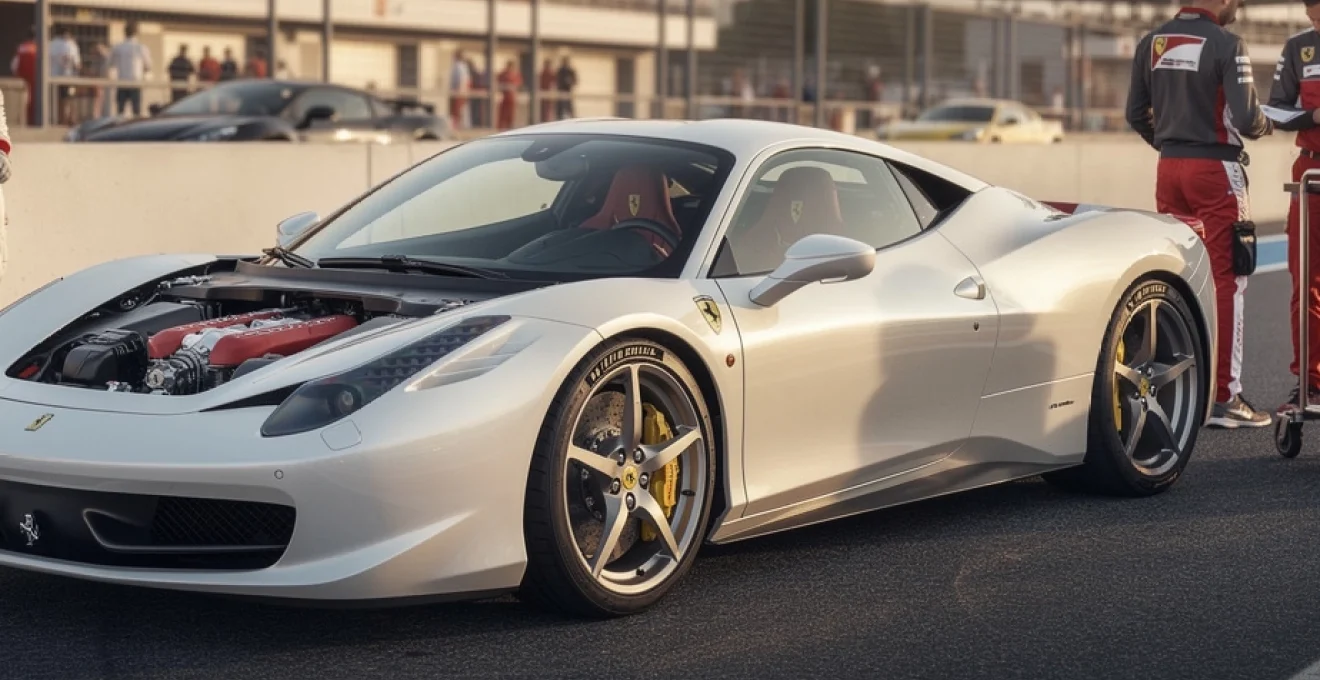
The Ferrari 458 Italia represents the pinnacle of naturally aspirated V8 engineering, combining breathtaking performance with timeless Italian design philosophy. When finished in pristine white paint schemes such as Bianco Avus or Bianco Fuji, this mid-engined masterpiece transforms into something truly extraordinary. The contrast between the pure, sophisticated white exterior and the aggressive aerodynamic lines creates a visual statement that captures both elegance and raw performance capability. This particular combination has become increasingly sought after among collectors and enthusiasts who appreciate the unique aesthetic that white brings to Ferrari’s naturally aspirated swan song.
Ferrari 458 italia technical specifications and engineering excellence
The heart of the 458 Italia lies in its meticulously crafted engineering package, which represents decades of Formula 1 technology transfer into road car applications. Every component has been designed to work in perfect harmony, creating a driving experience that remains unmatched in the naturally aspirated supercar segment.
4.5-litre V8 naturally aspirated engine performance metrics
At the core of the 458 Italia beats a magnificent 4.5-litre V8 engine that produces an astounding 562 horsepower at 9,000 rpm and 540 Nm of torque at 6,000 rpm. This naturally aspirated unit represents the culmination of Ferrari’s V8 development programme, featuring direct fuel injection, variable valve timing, and a compression ratio of 12.5:1. The engine’s ability to rev to 9,000 rpm while maintaining exceptional reliability demonstrates the precision of Italian engineering at its finest.
The specific power output of 125 horsepower per litre places this engine among the most efficient naturally aspirated units ever produced. Unlike modern turbocharged alternatives, the 458’s powerplant delivers instantaneous throttle response with a linear power delivery that creates an intimate connection between driver and machine. The distinctive Ferrari soundtrack builds progressively from a refined growl at idle to an intoxicating wail at the redline.
Seven-speed Dual-Clutch transmission system analysis
Ferrari’s seven-speed dual-clutch transmission represents a significant advancement over traditional manual gearboxes, offering lightning-fast gear changes without interrupting power delivery. The system can complete shifts in as little as 150 milliseconds in Race mode, while Comfort mode extends this to 250 milliseconds for smoother urban driving. The transmission features multiple driving modes that adjust shift patterns, throttle response, and suspension settings to match driving conditions.
The dual-clutch design eliminates the torque interruption typically associated with conventional automatic transmissions. One clutch handles odd-numbered gears while the other manages even gears, allowing the system to pre-select the next gear for seamless transitions. This technology, derived directly from Ferrari’s Formula 1 experience, provides both the convenience of automatic operation and the precision control demanded by track enthusiasts.
Aluminium space frame construction and weight distribution
The 458 Italia employs an advanced aluminium space frame construction that achieves exceptional rigidity while maintaining relatively modest weight figures. The chassis weighs just 197 kilograms yet provides 20,000 Nm/degree of torsional rigidity, creating the perfect foundation for precise handling characteristics. The use of aluminium extrusions, castings, and high-strength steel in critical areas optimises both weight distribution and crash protection.
Ferrari’s engineers achieved a near-perfect 42:58 front-to-rear weight distribution, placing the majority of mass over the driven rear wheels for optimal traction. The mid-mounted engine position contributes significantly to the car’s exceptional balance and rotational characteristics. This weight distribution, combined with the low centre of gravity, enables the 458 to change direction with remarkable agility while maintaining stability at high speeds.
Aerodynamic package and active suspension technologies
The 458 Italia incorporates sophisticated aerodynamic solutions that generate substantial downforce without compromising top speed capability. The front spoiler, side air intakes, and distinctive triple exhaust outlets all contribute to managing airflow around the vehicle. The active rear spoiler automatically deploys at 65 mph to increase stability and retracts at lower speeds to reduce drag.
Unlike many contemporary supercars, the Ferrari 458 Italia relies on a subtle mix of passive and active aerodynamic elements rather than oversized wings or dramatic add-ons. Flexible front winglets deform at higher speeds to reduce drag, while carefully sculpted underbody channels help create a ground-effect style suction that presses the car onto the tarmac. Combined with adaptive magnetorheological dampers and an electronically controlled limited-slip differential, this aerodynamic package allows the 458 to remain composed over challenging surfaces. The result is a white Ferrari 458 Italia that feels just as elegant at motorway speeds as it does razor-sharp on a mountain pass, blending real-world usability with track-ready stability.
Bianco avus paint finish: ferrari’s premium white exterior options
For many buyers, the decision to choose a Ferrari 458 Italia in white is as important as selecting its performance options. Ferrari has long offered a curated palette of white finishes, with Bianco Avus standing as one of the most iconic factory choices. On the 458 Italia, this bright, non-pearl white highlights every contour and crease of Pininfarina’s design, creating a visual contrast with dark carbon fibre details and red brake calipers. When you see a 458 in Bianco Avus under natural sunlight, the car almost seems to glow, reinforcing the impression of precision engineering wrapped in minimalist elegance.
Bianco avus metallic coating composition and durability
Bianco Avus is a high-quality multi-layer paint system engineered specifically for performance use. Although visually pure and solid, it typically consists of a primer layer, colour basecoat, and a clearcoat containing UV inhibitors to protect against fading. Ferrari’s paint process employs robotic application combined with hand finishing, ensuring consistent thickness and a deep gloss that complements the 458 Italia’s sculpted panels. This premium white finish has been designed to resist stone chips and micro-scratches better than older generation paints, provided the car is properly maintained.
From a durability standpoint, Bianco Avus performs well under both track and daily driving conditions, but white paint will naturally reveal contamination more readily than darker colours. Environmental fallout, rubber debris from high-speed track sessions, and even aggressive washing techniques can mar the surface over time. This is why enthusiasts of the white Ferrari 458 Italia often invest in routine decontamination and professional detailing. Treated correctly, Bianco Avus can maintain its mirror-like sheen for many years, preserving both the visual drama and resale value of the car.
Bianco fuji pearl white alternative specifications
While Bianco Avus appeals to purists seeking a clean, solid white, Bianco Fuji offers an alternative for those who want extra depth and luxury. Bianco Fuji is a premium, three-layer pearl white that incorporates special mica and metallic flakes within the paint structure. Under direct sunlight, these pearlescent elements create a subtle colour shift and a richer visual effect, similar to the way a finely cut diamond catches the light from different angles. On a Ferrari 458 Italia, Bianco Fuji can make the curves appear more fluid and organic, amplifying the sense of motion even when the car is stationary.
This pearl white finish is typically more expensive than Bianco Avus due to the additional layers and more complex application process. However, for collectors prioritising rarity and exclusivity, the extra cost is often justified. Bianco Fuji tends to be favoured on more bespoke builds or tailor-made commissions, where the owner wants a white Ferrari that stands apart from standard production cars. If you are considering a 458 Italia in white and plan to keep it long-term, Bianco Fuji may also offer a slight advantage in collectability thanks to its lower production volume.
Paint protection film application for white ferrari finishes
Owning a Ferrari 458 Italia in white means protecting that pristine appearance from chips, scratches, and staining. Paint protection film (PPF), often referred to as a clear bra, is one of the most effective ways to preserve Bianco Avus or Bianco Fuji finishes. Modern PPF is a transparent, self-healing polyurethane layer applied to high-impact areas such as the front bumper, bonnet, side mirrors, and side skirts. When exposed to heat, minor swirl marks and light surface scratches can literally disappear, keeping the white paint looking factory fresh.
For a car driven regularly on public roads or occasional track days, a full-front or even full-body PPF installation can be a wise investment. White paint tends to show road tar, rubber, and insect marks more visibly than darker hues, so a sacrificial film layer helps reduce the frequency of intensive polishing. It is important to choose an installer with experience working on Ferrari bodywork, as the complex curves and air intakes of the 458 require precise pattern cutting and stretching. Done correctly, high-end PPF is virtually invisible, preserving both the visual purity and long-term value of your white 458 Italia.
Maintenance requirements for ferrari white exterior surfaces
Maintaining a Ferrari 458 Italia in white demands a slightly more disciplined care routine than darker colours, but the rewards are spectacular when done right. Regular washing using the two-bucket method, pH-neutral shampoo, and soft microfibre mitts helps prevent swirl marks that are easily visible on white. Decontamination with clay bars or synthetic clay mitts every few months removes embedded particles that dull the glossy finish. Applying a ceramic coating on top of Bianco Avus or Bianco Fuji can further enhance hydrophobic properties, making it easier to rinse away dirt and brake dust.
Because white paint shows iron fallout and road grime more readily, using an iron remover periodically is particularly beneficial on the 458’s lower panels and rear bumper. You may also want to avoid automatic car washes, which can introduce fine scratches and reduce the clarity of the finish over time. Instead, opt for hand washes and, when possible, shaded parking to minimise UV exposure. With this level of care, a Ferrari 458 Italia in white can maintain its showroom-level brilliance, ensuring that every drive feels like a special occasion.
Track-focused performance capabilities of the 458 italia
Beyond its striking appearance, the Ferrari 458 Italia in white is a deeply capable track machine born from Ferrari’s motorsport DNA. Its powertrain, chassis, and electronic systems were engineered from the outset to perform under sustained high-load conditions. Whether you are lapping a local circuit or attending a dedicated Ferrari track day, the 458 delivers consistent performance and driver confidence. The combination of a naturally aspirated V8, advanced aerodynamics, and cutting-edge driver aids makes this Ferrari a benchmark for track-focused supercars.
Fiorano lap time achievements and circuit testing data
Ferrari’s own Fiorano test track is the proving ground for all of its road and race cars, and the 458 Italia posted an official lap time of around 1 minute 25 seconds. This placed it noticeably ahead of its predecessor, the F430, and closer to more hardcore, limited-production models from earlier generations. Independent testing on circuits such as the Nürburgring and Hockenheim has confirmed the car’s impressive pace, often matching or surpassing turbocharged rivals in similar power brackets. What stands out is not just raw speed, but the repeatability of lap times thanks to the car’s balanced chassis and thermal management.
On track, drivers frequently praise the 458 Italia for its predictable behaviour at and beyond the limit. High-speed sweepers, heavy braking zones, and technical sections all reveal a chassis that communicates grip levels clearly. This level of transparency allows you to build speed progressively, lap after lap, without feeling like you are fighting the electronics or the car’s weight. When combined with the dramatic visual presence of a white 458 attacking apexes, it is easy to understand why this model has become a favourite among serious track enthusiasts.
Electronic stability control and F1-Trac integration
A major contributor to the 458 Italia’s track performance is its sophisticated suite of electronic driver aids, centred around Ferrari’s F1-Trac system. Integrated with the electronic stability control (ESC) and E-Diff differential, F1-Trac constantly monitors wheel slip, steering angle, and yaw rate to optimise traction. Instead of abruptly cutting power, it subtly modulates torque delivery and braking to maintain the ideal slip angle for maximum cornering speed. The experience is comparable to having an invisible driving coach adjusting the car’s behaviour in real time.
The steering wheel-mounted Manettino switch allows you to choose between modes such as Wet, Sport, Race, and ESC Off, each recalibrating the level of intervention. In Race mode, the 458 gives you more freedom to explore mild oversteer while still catching major slides if you overstep the mark. Turn everything off, and the car becomes as raw and responsive as a traditional analogue supercar, demanding more skill but rewarding precise inputs. For owners of a Ferrari 458 Italia in white, this flexibility means the car can be both a forgiving companion on your first track day and an engaging weapon in the hands of an experienced driver.
Carbon-ceramic brake system performance characteristics
No discussion of the 458’s track capabilities would be complete without examining its standard carbon-ceramic braking system. The large front and rear discs, paired with multi-piston calipers, deliver immense stopping power and exceptional fade resistance under repeated heavy braking. Compared to conventional steel rotors, the carbon-ceramic setup offers better thermal stability, lower unsprung mass, and consistent pedal feel even after numerous hot laps. You can brake later and harder, confident that the system will respond with the same precision at the end of a session as it did on the out lap.
On the road, these brakes require a brief warm-up for optimal bite, but once at temperature they inspire confidence in all conditions. The reduced brake dust output is particularly beneficial on a Ferrari 458 Italia in white, as it keeps the wheels and lower bodywork cleaner for longer. While replacement costs for carbon-ceramic components are higher than steel counterparts, their longevity under normal road use can be impressive, often lasting the life of the vehicle. For track-focused owners, routine inspection and proper cool-down procedures can extend their service life and maintain peak performance.
Michelin pilot sport cup tyre specifications and grip levels
Tyres play a crucial role in unlocking the full potential of the 458 Italia, and many track-oriented owners opt for Michelin Pilot Sport Cup or similar semi-slick compounds. These tyres feature a high-grip rubber compound and reinforced sidewalls designed for precise steering response and maximum lateral grip. On a dry circuit, the difference in cornering speed and braking distances compared to standard road tyres can be dramatic. Think of them as the athletic shoes that allow the 458’s finely tuned suspension and aerodynamics to truly shine.
However, semi-slick tyres require a bit more attention from the driver. They perform best within a specific temperature window and can be less effective in cold or wet conditions, where their reduced tread depth becomes a disadvantage. For a white Ferrari 458 Italia driven to and from the circuit, it is worth considering a dedicated set of track wheels and tyres to avoid compromising everyday usability. Monitoring tyre pressures before and after sessions is also essential, as small adjustments can significantly affect grip and balance over a long stint.
Interior craftsmanship and customisation options
Step inside a Ferrari 458 Italia in white, and you are greeted by a cockpit that blends racing functionality with Italian luxury. The driver-focused layout places all primary controls within easy reach, including the Manettino dial, engine start button, and paddle shifters mounted on the steering wheel. High-quality leather, Alcantara, and carbon fibre trim elements create an ambience that feels both purposeful and elegant. Every surface you see and touch is engineered to remind you that this is a thoroughbred Ferrari, not just a fast car.
Ferrari’s Taylor Made and standard customisation programmes allow buyers to tailor the interior to their personal tastes. For a white exterior, many owners choose contrasting interiors in Nero (black), Rosso (red), or Cuoio (tan) to create a dramatic colour combination. You can specify Daytona-style seats, contrast stitching, embroidered prancing horse logos on the headrests, and even bespoke materials inspired by motorsport or haute couture. If you want the cabin to mirror the clean aesthetic of Bianco Avus, a light-coloured leather with subtle black or carbon accents can echo the exterior’s minimalist theme.
Practicality has also been taken into account, especially for owners who intend to use their Ferrari 458 Italia in white as more than a weekend toy. Storage compartments, a small front trunk, and optionally upgraded infotainment systems make longer journeys more comfortable. Sound insulation has been tuned to filter out unwanted noise while still allowing the V8’s mechanical symphony to fill the cabin at higher revs. As a result, the 458 manages to feel like a focused sports car on track yet a refined grand tourer when you are cruising along coastal roads or navigating city streets.
Market positioning against lamborghini gallardo and McLaren MP4-12C
When the Ferrari 458 Italia first arrived, its primary rivals were the Lamborghini Gallardo and the McLaren MP4-12C, both offering their own interpretation of the modern supercar formula. The Gallardo emphasised drama, angular design, and a more visceral driving experience, while the MP4-12C prioritised cutting-edge carbon tub technology and efficiency-focused performance. The 458 Italia carved out a distinct identity by combining emotional design, a naturally aspirated high-revving V8, and intuitive handling. In white, the car stands out even more, often perceived as the more elegant and understated option compared with its louder, more extroverted competitors.
From a performance standpoint, the Ferrari 458 Italia in white holds its own against both these icons. Its 0–100 km/h time of around 3.4 seconds and top speed in excess of 325 km/h place it right in the heart of the supercar segment. However, it is the 458’s steering feel, throttle response, and overall chassis balance that many testers and owners regard as superior. Where the Gallardo can feel more brute-force and the early MP4-12C somewhat clinical, the 458 strikes a middle ground—surgical in its precision yet emotionally engaging. For buyers who value both lap times and the intangible pleasure of driving, this balance remains a key differentiator.
In the current pre-owned market, the Ferrari 458 Italia often commands a premium over similar-era Gallardos and early MP4-12Cs, especially in desirable specifications and colours. A well-maintained Ferrari 458 Italia in white, particularly with Bianco Avus or Bianco Fuji and tasteful options, is frequently sought after by collectors looking for the last naturally aspirated mid-engined V8 Ferrari of its kind. Limited production relative to some competitors and strong global recognition of the 458 nameplate help support residual values. As electrification and downsizing reshape the supercar landscape, the 458’s analogue character and iconic design make it feel increasingly special.
Ownership experience and maintenance considerations
Owning a Ferrari 458 Italia in white is as much about the overall experience as it is about the raw numbers on a spec sheet. Day to day, you will notice how manageable the car feels in traffic, how clear the visibility is for a mid-engined design, and how compliant the adaptive suspension can be in softer modes. Service intervals are typically annual or every 20,000 km, with routine maintenance including oil changes, fluid checks, and inspections of suspension and electronic systems. Staying ahead of maintenance is the best way to ensure that the 458 remains both reliable and thrilling.
Prospective owners should budget for higher running costs than a conventional sports car, but many are pleasantly surprised by the 458’s robustness compared to older Ferraris. The naturally aspirated engine avoids some of the complexity associated with turbochargers, and the dual-clutch gearbox has proven durable when serviced correctly. Key items to monitor include the condition of the carbon-ceramic brakes, tyre wear—especially if the car sees regular track use—and the health of the battery and electronic systems. Working with an authorised Ferrari dealer or a respected specialist can provide additional peace of mind.
For a white Ferrari 458 Italia specifically, cosmetic care becomes an important part of the ownership routine. Regular detailing, periodic ceramic coatings, and possible paint protection film renewal will help the car continue to present as new. These aesthetic investments can have a tangible impact on resale value, as buyers in the secondary market often prioritise cars that appear to have been cherished rather than merely used. Ultimately, owning a 458 Italia in white is about embracing a holistic lifestyle—one that blends high performance, carefully curated aesthetics, and a deep appreciation for one of Ferrari’s most celebrated modern creations.