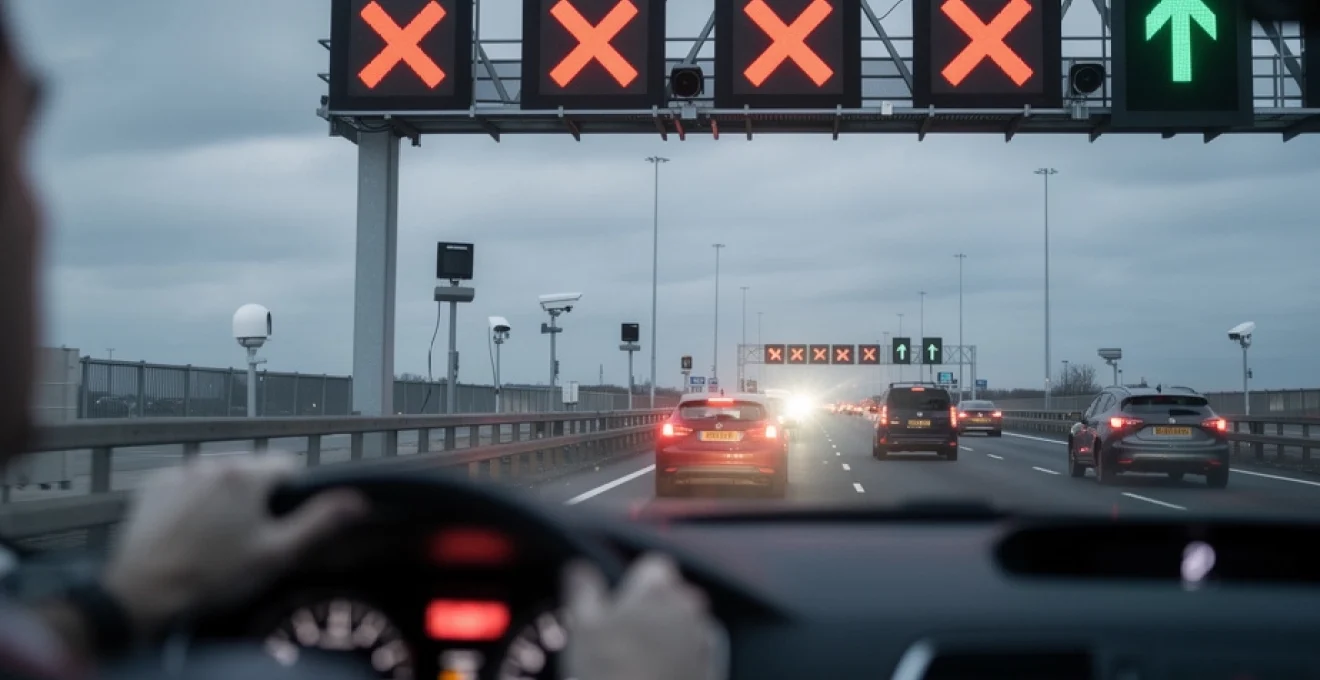
Red X signals on UK motorways represent one of the most critical safety measures in modern traffic management, yet confusion persists about the camera systems that enforce these lane closures. When a red X appears above a motorway lane, it indicates an absolute prohibition on using that lane, typically due to accidents, breakdowns, or maintenance work ahead. Understanding whether these enforcement cameras flash—and how they operate—has become increasingly important as more drivers face penalties for non-compliance with these vital safety signals.
The enforcement technology behind red X signals has evolved significantly since their introduction, incorporating sophisticated detection methods that don’t always rely on visible flashes. Modern motorway camera systems use a combination of infrared technology, digital sensors, and automated recognition systems to capture violations. This technological advancement means that drivers can no longer assume they haven’t been caught simply because they didn’t see a traditional camera flash when passing under a red X signal.
Red X camera technology and flash mechanisms
Understanding the technology behind red X enforcement cameras requires examining the various systems deployed across UK motorways. These cameras don’t operate as standalone units but are integrated into comprehensive traffic management systems that monitor multiple aspects of motorway safety simultaneously. The sophistication of these systems means they can detect violations in various lighting conditions and weather scenarios, making them far more reliable than older camera technologies.
Motorway variable message sign camera integration
Variable message sign cameras represent the backbone of red X enforcement technology. These systems integrate directly with the overhead gantries that display red X signals, creating a seamless connection between the warning display and enforcement mechanism. When a red X activates, the associated cameras automatically begin monitoring that specific lane for violations. This integration ensures that enforcement begins immediately when a lane closure is implemented, providing maximum protection for emergency responders and stranded motorists.
The cameras positioned on these gantries use advanced digital technology that doesn’t require a visible flash to capture high-quality images. Instead, they rely on infrared illumination that remains invisible to the human eye but provides clear photographic evidence of violations. This technology proves particularly effective during nighttime operations when traditional flash systems might create dangerous distractions for other motorists.
Infrared flash systems in SPECS average speed cameras
SPECS cameras, commonly found on smart motorways, utilise infrared flash systems that operate beyond the visible light spectrum. These cameras can simultaneously monitor speed violations and red X compliance, making them dual-purpose enforcement tools. The infrared flash technology ensures that violations are captured without creating the bright flashes that might startle other drivers or compromise road safety during peak traffic periods.
The infrared system operates by emitting light at wavelengths between 700 and 1000 nanometers, which remains invisible to drivers but provides excellent image quality for enforcement purposes. This technology allows cameras to operate continuously without the mechanical limitations of traditional flash bulbs, ensuring consistent enforcement regardless of weather conditions or time of day.
Digital enforcement camera flash detection methods
Modern digital enforcement cameras employ multiple detection methods that extend far beyond traditional flash systems. These cameras use piezoelectric sensors, radar technology, and computer vision algorithms to identify violations. The digital processing power allows these systems to distinguish between legitimate lane changes and red X violations, reducing false positives and ensuring accurate enforcement.
The detection algorithms analyse vehicle trajectories, speed patterns, and positioning relative to road markings to determine violations. This sophisticated analysis means that cameras can identify violations even when vehicles briefly enter closed lanes before correcting their position. The digital nature of these systems also enables automatic processing of violation data, streamlining the penalty notice process.
HADECS 3 camera flash visibility specifications
HADECS 3 cameras represent the latest generation of motorway enforcement technology, specifically designed for smart motorway operations. These cameras operate without visible flashes, instead using advanced digital sensors and processing capabilities to capture violations. The absence of visible flashes doesn’t indicate reduced effectiveness; rather, it demonstrates the technological advancement that makes these systems more reliable than their predecessors.
The technical specifications of HADECS 3 systems include high-resolution digital imaging, automatic number plate recognition, and real-time data transmission capabilities. These features enable immediate identification of violating vehicles and rapid processing of penalty notices. The cameras can operate effectively in all weather conditions and light levels, ensuring consistent enforcement coverage across the motorway network.
<h2
Red X signal enforcement camera types across UK motorways
Red X enforcement is not handled by a single “one size fits all” camera. Instead, different motorway schemes use different hardware, all connected to the same traffic management systems. For drivers, this can be confusing: one stretch might use compact, almost invisible cameras, while another has large, obvious roadside units. Understanding the main Red X camera types used across UK smart motorways helps you recognise when enforcement is active—even if you never see a visible flash.
Most Red X cameras are multi-purpose devices that enforce both speed limits and lane closures. When a lane is closed, the system essentially treats that lane as having a speed limit of 0 mph. Any vehicle detected travelling in that lane after the Red X is set can be recorded and processed as an offence. The technology used to detect these violations ranges from lane-based radar to sophisticated automatic number plate recognition (ANPR) systems.
VECTOR-SR speed detection camera systems
VECTOR-SR cameras are small, digital enforcement systems that often sit on gantries or roadside poles and blend into the motorway environment. They are fully digital, meaning they do not rely on traditional xenon flash tubes; instead, they use low-intensity or infrared illumination to capture high-resolution images. When integrated with smart motorway systems, VECTOR-SR cameras can be configured to monitor specific lanes and trigger when a Red X is active.
These systems combine speed detection with ANPR, allowing enforcement agencies to record the exact time and location of a Red X lane closure offence. Because they do not produce a bright, visible flash, many drivers may not realise they have been detected. The “silent” nature of VECTOR-SR enforcement underlines why assuming “no flash means no ticket” is such a risky mindset on today’s motorways.
Truvelo D-Cam red X enforcement units
Truvelo D-Cam units are another common enforcement camera found on UK motorways. Originally well-known for speed enforcement, the D-Cam platform has been adapted to handle Red X offences by linking the camera’s trigger logic directly to the motorway control system. When a lane is marked with a Red X, the D-Cam can be programmed to detect any vehicle present in that lane and capture an evidential image without the need for active policing at the roadside.
Unlike older Truvelo systems that sometimes used a visible flash, modern D-Cam units increasingly rely on digital imaging and filtered illumination. In practice, that means a driver might only notice a faint glow, if anything at all, when an offence is recorded. From an enforcement perspective, the advantage is constant coverage: the camera is always capable of capturing a sharp image, whether it is enforcing variable speed limits or a live Red X closure.
SPECS cameras on smart motorway lane control
SPECS cameras are best known as average speed cameras, monitoring a vehicle between two or more fixed points. On some smart motorway sections, these systems also work alongside Red X control. While SPECS themselves primarily track speed over distance, they sit within the same monitored corridor that includes lane closures and Red X signals, and their infrared-based imaging can be used as supplementary evidence if needed.
In practice, this means that on certain routes you may be monitored by both point-based cameras (such as HADECS 3 or Truvelo D-Cam) and route-based systems like SPECS. If you ignore a Red X and continue in a closed lane within an average speed camera zone, the SPECS images can help corroborate your presence and speed in the restricted lane over time, strengthening the evidential package used by enforcement authorities.
Gatso digital speed camera flash patterns
Gatso cameras are one of the most recognisable legacy speed enforcement systems, traditionally using a bright rear-facing flash and painted yellow housings. On some controlled motorway stretches, upgraded digital Gatso units are networked into the smart motorway system. While older Gatso flash patterns were very obvious, newer digital versions can use much less intrusive illumination or filtered light, particularly at night.
When configured for Red X enforcement, these Gatso units may trigger in patterns that are different from conventional speed-only enforcement. For example, a rapid double flash could be associated with a recorded offence, though in many digital systems the “flash” is actually an infrared pulse that you won’t see. The key point is that even on motorways where you spot traditional-looking Gatso boxes, their internal technology may have been upgraded to support lane-closure enforcement as well as speed limits.
Average speed camera zone red X integration
Average speed camera zones and Red X enforcement increasingly work as part of a single, integrated safety strategy. The same control centre that sets variable speed limits and activates average speed monitoring can also trigger lane closures and enable Red X enforcement. This joined-up approach is designed to reduce the risk of severe collisions when incidents occur in live lanes.
If you are driving in an average speed camera zone and a Red X appears above your lane, enforcement does not “switch off” just because the system is already calculating your average speed. Instead, an additional layer of monitoring is activated, and continuing under the Red X can lead to both speeding and lane-closure offences. In other words, the safest—and cheapest—choice is always to move out of a closed lane as soon as it is safe to do so, regardless of whether you notice any obvious camera activity.
Flash detection patterns for different red X camera models
Because different Red X camera models use different technologies, their flash patterns vary widely, and in many cases are practically invisible. Some systems use constant, low-level infrared illumination, while others pulse only when they detect a potential offence. From a driver’s perspective, this means you might occasionally notice a faint flicker from a gantry unit—but you are just as likely to see nothing at all.
Think of modern Red X cameras like CCTV systems in a supermarket: they are always watching, but you do not see a flash every time they record something. With infrared-based enforcement, the “flash” happens outside the visible spectrum, so any assumption that “I didn’t see a flash, so I must be fine” is misleading. This is especially true on smart motorways equipped with HADECS 3 and SPECS, where enforcement cameras are explicitly designed to work unobtrusively at night and in poor weather.
Another aspect to consider is that in busy traffic, a visible flash—if present—might not even be linked to your vehicle. Some cameras monitor multiple lanes, and an obvious flash could be triggered by a different car or lorry committing an offence. Have you ever seen a camera flash and wondered who it was aimed at? On Red X routes, the answer could be any vehicle in a closed lane, and the back-end systems will later match the recorded images with lane and time data to identify the correct offender.
Legal implications of red X lane closure violations
Ignoring a Red X lane closure is treated as a serious offence because of the heightened danger to stranded motorists, road workers, and emergency services. Legally, a Red X has the same status as a red traffic light: it is not advice or a suggestion; it is a mandatory order. Since June 2019, legislation has explicitly allowed the police to use camera evidence alone to enforce these offences on smart motorways across England and Wales.
For drivers, this shift to automated enforcement means you no longer need to be stopped at the roadside to face prosecution. A captured image showing your vehicle in a closed lane, combined with the gantry data confirming the Red X was active, is usually enough to trigger a fixed penalty notice. In more serious or contested cases, that same evidence can be used to support a court prosecution for dangerous or careless driving.
Highway code rule 258 red X enforcement
Highway Code Rule 258 deals directly with motorway signals, including the Red X. It states that when a Red X is displayed above your lane, you must not drive in that lane and should move out of it as soon as it is safe to do so. This wording is backed by underlying traffic regulations, meaning that failing to comply is not just poor driving—it is an offence that can be enforced with penalties and points.
Courts and enforcement authorities use Rule 258 as part of the legal framework when assessing Red X violations. If your vehicle is photographed under an illuminated Red X, the presumption is that you failed to comply with a clearly displayed mandatory signal. While there can be rare edge cases—for example, moving briefly through a Red X lane to avoid an imminent collision—the burden is on the driver to explain why remaining in or entering that lane was unavoidable.
Fixed penalty notice procedures for lane violations
For straightforward Red X offences, most cases are dealt with by a fixed penalty notice (FPN). Typically, this means a £100 fine and three penalty points on your driving licence. The notice is usually sent to the registered keeper of the vehicle after ANPR data from the Red X camera is matched with DVLA records. You are then required to identify the driver if it was not you, following the usual Section 172 process.
The FPN will outline the time, date, and location of the Red X offence, often including reference to the relevant motorway, junction numbers, and sometimes even the lane. In some regions, drivers may be offered an educational course as an alternative to points, particularly for a first-time Red X offence. However, this is not guaranteed and depends on local police policy and the circumstances of the violation, such as traffic conditions and any aggravating factors.
Court prosecution process for red X offences
More serious Red X violations can be referred directly to the magistrates’ court rather than being dealt with by a simple FPN. This tends to happen when the driving is considered particularly dangerous—for example, travelling at high speed in a closed lane with road workers or emergency services present, or continuing for a significant distance under a Red X despite multiple warnings. In these situations, prosecutors may pursue charges such as careless or dangerous driving.
In court, camera footage, still images, and control-centre logs will typically be used as evidence. You will have the opportunity to present your side, but penalties can be significantly higher than the standard £100 and three points. Fines can rise up to £1,000 on motorways (or more in extreme cases), and the court can impose more points, a driving ban, or even a custodial sentence if your behaviour is judged to have created a very high risk of harm.
Points system and driving licence endorsements
As things stand, most camera-enforced Red X offences attract three penalty points, similar to lower-end speeding offences. However, because these points sit alongside any other endorsements you may have, they can still push you towards the threshold for a totting-up ban. New drivers within the first two years of passing their test are particularly at risk, as six points are enough to have their licence revoked.
It is also possible that repeated Red X offences could be viewed more harshly over time. Even where each individual offence is only three points, a pattern of ignoring lane closures could lead insurers to view you as a higher-risk driver, potentially increasing your premiums. Some road safety experts and campaigning organisations have argued that Red X violations should carry heavier penalties—closer to mobile phone use—because of the high stakes when people are stranded in a live lane.
Smart motorway red X camera locations and coverage
Red X cameras are now widespread across the smart motorway network, but they are not always obvious. Many are mounted directly on the overhead gantries that display the Red X, positioned to capture a clear view of each individual lane. Others may sit on roadside poles slightly downstream of the gantry, angled to see vehicles that have passed under a closure and continued in the lane.
On all-lane-running (ALR) sections, where the former hard shoulder is a live lane, Red X coverage tends to be particularly dense. You will find enforcement between junctions and near emergency refuge areas, as these are the locations where incidents are both more likely and more dangerous. Have you ever wondered why gantries sometimes seem very close together? Part of the reason is to guarantee that a Red X lane closure—and the cameras that enforce it—can be quickly activated wherever a vehicle comes to a halt.
Sections of the M1, M3, M4, M5, M6, M25, M27, M42, M60 and M62 that operate as smart motorways feature some combination of HADECS 3, Truvelo D-Cam, VECTOR-SR, or SPECS systems, all coordinated through regional control centres. National Highways’ general advice is to assume cameras are always active, whether they are currently enforcing a reduced speed limit, the national speed limit, or a Red X lane closure. From a driver’s perspective, this means you should treat every camera-equipped gantry as capable of enforcing both speed and lane discipline at all times.
Driver recognition strategies for red X camera flash systems
Given how subtle modern enforcement technology can be, how can you, as a driver, stay on the right side of Red X cameras? The most reliable strategy is not to look for flashes at all, but to treat the Red X as a hard boundary you never cross unless you are directly instructed to by the police or traffic officers. In practice, that means scanning gantries well ahead, reacting to early warning arrows, and planning your lane changes in good time rather than waiting until you are directly under a Red X.
Think of the motorway as a live, constantly changing information system: overhead signs are the “notifications”, and cameras are the “logging” tool that records whether you responded correctly. Instead of asking, “Did the Red X camera flash at me?”, a far more useful question is, “Did I move out of that lane as soon as it was safe?” If the answer is yes, you are unlikely to have any issues, even if a camera elsewhere flashes at another driver in the same area.
On a practical level, it helps to build a few habits into your motorway driving:
- Glance at gantries as you approach them, not just at the lane ahead, so you see emerging Red X signs and variable limits early.
- Aim to move out of any lane with downward arrows or “lane closed ahead” messages before the Red X actually appears above it.
- Resist the temptation to stay in a faster-moving lane under a Red X “for just a bit longer” to get ahead of slower traffic—this is exactly the behaviour cameras are designed to catch.
Finally, remember that camera technology will only become more capable and less visible over time. Infrared flashes, digital sensors and integrated traffic systems all point towards one trend: enforcement that you can’t easily see but that works 24/7. Treating every Red X as if there is a camera watching—whether you spot hardware or not—is the safest and simplest way to avoid fines, points, and, more importantly, the risk of being involved in a serious collision on a smart motorway.