# Brake fluid service: is changing it every two years necessary?
Every motorist has encountered the standard service schedule recommendation: change your brake fluid every two years. Yet, as you sit in the waiting area of your local garage, watching the bill climb higher, you might wonder whether thisInterval is genuinely necessary or simply an industry convention designed to generate additional revenue. The truth about brake fluid maintenance lies somewhere between manufacturer prudence and actual chemical degradation—a balance that depends on your driving conditions, vehicle type, and the specific formulation of fluid in your hydraulic system. Understanding the science behind hygroscopic fluid deterioration, the variance in manufacturer specifications, and the real-world consequences of extended service intervals will help you make an informed decision about when your braking system truly requires attention.
How brake fluid degradation occurs through hygroscopic moisture absorption
Brake fluid operates within what manufacturers describe as a “sealed system,” yet this description proves somewhat misleading in practical application. While the hydraulic circuit itself maintains pressure integrity, the fluid reservoir features a vent that allows atmospheric pressure equalisation as fluid levels fluctuate during brake pad wear. This necessary ventilation creates an unavoidable pathway for moisture ingress, establishing the foundation for progressive fluid contamination. The hygroscopic nature of glycol-based brake fluids means they actively attract and absorb water molecules from humid air, with absorption rates varying considerably based on ambient humidity levels and reservoir design.
Understanding DOT 3, DOT 4, and DOT 5.1 Glycol-Based fluid composition
The Department of Transportation classification system defines brake fluid specifications according to boiling point thresholds and viscosity characteristics. DOT 3 fluid, formulated primarily from polyethylene glycol ethers, represents the baseline standard with a minimum dry boiling point of 205°C and a wet boiling point of 140°C. DOT 4 formulations incorporate borate esters alongside glycol ethers, elevating the dry boiling point to 230°C and the wet threshold to 155°C. The premium DOT 5.1 specification—not to be confused with the silicone-based DOT 5—achieves even higher performance metrics with a dry boiling point of 260°C and wet boiling point of 180°C, making it the preferred choice for performance-oriented applications and vehicles equipped with advanced stability control systems.
Each formulation shares the fundamental hygroscopic characteristic that drives degradation, though higher-specification fluids typically incorporate additional corrosion inhibitors and antioxidants to extend service life. The chemical composition determines not only temperature resistance but also compatibility with various seal materials throughout the braking system, explaining why manufacturers specify particular DOT ratings for different vehicle platforms.
The chemistry behind water contamination and boiling point depression
Water contamination fundamentally alters brake fluid performance through a straightforward physical principle: water possesses a dramatically lower boiling point than glycol-based fluids. As moisture content increases from zero percent in fresh fluid to three or four percent after extended service, the effective boiling point of the mixture decreases proportionally. This phenomenon, known as boiling point depression, occurs because water molecules disrupt the intermolecular forces within the glycol structure, requiring less thermal energy to transition from liquid to vapour phase.
The practical consequence manifests during demanding braking scenarios—descending mountain passes, towing heavy trailers, or repeated hard stops—where brake component temperatures can exceed 200°C. When contaminated fluid reaches its depressed boiling point, localised vapour pockets form within the hydraulic circuit. Unlike incompressible liquid, these gas bubbles compress readily under pedal pressure, resulting in the characteristic “spongy” pedal feel and extended stopping distances that signal brake fade. Research conducted by the Society of Automotive Engineers indicates that brake fluid with just 3% water content can experience boiling point reductions of 50°C or more, substantially compromising safety margins during emergency braking situations.
Measuring moisture content using refractometer and electronic tester methods
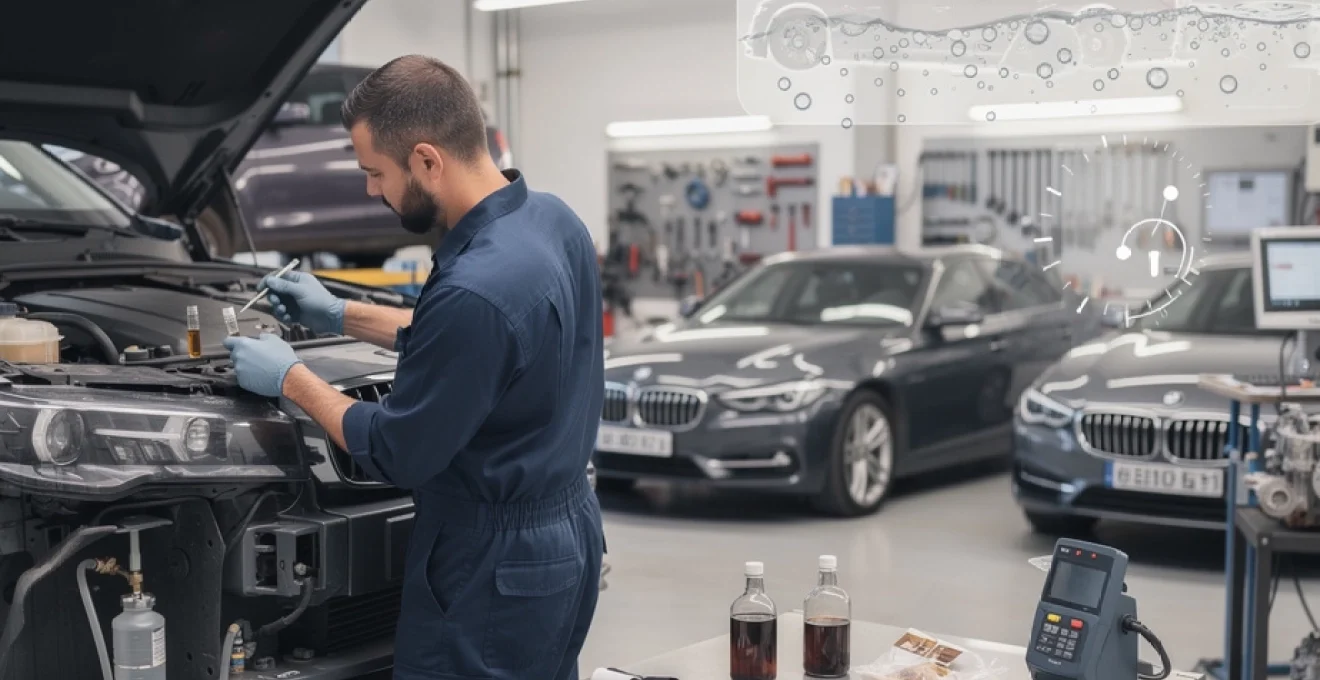
Professional technicians employ two primary testing methodologies to assess brake fluid condition. Electronic moisture testers utilise impedance measurement principles, passing a small electrical current through the fluid sample and calculating water content based on conductivity changes
to infer overall condition. These handheld testers typically report moisture content as a percentage or via a simple traffic light display, giving you an instant indication of whether a brake fluid change is advisable. Refractometers, by contrast, measure how much light bends as it passes through the fluid, a property that shifts as water content increases. While refractometers can offer excellent accuracy when correctly calibrated and used with a reference chart, electronic testers are generally quicker and more practical in a workshop environment. For most drivers, the key takeaway is that objective testing—rather than guesswork based solely on age—is the most reliable way to decide whether your brake fluid service is genuinely due.
Corrosion formation in ABS modulators and master cylinders
Moisture in brake fluid does more than lower the boiling point; it also drives internal corrosion in critical components like ABS modulators, master cylinders, and caliper bores. Steel and iron surfaces inside these units are continually exposed to a thin film of fluid, and when that fluid contains dissolved oxygen and water, microscopic rust begins to develop. Over time, this corrosion can pit sealing surfaces, contaminate valves with rust particles, and cause sticking pistons or malfunctioning ABS solenoids, often long before you notice any obvious change in pedal feel.
ABS hydraulic control units are particularly vulnerable because of their complex network of tiny passages and valves. Once rust or sludge forms inside these intricate channels, flushing alone may not restore normal operation, leading to expensive replacement of the entire module. Similarly, corrosion in the master cylinder bore can abrade rubber seals, causing internal leaks that produce a slowly sinking pedal. From a cost perspective, periodic brake fluid replacement is inexpensive insurance against four-figure repair bills, especially on modern vehicles with sophisticated stability and traction control systems integrated into the ABS hardware.
Manufacturer service interval specifications across major automotive brands
With the chemistry in mind, how do manufacturers translate fluid behaviour into real-world service intervals? Service recommendations vary widely between brands, reflecting differences in brake system design, target customers, and legal environments. European marques, especially those with performance-oriented line-ups, tend to mandate more frequent brake fluid changes, often every two years regardless of mileage. Japanese and some American manufacturers, by contrast, may specify longer intervals or base replacement more explicitly on inspection and testing.
This divergence can be confusing when you compare your owner’s manual to generic advice from garages, many of which promote a two-year rule as a universal standard. In reality, no single interval is correct for every model or usage pattern. Understanding how your particular manufacturer views brake fluid degradation—and why—helps you decide whether sticking rigidly to the schedule is essential or whether an evidence-based, test-led approach might be acceptable for your driving style.
BMW and Mercedes-Benz two-year replacement protocols
BMW and Mercedes-Benz are among the most consistent advocates of a strict two-year brake fluid service interval, regardless of model or engine size. Their rationale is rooted partly in engineering and partly in liability: these cars are often capable of sustained high-speed driving on unrestricted roads such as the German Autobahn, where brake temperatures can escalate quickly. In that context, keeping the wet boiling point as high as possible is not a theoretical exercise; it is a concrete safety margin for repeated high-energy stops.
Both brands typically include brake fluid changes as part of their official service schedules and digital service records, which can influence warranty coverage and long-term resale value. If you drive one of these vehicles and expect to maintain a full dealer history, deviating significantly from the prescribed two-year interval is rarely worth the potential complications. Even if your personal driving is gentle, BMW and Mercedes-Benz calibrate their advice for worst-case, not average, usage—so in their view, the cost of an extra fluid change is negligible compared with the risk of brake fade under extreme conditions.
Toyota and honda extended service recommendations
Toyota and Honda, by contrast, often recommend longer intervals for brake fluid service, particularly on mainstream models used primarily for commuting and family duties. Some Toyota and Honda owner’s manuals specify inspection at each service and replacement every three years, or even “as needed” based on fluid condition. This reflects both conservative brake sizing—with large safety margins for everyday use—and a customer base that is less likely to subject their vehicles to repeated high-speed stops.
For drivers of these brands, a sensible approach is to treat the manufacturer interval as a maximum rather than a minimum. If your vehicle sees mostly urban and suburban driving with modest brake temperatures, following a three-year or condition-based schedule is usually adequate, especially when combined with periodic moisture or boiling-point testing. However, if you tow frequently, live in mountainous regions, or drive aggressively, adopting a two-year interval—even if your manual allows longer—can offer additional protection without dramatically increasing ownership costs.
Performance vehicle requirements: porsche, ferrari, and track-focused applications
Performance manufacturers such as Porsche and Ferrari take a much more stringent view of brake fluid maintenance, particularly for vehicles that see track use. These brands design braking systems to tolerate repeated deceleration from very high speeds, but that capability assumes fresh, high-specification fluid with a robust wet boiling point. As a result, owner’s manuals and track-day guides often recommend annual brake fluid changes or even more frequent service for cars driven regularly on circuits.
For track-focused applications, the question “is changing brake fluid every two years necessary?” becomes almost irrelevant—most enthusiasts and race teams replace fluid before major events as a matter of course. The thermal stress experienced in a single track day can exceed what many family cars encounter in a year of normal driving. If you use a high-performance road car for occasional track days, it is wise to schedule a fluid flush beforehand and at least inspect the fluid afterwards. Treat brake fluid as you would engine oil in a high-stress environment: cheap to replace, expensive to neglect.
Heavy-duty and commercial vehicle fluid change standards
Heavy-duty and commercial vehicles, including vans, minibuses, and light trucks, present a different challenge. They often operate at or near maximum gross vehicle weight, generating substantial brake heat on long descents or in stop–start delivery routes. Many fleet maintenance programmes adopt a conservative two-year (or mileage-based) brake fluid interval, combined with regular testing, to minimise downtime and reduce the risk of brake-related incidents.
Fleet operators also factor in total cost of ownership. Corroded calipers, seized wheel cylinders, or failed ABS units on a commercial vehicle do not just incur repair bills; they also remove that vehicle from service. For that reason, a proactive approach to brake fluid service—sometimes even more frequent than manufacturer guidance—can be the most economical choice over a vehicle’s working life. If you run a van or use a pickup for towing heavy loads, aligning your brake fluid replacement schedule with these more rigorous fleet standards is a pragmatic way to preserve both safety and reliability.
Wet boiling point vs dry boiling point: critical temperature thresholds
When you read a brake fluid specification sheet, you will see two key numbers: the dry boiling point and the wet boiling point. The dry boiling point is measured with brand new fluid containing virtually no water, representing best-case performance immediately after a complete flush. The wet boiling point, typically defined with 3.7% water content, simulates fluid that has been in service for some time under normal conditions. For DOT 4 fluid, for example, the minimum dry boiling point is 230°C, while the wet boiling point drops to 155°C—a substantial reduction.
Why does this distinction matter? Under everyday commuting, you may never approach either threshold, and so an older fluid might appear to work just fine. However, in emergency braking or sustained downhill driving, brake disc temperatures can climb rapidly, and the fluid in the calipers can easily reach 150–200°C. If your fluid’s effective boiling point has been dragged down by absorbed moisture to a temperature close to that range, the safety margin narrows dramatically. Think of it as the difference between wearing a life jacket that keeps you well above the water and one that barely keeps your nose clear; both might work in calm conditions, but only one gives you confidence when the sea turns rough.
Testing brake fluid condition using professional diagnostic equipment
Given the variability in driving styles and climates, relying solely on mileage or time to decide when a brake fluid change is due can be overly simplistic. That is where professional diagnostic tools come into play. Modern workshops use a combination of chemical test strips, digital moisture testers, and visual inspection to create a more nuanced picture of brake fluid health. This condition-based approach allows you to answer a more meaningful question: “What is the state of my brake fluid today?” rather than “How old is it?”
For drivers who are sceptical about changing brake fluid every two years, requesting an objective test is a practical compromise. If the measured moisture content, copper level, or boiling point remains within safe limits, you may choose to extend the interval slightly. Conversely, if the diagnostic equipment flags high contamination after only 18 months—perhaps due to a very humid climate or heavy brake usage—you can understand why an early fluid change is advisable, rather than feeling pressured by a generic schedule.
Phoenix systems BrakeStrip copper content analysis
One widely used method to assess brake fluid condition is the Phoenix Systems BrakeStrip test, which measures copper content in the fluid. Copper leaches into the fluid from metal brake lines and internal components as corrosion begins, making it a useful proxy for overall system wear. Technicians dip a test strip into the reservoir and compare the resulting colour change to a chart that corresponds to different parts-per-million (ppm) copper levels, typically indicating whether the fluid is in a “good,” “borderline,” or “replace now” range.
Why focus on copper rather than just water? Because copper concentration reflects the cumulative chemical attack on the internals of the brake system, not just recent moisture absorption. Elevated copper levels suggest that inhibitors in the fluid have been depleted and that corrosion is actively occurring on metal surfaces. If a BrakeStrip test shows high copper even when moisture content appears moderate, a brake fluid change is still recommended to slow further internal damage. For you as a vehicle owner, this kind of evidence can bring clarity: it is easier to approve a fluid flush when you can see a test strip confirming that the old fluid is no longer providing proper protection.
Digital brake fluid testers: bosch, VXDAS, and gunson calibration
Digital brake fluid testers from brands such as Bosch, VXDAS, and Gunson take a different approach, using electrical properties of the fluid to estimate water content. Most models feature a probe that is dipped into the reservoir; the device then displays either a percentage moisture reading or a simple series of LEDs indicating “OK,” “service soon,” or “change now.” These testers are particularly popular in fast-fit centres and independent garages because they provide a quick, repeatable result without consuming disposable test strips.
Accuracy, however, depends heavily on correct calibration and usage. Professional-grade units are usually set up for specific fluid types and may need periodic calibration checks to ensure reliable readings. Lower-cost consumer testers can still be useful as a rough guide, but their results should be interpreted with caution and, where possible, cross-checked against other indicators such as boiling point tests or manufacturer service history. As with any diagnostic tool, the value lies less in the exact number on the display and more in the trend it reveals: if moisture readings are creeping upward visit after visit, it is a clear signal that a brake fluid change should not be postponed much longer.
Visual inspection indicators: colour changes from clear to dark brown
Visual inspection remains the simplest and most accessible way to gauge brake fluid condition, even if it is not as precise as laboratory-style testing. Fresh glycol-based brake fluid is usually clear to pale amber in colour. As it ages, absorbs moisture, and accumulates microscopic particles from seals and metal surfaces, it darkens toward a tea-coloured or even dark brown appearance. If the fluid in your reservoir resembles used engine oil, that is a strong indication that a brake fluid service is overdue.
Of course, colour alone cannot quantify moisture or copper content, and some fluids darken faster than others due to their additive packages. Nonetheless, combining a quick visual check with your knowledge of the fluid’s age can be revealing. Ask yourself: if the fluid looks visibly dirty and it has been more than three years since the last change, is saving a modest service fee really worth the potential risks? Much like looking at the colour of engine oil on the dipstick, the goal is not laboratory precision but practical decision-making—spotting when “probably fine” has shifted into “time to act.”
Consequences of postponing brake fluid replacement beyond recommended intervals
So what actually happens if you ignore the two-year guideline and push your brake fluid service out to four, six, or even ten years? In many everyday scenarios, nothing dramatic occurs overnight, which is precisely why some drivers become complacent. The degradation is gradual: boiling point slowly drops, inhibitors are consumed, copper and iron levels rise, and seals harden or swell. Most of the time, your brakes still feel normal—until you encounter that rare combination of high speed, heavy load, and prolonged braking where the reduced safety margin suddenly matters.
The immediate risks of overdue brake fluid tend to fall into two categories: brake fade and component failure. Brake fade, caused by localised boiling and vapour bubbles in the hydraulic circuit, manifests as a soft pedal and longer stopping distances just when you most need confident braking. Component failure, on the other hand, builds invisibly over years as corrosion attacks calipers, wheel cylinders, and ABS units, eventually leading to seized pistons, binding brakes, or internal leaks. At that point, the cost of skipping two or three inexpensive fluid changes can show up as a substantial repair bill.
There are also secondary effects to consider. Contaminated brake fluid can cause rubber components to deteriorate prematurely, introducing more particulates into the system and accelerating wear. In severe cases, a neglected system may require replacement of multiple calipers, a master cylinder, and even the ABS hydraulic unit—repairs that can easily exceed the value of an older vehicle. In short, while you might “get away with it” for years, the cumulative downside of postponing brake fluid replacement goes far beyond the modest price of periodic servicing.
Complete brake fluid exchange procedures: gravity bleeding vs pressure bleeding systems
When the time comes to actually perform a brake fluid change, the method used can influence both the thoroughness of the exchange and the risk of introducing air into the system. Two common approaches are gravity bleeding and pressure bleeding, each with its own advantages. Understanding the basic principles behind these methods will help you appreciate what your technician is doing—or, if you are a confident DIYer, decide which approach best suits your tools and experience.
Regardless of method, the goal is the same: to remove as much old, moisture-laden fluid as possible from all corners of the hydraulic circuit and replace it with fresh fluid of the correct DOT rating. This involves working through each brake in turn, starting with the wheel farthest from the master cylinder and finishing with the nearest, while ensuring the reservoir never runs dry. Think of it as flushing an old coolant system; if you simply top up without driving the stale mixture out of the pipes, you never truly reset the system’s condition.
Gravity bleeding is the simplest technique. With this method, the mechanic opens the bleed nipple on a caliper or wheel cylinder and allows gravity to draw old fluid out into a container, periodically topping up the master cylinder with fresh fluid. Over time, the new fluid displaces the old, eventually running clear at the bleed point. Gravity bleeding requires minimal equipment and reduces the risk of over-pressurising delicate components, but it can be slow and may not be effective at purging trapped air or stale fluid from complex ABS units.
Pressure bleeding, by contrast, uses a specialised device to apply controlled pressure to the master cylinder reservoir, forcing fresh fluid through the system at a steady rate. The technician then opens each bleed nipple in sequence, observing as old fluid is pushed out and replaced by new. This approach is faster and more thorough, especially on modern vehicles with intricate ABS and stability control pathways, and it is widely used in professional workshops. However, it demands appropriate equipment and care: excessive pressure can potentially damage seals, and improper setup may introduce air if the reservoir is allowed to run low.
In some cases—particularly for high-performance or heavily contaminated systems—a combination of methods is used, including traditional pedal-pump bleeding to chase out stubborn air pockets. Whichever technique is chosen, the result should be the same: a firm, consistent pedal, clear fluid in the reservoir, and a documented reset of your brake fluid service clock. If you are ever unsure what has been done, do not hesitate to ask your garage which bleeding method they used and whether the ABS unit was properly cycled during the process. That simple question can be the difference between a nominal fluid change and a truly comprehensive brake fluid service.