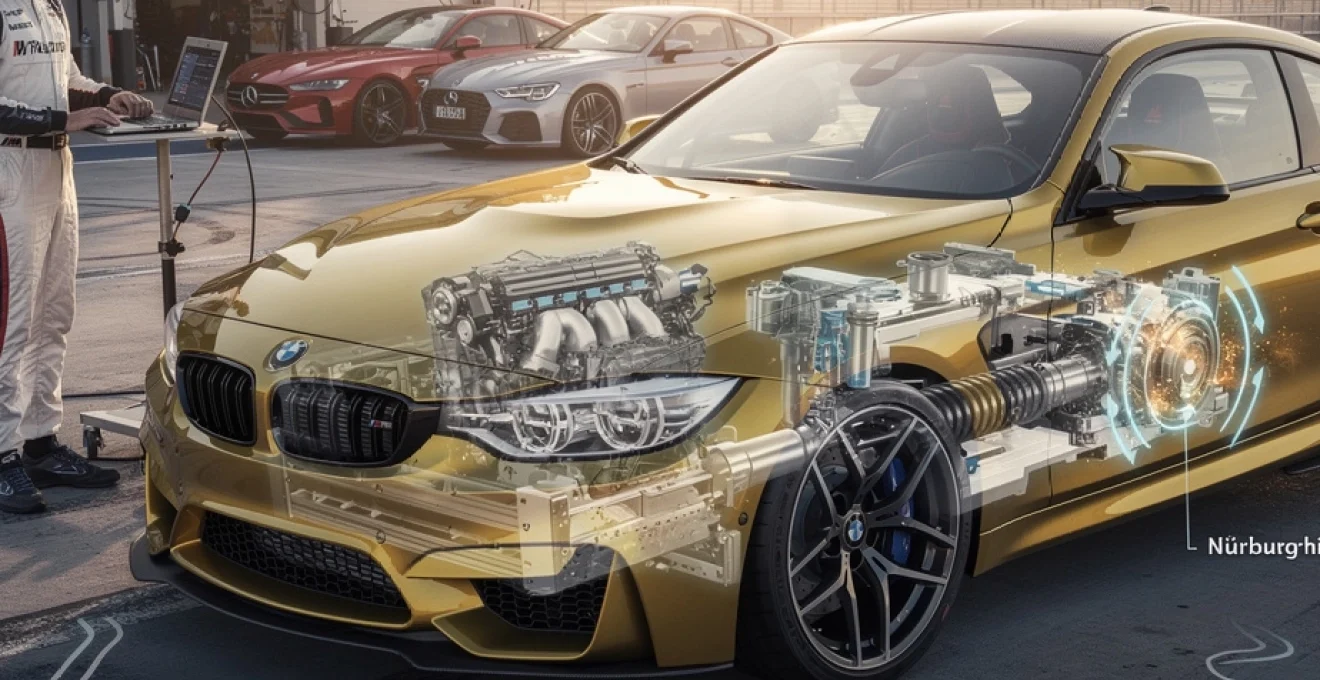
The BMW F82 M4 represents a pivotal moment in the German manufacturer’s performance heritage, marking the first time the iconic M3 coupe received its own distinct model designation. Launched in 2014, this generation introduced forced induction to the M Division’s mid-range coupe lineup, replacing the naturally aspirated V8 with a sophisticated twin-turbocharged inline-six configuration. The transition sparked considerable debate among automotive enthusiasts, yet the F82 M4 ultimately established itself as a compelling blend of cutting-edge technology and traditional M car dynamics. This comprehensive analysis examines the engineering excellence, design philosophy, and performance characteristics that define this remarkable machine.
S55 Twin-Turbo engine architecture and power delivery specifications
At the heart of the F82 M4 lies the revolutionary S55 powerplant, representing BMW’s bold departure from naturally aspirated performance engines. This sophisticated inline-six configuration demonstrates the manufacturer’s commitment to efficiency without compromising the exhilarating driving experience that defines the M brand. The engine’s development process involved extensive collaboration between BMW’s M Division and their motorsport engineers, resulting in a powerplant that delivers exceptional performance metrics whilst meeting increasingly stringent emissions regulations.
3.0-litre Inline-Six Twin-Scroll turbocharger configuration
The S55 engine employs a meticulously engineered 3.0-litre displacement that maximises the benefits of forced induction technology. Twin-scroll turbochargers work in perfect harmony to eliminate the traditional turbo lag associated with earlier forced induction systems. Each turbocharger operates on a bank of three cylinders, creating an optimal balance between power delivery and thermal efficiency. The twin-scroll design separates exhaust pulses from different cylinders, maintaining higher exhaust gas velocity and improving overall turbine efficiency.
This configuration enables the engine to maintain consistent boost pressure across a remarkably broad rev range, delivering what engineers describe as a “flat torque curve” that fundamentally changes the driving character compared to naturally aspirated predecessors. The sophisticated exhaust manifold design incorporates integrated cooling passages, ensuring optimal operating temperatures even under extreme performance conditions.
425bhp peak power output and 550nm torque characteristics
The S55 powerplant delivers an impressive 425bhp at 5,500-7,300rpm, representing a significant advancement over the previous generation’s naturally aspirated V8. More importantly, the engine produces a substantial 550Nm of torque between 1,850-5,500rpm, providing exceptional mid-range performance that transforms the driving experience. This torque output represents a 40% increase over the outgoing V8, fundamentally altering the M4’s character from a high-revving screamer to a more versatile performance machine.
The broad torque plateau ensures exceptional flexibility across various driving scenarios, whether navigating urban traffic or attacking challenging mountain passes. Peak power delivery occurs much earlier in the rev range compared to naturally aspirated engines, allowing drivers to access maximum performance without constantly chasing the redline.
M TwinPower turbo technology and High-Precision direct injection
BMW’s M TwinPower Turbo technology represents the culmination of decades of forced induction development, incorporating multiple sophisticated systems working in perfect synchronisation. The high-precision direct injection system operates at pressures exceeding 200 bar, enabling precise fuel metering that optimises both performance and efficiency. Variable valve timing on both intake and exhaust camshafts ensures optimal breathing characteristics across the entire rev range.
The advanced engine management system continuously monitors over 50 different parameters, making thousands of calculations per second to optimise ignition timing, fuel delivery, and boost pressure. This level of sophistication enables the S55 to deliver consistent performance regardless of ambient temperature, altitude, or fuel quality variations.
Forged crankshaft and Closed-Deck engine block construction
The S55’s internal components reflect M Division’s uncompromising approach to durability and performance. The forged steel crankshaft provides exceptional strength while minimising rotational mass, contributing to the engine’s impressive rev capability. Closed-deck engine
construction, with coolant passages cast around the cylinders for improved thermal stability, allows the S55 to run higher cylinder pressures than an open-deck design. This architecture is more commonly found in endurance racing engines, underlining how seriously BMW approached reliability in the F82 M4. Reinforced crankshaft bearings, sodium-filled exhaust valves and a robust oiling system with additional scavenging pumps ensure consistent lubrication during sustained high-g cornering. For owners who plan regular track use, this means the S55 can withstand repeated high-load cycles with far less risk of heat-related degradation than many rival powerplants.
Active M differential electronic torque vectoring system
Transmitting the S55’s power to the road is the Active M Differential, an electronically controlled multi-plate limited-slip unit mounted on the rear axle. Unlike a traditional mechanical LSD that reacts only to differences in wheel speed, the Active M Differential is proactively managed by the car’s central control unit. It can vary the locking effect between 0 and 100 per cent in milliseconds, taking into account throttle position, lateral acceleration, steering angle, and yaw rate.
On a fast B-road or circuit, this translates into impressive traction out of slower corners and exceptional stability when you deliberately unweight the rear. Rather than waiting for one wheel to spin before locking, the system anticipates the need for torque transfer and pre-loads the differential accordingly. The result is a rear axle that feels more like a well-trained partner than an unpredictable source of oversteer. For drivers stepping up from more mainstream performance cars, this sophisticated torque vectoring system makes the F82 M4 feel both faster and more approachable at the limit.
Carbon fibre reinforced plastic body construction and aerodynamic package
One of the key differentiators of the BMW F82 M4 in the performance coupe segment is its extensive use of carbon fibre reinforced plastic (CFRP) and lightweight metals. BMW’s M Division treated weight reduction as seriously as power output, chasing the classic motorsport formula of “adding lightness” wherever possible. Compared to the previous E92 M3, the F82 sheds around 80kg, a significant achievement given stricter safety standards and added equipment. These measures play a crucial role in the car’s agility, braking performance and fuel efficiency.
Beyond simple mass reduction, the F82’s body construction and aero package are designed to manipulate airflow in a way that increases stability and cooling without introducing excessive drag. Every vent, crease and duct has a defined purpose, from reducing lift at high speeds to feeding cool air to radiators and brakes. For anyone looking at the BMW F82 M4 as a track-capable daily driver, this attention to aerodynamic detail pays dividends in both confidence and consistency during hard driving.
CFRP roof panel weight reduction and centre of gravity optimisation
The most visible expression of the M4’s lightweight philosophy is the exposed carbon fibre roof panel. Replacing a conventional steel roof with CFRP saves approximately 6kg, but the real benefit is not the raw number, it’s where that weight is removed from. By shaving mass from the highest point of the body shell, BMW lowers the M4’s centre of gravity, improving turn-in, body control and overall response to steering inputs.
You can think of this like a figure skater pulling their arms in to spin faster: reducing mass further from the rotational axis reduces inertia and makes direction changes more immediate. On the road, the effect is subtle but noticeable, particularly when transitioning quickly between left and right-hand bends. On circuit, the CFRP roof helps the F82 M4 feel more composed through high-speed direction changes, allowing the suspension to work more effectively and tyres to stay better planted.
M aerodynamics package front splitter and rear diffuser design
The standard M Aerodynamics Package on the BMW F82 M4 is more than just visual theatre. The aggressive front apron, sculpted side skirts and functional rear diffuser are engineered to manage airflow around and under the car. The front splitter and deep lower intake area help reduce front-end lift by directing air over and around the body rather than allowing it to pile up beneath the chassis. This helps keep the nose more stable at motorway and autobahn speeds.
At the rear, the diffuser works in conjunction with the flat sections of underbody panelling to reduce turbulence and encourage smoother flow separation. The familiar quad exhaust outlets are integrated into this design, minimising disruption to the underbody airflow. Together with the subtle rear lip spoiler on the bootlid, the package strikes a balance between downforce and drag, improving high-speed stability without compromising the car’s impressive top speed or efficiency. For drivers who regularly explore the M4’s performance envelope, this aero tuning helps the car feel planted and predictable even well into triple-digit velocities.
Active front grille shutters and brake cooling duct integration
Cooling and aerodynamics often compete with each other, but the F82 M4 uses active technology to reconcile these demands. Behind the classic BMW kidney grille sit active air flaps that open or close depending on cooling requirements. Under light loads or in cold weather, the shutters stay closed to improve aerodynamic efficiency and shorten engine warm-up times, aiding both fuel economy and emissions.
When the driver demands more from the S55 engine or the ambient temperature rises, the shutters open to let more air pass through the radiators and auxiliary coolers. Additional dedicated ducts in the front bumper route airflow towards the high-performance braking system, helping to dissipate heat during repeated heavy stops. This intelligent approach means the BMW M4 can cruise efficiently when you are commuting, yet still manage thermal loads effectively when you push hard on a track day or mountain pass.
Carbon fibre propeller shaft and aluminium space frame technology
Under the skin, the BMW F82 M4 features a carbon fibre reinforced plastic propeller shaft, a component more often associated with race cars and supercars. This single-piece shaft is significantly lighter than a traditional steel equivalent and crucially reduces rotational mass in the drivetrain. Less inertia in the driveline allows the engine to rev more freely and improves throttle response, contributing to the car’s immediate acceleration feel despite its turbocharged nature.
Complementing this is the extensive use of aluminium in the body structure and suspension components. The front subframe, many suspension arms and parts of the crash structure are made from lightweight alloys to reduce unsprung mass and overall vehicle weight. The result is a chassis that feels rigid yet responsive, providing a stable platform for the M Adaptive Suspension while keeping the BMW F82 M4’s kerb weight below many of its rivals. For enthusiasts who value precision and feedback, these construction details are a key part of what makes the F82 feel like a genuine M car.
Adaptive M suspension and dynamic stability control systems
If the engine is the heart of the F82 M4, the chassis electronics are its nervous system. BMW’s Adaptive M Suspension and sophisticated stability control hardware work together to give the driver a wide range of character settings, from relaxed GT cruiser to track-focused weapon. With the press of a button, damping, steering, throttle and stability thresholds can all be tailored to suit road conditions and driving style.
For many owners, this breadth of capability is what makes the BMW F82 M4 such an appealing daily driver. You can cover long motorway journeys in comfort, then arrive at your favourite back road, tap an M Drive button on the steering wheel, and instantly access a far sharper configuration. The electronics are there to enhance the experience, not dilute it, provided you take the time to understand how each system influences the driving feel.
Electronically controlled dampers and M adaptive suspension setup
The M Adaptive Suspension uses continuously variable dampers at all four corners, each controlled by high-speed valves and a central control unit. Sensors monitor wheel movement, body motion, steering input and brake pressure, and the system adjusts damping forces in milliseconds. The driver can choose between three primary modes: Comfort, Sport and Sport Plus, each with distinct behaviour.
In Comfort, the BMW M4 is impressively compliant for a performance coupe, soaking up most surface imperfections and making long-distance travel genuinely relaxing. Switch to Sport and the body movements tighten up, with reduced roll and pitch while still preserving enough compliance for typical British and European roads. Sport Plus is best reserved for smooth asphalt or circuit use, where the firmer damping delivers sharper response and more immediate feedback. Treat these modes like a toolkit: you can mix suspension settings with different engine and steering maps to create the blend that suits your driving and the conditions.
Dynamic stability control with M dynamic mode calibration
BMW’s Dynamic Stability Control (DSC) in the F82 M4 is far more sophisticated than a simple on/off safety net. In its standard setting, DSC keeps a close watch on wheel speeds, yaw rate and steering angle, stepping in discreetly to correct slides and wheelspin, especially in wet or low-grip conditions. This mode is ideal when you are still learning the car’s limits or driving on poor surfaces, as it allows brisk progress without unnecessary drama.
Engage M Dynamic Mode (MDM), however, and the character changes. The algorithms permit greater slip angles and more wheelspin before cutting in, giving keen drivers the chance to explore controlled oversteer and throttle steering while still retaining a margin of electronic backup. Turn the system fully off and you are entirely in charge, with no safety net if you misjudge traction levels. For most owners, MDM offers the best balance between fun and security, particularly on the road where surface grip can change rapidly and unexpectedly.
Variable sport steering and servotronic assistance technology
The F82 M4 features Variable Sport Steering, an electromechanical system with a variable steering ratio that changes depending on steering angle. Around the straight-ahead, the ratio is relatively slow, aiding stability at higher speeds and avoiding nervousness on the motorway. As you wind on more lock, the ratio quickens, reducing the amount of steering input needed for tight corners or rapid direction changes, which is especially useful on twisty roads or when manoeuvring in town.
Servotronic speed-sensitive assistance adjusts the level of power assist provided, making the wheel light in parking situations and progressively firmer as speed builds. The driver can choose between Comfort, Sport and Sport Plus steering maps, each altering the weighting and response. While purists may miss the granular feedback of older hydraulic systems, the BMW F82 M4’s steering remains precise and consistent, allowing you to place the car accurately and build trust in its responses. Once you adapt to the weighting, the system becomes a natural extension of your inputs.
M compound braking system with blue painted callipers
Bringing the BMW M4’s substantial performance under control is the standard M Compound braking system, identifiable by its blue multi-piston calipers and large ventilated discs. These brakes use a combination of lightweight materials to reduce unsprung mass while still delivering excellent fade resistance. On the road, pedal feel is firm and reassuring, with a progressive response that makes it easy to modulate braking force in traffic or on a demanding descent.
For drivers planning regular track use, BMW also offered optional carbon-ceramic brakes, which significantly improve heat resistance and cut additional weight from the rotating masses. However, for most owners the standard M Compound setup strikes a sweet spot between cost, performance and day-to-day usability. As with any high-performance system, using quality pads and fluid, and allowing cooling laps after intense track sessions, will keep the braking performance consistent over the long term.
Interior design philosophy and M performance cockpit layout
Inside, the BMW F82 M4 combines traditional BMW ergonomics with subtle motorsport-inspired touches. The overall dashboard architecture will feel familiar to anyone who has driven a contemporary 3 or 4 Series, but the choice of materials, seat design and M-specific switchgear clearly differentiate the cabin. Soft-touch plastics, high-quality leather and optional carbon fibre trim create an environment that feels suitably premium for a car in this price bracket.
The driving position is one of the highlights of the F82 M4 interior. You sit low, with a wide range of adjustment in both the seat and the steering wheel, making it easy for drivers of different sizes to find a comfortable, focused posture. The heavily bolstered M sport seats offer excellent lateral support without being overly restrictive, making them suitable for both spirited driving and long journeys. Integrated headrests, illuminated M logos (on some models) and contrasting stitching add a subtle visual flourish.
The M-specific instrument cluster provides clear, legible information, with a large central rev counter and speedometer flanked by configurable digital displays. In Sport or Sport Plus engine modes, the cluster’s graphics and shift lights emphasise performance driving, encouraging you to use the S55 engine’s rev range effectively. The thick-rimmed M steering wheel incorporates programmable M1 and M2 buttons, which let you store personalised combinations of engine, suspension, steering and DSC settings. With a single press, you can transform the car from a calm commuter to a track-ready tool.
BMW’s iDrive infotainment system, controlled via a rotary dial on the centre console, manages navigation, media, vehicle settings and connectivity. While the interface has evolved since the F82’s launch, even early cars offer intuitive menu structures and clear graphics. Practical touches, such as decent rear-seat legroom for a coupe, split-folding rear seats and a 445-litre boot, reinforce the M4’s role as a genuinely usable everyday performance car. For buyers seeking a blend of practicality and excitement, this interior layout makes the F82 M4 an easy car to live with.
Track performance metrics and nürburgring nordschleife benchmarking
No review of a BMW M4 would be complete without considering its track credentials. The F82 M4 was developed with extensive testing at the Nürburgring Nordschleife, and it shows in the way the car behaves when pushed to the limit. In factory trim, the standard M4 Coupe is capable of lapping the ‘Ring in the low 7:50s, while more focused variants such as the M4 GTS dip well into the 7:20s, placing them firmly in supercar territory for outright lap time.
On a typical circuit day, the BMW F82 M4’s combination of strong mid-range torque, stable braking and predictable rear-drive balance makes it accessible even to intermediate drivers. The car is fast enough to feel exciting, yet not so overwhelming that you are afraid to explore its abilities. With the right tyres and fluid upgrades, owners report consistent performance over 15–20 minute sessions without significant fade or heat-soak issues, especially in cooler climates.
Where the F82 particularly shines is in its ability to put power down out of slower corners. The Active M Differential and wide rear tyres work together to translate the S55’s torque into forward motion rather than wheelspin. As you become more confident, M Dynamic Mode allows you to experiment with small, controllable slides that can shave tenths off your lap times if used skilfully. It is this blend of approachability and depth that makes the BMW F82 M4 a popular choice among track-day enthusiasts seeking a car that can drive to the circuit, perform strongly all day, and then cruise home in comfort.
Market positioning against audi RS5 and Mercedes-AMG C63 coupe competition
In the high-performance coupe market of the mid-2010s, the BMW F82 M4 faced two primary rivals: the Audi RS5 and the Mercedes-AMG C63 Coupe. Each car approached the brief with a distinct personality. The RS5 emphasised all-weather traction and understated design, leveraging its quattro all-wheel-drive system to offer secure, predictable performance in poor conditions. The C63, by contrast, delivered a charismatic V8 soundtrack and a more flamboyant character, appealing to drivers who value drama and straight-line muscle.
The BMW M4 positioned itself as the driver’s choice, prioritising agility, feedback and weight reduction over outright cylinder count or the security of four driven wheels. On a dry, twisting road or circuit, the F82’s lower mass and rear-drive balance typically translate into sharper turn-in and greater adjustability than its competitors. For buyers who prioritise steering feel, chassis balance and track capability, this focus gives the M4 a distinct edge.
From an ownership perspective, the turbocharged S55 engine also offers a more efficient package than the naturally aspirated or larger-capacity turbo V8 units in its German rivals. Real-world fuel consumption in the mid-to-high 20s (mpg) is achievable with mixed driving, while CO₂ emissions remain relatively modest for a car of this performance level. Maintenance costs and insurance are in line with the segment, but prospective buyers should budget appropriately for premium tyres and high-spec brake components, especially if they plan regular spirited or track use.
Ultimately, choosing between a BMW F82 M4, an Audi RS5 and a Mercedes-AMG C63 Coupe comes down to personal priorities. If you value year-round traction and understated confidence, the RS5 remains compelling. If you are drawn to the raw emotion of a thundering V8, the C63 is hard to ignore. But if your ideal performance coupe is one that feels like a precision tool, encourages you to refine your driving and rewards commitment with remarkable pace, the BMW F82 M4 stands out as a benchmark in its class.