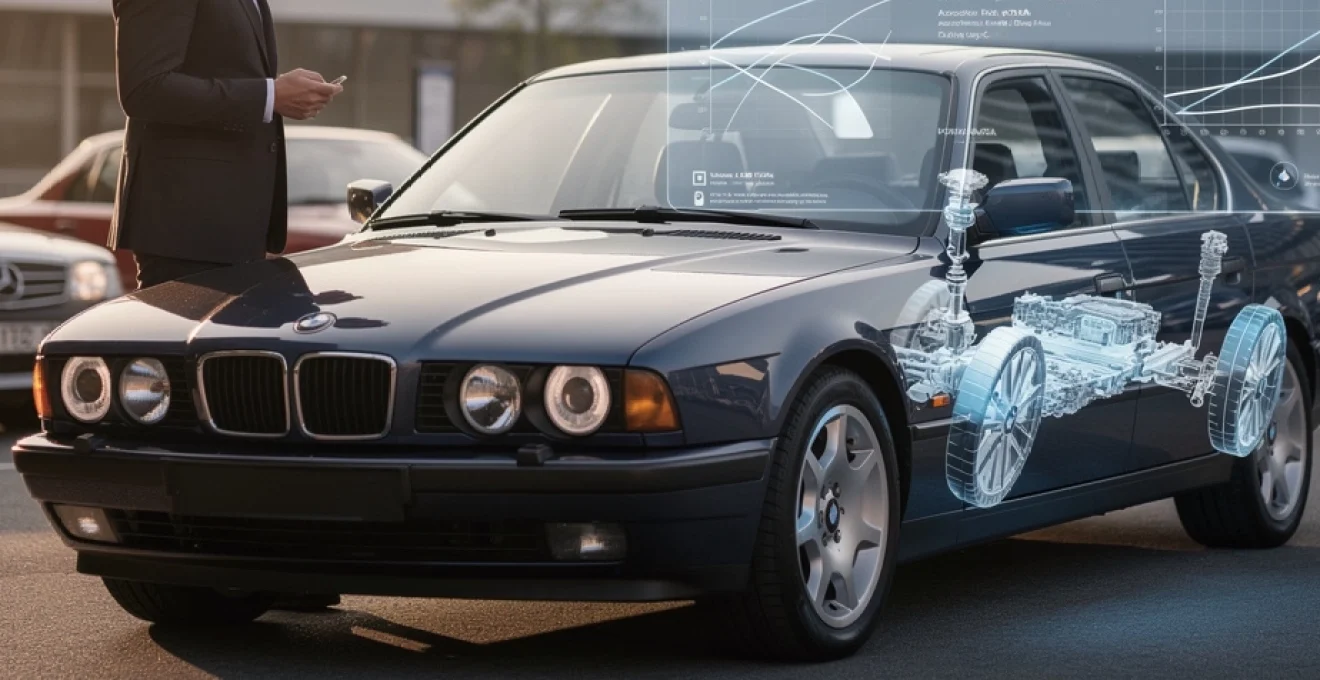
The BMW 5 Series E34 generation represents one of the most significant achievements in automotive engineering history, establishing new benchmarks for executive saloon performance, luxury, and driving dynamics. Launched in late 1987, this third-generation 5 Series fundamentally redefined what premium executive vehicles could deliver, combining cutting-edge technology with timeless design excellence. The E34’s influence extends far beyond its production years, with enthusiasts and collectors recognising its status as a modern classic that perfectly encapsulates BMW’s engineering philosophy during the late 1980s and early 1990s.
This remarkable vehicle showcased BMW’s commitment to innovation while maintaining the brand’s core values of ultimate driving pleasure and uncompromising quality. The E34’s development represented a £2.5 billion investment in research and development, resulting in advanced aerodynamics, sophisticated suspension systems, and groundbreaking safety technologies that would influence automotive design for decades to come.
E34 generation development timeline and market positioning strategy
The E34’s development journey began in 1983 when BMW recognised the need to create a successor to the highly successful E28 generation. The project, internally designated as Project E34, aimed to establish BMW’s dominance in the executive saloon segment against formidable competitors including the Mercedes-Benz W124 and Audi’s emerging premium offerings.
Wolfgang reitzle’s engineering vision for executive mobility
Under the guidance of BMW’s engineering leadership, the E34 project embraced a revolutionary approach to executive vehicle design. The development team focused on creating a vehicle that would deliver exceptional performance whilst maintaining the refinement expected from a premium saloon. This philosophy resulted in the implementation of advanced technologies including electronic engine management systems, sophisticated suspension configurations, and pioneering safety features.
The engineering team prioritised aerodynamic efficiency, achieving an impressive drag coefficient of 0.32 Cd through extensive wind tunnel testing and refined bodywork design. This achievement represented a significant improvement over the predecessor’s 0.36 Cd, contributing to enhanced fuel economy and reduced wind noise at highway speeds.
Competition analysis against Mercedes-Benz W124 and audi 100 C4
BMW’s market research identified key areas where competitors excelled, particularly in interior refinement and build quality perception. The E34 development programme specifically addressed these concerns through enhanced materials selection, improved manufacturing tolerances, and innovative design solutions. The result was a vehicle that matched or exceeded competitor offerings in virtually every measurable aspect.
Performance benchmarking against the Mercedes-Benz W124 revealed opportunities for BMW to establish superiority in driving dynamics and engine technology. The E34’s chassis tuning delivered more engaging handling characteristics whilst maintaining the comfort levels expected in the executive segment, creating a unique positioning advantage.
Global market launch strategy from 1987 to 1996
BMW’s international launch strategy for the E34 commenced with European markets in November 1987, followed by North American introduction in spring 1988. The phased global rollout allowed BMW to optimise production capacity whilst ensuring adequate dealer preparation and parts supply networks. Initial market reception exceeded expectations, with order books filling rapidly across all major markets.
The launch lineup featured four engine variants: the 520i with the M20B20 engine, the 525i utilising the M20B25 powerplant, the 530i equipped with the M30B30 unit, and the range-topping 535i featuring the M30B35 engine. This comprehensive engine range addressed diverse customer preferences whilst maintaining BMW’s performance-oriented brand positioning.
Production milestones at dingolfing manufacturing plant
BMW’s Dingolfing facility underwent significant expansion to accommodate E34 production, with investment exceeding 800 million Deutsche Marks in new manufacturing equipment and process improvements. The production line incorporated advanced robotics and quality control systems that established new industry standards for precision assembly and paint quality.
Daily production capacity reached 850 vehicles at peak efficiency, with total E34 production spanning 1.33 million units across all variants. The manufacturing process emphasised handcrafted elements combined with precision automation, creating vehicles that exhibited exceptional build quality and attention to detail that became synonymous with BMW excellence.</p
Importantly, Dingolfing also became a pilot site for BMW’s enhanced corrosion protection, with extensive galvanisation and advanced paint processes helping many E34s resist rust better than rivals when new. For buyers today, cars that still present original paintwork and clean seams around the sills and arches are a testament to this manufacturing quality. The plant’s focus on continuous improvement meant that late-production E34 models often benefitted from incremental upgrades in materials, electronics and assembly precision, making 1993–1996 cars particularly desirable for daily usability.
Powertrain engineering excellence and m-performance variants
M20 and M50 naturally aspirated engine technologies
At the heart of the BMW 5 Series E34’s appeal was an exceptionally broad range of straight-six engines, beginning with the M20 and later evolving into the more advanced M50 family. Early 520i and 525i models used the M20, an overhead-cam inline-six with a cast-iron block and belt-driven camshaft that prioritised smoothness and reliability. These units delivered a classic BMW sound and linear power delivery, making even modestly powered E34 saloons feel refined and engaging on the motorway.
From 1990 onward, BMW introduced the M50 engine range, bringing 24-valve, twin-cam technology and electronic engine management to the 5 Series E34. The M50B20 and M50B25 engines significantly improved power output, throttle response and fuel efficiency, while offering cleaner emissions for increasingly strict regulations. With coil-on-plug ignition, knock sensors and advanced Bosch Motronic control, these engines turned the 520i and 525i into truly modern executive saloons that could comfortably compete with newer rivals well into the mid-1990s.
In 1992, the M50TU (Technical Update) added VANOS variable camshaft timing on the inlet side, optimising torque at low and mid-range revs without sacrificing high-end performance. For many enthusiasts, a well-maintained 525i with the M50TU represents the sweet spot in the E34 lineup, combining characteristic BMW six-cylinder smoothness with everyday reliability and reasonable fuel economy. If you are considering an E34 as a classic daily driver, these 24-valve cars often offer the best balance of performance, efficiency and long-term parts support.
M60 V8 and S38B36 M5 high-performance powertrains
To move the BMW 5 Series E34 further upmarket, BMW introduced the M60 V8 engine family in 1992, launching the 530i and 540i. These all-aluminium, quad-cam V8s were designed to deliver effortless torque and refinement, with power outputs ranging from around 215 bhp in the 3.0-litre to 282 bhp in the 4.0-litre variant. The result was an executive saloon that could cruise quietly at autobahn speeds yet surge forward with sports-car urgency when required. Compared with rival Mercedes V8s of the time, the M60 units offered a more rev-happy, free-spinning character, reinforcing BMW’s performance image.
At the very top of the range sat the E34 M5, powered initially by the S38B36 and later the enlarged S38B38 straight-six. Hand-built by BMW Motorsport, these engines used individual throttle bodies, high-lift cams and extensive internal strengthening to produce up to 335 bhp in later 3.8-litre form. The S38 delivered a unique blend of race-bred character and everyday usability, with a spine-tingling induction roar above 4000 rpm that made the M5 feel genuinely special. Even today, an E34 M5 remains one of the most engaging analog performance saloons you can drive, with an immediacy that many modern turbocharged cars struggle to replicate.
Of course, owning an M60 or S38-powered BMW 5 Series E34 requires a more considered approach to maintenance and budgeting. Timing chain guides, cooling systems and oil leaks must be monitored carefully on V8 models, while the S38 demands regular valve clearance checks and meticulous servicing to stay healthy. Yet for enthusiasts seeking the pinnacle of naturally aspirated BMW engineering, these powertrains offer an experience that is closer to a classic performance car than a typical executive saloon. In many ways, they represent the last chapter of BMW’s high-revving, naturally aspirated era before widespread turbocharging.
ZF 5HP18 automatic transmission integration
While many purists favour manual gearboxes, the BMW 5 Series E34 was also a showcase for sophisticated automatic transmission technology, particularly the ZF 5HP18. This five-speed automatic, introduced on selected six-cylinder and V8 models, brought closer gear spacing and improved fuel efficiency compared with earlier four-speed units. Intelligent shift programming adapted to driving style, holding gears longer during brisk acceleration yet shifting early for economy in relaxed cruising. For executive buyers in the 1990s, this level of refinement was a key selling point.
The integration of the ZF 5HP18 with BMW’s engine management systems allowed smoother torque converter lock-up and more precise control of shift timing. In practice, this meant that an E34 525i or 530i fitted with the five-speed automatic could deliver both responsive overtaking performance and relaxed, low-rpm cruising on long journeys. For today’s owners, a well-maintained ZF automatic can still feel remarkably modern, provided that fluid and filter changes are performed regularly despite the original “lifetime fill” marketing claims.
If you are evaluating a used BMW 5 Series E34 with an automatic transmission, smooth upshifts, clean downshifts and minimal delay when engaging drive or reverse are essential signs of health. Any signs of flaring between gears, harsh engagement or hesitation warrant further investigation, as a full rebuild can be costly. That said, many specialists are experienced with the 5HP18, and proactive servicing often extends these gearboxes well beyond 200,000 miles, making them a viable option for a comfortable classic daily driver.
BMW M5 E34 touring estate performance specifications
Among all BMW 5 Series E34 variants, the M5 Touring is arguably the most intriguing and collectible. Built in very limited numbers from 1992, the M5 Touring combined the Motorsport-tuned S38B38 engine with the practical Touring estate body, creating one of the earliest true “super wagons”. With approximately 335 bhp and 400 Nm of torque, the car could sprint from 0–62 mph in around 5.9 seconds and reach an electronically limited top speed of 155 mph, all while carrying family, luggage or even sports equipment in the rear.
BMW produced fewer than 900 E34 M5 Touring units, all left-hand drive and most destined for European markets, which has contributed to their rarity and desirability today. The chassis received uprated springs and dampers, wider tyres and more powerful brakes, ensuring that handling matched the potent powertrain. For many enthusiasts, the M5 Touring encapsulates the E34 philosophy perfectly: an understated, elegant shape hiding serious performance capability. How many other early-1990s estates could tackle a mountain pass with such confidence and composure?
From a usability perspective, the M5 Touring retained the split-opening tailgate glass and generous load area of standard Touring models, making it surprisingly practical as a long-distance grand tourer. However, maintenance and restoration costs can be significant, especially for S38 engine work and M-specific suspension or trim components. If you are considering one as an investment-grade classic, a detailed inspection by a marque specialist and a comprehensive history file are absolutely essential. Given their low production numbers, well-maintained examples are increasingly viewed as blue-chip modern classics.
525tds turbodiesel innovation and fuel economy achievements
Although petrol engines tend to dominate discussions of the BMW 5 Series E34, the 525tds turbodiesel played an important role in the model’s European success. Powered by the M51 six-cylinder diesel engine with direct injection and a turbocharger, the 525tds offered a compelling blend of torque and economy for high-mileage drivers. With around 143 bhp and a strong mid-range, it provided relaxed cruising and impressive real-world fuel consumption figures that could exceed 40 mpg on long motorway runs, a key advantage in markets with high fuel prices.
BMW’s approach to diesel refinement meant that the 525tds was significantly quieter and smoother than many rival diesel saloons of the early 1990s. Enhanced sound insulation, optimised combustion and careful engine mounting design all contributed to an experience that felt more like a muted petrol six than a traditional clattery diesel. For fleet buyers and long-distance commuters, this made the diesel-powered E34 an attractive alternative to the Mercedes-Benz W124 diesels and Audi 100 TDI models.
Today, a 525tds can still make sense if you undertake substantial annual mileage and value fuel efficiency, but you should factor in the greater complexity of the diesel injection system and turbocharger. Age-related issues such as injector wear, boost leaks and cooling system neglect can quickly erode the initial fuel savings if not addressed. For most modern classic enthusiasts, a petrol-powered BMW 5 Series E34 will offer a more straightforward ownership experience, but the turbodiesel remains an interesting chapter in BMW’s executive saloon history.
Chassis dynamics and suspension engineering architecture
Macpherson strut front suspension geometry
The E34’s reputation as a benchmark executive saloon owes much to its carefully engineered suspension architecture, starting with the MacPherson strut front end. Shared in concept with the larger E32 7 Series, the front suspension combined struts, wishbones and tension struts to achieve precise wheel control and stable geometry under load. This arrangement allowed BMW engineers to fine-tune steering response and camber characteristics, ensuring excellent grip in fast corners while preserving the ride comfort expected in the premium segment.
One of the strengths of the BMW 5 Series E34 chassis is the way it communicates road conditions to the driver without becoming harsh or fatiguing. You can think of it as a well-tuned musical instrument: sensitive enough to let you “hear” every note of the road surface, yet never so sharp that it becomes tiring. When front control arm bushes and ball joints are in good condition, the E34 tracks accurately at high speed and inspires confidence, even by modern standards. For buyers today, a tight, rattle-free front end is a strong indicator of careful maintenance.
However, the same precision that makes the E34 so satisfying to drive also means that worn components are quickly noticeable. A characteristic steering shimmy at around 50–60 mph often points to tired thrust arm bushes or worn tie rods, which should be addressed promptly to restore the car’s original poise. Fortunately, quality replacement parts from OEM suppliers remain readily available, and a full refresh of the front suspension can transform a tired car into something that feels remarkably close to its factory-fresh character.
Semi-trailing arm rear axle configuration
At the rear, the BMW 5 Series E34 employed a semi-trailing arm axle, an evolution of a layout that BMW had refined over several generations. This configuration provided a good balance between packaging efficiency, ride comfort and predictable handling, particularly in wet or low-grip conditions. While more modern multi-link designs can offer superior camber control, the E34’s rear axle remains impressive for its era, delivering secure high-speed stability and progressive breakaway characteristics that suit both spirited and relaxed driving.
Self-levelling suspension (SLS) was fitted to some higher-specification and Touring models, using hydraulic struts and a load-sensing system to maintain consistent ride height regardless of payload. For executive customers who regularly carried passengers or luggage, this feature preserved handling and comfort, especially on long journeys. When functioning correctly, SLS is unobtrusive, but leaks from hydraulic lines or struts can lead to sagging and harshness. As a result, some owners have chosen to retrofit conventional springs and dampers, trading originality for simplicity.
As with the front axle, worn bushes and trailing arm mounts can gradually erode the E34’s composure, leading to vague rear-end behaviour or clunks over sharp bumps. The good news is that a thorough overhaul of the rear suspension with modern rubber or polyurethane components can significantly sharpen the car’s responses. If you are planning to use a BMW 5 Series E34 for enthusiastic driving or regular long-distance touring, budgeting for a suspension refresh is one of the most effective ways to enhance both safety and enjoyment.
Electronic damper control and ASC+T traction systems
Certain higher-end E34 models were available with Electronic Damper Control (EDC), a system that allowed the shock absorbers to adapt to driving style and road conditions. By varying damping rates electronically, EDC aimed to combine supple low-speed comfort with firm, controlled body movements during dynamic driving. In practice, this made the BMW 5 Series E34 feel like two cars in one: a relaxed executive saloon in its softer setting and a composed sports saloon when driven harder. For its time, EDC was genuinely cutting-edge, prefiguring the adaptive dampers now common in modern premium cars.
Another key technology was ASC+T, BMW’s traction control system that worked alongside the anti-lock brakes to curb wheelspin on slippery surfaces. By modulating engine power and, in some cases, applying individual brakes, ASC+T made the E34 more forgiving at the limit, particularly in wet or snowy conditions. This was especially valuable for powerful rear-wheel-drive variants like the 540i and M5, where the combination of high torque and modest contemporary tyre technology could otherwise catch out inattentive drivers.
From an ownership perspective, EDC and ASC+T add complexity, but they also contribute to the car’s character and usability. Replacement EDC dampers are no longer available new, although specialist firms can refurbish original units to factory specification. If you encounter an E34 with inoperative EDC or warning lights related to ASC+T, it is wise to obtain a clear diagnosis before purchase. For many enthusiasts, however, the presence of these systems is part of what makes a well-preserved BMW 5 Series E34 feel like a genuinely advanced executive saloon even decades after launch.
Servotronic power steering calibration
The steering of the BMW 5 Series E34 is often praised for its natural weighting and accuracy, and on certain models this was enhanced further by BMW’s Servotronic system. Servotronic varied power assistance according to road speed, providing light steering effort in urban environments and heavier, more stable weighting at motorway velocities. This calibration helped the E34 strike a rare balance between low-speed ease and high-speed confidence, something that many enthusiasts still prefer over the over-assisted feel of some modern systems.
In everyday use, a healthy Servotronic-equipped E34 feels intuitive and transparent, allowing you to place the car precisely on narrow B-roads or sweeping motorways alike. The system’s hydraulic foundation also ensures that, unlike many electric setups, there is still a genuine flow of feedback through the rim. If you imagine the steering as a conversation between you and the car, the E34 manages to be both articulate and calm, conveying what the front tyres are doing without shouting about it.
Age-related issues, such as leaks from the steering box or worn joints in the column and linkages, can gradually dull this clarity. Reconditioned steering boxes and quality replacement components are available, and many owners report that a refreshed steering system dramatically enhances the driving experience. When test-driving a prospective purchase, pay attention to on-centre feel, response to small inputs and any knocking or play; these subtle details can tell you a lot about how well the car has been maintained.
Interior design philosophy and ergonomic innovation
The cabin of the BMW 5 Series E34 was designed around the driver, continuing a BMW tradition of subtly angled centre consoles and logical control placement. Unlike some contemporaries that favoured flamboyant styling, the E34 interior embraced a clean, functional aesthetic with high-quality plastics, solid switchgear and carefully chosen fabrics or leather. This focus on understated design has aged remarkably well, meaning that a well-preserved E34 cabin still feels cohesive and welcoming. You are unlikely to find complex touchscreens here, but you will discover intuitive rotary dials, clear instruments and tactile buttons that make daily use straightforward.
Ergonomically, the E34 set new standards for executive saloons in its era. Multi-adjustable seats with generous bolstering, reach-and-rake steering adjustment and well-positioned pedals allowed a wide range of drivers to achieve a comfortable, confidence-inspiring driving position. BMW also placed importance on visibility, with relatively slim pillars and large glass areas providing an airy feel and excellent outward sightlines compared with many modern cars. For long-distance commuting or cross-country drives, this combination of comfort and clarity remains a major attraction of the BMW 5 Series E34.
Technological features in the cabin reflected BMW’s premium aspirations. Depending on specification, owners could enjoy automatic climate control, on-board computer functions, premium audio systems and even early forms of driver information displays. Optional features such as heated seats, sunroofs and electric memory adjustment added to the feeling of luxury. Today, some of these systems require sympathetic refurbishment, but many E34 owners find that restoring factory-spec equipment enhances both the usability and authenticity of their executive saloon.
From a practical standpoint, the E34’s interior packaging was carefully considered. The saloon offered generous front space and adequate rear legroom for adults, while the Touring models added a versatile load area with split-folding rear seats and a separate opening tailgate glass. Families and business users alike appreciated this flexibility, which helped the E34 compete effectively with rivals from Mercedes and Audi. If you are evaluating an E34 as a usable classic, examining seat wear, headlining condition and the functionality of electrical equipment will provide valuable clues about how the car has been treated over the years.
Collectibility factors and modern classic investment potential
In recent years, the BMW 5 Series E34 has undergone a clear transition from used executive saloon to recognised modern classic. Several factors contribute to its growing collectibility: timeless design, robust engineering, and the availability of characterful powertrains ranging from smooth straight-sixes to hand-built M5 engines. For many enthusiasts, the E34 represents the sweet spot between analog driving engagement and everyday usability, sitting at the crossroads between the simpler 1980s era and the more complex, electronics-heavy cars of the 2000s.
When considering an E34 as an investment, rarity and specification play important roles. Low-production models such as the M5 Touring, 540i manual and special-edition variants command strong premiums, particularly when accompanied by full service history and original documentation. However, even more common models like the 525i or 530i can offer solid long-term prospects if they are rust-free, unmodified and in excellent cosmetic condition. As with many emerging classics, the very best examples tend to appreciate first, while average cars follow later as the pool of good vehicles shrinks.
Market data from specialist auctions and enthusiast classifieds suggests that values for high-quality E34s have been steadily rising over the past decade, with standout cars achieving record prices. Does this mean every BMW 5 Series E34 is a guaranteed investment? Not quite. Ongoing maintenance, storage conditions and usage patterns all influence long-term costs and potential returns. Buyers who approach the car as a “usable classic” rather than a purely speculative asset often enjoy the best of both worlds: a rewarding driving experience today and the likelihood of stable or gently appreciating values over time.
For those looking to purchase an E34 with an eye on future value, prioritising originality, rust-free bodywork and documented servicing is far more important than chasing the lowest purchase price. Cars that have been modified extensively, neglected cosmetically or repaired poorly after accidents are less likely to attract discerning collectors. In contrast, a well-kept, stock 525i or 540i in a desirable colour with clean history can be both a pleasure to own and a sensible place to park your money in the modern classic market.
Technical maintenance requirements and common service intervals
Owning a BMW 5 Series E34 as a modern classic is most rewarding when you understand its technical maintenance needs and plan servicing proactively. While these cars were engineered to a high standard, age and mileage mean that preventative maintenance is now more important than ever. Regular oil and filter changes every 6000–10,000 miles or annually, using quality synthetic oil, are essential for the longevity of both petrol and diesel engines. Coolant, brake fluid and differential oil should also be renewed at sensible intervals to guard against corrosion, overheating and premature wear.
For timing belt-equipped engines such as early M20 units, replacement at least every 25,000–40,000 miles or four years is a wise precaution, despite more optimistic original recommendations. Chain-driven engines like the M50 and M60 are more robust but still benefit from attentive oil changes to protect guides and tensioners. Ignition components, including coils, plugs and leads, should be inspected regularly to prevent misfires and hard starting, especially on cars used infrequently. Think of this routine care as the automotive equivalent of regular exercise: it keeps the BMW 5 Series E34 healthy and responsive well into old age.
Beyond the engine, suspension and steering components deserve close attention given their impact on the driving experience and safety. Bushes, ball joints, shocks and springs can all degrade gradually, so a thorough inspection every few years is recommended, particularly if you notice knocks, vague steering or uneven tyre wear. Brake systems should be checked for seized calipers, worn discs and tired pads, with ABS sensors and wiring inspected if warning lights appear. Keeping on top of these items not only preserves the E34’s renowned driving dynamics but also helps prevent small issues from turning into costly repairs.
Electrical systems on the E34 are relatively straightforward compared with later BMWs, but age can still cause problems such as corroded connectors, failing window regulators or intermittent instrument cluster issues. Systematic diagnosis, cleaning of grounds and the use of quality replacement parts will usually resolve most faults. If you are new to classic BMW ownership, establishing a relationship with a trusted independent specialist or joining a marque club can be invaluable. With sensible maintenance, careful inspections and a realistic budget, a BMW 5 Series E34 can continue to serve as a dependable, characterful executive saloon for many years to come.