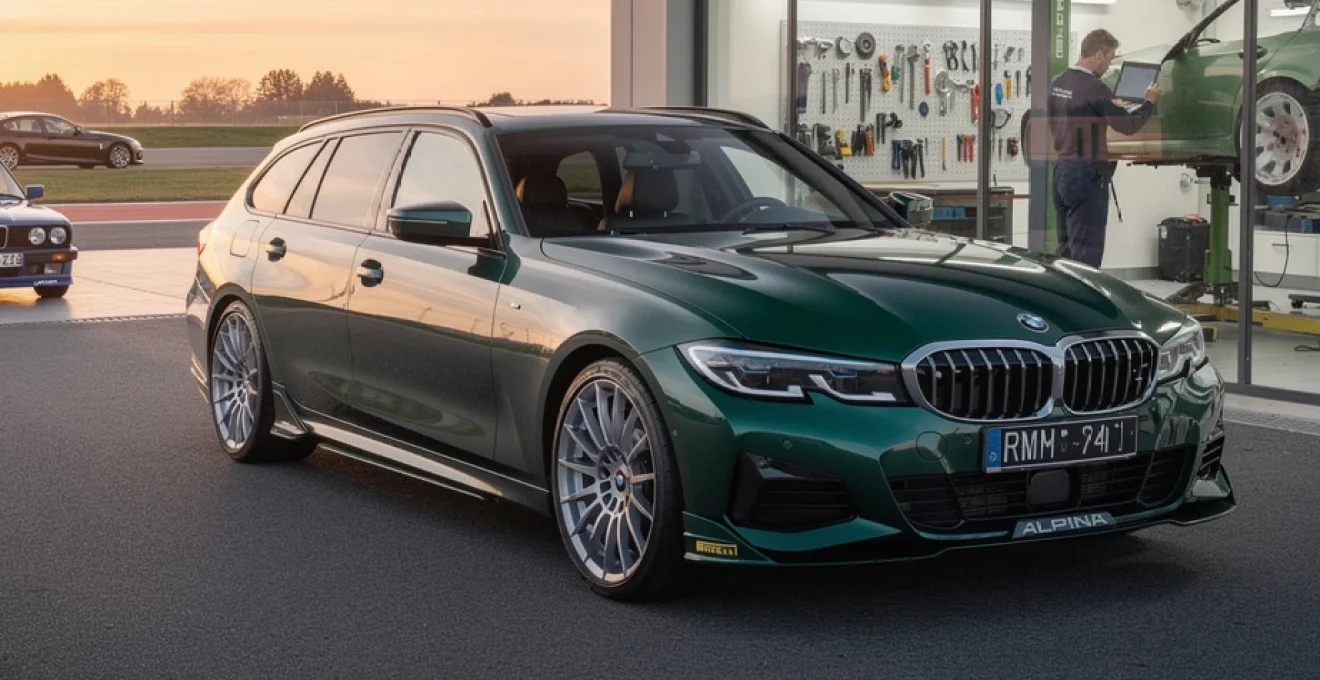
The BMW 3 Series Alpina represents one of automotive engineering’s most enduring partnerships, where Bavarian precision meets boutique craftsmanship. Since the 1960s, Alpina has transformed BMW’s foundation into something distinctly more exclusive, creating vehicles that bridge the gap between luxury grand tourers and outright performance machines. The collaboration has produced some of the most coveted sports saloons and estates in automotive history, combining BMW’s engineering excellence with Alpina’s unique tuning philosophy.
What sets the BMW 3 Series Alpina apart isn’t merely additional power or sportier suspension – it’s a comprehensive reimagining of what a premium performance car can be. While BMW’s M Division focuses on track-oriented aggression, Alpina prioritises refined velocity, creating machines that deliver supercar performance whilst maintaining the composure and comfort of a luxury cruiser. This approach has earned the marque a devoted following among discerning enthusiasts who value exclusivity and sophistication over outright lap times.
Alpina’s engineering legacy in BMW 3 series development
Burkard bovensiepen’s vision and alpina’s independent tuning philosophy
Burkard Bovensiepen founded Alpina in 1965 with a revolutionary concept: rather than simply bolting on aftermarket parts, the company would work intimately with BMW to develop truly bespoke automobiles. This philosophy established Alpina as more than a tuning house – it became a manufacturer in its own right, officially recognised by German authorities in 1983. The company’s logo, featuring twin carburettors and a crankshaft, symbolises this deep mechanical heritage and commitment to internal combustion excellence.
The relationship between BMW and Alpina extends far beyond typical supplier arrangements. Alpina engineers work directly within BMW’s development programmes, testing components and providing feedback that often influences production BMW models. This integration means that every BMW contains elements of Alpina DNA, from suspension tuning to electronic management systems. The collaboration represents one of the automotive industry’s most successful partnerships, demonstrating how small-volume specialists can enhance mass-market engineering.
E30 B6 2.7 and B3 evolution: First-Generation performance milestones
The E30 generation marked Alpina’s true coming of age in the BMW 3 Series platform. The B6 2.7, introduced in 1988, represented a quantum leap from earlier models, featuring a naturally aspirated 2.7-litre inline-six producing 210bhp – extraordinary figures for a compact executive car of that era. The engine’s character exemplified Alpina’s philosophy: smooth, torque-rich delivery that prioritised real-world usability over peak power statistics.
The subsequent B3 Evolution pushed boundaries further, incorporating advanced engine management systems and aerodynamic enhancements that would influence BMW’s own M3 development. These early models established key Alpina hallmarks: distinctive 20-spoke alloy wheels, subtle aerodynamic modifications, and luxurious interior appointments that elevated the driving experience beyond BMW’s standard offerings. The limited production runs – typically fewer than 500 units annually – ensured exclusivity that remains a cornerstone of the Alpina proposition.
Switch engine technology and alpina’s proprietary ECU programming
Alpina’s technical innovation extends deep into engine management systems, where proprietary ECU programming unlocks performance potential whilst maintaining long-term reliability. The company’s Switch Engine Technology allows drivers to select between multiple engine mapping modes, adjusting throttle response, boost pressure, and transmission behaviour to suit different driving conditions. This technology predated BMW’s own driving mode systems by several years, demonstrating Alpina’s engineering foresight.
The ECU modifications go beyond simple remapping, involving comprehensive recalibration of fuel injection timing, ignition advance curves, and turbocharger wastegate control. Alpina engineers spend months optimising these parameters to achieve their characteristic power delivery: immediate throttle response at low RPM, sustained mid-range torque, and smooth high-RPM operation. This meticulous approach explains why Alpina engines often feel more refined than their BMW M counterparts, despite producing comparable power figures.
<h
Alpina classic car programme and heritage model restoration
As Alpina transitions from building new combustion-engined cars in Buchloe to focusing more heavily on its heritage, the Alpina Classic programme has become central to the BMW 3 Series Alpina story. With roughly 60,000 Alpinas produced since the late 1960s and an estimated 25,000 still on the road, there is a growing community of owners who want their E21, E30 and E36 3 Series Alpina models preserved to factory specification. Alpina Classic was conceived to support these cars long term, safeguarding both mechanical integrity and brand value.
In practical terms, this means that classic BMW 3 Series Alpina models can return “home” to Buchloe for mechanical overhauls, sympathetic upgrades and factory-correct cosmetic work. Engines, gearboxes and rear axles are stripped and rebuilt by technicians trained not only in modern diagnostics but also in the more analogue art of precision assembly. Where original parts are no longer available from BMW, Alpina has begun remanufacturing key components – from period-correct alloy wheels to turbochargers – to ensure that heritage 3 Series Alpina cars can continue to be driven, not just displayed.
For owners, the benefits go far beyond nostalgia. A factory-restored E30 B6 2.7 or early B3 not only feels closer to its original character but is also more likely to retain (or even increase) its value in the growing youngtimer market. Alpina has already demonstrated its willingness to discreetly integrate modern technology, such as updated ignition and fuel injection systems, into classic models where reliability or emissions compliance would otherwise be a concern. The result is a unique blend: period-correct driving feel with the usability you’d expect from a well-sorted modern sports saloon.
Looking ahead, the Alpina Classic programme is expected to expand significantly once series production in Buchloe ends in 2025. Workshop space that was previously dedicated to new BMW 3 Series Alpina builds will shift to restoration and bespoke projects. For enthusiasts considering a classic 3 Series Alpina purchase, this evolving support network offers reassurance: you are not just buying a rare performance car, you are buying into a long-term ecosystem of parts, expertise and documentation directly from the brand that created it.
Contemporary B3 touring and saloon performance architecture
S58 Bi-Turbo engine modifications and Alpina-Specific tuning maps
The latest BMW 3 Series Alpina B3 – available as both Saloon and Touring – is powered by BMW’s S58 3.0-litre twin-turbocharged inline-six, shared in basic architecture with the M3 Competition. However, to call the B3 merely a re-badged M3 powertrain would miss the point entirely. Alpina reworks the engine with its own intercoolers, larger cooling package, bespoke turbocharger configuration and, crucially, Alpina-specific engine management software. The result is up to 488bhp and a colossal 730Nm of torque, delivered with the brand’s trademark smoothness.
Where the M3 chases peak power and explosive top-end response, the BMW 3 Series Alpina B3 is calibrated for effortless, real-world performance. Maximum torque is available from around 2,500rpm to 4,500rpm, giving the car a “continental express” character: you can flow along at high speed with barely more than a flex of your right foot. This broad torque band is the direct outcome of Alpina’s unique tuning maps, which alter boost pressure, fuel delivery and ignition timing to prioritise mid-range muscle rather than headline-grabbing rev limits.
Alpina also pays close attention to thermal robustness and longevity, knowing that many B3 owners will cover high annual mileages. Enlarged radiators, an uprated oil cooler and carefully managed charge-air temperatures help the engine maintain consistent output, even during prolonged autobahn runs. In everyday driving, you simply experience this as unflustered performance – the BMW 3 Series Alpina B3 feels just as strong after several hours on the motorway as it does on a short back-road blast.
Interestingly, the softer calibration of the S58 in the B3 has a side benefit: refinement. The engine’s acoustic signature has been tuned to produce a creamy straight-six rumble under load, avoiding the harsher bark you often hear in M models. For drivers who want an “everyday supercar” in discreet estate or saloon form, this balance between performance and civility is a major part of the 3 Series Alpina appeal. You get M3-rivalling acceleration – officially 0–62mph in just 3.7 seconds – without having to live with a track-car soundtrack on your daily commute.
ZF 8HP sport automatic transmission calibration and shift logic
The BMW 3 Series Alpina B3 does not use a dual-clutch gearbox like some performance rivals. Instead, it relies on the latest generation of ZF’s 8HP sport automatic, heavily recalibrated in Buchloe. On paper, this might seem like a more conservative choice, but in practice it suits the Alpina philosophy perfectly. The transmission combines near-instantaneous shifts with the smoothness and low-speed refinement that dual-clutch systems often struggle to match.
Alpina’s engineers rework both hardware and software aspects of the gearbox. Bespoke torque converter lock-up strategies, reduced shift times in Sport and Sport+ modes, and tailored shift points for each driving mode help the 3 Series Alpina B3 feel intuitive and responsive. In Comfort mode, the gearbox melts into the background, keeping revs low and shifts almost imperceptible. Switch to a more dynamic setting and the same unit becomes crisp and decisive, holding lower gears longer and responding keenly to manual paddle inputs.
One of the key advantages of this Alpina-specific shift logic is how well it complements the engine’s torque curve. Because the S58 in the B3 delivers so much mid-range pull, the gearbox can often stay one gear higher than an M3 would, improving refinement and efficiency without sacrificing speed. On a twisting B-road, you’ll often find yourself surfing the engine’s torque in third or fourth gear rather than constantly downshifting, which makes the car feel both faster and more relaxed.
From a long-term ownership perspective, the ZF 8HP’s robustness is another plus. This transmission has been proven across high-torque applications, and Alpina’s careful calibration helps manage mechanical stress. For drivers considering a BMW 3 Series Alpina B3 as a long-distance daily – perhaps covering 20,000 miles a year across Europe – that combination of reliability, smoothness and performance is a compelling reason to choose the B3 over more highly strung, track-oriented rivals.
Alpina dynamic suspension technology and adaptive damping systems
Suspension tuning is arguably where the BMW 3 Series Alpina B3 most clearly differentiates itself from the M3 and other hardcore performance saloons. Instead of chasing ultimate lap times, Alpina’s Dynamic Suspension Technology is tuned to deliver a broad bandwidth of comfort and control. The system combines bespoke springs, Alpina-specific bump stops, reinforced anti-roll bars and adaptive dampers with unique software calibration. Think of it as having two cars in one: a supple long-distance GT and a fast, composed sports saloon when you need it.
In Comfort mode, the B3 glides over rough tarmac that would make a typical track-focused car fidget and crash. Even with optional 20-inch wheels, sharp-edged potholes and expansion joints are rounded off, preserving that hallmark “Buchloe ride”. Yet the suspension never feels floaty; body control remains tight enough that you don’t get the wallowing or secondary movements typical of softer setups. For many owners, this ability to cover poor surfaces at speed without fatigue is the defining trait of the 3 Series Alpina driving experience.
Switch to Sport or Sport+ and the adaptive damping system stiffens noticeably, reducing roll and sharpening the car’s responses. Alpina’s calibration deliberately retains a degree of compliance, so the B3 doesn’t become skittish over mid-corner bumps. All-wheel drive and a rear limited-slip differential work with this chassis tuning to provide high levels of mechanical grip and stability. You may not get the oversteer theatrics of an M3 on track, but on typical roads the Alpina’s measured, confidence-inspiring balance often makes it the quicker, more relaxing choice.
For potential buyers comparing a BMW 3 Series Alpina B3 Touring with an M3 Touring or Mercedes-AMG C63 Estate, this suspension philosophy is a critical consideration. Ask yourself how you really use your car: do you spend more time on motorways and B-roads than on circuit days? If the answer is yes, the Alpina’s adaptive damping and broader comfort envelope may well make it the more enjoyable companion, especially if you regularly carry passengers or tackle long cross-country journeys.
Pirelli P zero tyre development and 20-inch alpina classic wheel design
Tyres and wheels are often treated as aftermarket afterthoughts, but in the BMW 3 Series Alpina B3 they are integral components of the engineering package. Alpina works directly with Pirelli to develop bespoke P Zero tyres, each marked with a small “ALP” code on the sidewall to indicate a unique compound and construction. These tyres are tuned specifically for the B3’s weight distribution, suspension characteristics and performance targets, helping the car achieve both high-speed stability and low noise levels on the motorway.
The iconic 20-spoke Alpina Classic wheel design, offered in 19- and 20-inch diameters, is more than a styling signature. These forged or flow-formed wheels are engineered to be both light and strong, reducing unsprung mass and improving steering response. Their narrow spokes also aid brake cooling, which is especially useful on high-speed autobahn runs or spirited mountain driving. Combined with the bespoke Pirelli rubber, they give the BMW 3 Series Alpina B3 a distinctive road feel: precise yet never nervous, with progressive breakaway characteristics.
From a practical standpoint, the tyre and wheel package also contributes to the B3’s everyday usability. Noise, vibration and harshness (NVH) levels are carefully controlled through the tyre sidewall design and internal construction, helping the car remain quiet at a cruise. At the same time, wet-weather performance is strong, with all-wheel drive and the Alpina-tuned P Zero combination providing secure traction even in heavy rain. If you live in a region with varied seasons, Alpina can also recommend winter tyre setups that preserve much of the car’s dynamic character.
For owners considering aftermarket changes, it’s worth remembering how much development time goes into this OE configuration. Swapping to generic ultra-high-performance tyres or heavier wheels may improve aesthetics or outright grip in certain conditions, but it can also upset the carefully judged balance between comfort and control. If your priority is to maintain the quintessential BMW 3 Series Alpina character, sticking with the factory-spec Pirelli and Alpina Classic combination – or their approved replacements – is usually the wisest choice.
Track-focused B3 GT aerodynamics and chassis engineering
While the core B3 Saloon and Touring are tuned for everyday usability, Alpina has also explored a more focused interpretation of the BMW 3 Series Alpina formula with limited-run GT variants. The B3 GT Touring, for example, builds on the standard car’s architecture but introduces subtle aerodynamic and chassis changes aimed at higher sustained speeds and more aggressive driving. Unlike a full M3 track package, these GT enhancements are still filtered through Alpina’s comfort-first philosophy, resulting in a car that is sharper yet still eminently liveable.
Aerodynamically, the B3 GT benefits from a revised front splitter, deeper side skirts and a more pronounced rear diffuser, all designed to reduce lift and improve stability at autobahn velocities approaching 190mph. The changes are far from ostentatious – there’s no towering rear wing or exaggerated vents – but collectively they smooth airflow around the body and manage underbody turbulence. For the driver, this translates into a reassuring sense of calm at speeds where many estates begin to feel light or nervous.
Underneath, the GT’s chassis tuning is tightened with firmer spring rates and revised damper calibration, alongside minor geometry tweaks to enhance front-end bite. Brakes are typically upgraded with larger, more temperature-resistant components to withstand repeated heavy stops. On circuit, the result is a BMW 3 Series Alpina that turns in more eagerly and resists fade better, narrowing the performance gap to overtly track-focused rivals. Yet ride quality remains closer to the standard B3 than to an M3 on its stiffest settings, which means you can still enjoy a long drive home after a day at the track.
Who is the B3 GT for? In many ways, it’s aimed at the small but passionate group of enthusiasts who love the Alpina ethos yet occasionally want to stretch their car’s legs on circuit or unrestricted highways. If you appreciate the idea of a 190mph family estate that can carry four adults and luggage in comfort, the B3 GT neatly encapsulates the dual personality that defines the BMW 3 Series Alpina lineage. It underscores a core truth: in Buchloe’s world, increased performance must never come at the expense of everyday usability.
Alpina’s buchloe manufacturing process and quality standards
One of the most intriguing aspects of the BMW 3 Series Alpina story is how these cars are built. Unlike typical aftermarket tuners who modify finished vehicles, Alpina receives partially assembled BMW 3 Series models from BMW’s Regensburg plant. These “pre-Alpina” cars arrive with specific hardware – such as reinforced chassis elements and wiring provisions – already in place. They then enter Alpina’s small-scale manufactory in Buchloe, where the transformation into a B3 Saloon or Touring begins.
In Buchloe, engines are fitted with Alpina-specific turbochargers, intercoolers and cooling systems, while transmissions receive updated software and, in some cases, additional hardware changes. Suspension components, including bespoke springs, dampers and anti-roll bars, are installed by hand. Interior trim is also upgraded, often with high-grade Lavalina leather, custom stitching and Alpina-branded details. This process can involve significantly more manual labour than a conventional BMW assembly line, which is why annual production for all Alpina models has historically been capped at around 2,000–2,200 units.
Quality control is rigorous. Each BMW 3 Series Alpina undergoes extended road testing on a variety of surfaces, as well as dynamometer checks to verify engine output and emissions compliance. Because Alpina is recognised as an independent manufacturer by German authorities, the brand is responsible for its own homologation and certification. That means the B3’s performance upgrades must meet the same durability and safety standards as a factory BMW, from crashworthiness to long-term emissions performance.
This artisanal yet highly technical manufacturing process contributes heavily to the B3’s exclusivity and long-term appeal. For many buyers, the knowledge that their car has passed through the hands of a relatively small team of specialists – rather than simply rolling off a mass-production line – is part of the allure. It also helps explain why residual values for BMW 3 Series Alpina models tend to be strong, particularly for well-specified cars with documented Buchloe provenance. When you buy a B3, you are effectively commissioning a small-batch performance machine, not just another high-volume sports saloon.
Market positioning against BMW M3 competition and Mercedes-AMG C63
On paper, the BMW 3 Series Alpina B3 occupies a curious niche. It is priced above a standard M340i xDrive, often close to – or slightly below – a BMW M3 Competition, and directly against high-spec versions of the Mercedes-AMG C63. Yet in character, it sits somewhat apart from both. Rather than chasing lap records or aggressively styled bodywork, the B3 offers what you might call “stealth wealth” performance: supercar-rivalling pace wrapped in understated, executive styling.
Against the BMW M3 Competition, the B3 Saloon and Touring trade ultimate track prowess for a more rounded everyday package. The M3 offers sharper turn-in, more adjustability on the limit and a chassis tuned for enthusiastic circuit use. The 3 Series Alpina, by contrast, focuses on long-distance comfort, cabin refinement and discreet aesthetics. For drivers who spend more time on motorways than on racetracks, this balance can make the B3 feel like the more mature, sustainable choice. You can use the car’s performance more often, in more situations, without feeling like you are constantly driving a race car in road clothes.
Compared with the Mercedes-AMG C63, especially the latest hybrid four-cylinder variant, the B3’s inline-six powerplant and traditional grand-touring philosophy have strong emotional appeal. Many enthusiasts still prefer the smooth, linear delivery of a straight-six to the highly boosted, often more frenetic nature of downsized engines. The Alpina’s cabin, with its softer leather and bespoke detailing, also leans more towards understated luxury than overt sportiness. If you value a quieter, more relaxed ambience on long trips, the BMW 3 Series Alpina experience may resonate more strongly than the “always on” character of some AMG models.
Naturally, this positioning has implications for ownership costs and audience. The B3 is not a bargain alternative to an M3; it is a deliberately premium product, and option lists can quickly push prices into the territory of larger, more powerful cars like the Audi RS6 Avant. Yet that is precisely the point: Alpina is selling exclusivity, heritage and a very specific driving experience. For buyers who understand and value that blend, the 3 Series Alpina often represents a “last of its kind” opportunity – a highly engineered, combustion-powered performance saloon or estate that feels genuinely different from anything else on the market.
Future B3 electrification strategy and hybrid powertrain integration
As the automotive industry moves towards electrification, many enthusiasts naturally wonder what this means for the BMW 3 Series Alpina. With BMW having formally acquired the Alpina brand rights, future models bearing the BMW Alpina name will almost certainly feature some level of electrified powertrain technology. The challenge will be to integrate hybrid or fully electric systems without losing the distinctive character – the “refined velocity” – that has defined Alpina’s 3 Series models for decades.
In the near term, the most plausible path for a future B3 successor is a performance-oriented plug-in hybrid, leveraging BMW’s latest modular powertrains. A combination of a turbocharged inline-four or six-cylinder petrol engine with a powerful electric motor could deliver both strong performance and significantly reduced CO2 emissions. For drivers in markets with strict tax regimes or city-centre restrictions, such a hybrid BMW 3 Series Alpina would offer a way to enjoy high-end performance without incurring the highest fiscal penalties.
From an engineering perspective, electrification also opens interesting possibilities that align with the Alpina ethos. Instant electric torque could be calibrated to complement, rather than simply augment, combustion output, smoothing power delivery and enhancing that signature effortless surge. Battery placement along the centre tunnel or under the boot floor could lower the centre of gravity and improve stability, provided weight is carefully managed. The key question will be whether these technologies can be implemented in a way that preserves the subtlety and composure we associate with the current B3.
For existing and prospective owners of combustion-powered BMW 3 Series Alpina models, the coming shift to electrification may actually reinforce the desirability of today’s cars. Just as mechanical Swiss watches gained prestige in the quartz era, there is a strong chance that well-kept B3 Saloons and Tourings with inline-six engines will become even more coveted as new BMW Alpina models move towards hybrid or EV platforms. If you are considering adding a 3 Series Alpina to your garage, we are arguably living in a pivotal moment: the last few years in which you can enjoy the full Buchloe interpretation of a BMW 3 Series with a purely mechanical heart.