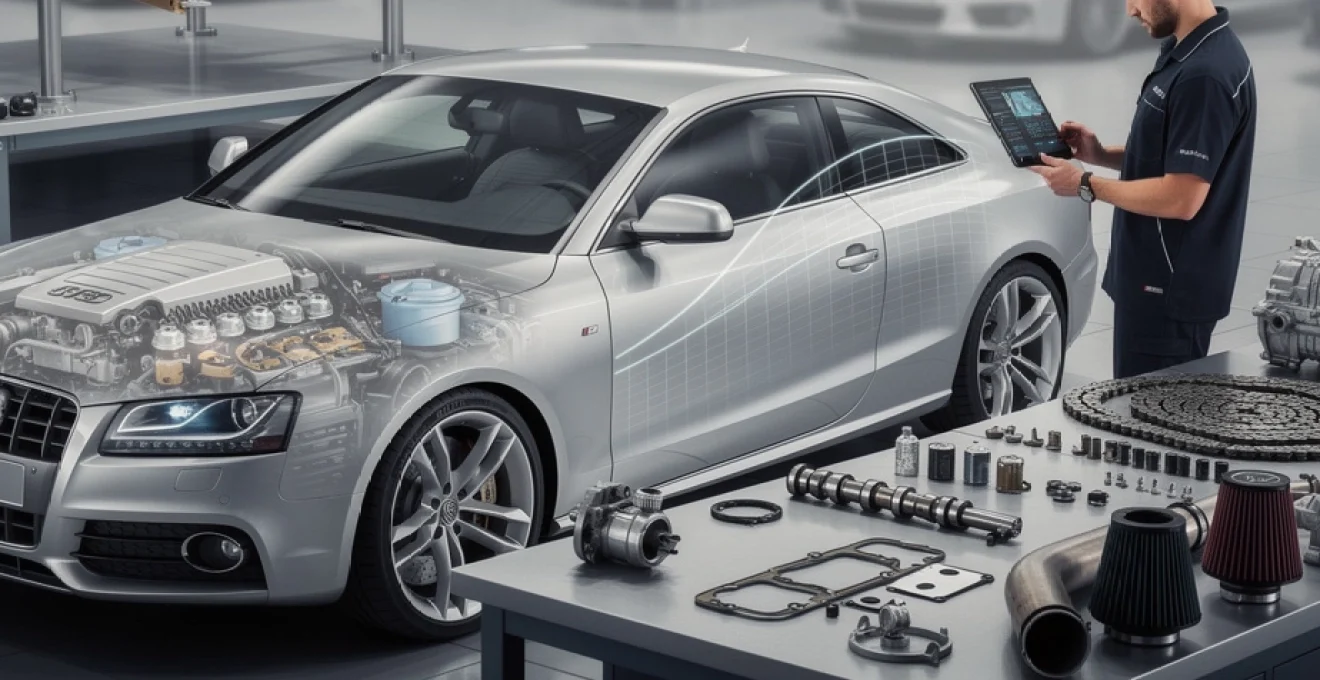
The Audi S5’s 4.2-litre V8 engine represents a defining moment in the brand’s performance heritage, marking the last chapter of naturally aspirated powerplants before the industry’s wholesale shift towards forced induction. Launched in 2007 as part of the original B8 platform, this FSI (Fuel Stratified Injection) V8 delivered a visceral driving experience that turbocharged engines struggle to replicate. With 354 PS on tap and a soundtrack reminiscent of Lamborghini’s finest, the engine became an instant classic amongst enthusiasts who valued linear power delivery over outright forced-induction thrust. Understanding this powerplant’s architecture, characteristics, and quirks remains essential for anyone considering ownership of these increasingly collectible performance coupes.
The 4.2 V8’s significance extends beyond mere specification sheets. It bridged the gap between Audi’s motorsport ambitions and its luxury grand touring aspirations, offering a uniquely balanced proposition that few contemporary rivals could match. Today, as these engines age into modern classic status, their engineering sophistication and inherent character continue to attract discerning enthusiasts seeking an alternative to the downsized, turbocharged norm.
FSI V8 engine architecture and internal specifications
Naturally aspirated 4.2-litre configuration with direct fuel stratified injection
The heart of the B8 S5’s performance credentials lies in its 4163cc V8 engine, featuring Audi’s pioneering FSI direct injection technology. This system delivered fuel directly into the combustion chambers at pressures exceeding 100 bar, enabling precise control over mixture formation and combustion timing. Unlike port injection systems where fuel mixes with air before entering the cylinder, FSI technology atomized fuel precisely where needed, improving both efficiency and power output. The 90-degree cylinder bank configuration ensured optimal balance and packaging within the engine bay, whilst the all-aluminium construction kept weight to a remarkably competitive 202kg.
Direct injection presented significant advantages for naturally aspirated applications. The cooling effect of fuel vapourising within the combustion chamber allowed for higher compression ratios without detonation risk, whilst stratified charge operation enabled the engine to run ultra-lean under light loads. These benefits translated into impressive fuel economy figures for a 4.2-litre performance engine, though as you’ll discover, the FSI system also introduced specific maintenance challenges that owners must address proactively.
Forged crankshaft and Aluminium-Silicon block construction
Audi’s engineers specified a forged steel crankshaft for the 4.2 V8, ensuring exceptional strength and durability even under sustained high-RPM operation. This component, combined with forged connecting rods and lightweight pistons, created a reciprocating assembly capable of withstanding the stresses associated with a 7,000 RPM redline. The engine block utilised an aluminium-silicon alloy with Alusil cylinder bore coating, eliminating the need for cast-iron cylinder liners and further reducing mass. This construction methodology, whilst technically sophisticated, required precise manufacturing tolerances and specific rebuilding techniques should internal work become necessary.
The crankshaft’s counterweighting and journal dimensions were optimised for smooth operation across the rev range. Eight individual throttle bodies, one per cylinder, ensured instantaneous throttle response that turbocharged engines simply cannot replicate. This configuration contributed to the engine’s characteristically eager nature, though it also meant that initial throttle application required a delicate touch—something contemporary road testers frequently noted when first acquainting themselves with the S5’s performance delivery.
Valve train geometry: Chain-Driven dual overhead camshafts
Each cylinder bank featured dual overhead camshafts operating four valves per cylinder through hydraulic tappets. The camshafts themselves were driven by a multi-stage chain system from the crankshaft, with hydraulic tensioners maintaining appropriate chain tension throughout the engine’s operational life. Audi incorporated variable valve timing on both intake and exhaust camshafts, allowing the engine management system to optimise valve overlap for different operating conditions. This variable valve timing system broadened the torque curve significantly, delivering strong mid-range performance
at lower engine speeds and helped maintain breathing efficiency closer to the 7,000 RPM power peak. From a driver’s perspective, this translated into an engine that pulled cleanly from relatively low revs yet came alive in the upper third of the rev range. The chain-driven layout also eliminated the need for periodic cambelt replacement intervals, which many owners appreciated. However, as we will explore later, this complex chain system introduced its own long-term reliability considerations once mileage began to climb.
Compression ratio engineering and cylinder head design
The Audi S5 4.2 V8 runs a relatively high compression ratio of around 11.0:1, made possible by the efficient combustion chamber shape and the cooling effect of direct fuel injection. The pent-roof cylinder heads feature centrally located spark plugs and carefully sculpted ports designed to promote strong swirl and tumble within the combustion chamber. This charge motion ensures thorough mixing of air and fuel, supporting both power output and emissions performance. The result is a naturally aspirated engine that delivers impressive specific output without resorting to extreme cam profiles or peaky, unusable power bands.
Engineers also prioritised thermal management in the cylinder head design. Integrated coolant passages around the exhaust valve seats help stabilise temperatures under sustained high-load operation, which is common in spirited driving or track use. Sodium-filled exhaust valves further assist heat transfer away from the hottest parts of the valvetrain, protecting against valve seat recession and detonation. For you as an owner, these engineering choices mean the 4.2 FSI can comfortably tolerate regular high-RPM use, provided oil quality and cooling systems are maintained correctly. It is this blend of robust design and high compression efficiency that underpins the engine’s reputation as a classic performance powerplant.
Power delivery characteristics and torque curve analysis
354 PS peak power output at 7,000 RPM
On paper, the Audi S5 4.2 V8’s headline figure of 354 PS (349–354 hp depending on market) at 7,000 RPM might not dazzle in an era of turbocharged torque monsters, but numbers only tell half the story. The way this engine builds power is what makes it memorable. Rather than delivering a single, dramatic surge, the 4.2 FSI accumulates pace in a smooth, linear arc that encourages you to chase the red line. As the tachometer needle sweeps past 5,000 RPM, the intake resonance and exhaust note harden into a purposeful howl, rewarding committed drivers with a distinctly mechanical, motorsport-inspired soundtrack.
Peak power arriving so close to the 7,000 RPM red line also means the usable performance band is wide. You are not forced to constantly downshift to find thrust; instead, the S5 pulls strongly from the mid-range and simply gets more urgent as revs rise. In real-world driving, especially on fast A-roads or autobahns, this translates into effortless overtaking and sustained high-speed cruising. The absence of forced induction lag further enhances this feeling of immediate response, giving the 4.2 V8 an old-school charm that many modern turbocharged Audi S models struggle to replicate.
440 nm maximum torque plateau between 3,500–5,500 RPM
The 4.2 V8 develops a maximum torque figure of 440 Nm (324 lb-ft) at around 3,500 RPM, with a broad plateau extending up to approximately 5,500 RPM. This spread is crucial for everyday drivability. It means you can leave the engine in a higher gear and still access meaningful acceleration without constantly hunting through the gearbox. Around town, the S5 feels tractable and refined, while on the motorway the engine sits comfortably in the heart of its torque band, ready to respond to even gentle throttle inputs.
Compared with many traditional naturally aspirated V8s, the FSI unit’s mid-range strength stands out. Direct injection and variable valve timing allow the engine to generate strong cylinder pressures without resorting to excessive displacement. From a technical perspective, the broad torque plateau is a testament to the careful calibration of intake geometry, cam phasing, and ignition timing. For you as a driver, the practical implication is simple: the S5 always feels like it has reserves in hand, whether you’re rolling on from 60 mph or exiting a tight bend in third gear.
Linear throttle response versus modern turbocharged alternatives
One of the defining traits of the Audi S5 4.2 V8 is its linear throttle response. With no turbochargers to spool and no complex boost control strategies to manage, the connection between your right foot and the crankshaft feels almost analogue. Press the accelerator and the engine responds in a proportional, predictable manner, making it easier to balance the car on throttle through corners. For enthusiastic drivers, this sense of precision can be more rewarding than the sheer torque hit of newer turbocharged Audi S5 engines.
If you’ve driven a modern turbocharged V6, you’ll know that most of the drama happens in a compressed surge of torque low in the rev range. By contrast, the 4.2 FSI’s power delivery feels more like stretching an elastic band: the more you pull, the more energy you release, with no sudden steps or plateaus. This makes heel-and-toe downshifts, throttle modulation on wet roads, and track driving more intuitive. It also means you can enjoy the engine at a variety of speeds, rather than feeling compelled to short-shift to stay within a narrow torque window.
Red line performance and over-rev protection systems
The official red line for the Audi S5 4.2 V8 sits at 7,000 RPM, with a hard fuel cut shortly beyond that to protect the valvetrain and rotating assembly. The engine control unit (ECU) constantly monitors crankshaft speed and various sensor inputs, stepping in to reduce fuel and, where necessary, ignition advance when the engine approaches its safe operating limit. This over-rev protection becomes particularly important in manual models, where a misjudged downshift could otherwise mechanically over-speed the engine beyond what electronic systems can mitigate.
Interestingly, the 4.2 FSI feels happiest when worked near this upper range, which encourages drivers to use the full sweep of the rev counter. Audi calibrated the ECU to allow a brief, soft-touch interaction with the limiter, so you are gently reminded to shift rather than abruptly cut off. For track-day use or spirited driving in the mountains, this predictability inspires confidence. As long as you respect warm-up procedures and oil temperature guidelines, the engine is more than capable of repeated high-RPM runs without protest—one of the key reasons enthusiasts still seek out this naturally aspirated Audi S5 V8 today.
B8 platform integration and quattro drivetrain configuration
Crown gear centre differential and torsen technology
The B8-generation Audi S5 represented a significant evolution in quattro drivetrain technology. Earlier performance Audis relied on purely mechanical Torsen differentials, but the S5 combined a crown gear centre differential with advanced electronic stability and traction control. This crown gear unit could vary torque distribution between the front and rear axles far more rapidly than previous systems, defaulting to a rear-biased split (typically around 40:60) for a more engaging driving feel. Under extreme conditions, it could send up to 70% of torque to the front or 85% to the rear, enhancing both traction and agility.
From a practical standpoint, this means the Audi S5 4.2 V8 feels more rear-driven than many earlier quattro models. On a twisty road, you can sense the system shuffling torque rearward as you feed in throttle exiting a corner, helping to rotate the car rather than simply dragging it out under power. Compared with rival rear-wheel-drive platforms, the S5 delivers remarkable all-weather capability without entirely sacrificing driver engagement. For owners in regions with mixed climates, this sophisticated quattro configuration is one of the car’s compelling selling points.
Six-speed manual versus S tronic dual-clutch transmission options
Early Audi S5 V8 models were launched with a six-speed manual gearbox, which many purists still consider the most authentic pairing for this engine. The manual transmission offers a direct, mechanical connection that suits the naturally aspirated power delivery, and road testers at the time praised the combination for its character, even if the shift action could feel slightly notchy when rushed. Later in the model cycle, Audi introduced a six-speed Tiptronic automatic in some markets rather than the faster-shifting S tronic dual-clutch unit fitted to smaller-engined models. This conventional torque-converter automatic prioritised smoothness and GT-like refinement over razor-sharp response.
So which should you choose if you’re shopping for an Audi S5 4.2 V8 today? If involvement and long-term enthusiast appeal matter most, the six-speed manual is the clear winner. It lets you exploit the 4.2 FSI’s rev-hungry nature and makes every drive feel more special. However, the Tiptronic has its own strengths. It pairs well with the car’s grand touring character, offers relaxed cruising, and generally copes well with the engine’s torque. Whichever transmission you opt for, regular fluid changes and sensible warm-up routines are crucial to longevity, especially as these cars move firmly into modern-classic territory.
Front-mid engine placement and weight distribution dynamics
One of the less obvious but most important engineering changes introduced with the B8 platform was the shift towards a front-mid engine layout. Audi moved the front axle line forward and pushed the 4.2 V8 further back towards the cabin, bringing the engine’s mass closer to the car’s centre of gravity. This adjustment improved weight distribution compared with earlier Audi coupes, which were often criticised for excessive front-end heaviness. While the S5 is still no featherweight, the revised architecture yields noticeably more neutral handling.
On the road, this manifests as reduced understeer at turn-in and greater willingness to adjust the car’s attitude with small throttle inputs. The aluminium-intensive suspension—multi-link at both front and rear—works in concert with the revised engine placement to deliver a planted, confident feel. Is it as playful as a rear-wheel-drive rival like the BMW E92 M3? Not quite. But for many drivers, the trade-off between security, comfort, and performance is well-judged. With a good wheel and tyre setup and fresh suspension bushes, an Audi S5 4.2 V8 can feel surprisingly agile for a car of its size and layout.
Known reliability issues and common failure points
Carbon build-up on intake valves in direct injection systems
Like many early direct injection engines, the Audi S5 4.2 FSI is susceptible to carbon build-up on the intake valves. Because fuel is injected directly into the combustion chamber rather than onto the back of the valves, there is no natural cleaning action to remove oil vapours and microscopic particulates that enter via the crankcase ventilation system. Over time—often from 60,000–80,000 miles onwards—this can lead to significant deposits that restrict airflow, reduce power, and cause rough idle or misfires. If you’ve ever wondered why a once-strong S5 feels a little lethargic, intake valve carbon is a prime suspect.
The most effective solution is periodic walnut shell blasting, a process where the intake manifold is removed and crushed walnut shells are blasted onto the valves to physically dislodge deposits. Many specialists recommend this service every 50,000–70,000 miles, especially if you want to preserve the crisp throttle response that defines the 4.2 V8. You can help slow build-up by using high-quality fuel, changing oil at conservative intervals, and occasionally allowing the engine to reach full operating temperature and rev range. However, given the nature of FSI technology, some degree of carbon cleaning is simply part of long-term Audi S5 V8 ownership.
Timing chain tensioner wear and camshaft adjuster problems
The 4.2 FSI uses a complex set of timing chains and guides located at the rear of the engine, driving four camshafts plus ancillary components. In theory, chains are designed to last the life of the engine, but in practice, wear to the guides and hydraulic tensioners can lead to rattling on cold start and, in worst cases, timing errors. These symptoms typically emerge as mileage climbs beyond 100,000 miles, though poor maintenance or extended oil change intervals can accelerate wear. Camshaft adjusters, which enable variable valve timing, can also develop issues, leading to fault codes, rough running, or reduced performance.
Addressing timing chain and cam adjuster problems is labour-intensive because the engine often needs to be removed for access. As a result, preventative maintenance and early diagnosis are crucial. If you hear prolonged rattling at start-up or notice timing-related fault codes, it’s wise to consult a knowledgeable specialist sooner rather than later. Many owners choose to proactively replace tensioners, guides, and adjusters during other major work, such as clutch replacement, to consolidate labour costs. While the underlying components are generally robust, neglecting these warning signs can transform a manageable issue into a very expensive repair.
PCV system failures and oil consumption patterns
Another common talking point among Audi S5 4.2 V8 owners is oil consumption. Some engines use little between services, while others can consume a litre or more every 1,000 miles, particularly when driven hard. Part of this variation stems from piston ring design and manufacturing tolerances, but crankcase ventilation hardware also plays a role. The positive crankcase ventilation (PCV) system regulates pressure within the crankcase and routes oil vapours back into the intake. When PCV valves or diaphragms fail, they can exacerbate oil usage, cause rough running, or trigger lean mixture fault codes.
Monitoring oil level regularly is essential with any older performance engine, and the S5 V8 is no exception. If you notice a sudden increase in consumption, visible smoke on overrun, or an erratic idle, a PCV system check should be high on your diagnostic list. Replacing a failed PCV valve is relatively straightforward compared with more invasive engine work, and it can significantly stabilise both idle quality and oil usage. Using the correct manufacturer-approved oil grade and avoiding extended drain intervals also helps minimise wear-related consumption over the long term.
Coolant flange cracking and thermostat housing vulnerabilities
Cooling system components on the B8 S5, particularly plastic coolant flanges and thermostat housings, are known wear items as the cars age. Heat cycles and material fatigue can lead to hairline cracks, slow leaks, and eventual coolant loss. Because some of these components are tucked away under covers and ancillary hardware, owners may not immediately spot minor leaks. Instead, they might first notice a faint sweet smell of coolant, a low-coolant warning, or slightly elevated running temperatures.
If ignored, even small coolant leaks can lead to overheating and, in severe cases, head gasket damage or warped components. The best approach is prompt inspection whenever coolant smell or level warnings appear. Many experienced specialists recommend pre-emptively replacing vulnerable plastic housings and flanges with updated parts during routine maintenance such as water pump or timing-related work. For anyone planning to keep an Audi S5 4.2 V8 long term, budgeting for periodic cooling system refreshes is sensible and far cheaper than the consequences of overheating this tightly engineered V8.
Aftermarket tuning potential and performance modifications
ECU remapping limitations for naturally aspirated platforms
When it comes to tuning the Audi S5 4.2 V8, it’s important to manage expectations. Unlike the later supercharged and turbocharged Audi S5 engines, this naturally aspirated FSI unit offers relatively modest gains from ECU remapping alone. A well-developed tune can sharpen throttle response, remove certain factory torque limiters, and eke out a small increase in peak power—typically in the region of 10–20 hp when combined with supporting hardware. However, you will not see the dramatic percentage improvements that forced-induction platforms routinely deliver.
So is ECU tuning still worthwhile? For many owners, yes, but more for drivability improvements than headline figures. A good calibration can smooth low-speed behaviour, optimise ignition timing for higher-octane fuel, and raise rev limiters slightly within safe margins. It can also be tailored to work with other modifications such as exhaust and intake upgrades, ensuring the engine management system fully exploits the improved breathing. If you’re planning a series of modifications, it’s wise to finish with a reputable custom tune rather than relying solely on generic off-the-shelf maps.
Free-flow exhaust systems: milltek sport and akrapovič options
One of the most transformative upgrades for the Audi S5 4.2 V8 is a high-quality free-flow exhaust system. From the factory, the car is relatively muted to meet noise and emissions regulations. Replacing the restrictive rear silencers and, where legal, the centre resonators with a performance exhaust from brands such as Milltek Sport or Akrapovič can unlock the engine’s natural voice. The result is a richer, more exotic soundtrack that highlights the V8’s similarity to other high-revving Audi and Lamborghini engines of the era.
Beyond sound, a well-designed cat-back exhaust can reduce backpressure, marginally improving mid-range torque and high-RPM breathing. Gains are typically in the single-digit horsepower range, but the subjective difference in responsiveness and character is far more noticeable. When shopping for an exhaust, consider your local noise regulations and your own tolerance for cabin volume. Some systems offer optional resonated and non-resonated configurations, allowing you to choose between a more subtle GT tone and a louder, track-oriented setup. In many ways, an exhaust upgrade is less about raw performance and more about amplifying what makes the Audi S5 V8 special to drive.
Cold air intake solutions and throttle body upgrades
Cold air intake systems are another popular modification, though their benefits on the 4.2 FSI can vary depending on design. The goal is simple: feed the engine cooler, denser air and reduce intake restriction. High-quality intakes with proper heat shielding and smooth-flowing pipework can sharpen induction sound and, in some cases, add a few horsepower when combined with ECU tuning. However, poorly engineered open-cone setups that draw hot air from the engine bay can actually reduce performance, especially during heat-soak conditions.
Some enthusiasts also explore larger throttle bodies or ported intake manifolds to further reduce intake restriction. These modifications tend to offer the best results on engines that see frequent high-RPM use, such as track or fast-road cars. As always, supporting software is critical: without a tune to account for altered airflow characteristics, the ECU may not fully capitalise on the hardware changes. If you’re aiming for a cohesive package rather than a collection of unrelated parts, working with a specialist who understands the nuances of the Audi S5 4.2 V8 platform is invaluable. Think of it as orchestrating a symphony: each component has to play in harmony for the overall performance to truly improve.
Market position against contemporary V8 rivals
BMW E92 M3 S65 V8 performance comparison
When new, the Audi S5 4.2 V8 inevitably faced comparison with one of the era’s most celebrated performance coupes: the BMW E92 M3, powered by the 4.0-litre S65 V8. On paper, the BMW enjoyed clear advantages in peak output, revving to 8,400 RPM and producing around 420 hp. It was lighter, more overtly track-focused, and widely praised for its steering feel and chassis balance. In a head-to-head drag race or circuit battle, the M3 generally held the upper hand, especially in the hands of an experienced driver willing to exploit its higher-revving nature.
Yet the Audi S5 occupied a subtly different niche. With quattro all-wheel drive, a more luxurious cabin, and a grand tourer bias, it appealed to buyers who wanted year-round usability alongside V8 character. The S5’s torque-rich mid-range and secure traction made it particularly effective in poor weather or on real-world roads where ultimate lap times mattered less than confidence and comfort. If you view the Audi as a fast, refined coupe with a classic naturally aspirated engine rather than a hardcore track tool, its position next to the E92 M3 makes a lot more sense. Even today, many enthusiasts cross-shop the two as complementary rather than directly interchangeable experiences.
Mercedes-benz C63 AMG M156 engine benchmark
Another major rival at the time was the Mercedes-Benz C63 AMG, powered by the legendary 6.2-litre M156 V8. With up to 457 hp in early iterations and a soundtrack that bordered on antisocial, the C63 embodied a more muscular, rear-drive performance philosophy. It delivered enormous straight-line performance and dramatic oversteer potential, quickly earning a reputation as one of AMG’s most charismatic creations. Against this backdrop, the Audi S5 4.2 V8 came across as the more restrained, technical alternative—less shouty, more all-weather capable, and more understated in its aesthetic.
From a reliability and ownership standpoint, both engines have their well-documented quirks: the M156 with potential head bolt and cam lobe issues, the 4.2 FSI with its timing chain and carbon concerns. However, the character contrast is stark. If the C63 is the loud, extrovert muscle car of the German trio, the S5 is the quietly confident GT that prefers to cover ground quickly and discreetly. For buyers who value understated performance and all-wheel-drive security over smoky burnouts, the Audi S5 V8 offered—and still offers—a compelling counterpoint to the AMG’s bombast.
Lexus IS F 2UR-GSE reliability and character contrast
The Lexus IS F, featuring the 5.0-litre 2UR-GSE V8, rounded out the main group of contemporary rivals. With around 423 hp and an eight-speed automatic gearbox, the IS F combined Japanese engineering rigour with an unexpectedly playful personality. Its V8 loved to rev, emitting a distinctive induction roar as its secondary intake opened at higher RPM. The Lexus also quickly gained a reputation for strong long-term reliability, reflecting Toyota’s conservative engineering margins and focus on durability. For many enthusiasts, it represented a left-field alternative to the dominant German options.
In this context, the Audi S5 4.2 V8 sits somewhere between the IS F’s reliability-focused philosophy and the Germans’ pursuit of outright performance. While the Lexus may edge it in long-term dependability, the S5 counters with the unique appeal of quattro, a more spacious and premium-feeling cabin, and that unmistakable Audi design language. If you prioritise low-drama ownership and plan to keep the car for a decade or more, the Lexus IS F might hold the advantage. But if you want a classic naturally aspirated V8 experience wrapped in a refined, all-weather-capable coupe, the Audi S5 4.2 remains a deeply satisfying choice in the modern classic marketplace.