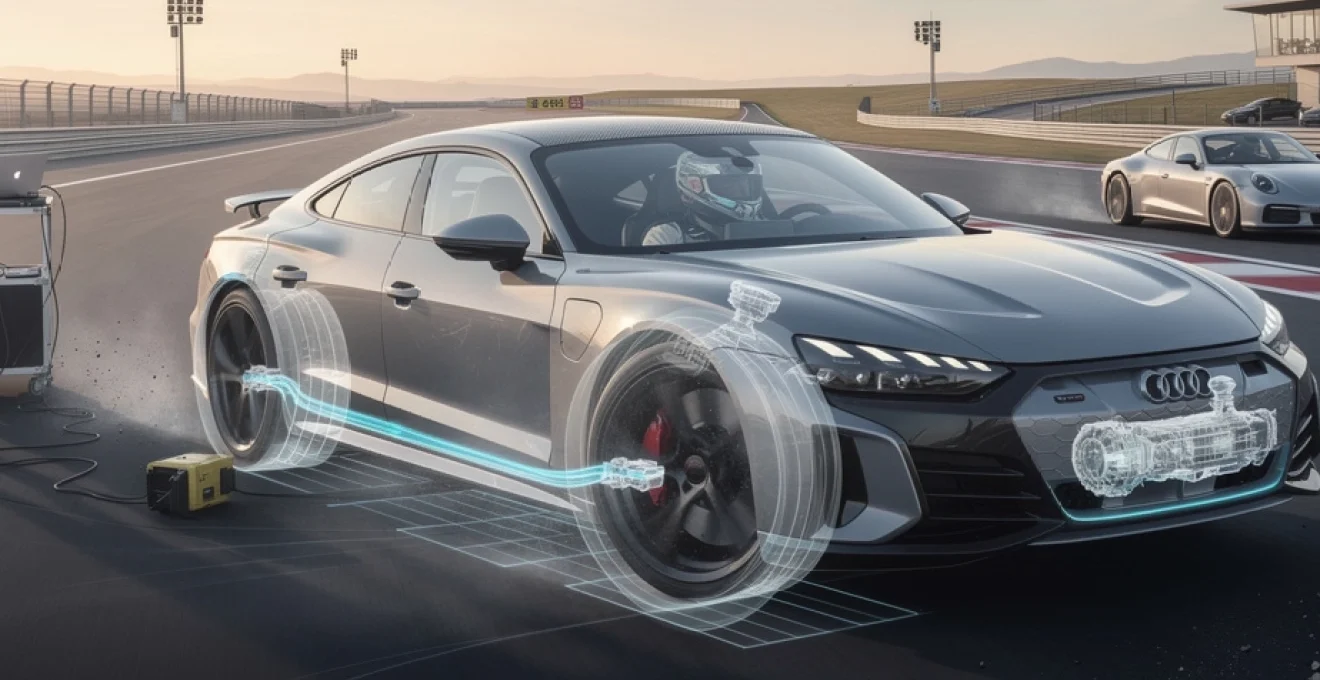
The Audi RS e-tron GT represents a watershed moment in automotive performance engineering, where traditional combustion-powered acceleration metrics meet cutting-edge electric propulsion technology. When Audi’s engineers set out to create their flagship electric performance sedan, they didn’t just aim to match conventional sports cars—they sought to redefine what acceleration means in the modern era. The result is a machine that delivers face-melting performance figures whilst maintaining the refined character expected from Ingolstadt’s finest. With a claimed 0-60 mph time hovering around the 2.8-second mark when equipped with launch control, the RS e-tron GT positions itself amongst the world’s quickest production saloons. Yet these numbers only tell part of the story; understanding how Audi achieves this explosive performance requires examining the sophisticated powertrain architecture, advanced electronic systems, and precise engineering calibrations that work in concert to deliver acceleration that feels, as one tester described it, like “a roller coaster in freefall.”
Audi RS e-tron GT acceleration metrics: official 0-60 mph performance data
According to official Audi documentation and independent testing by automotive publications, the RS e-tron GT achieves 0-60 mph in 2.9 seconds when measured using the standard testing protocol that includes a one-foot rollout. This figure represents the pre-facelift model’s performance envelope. The updated 2024 model, particularly the range-topping RS e-tron GT Performance variant, pushes this boundary even further with a claimed 2.5-second sprint to 62 mph—a marginal difference in measurement standards but a significant psychological barrier nonetheless.
Car and Driver’s comprehensive testing of the original RS e-tron GT recorded a 2.9-second 0-60 mph time, with the quarter-mile dispatched in 11.0 seconds flat at 127 mph. These figures position the RS e-tron GT in rarified company, edging out Audi’s own 591-horsepower RS7 whilst trailing the more powerful Porsche Taycan Turbo S by approximately half a second to 60 mph. The 0-100 mph benchmark falls in just 6.9 seconds, demonstrating the sustained thrust available from the electric powertrain well beyond initial launch. Perhaps most impressively, the RS e-tron GT continues accelerating strongly to 150 mph in 16.5 seconds, showcasing performance that extends far beyond party-trick standing-start acceleration.
What makes these acceleration figures particularly noteworthy is their consistency and repeatability. Unlike turbocharged petrol engines that may suffer from heat soak during repeated performance runs, the RS e-tron GT’s electric motors and sophisticated thermal management systems allow for consistent performance across multiple launches. Testing has shown minimal degradation in acceleration times even after several consecutive full-power runs, provided the battery maintains sufficient charge—typically above 80 percent for optimal performance delivery.
The RS e-tron GT delivers acceleration that transforms typical driving expectations, with power delivery so immediate and forceful that it genuinely reshapes your understanding of what a grand touring saloon can achieve.
Dual-motor quattro powertrain architecture and torque vectoring dynamics
The foundation of the RS e-tron GT’s explosive acceleration lies in its sophisticated dual-motor configuration, with permanently excited synchronous AC motors positioned at both the front and rear axles. This architecture provides not just all-wheel traction but intelligent torque distribution that adapts in milliseconds to optimize both performance and stability. The combined system output reaches 637 horsepower under normal operating conditions, with peak torque of 612 lb-ft available across a remarkably broad rev range—a characteristic advantage of electric propulsion that fundamentally alters acceleration dynamics compared to internal combustion engines.
Permanent magnet synchronous motors: front and rear axle power distribution
The front motor produces 238 horsepower whilst the rear unit generates 456 horsepower, creating a rear-biased power distribution that enhances the RS e-tron GT’s dynamic character. Despite what simple mathematics might suggest, the total output doesn’t equal 694 hor
694 horsepower; instead, total system output is governed by software that manages how and when each motor can deliver its peak. This is partly to preserve drivetrain longevity and partly to keep energy demand within the capability of the high-voltage battery and inverters. In practice, you experience an almost seamless surge rather than two motors fighting for traction. Under hard acceleration, the control unit prioritises the rear axle for a classic RS rear-biased feel, then vectors torque forward as required to keep the car arrow-straight, even on imperfect surfaces.
Torque vectoring is handled not only through the independent control of the two motors but also via the electronically controlled rear differential. By overdriving the outer rear wheel in a corner and braking the inner wheel when needed, the RS e-tron GT can rotate more keenly than its 2.3‑tonne mass suggests. The result is that when you go for a full-bore 0-60 mph run out of a tight junction or slip road, the car feels locked into the tarmac rather than scrambling for grip. That confidence is a big reason why the Audi RS e-tron GT 0-60 performance stats are so consistently repeatable in real-world conditions.
Two-speed transmission system impact on launch control performance
One of the defining technical elements the RS e-tron GT shares with the Taycan is its two-speed transmission on the rear axle. Most electric cars rely on a single reduction gear, which can limit either off-the-line punch or high-speed efficiency. Audi’s solution is to combine a short first gear for brutal launches with a longer second gear for sustained acceleration and motorway efficiency. During a launch-control start, the gearbox locks into first and holds it longer than you might expect, delivering that unforgettable roller-coaster surge as the car hurls itself at the horizon.
The shift to second is almost imperceptible from the driver’s seat, but it plays a key role in how the RS e-tron GT maintains thrust past 60 mph and on toward 100 mph and beyond. Think of it like a sprinter switching from an explosive crouch start to a longer, more efficient stride: the initial hit is all about maximum traction and torque multiplication, while the second gear allows the motors to operate in a more efficient band at higher speeds. This is one reason the Audi’s 0-60 mph time of 2.8–2.9 seconds is matched by a very strong 0-124 mph (0-200 km/h) performance, making it feel just as relentless in a high-speed overtake as it does off the line.
For drivers interested in optimising their own 0-60 mph runs, it’s useful to understand that the two-speed transmission also helps protect the motors and battery from extreme current spikes. By giving the rear motor a shorter effective ratio for the first few metres, Audi can deliver peak torque without forcing the system to pull unsustainable amperage from the battery. That balance between savage acceleration and long-term durability is central to how the RS e-tron GT has been engineered.
93.4 kwh battery pack energy deployment during maximum acceleration
Under the floor sits a battery pack with a gross capacity around 93–93.4 kWh (roughly 83 kWh usable in the original car), arranged in a flat, skateboard-style layout. During a launch, the pack’s primary job is to deliver enormous current without a significant voltage sag, ensuring the motors can access their full power potential. Audi’s 800‑volt architecture is key here: by running at a higher voltage than most EVs, the RS e-tron GT can supply the same power with lower current, reducing heat build-up in the cabling and power electronics. This is one reason why you can do multiple Audi RS e-tron GT 0-60 tests in quick succession without the car immediately throttling performance.
The battery management system continuously monitors cell temperatures, state of charge, and discharge rates, adjusting power output in real time. When you’re above about 80 percent state of charge and the pack is in its optimal temperature window, the full published performance figures are available. As charge drops below roughly 20–30 percent, you’ll notice a slight softening of the initial hit, though the car remains very quick by any conventional standard. For everyday driving, this means you don’t have to baby the battery to enjoy the RS e-tron GT’s acceleration; for track days or repeated drag-strip runs, preconditioning the pack via the navigation or drive modes will ensure you’re in the sweet spot.
From an energy perspective, a single 0-60 mph run consumes only a tiny fraction of the pack’s usable capacity—think of it like briefly opening a fire hose from a large water tank. The real challenge isn’t capacity but thermal management. Audi uses liquid cooling channels within the battery housing, along with dedicated coolant loops for the motors and inverters, to keep temperatures in check. This hardware is what allows the RS e-tron GT to pair supercar-level acceleration with the ability to cruise silently and efficiently when you’re not chasing tenths.
Overboost function: temporary power surge from 637 to 646 PS
A key part of the RS e-tron GT’s headline 0-60 mph stat is its overboost function. In everyday driving, system output is capped at around 590–637 PS (depending on model year and market), which is already more than enough. However, when you engage launch control or fully depress the accelerator in Dynamic mode, the control software temporarily unlocks additional power, nudging peak output closer to 646 PS (and even higher in the latest RS and RS Performance variants). This temporary power surge lasts only a few seconds, but that’s all you need to blast past 60 mph.
Why limit this extra power to short bursts? The answer lies in heat management and component protection. Delivering maximum current for prolonged periods would accelerate wear on the battery and inverters, much like running a turbocharged engine at redline continuously. By restricting overboost to brief windows—typically 2.5 to 10 seconds depending on the specific mode and model—Audi ensures you get that fireworks-display acceleration when you want it without compromising longevity. For the driver, it feels like a hidden reserve being unleashed, particularly when you combine overboost with a well-prepared launch on a warm, dry surface.
On the updated 2024 RS e-tron GT, Audi has refined this concept further with functions like a push-to-pass button that delivers a 10‑second, ~95 PS power bump for quick overtakes. It’s the EV equivalent of a nitrous shot or F1-style hybrid boost, and it adds another layer of engagement when you’re exploring the car’s performance envelope. Used wisely—on an on-ramp or at a safe overtaking opportunity—it can shave precious tenths off your 0-60 mph and 0-100 mph sprints in real-world conditions.
Launch control protocol and dynamic drive mode calibration
Getting from 0 to 60 mph in under three seconds isn’t just about hardware; it’s also about how that hardware is orchestrated. Audi’s launch control system acts as the conductor, coordinating the dual motors, two-speed rear gearbox, battery output, and traction systems to deliver maximum acceleration with minimum wheelspin. The interface for the driver is deliberately simple—select the right drive mode, left foot on the brake, right foot fully on the accelerator—but behind the scenes the car is performing countless calculations per second. If you’ve ever wondered why some owners can’t quite match factory Audi RS e-tron GT 0-60 performance stats, it often comes down to not following this protocol precisely, or attempting launches with a cold battery or in suboptimal road conditions.
Rs-specific drive select settings: dynamic plus mode activation
Central to the launch procedure is Audi’s Drive Select system, which tailors the car’s behaviour to different driving scenarios. For maximum 0-60 mph performance, you’ll want to select an RS-specific setting—typically Dynamic or RS Mode (sometimes labelled RS1/RS2 on the steering wheel). These profiles stiffen the adaptive air suspension, sharpen throttle response, and relax some of the electronic stability control thresholds. In newer models, there’s also a Dynamic Plus calibration that primes the drivetrain and thermal systems specifically for short, intense bursts of acceleration.
Once in the appropriate mode, the car preconditions the battery to its ideal temperature range, provided you’ve been driving long enough or have set a high-performance route in the navigation. It also selects first gear on the rear transmission and biases torque to the rear axle while standing still. When you apply full throttle with the brake still engaged, the system recognises your intention to use launch control and displays a confirmation in the cluster. Release the brake, and the RS e-tron GT fires itself forward with a violence that can surprise even seasoned performance-car owners.
For everyday use, you won’t need these aggressive calibrations; Comfort or Efficiency modes already make the RS e-tron GT feel brisk thanks to the inherent torque of its electric motors. But if you’re aiming to replicate the official Audi RS e-tron GT 0-60 mph numbers for yourself, using the RS drive modes is essential. Think of them as a pre-set recipe: they ensure every ingredient—suspension, power delivery, ESC thresholds, and cooling—is optimally configured for that brief moment of maximum attack.
Electronic stability control intervention parameters during standing starts
Electronic Stability Control (ESC) is often seen as the fun police in performance cars, but in a 590–900 PS electric sedan it’s more like a trusted co-pilot. During a launch, the RS e-tron GT’s ESC system constantly monitors wheel speeds, yaw rate, steering angle, and longitudinal acceleration. In its most conservative settings, it will quickly cut power or brake individual wheels to stamp out any hint of slip. However, in RS-specific or ESC Sport modes, the intervention parameters are relaxed, allowing a small, controlled amount of wheelspin and slip angle that can actually improve traction on imperfect surfaces.
Imagine trying to sprint on a slightly dusty floor: a tiny bit of slip as you push off can help you load your muscles and find grip, whereas a complete lack of movement would mean you’re not using your full potential. The ESC in the RS e-tron GT works in a similar way, allowing just enough tyre slip to keep the motors in their sweet spot without letting things get out of hand. This is particularly important given the instant torque on tap; without smart ESC tuning, even wide, sticky tyres could be overwhelmed during an aggressive 0-60 mph blast.
For drivers experimenting with different ESC settings, the key takeaway is that fully disabling the system rarely results in better Audi RS e-tron GT 0-60 performance stats unless you’re on a perfectly prepared drag strip with warm tyres. On real roads, leaving ESC in its sport or dynamic setting typically delivers the best blend of traction and control. You’ll feel the car hook up cleanly with minimal drama, which is exactly what you want when you’re deploying supercar-level performance in a four-door GT.
Adaptive air suspension preload and ride height adjustment for optimal traction
The RS e-tron GT’s adaptive three-chamber air suspension is not just about comfort; it’s a quiet partner in delivering rapid standing-start acceleration. In Dynamic or RS modes, the suspension lowers the body slightly, reducing aerodynamic drag and lowering the centre of gravity. More subtly, it adjusts damping and spring rates to limit squat at the rear and dive at the front when you launch. This keeps more consistent load on all four tyres, which in turn maximises the available grip for that crucial first second of the run.
Under hard acceleration, weight naturally transfers to the rear axle. If the suspension is too soft, the rear can compress excessively, changing the alignment and reducing the tyre’s contact patch. Audi’s calibration strikes a balance by allowing just enough squat to aid traction while using firm damping to prevent uncontrolled movement. The front end, meanwhile, is kept from rising too much, preserving steering precision if you need to correct your line early in the launch. It’s the chassis equivalent of bracing your core before lifting a heavy weight—everything tightens up to handle the load efficiently.
Some models add active air suspension and rear-wheel steering, further enhancing launch stability and low-speed manoeuvrability. Rear-wheel steering can subtly counteract any tendency for the car to wander under extreme acceleration, keeping you locked on your chosen path. For owners wondering whether these chassis options are worth it, the answer is yes if you value both comfort and the ability to extract consistent, drama-free 0-60 mph performance in all weathers.
Real-world testing: RS e-tron GT vs porsche taycan turbo S acceleration comparison
Given that the Audi RS e-tron GT and Porsche Taycan Turbo S share the same fundamental platform and 800‑volt architecture, comparisons between their acceleration figures are inevitable. On paper, the Taycan Turbo S generally has the edge, with many tests recording 0-60 mph times in the 2.4–2.6 second range, versus the Audi’s 2.8–2.9 seconds. That half-second gap is noticeable in a drag race video, but in day-to-day driving the difference is less dramatic than you might think. Both cars deliver an almost surreal hit of torque off the line, pinning you back in your seat and compressing your internal organs in a way traditional V8 saloons simply can’t match.
In independent testing, the RS e-tron GT’s quarter-mile times typically land around 11.0 seconds at 125–128 mph, while the Taycan Turbo S can dip into the high 10s on a well-prepped surface. Where the Porsche pulls ahead is mainly in the first 60–80 mph window, thanks to slightly more aggressive overboost tuning and weight distribution that’s biased even more toward performance. However, the Audi counters with a marginally softer, more compliant ride and a cabin that many find more relaxing over long distances. If you’re chasing absolute bragging rights at the drag strip, the Porsche remains the weapon of choice; if you want near-Turbo-S pace wrapped in a slightly more forgiving GT package, the Audi makes a compelling case.
Another factor in real-world comparisons is tyre choice and surface conditions. Many Taycan Turbo S examples are delivered on ultra-sticky performance tyres, while some RS e-tron GTs, particularly outside of dedicated performance packs, come on slightly more road-biased rubber. On a cool, damp day, that can narrow or even erase the theoretical performance gap, with the Audi’s more progressive chassis tuning making it easier for average drivers to extract consistent 0-60 mph times. Ultimately, choosing between them comes down less to tenths of a second and more to whether you prefer Audi’s design language and interior ethos or Porsche’s more hardcore, driver-centric approach.
Performance package influence on 0-60 times and quarter-mile results
Factory and dealer performance packages can subtly—but meaningfully—influence the Audi RS e-tron GT 0-60 performance stats you’re able to achieve. While the core drivetrain hardware is similar across many trims, options such as upgraded tyres, ceramic brakes, and carbon-fibre roof panels all affect the car’s mass distribution and grip levels. In a vehicle this powerful, shaving even 30–50 kg from the top half of the body or switching to a more aggressive tyre compound can translate into improved traction and slightly sharper launches. The differences may only amount to a tenth or two on a timing slip, but they can be the margin between matching and beating a rival in a heads-up drag race.
It’s worth noting that Audi’s own WLTP and performance claims are typically based on a representative but not fully optioned specification. If you load your RS e-tron GT with every comfort and styling option—panoramic glass roof, larger wheels, heavy sound system upgrades—you might add enough weight to blunt the car’s edge very slightly. Conversely, ticking the right performance boxes can help you get closer to, or even exceed, independent test figures when conditions are in your favour.
Continental SportContact 7 tyre compound grip coefficient analysis
Tyres are the only part of the RS e-tron GT that actually touch the road, so their specification has an outsized impact on 0-60 mph performance. Many high-spec or facelifted cars are delivered on ultra-high-performance rubber such as Continental SportContact 7 or similar, which offer a higher dry grip coefficient than more comfort-oriented alternatives. In plain terms, these tyres can generate more friction before they start to slip, allowing the launch-control system to deploy more torque without triggering ESC intervention. On warm tarmac, that can be worth a noticeable reduction in 0-60 mph times.
The trade-off, as always, is that stickier compounds may wear faster and can be more sensitive to temperature. On a cold or wet road, a slightly less aggressive tyre can sometimes be easier to manage, as it communicates grip levels more progressively. For owners who prioritise maximum Audi RS e-tron GT 0-60 performance stats and occasional track use, choosing a tyre like the SportContact 7—and ensuring it’s properly warmed up and inflated—is a smart move. For year-round commuting in mixed climates, a premium all-season or less extreme summer tyre might offer a better real-world balance.
If you’re looking to optimise your own car, start by checking tread depth and pressure; even the best compound will struggle if it’s worn or underinflated. Consider that a 5–10 percent drop in tyre pressure can increase rolling resistance and reduce the effective contact patch during a launch, costing you valuable grip. Treat your tyres like the performance components they are, and they’ll reward you with more consistent, confidence-inspiring acceleration.
Ceramic brake system weight reduction impact on acceleration physics
At first glance, brakes might seem irrelevant to a 0-60 mph sprint, but the RS e-tron GT’s optional carbon-ceramic brake system contributes to performance in a more indirect way. Ceramic discs are lighter than equivalent steel rotors, particularly in larger diameters, which reduces unsprung mass at each corner. Less unsprung mass allows the suspension to react more quickly to bumps and surface changes, keeping the tyre in better contact with the road. During a full-bore launch, that improved contact translates to more stable grip and fewer micro-slips that might otherwise trigger ESC intervention.
The reduction in rotating mass at the wheels can also have a small but measurable effect on acceleration. Spinning up a lighter disc requires less energy, leaving more of the powertrain’s output available to accelerate the car itself rather than its own components. The effect is analogous to fitting lighter wheels on a track car: you won’t necessarily feel it as a dramatic change, but back-to-back testing can reveal a slight improvement in both 0-60 mph and 0-100 mph times. In addition, the ceramic system’s superior heat resistance means you can do repeated hard acceleration and braking runs—such as at a drag strip or on a twisty road—without fade.
Of course, the primary benefit of ceramic brakes remains their stopping power and durability, which are critical when you’re regularly exploring a car capable of 150+ mph. But if you’re speccing an RS e-tron GT with an eye toward maximum performance, the ceramic package aligns well with that goal, even if its contribution to straight-line speed is more about enabling consistent grip and chassis control than adding raw power.
Carbon fibre roof panel contribution to power-to-weight ratio optimisation
Another seemingly small option with outsized benefits is the carbon-fibre roof panel available on certain RS e-tron GT trims and performance packages. Swapping the standard steel or glass roof for a carbon panel saves weight exactly where it matters most: high up on the car. This reduces the centre of gravity, which improves both cornering agility and stability under acceleration and braking. The effect on 0-60 mph times might be modest on paper—perhaps a few hundredths of a second—but it contributes to a more planted, confidence-inspiring feel when you launch the car hard.
Lowering the centre of gravity also reduces body roll and pitch, which helps the adaptive suspension maintain optimal tyre contact patches. Think of it like a tightrope walker lowering their balancing pole; the lower their mass sits, the easier it is to stay stable. On a car as heavy and powerful as the RS e-tron GT, every kilogram removed from the upper structure has a multiplier effect on how composed the chassis feels. That composure allows the launch-control system to be more assertive with torque delivery, knowing that sudden weight transfers are less likely to upset the tyres’ grip.
For enthusiasts comparing spec sheets, the combination of a carbon roof, ceramic brakes, and performance tyres makes for the sharpest possible RS e-tron GT in terms of acceleration and handling response. If your goal is to come as close as possible to the very best Audi RS e-tron GT 0-60 performance stats recorded by professional testers, prioritising these weight-saving and grip-enhancing options is a smart strategy.
Environmental variables affecting recorded 0-60 performance figures
Even with all of Audi’s engineering wizardry, the RS e-tron GT is still subject to the laws of physics—and the environment you drive in plays a major role in the numbers you’ll see. Temperature, road surface, altitude, and even wind can all influence your 0-60 mph results. For instance, cold temperatures can reduce battery efficiency and tyre grip simultaneously, making it harder to match the official figures. Conversely, a cool but not cold day (around 10–20°C / 50–68°F) with a dry, smooth road surface can be close to ideal, allowing the battery to deliver strong current while the tyres find plenty of traction.
Altitude is another often-overlooked factor. Unlike combustion engines, electric motors don’t lose power as air density decreases, so the RS e-tron GT maintains its rated output even at higher elevations. However, reduced air density also means less aerodynamic drag, which can actually help slightly at speeds above 60 mph. In practical terms, this means your quarter-mile times might improve marginally at altitude, even if your 0-60 mph results are dominated more by tyre grip than aero. Wind direction can also make a surprising difference; a light tailwind can help, while a strong headwind will blunt both acceleration and top speed.
Road surface quality may be the single most important real-world variable. A clean, well-laid asphalt surface offers far more grip than an older, polished, or dusty road. Small contaminants like sand, leaves, or loose gravel can upset traction in the first few metres of a launch, forcing the ESC to trim power. If you’re serious about testing your Audi RS e-tron GT 0-60 performance stats, choosing a safe, traffic-free stretch of high-quality tarmac—and ensuring the tyres are properly warmed—will yield much more representative numbers than a random side street.
Finally, driver technique still matters, even in a car with such advanced electronics. Ensuring the battery is adequately charged and preconditioned, selecting the correct RS drive mode, using both pedals correctly to engage launch control, and keeping the steering wheel dead straight all contribute to achieving the best possible run. Think of the RS e-tron GT as a highly sophisticated instrument: it will do most of the hard work for you, but a little preparation and understanding of the conditions can help you unlock its full potential, turning published 0-60 mph figures from theoretical benchmarks into personal bests you can actually experience from behind the wheel.