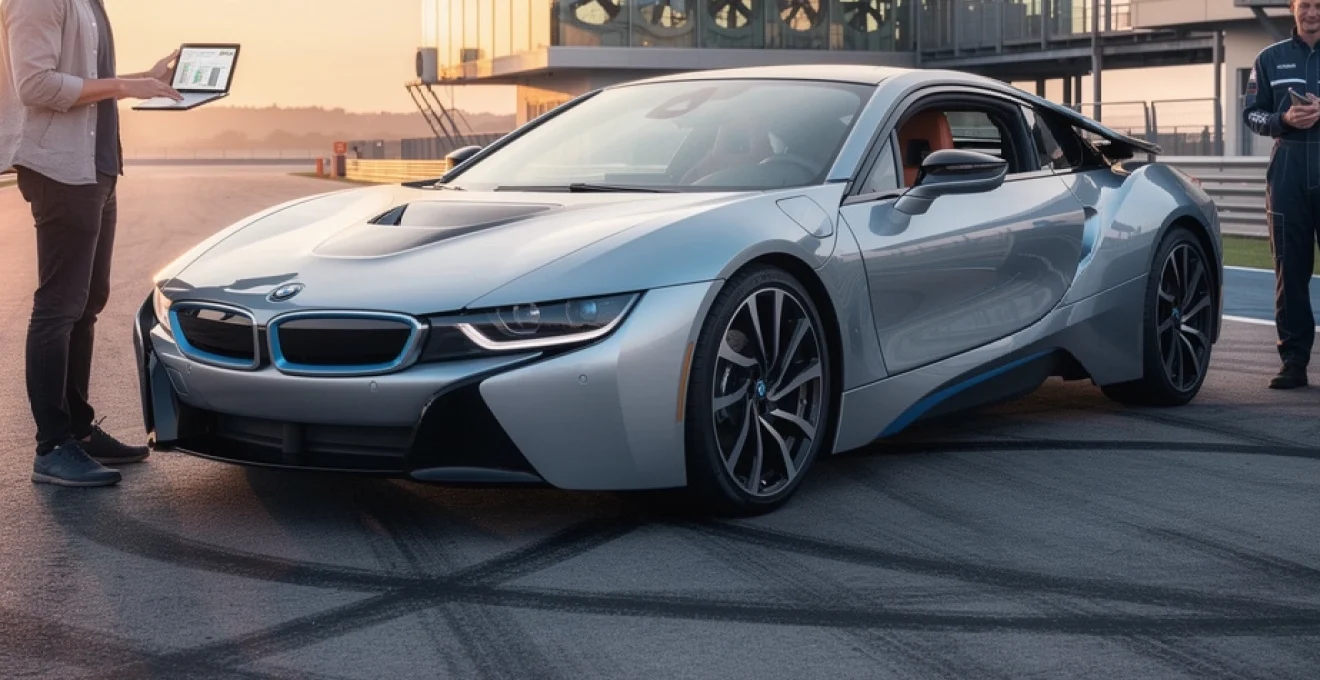
# 2014 BMW i8 Coupe review: futuristic hybrid sports car
When BMW unveiled the i8 in 2014, the automotive world witnessed something genuinely unprecedented. This wasn’t just another hybrid vehicle attempting to balance performance with efficiency—it was a radical reimagining of what a sports car could be. The i8 challenged every conventional assumption about high-performance motoring, combining supercar aesthetics with technology borrowed from Formula One racing and efficiency figures that embarrassed traditional superminis. With its dramatic dihedral doors, carbonfibre construction, and plug-in hybrid powertrain delivering both electric silence and petrol-powered excitement, the i8 represented BMW’s most ambitious engineering project since the legendary M1 supercar of the late 1970s. For enthusiasts accustomed to measuring performance solely in horsepower and lap times, the i8’s ability to complete your morning commute in near-silence before transforming into a canyon-carving weapon seemed almost impossible. Yet BMW delivered exactly that—a vehicle that could genuinely claim 0-62mph in 4.4 seconds whilst officially returning up to 150mpg.
BMW i8 Plug-In hybrid powertrain architecture and edrive technology
The heart of the i8’s revolutionary character lies in its sophisticated plug-in hybrid powertrain, which BMW engineers developed specifically for this application. Unlike conventional performance cars that rely solely on internal combustion, or even standard hybrids that use electric motors merely to supplement petrol engines, the i8 features two completely independent propulsion systems working in harmony. This dual-motor configuration represents one of the most technologically advanced approaches to automotive propulsion available during its production run from 2014 to 2020.
1.5-litre Three-Cylinder TwinPower turbo petrol engine specifications
At first glance, the specification sheet seems almost comical for a vehicle with supercar pretensions: a 1.5-litre three-cylinder petrol engine. This is the same fundamental architecture found in the MINI hatchback, yet BMW’s engineers extracted 228bhp from this compact powerplant through extensive modifications. The TwinPower Turbo technology incorporates variable valve timing, direct fuel injection, and a sophisticated turbocharger that eliminates lag whilst maximising mid-range torque. Positioned behind the passenger compartment in classic mid-engine configuration, this lightweight aluminium block contributes just 150kg to the overall vehicle mass. The engine drives the rear wheels exclusively through a six-speed Steptronic automatic transmission, providing the traditional rear-wheel-drive character that BMW enthusiasts expect. Later versions received particulate filters to meet increasingly stringent emissions regulations, demonstrating how the i8 evolved throughout its lifecycle to maintain compliance without sacrificing performance.
Synchronous electric motor integration and Lithium-Ion battery capacity
Complementing the petrol engine is a permanent magnet synchronous electric motor producing 141bhp (later increased from 129bhp in early models). This motor drives the front axle through a two-speed automatic transmission, creating an intelligent all-wheel-drive system where power distribution adapts to driving conditions. The lithium-ion battery pack evolved significantly during production, with capacity increasing from 20Ah to 34Ah in 2018 models. This 50% improvement in energy storage translated directly into extended electric range, allowing later i8s to travel up to 34 miles on battery power alone—a substantial increase from the original 20-mile capability. The battery cells sit in a protected tunnel running through the centre of the vehicle, contributing to the car’s exceptionally low centre of gravity whilst providing crucial crash protection. BMW covered the battery pack with an eight-year, 100,000-mile warranty, addressing one of the primary concerns potential buyers expressed about long-term hybrid ownership.
Combined system output: 362 PS and 570 nm torque delivery
When both propulsion systems operate simultaneously, the i8 delivers a combined output of 374bhp (362 PS in some markets) with maximum torque reaching 570 Nm. These figures might seem modest compared to traditional supercars boasting 500, 600, or even 700 horsepower, yet
on the road they translate into performance that feels every bit as urgent as those bigger numbers on paper. Because the electric motor can deliver its torque instantaneously from zero rpm, the i8 surges off the line with the kind of effortless thrust you normally associate with large-capacity engines. The petrol engine then joins in seamlessly, adding a harder edge to the acceleration as speeds rise. BMW quotes 0-62mph in 4.4 seconds for the 2014 i8 coupe, but what really impresses is the in-gear response when you ask for a quick overtake on a country road. There is no waiting for turbos to spool or gearboxes to kick down; the combined system simply hooks up and goes.
Equally important, the way that 570 Nm is delivered makes the car feel friendly rather than intimidating, even if you are new to high-performance hybrids. In Comfort mode, throttle mapping is progressive and the eDrive system prioritises smoothness, offering creamy, uninterrupted acceleration rather than a dramatic shove. Switch to Sport, and the calibration changes noticeably: the powertrain becomes more assertive, the petrol engine stays on song for longer and the car feels as if it is always poised on the balls of its feet, ready to sprint. The result is a driving experience that blends electric immediacy with classic BMW rear-drive character, giving you a different sort of thrill from a traditional V8 or flat-six.
Intelligent energy management and charge depletion mode
Coordinating two power sources, two gearboxes and a high-voltage battery requires far more than simple software; it demands a sophisticated energy management system that can anticipate what you are about to do. BMW’s eDrive control unit constantly analyses speed, throttle input, navigation data and battery state of charge to decide whether to prioritise efficiency, performance or a blend of both. In day-to-day driving, this means the 2014 BMW i8 coupe can glide through town in near-silent electric mode, fire its three-cylinder petrol engine only when needed, and harvest energy under braking to replenish the lithium-ion pack. The driver never needs to think about which axle is doing what, because the electronics orchestrate everything in the background.
Charge depletion mode is where the i8 behaves like a classic plug-in hybrid: it uses up the energy you have stored in the battery before relying primarily on the petrol engine. If you leave the drive system in standard Comfort mode and start with a full battery, the coupe will generally try to complete as much of the urban part of your journey on electric power alone. Once the available electric-only range is exhausted, the car settles into a blended hybrid strategy, with the engine doing more of the heavy lifting while the motor assists under acceleration and recovers energy on the overrun. For many owners with a typical commute of 20–30 miles and access to home charging, this intelligent energy usage can significantly reduce fuel consumption and running costs.
For those who want even more control, the i8 offers additional settings that allow you to influence how and when energy is used. Selecting eDrive forces the car into electric-only running, provided there is enough charge and you do not demand full-throttle acceleration. This is ideal if you are cruising through low-emissions zones or arriving late at night and want to keep noise to a minimum. Conversely, activating Sport mode not only sharpens throttle response and weights up the steering, but also turns the petrol engine into a generator, aggressively feeding power back into the battery whenever possible. Think of it as a dynamic “self-charging” mode that lets you rebuild electric range while having fun on a twisty road, so that you can switch back to near-silent EV driving when you reach town again.
Carbon fibre reinforced plastic life module construction and aluminium drive module
Underneath the futuristic skin, the 2014 BMW i8 coupe hides one of the most advanced vehicle architectures ever put into series production. BMW calls it LifeDrive: a two-part structure comprising a carbon fibre reinforced plastic (CFRP) passenger cell—the Life Module—and an aluminium chassis that carries the drivetrain and crash structures—the Drive Module. This separation of roles is similar to how an aircraft is designed, with a strong, lightweight fuselage linked to subframes that support the engines and landing gear. For a hybrid sports car, the benefits are obvious: reduced weight, improved rigidity and carefully optimised packaging for both the battery and powertrains.
CFRP was still exotic in 2014, mostly reserved for race cars and ultra-low-volume supercars, but BMW invested heavily in its own production facilities to bring the material into mainstream manufacturing. The i8’s passenger cell is moulded from this carbon composite, which offers exceptional strength and resistance to corrosion while being significantly lighter than steel. Using CFRP for the core structure helps offset the extra mass of the electric motor and battery pack, allowing the i8 to weigh around 1,535kg—remarkably lean for a plug-in hybrid sports car. The aluminium Drive Module, meanwhile, packages the electric motor up front, the petrol engine at the rear and the high-voltage battery in the centre tunnel, all tied together in a rigid, crash-optimised framework.
CFRP passenger cell weight distribution and torsional rigidity
The use of carbon fibre for the Life Module does more than just shave kilos from the kerb weight; it dramatically enhances torsional rigidity, which is a fancy way of describing how resistant the structure is to twisting forces. In a high-performance coupe like the BMW i8, a stiff shell is vital for precise handling and consistent suspension geometry, especially when you are loading up the chassis through fast corners. Because the CFRP tub can be engineered with specific fibre orientations and reinforcements where needed, BMW’s engineers were able to achieve levels of stiffness that would be far harder—and heavier—to replicate using conventional metals. The result is a car that feels solid and unflustered even on poor road surfaces.
This rigidity also allows the suspension to be tuned for both agility and comfort without the compromise you might expect. With less flex in the body, the dampers and springs can do their job more accurately, which helps the 2014 BMW i8 coupe maintain composure over mid-corner bumps and ridges. In practical terms, you experience this as a sense of calm confidence: the car feels like it pivots around you, with minimal delay between steering input and chassis response. The low-slung CFRP cell also helps to keep the centre of gravity close to the road surface, further enhancing stability. When you combine this with the all-wheel-drive hybrid system, the i8 delivers a planted, secure feel that encourages you to explore its performance envelope.
50:50 weight balance achievement through LifeDrive architecture
Achieving near-perfect 50:50 weight distribution has long been a BMW hallmark, and the i8 takes this philosophy into the electrified era. Placing the petrol engine behind the cabin and the electric motor ahead of the front axle allows the masses to be spread almost evenly between the two ends of the car. The lithium-ion battery pack, mounted low in the central tunnel, acts like a structural spine, further centralising weight and stabilising the platform. This carefully calculated layout is one of the reasons the i8 feels so neutral and predictable when you push it hard on a twisting road.
From the driver’s seat, a balanced chassis translates into intuitive handling: the nose turns in sharply, the rear follows faithfully and there is a natural progression from grip to slip if you deliberately provoke it. You do not have to wrestle the car to keep it on line, even when exploiting the combined 374bhp. Instead, the 2014 BMW i8 coupe flows from corner to corner with a fluidity that suits both fast B-road blasts and long cross-country journeys. The hybrid system’s ability to shuffle torque between axles further refines this experience, subtly trimming understeer or oversteer before you even notice it. For many drivers, it is this blend of confidence and involvement that makes the i8 feel more approachable than some traditional rear-drive supercars.
Aluminium space frame chassis engineering and crash structure integration
While the CFRP passenger cell protects occupants, the aluminium Drive Module handles the brutal realities of real-world impacts. BMW engineered complex front and rear subframes that deform in a controlled way during a collision, absorbing energy before it reaches the carbon tub. Think of it like the crumple zones on a conventional car, but tailored to work in harmony with a rigid composite core. The front structure incorporates specific crash boxes around the electric motor and power electronics, while the rear framework shields the three-cylinder petrol engine and fuel tank. All of this had to be designed with plug-in hybrid safety in mind, ensuring that high-voltage components remain isolated in serious accidents.
Beyond crash safety, the aluminium space frame also plays a key role in how the i8 steers and rides. Suspension mounting points are cast or extruded into the structure, providing precise reference points for the double-wishbone front and multi-link rear setups. Because aluminium is lighter than steel yet easier to repair than CFRP, BMW could position extra bracing where it mattered most without incurring a huge weight penalty. The result is a chassis that feels both robust and responsive, transmitting just enough road feel to keep you connected without becoming harsh. For buyers considering a used 2014 BMW i8 coupe today, it is reassuring to know that this combination of carbon and aluminium has proven durable in real-world use, with relatively low corrosion issues compared with older steel-intensive sports cars.
Aerodynamic coefficient and active aero elements performance analysis
One glance at the i8’s dramatic silhouette tells you that aerodynamics played a central role in its design. Those flowing lines, sculpted side channels and layered rear arches are not just for show; they are the result of countless hours in the wind tunnel, all aimed at reducing drag while maintaining stability. For a plug-in hybrid sports car, cutting through the air cleanly is essential, because every reduction in aerodynamic resistance directly improves both high-speed performance and electric-only range. The 2014 BMW i8 coupe achieves a drag coefficient of just 0.26, placing it among the slipperiest performance cars of its era.
Unlike some supercars that rely on huge fixed wings to generate downforce, the i8 takes a more subtle, integrated approach. Air is guided over, under and through the bodywork via channels and vents, much like water flowing around the hull of a racing yacht. The result is a stable, composed feel even at Autobahn speeds, with the hybrid system able to maintain cruising efficiency that would embarrass many diesel hatchbacks. For you as the driver, that means less wind noise, lower fuel consumption and a sense that the car is effortlessly slicing through the air rather than fighting against it.
0.26 drag coefficient achievement through stream flow design
The key to the i8’s low drag figure lies in BMW’s so-called Stream Flow design language. Look at the car in profile and you will see how the roofline tumbles down towards the rear deck, while the side windows taper and the shoulder line kicks up over the rear wheels. This creates a “channel” where the airflow is drawn tightly along the body, reducing turbulence and helping the wake close cleanly behind the car. It is a similar principle to that used on high-speed trains, where a tapered tail reduces the low-pressure zone that forms behind the vehicle, cutting drag and noise.
On the i8, these sculpted surfaces do more than just improve the drag coefficient; they also lend the coupe its unmistakable visual drama. Those deep rear buttresses, for example, are not just wild styling flourishes, but functional aerodynamic elements that guide air towards the rear lights and spoiler lip. By carefully managing how the airflow detaches from the body, BMW’s designers were able to balance low drag with sufficient rear-axle downforce for high-speed stability. It is a reminder that, in a car like the 2014 BMW i8 coupe, form and function are intertwined: the shapes you see are there because they help the car move through the air more efficiently.
Active grille shutters and adaptive air curtain functionality
Beyond its passive shape, the i8 also employs active aerodynamic components to adapt to changing driving conditions. One of the most important of these is the active grille shutter system. At lower speeds or when additional cooling is required—for example, during spirited driving or in hot weather—the shutters open to allow air to flow through the radiators. At higher cruising speeds, when cooling demand is lower, the shutters close to smooth the front end and reduce drag. This may seem like a small detail, but over long motorway journeys it can have a measurable impact on efficiency and noise levels.
Another clever feature is the Air Curtain system, which channels high-speed air through narrow vertical intakes in the front bumper and out across the front wheels. By wrapping airflow tightly around the rotating tyres, the i8 reduces the turbulence that typically forms in this area. It is a bit like smoothing your hand over the surface of a stream to calm the ripples: the air flows more cleanly down the sides of the car, cutting both drag and wind noise. For a hybrid sports car striving to maximise its electric-only range, such marginal gains add up, helping the 2014 BMW i8 coupe deliver impressive real-world efficiency even when driven briskly.
Rear spoiler deployment mechanism and downforce generation
Unlike some rivals that feature large retractable wings, the i8 adopts a more integrated rear spoiler concept. The trailing edge of the rear decklid is subtly raised, forming a built-in Gurney-style lip that generates downforce without the need for moving parts. By accelerating airflow over the upper surface and managing how it separates at the rear, this lip creates a low-pressure zone that helps to press the rear axle into the road at speed. The benefit for you, the driver, is enhanced straight-line stability and more reassuring behaviour during fast lane changes or high-speed sweepers.
Because this spoiler is fixed, there is no complex deployment mechanism to maintain, which can be a relief for long-term owners of the 2014 BMW i8 coupe. The aerodynamic balance remains consistent regardless of speed or drive mode, so you always know how the chassis will react as you approach the car’s limits. In combination with underbody diffusers and careful tuning of the rear bumper vents, the integrated spoiler contributes to a neutral, confidence-inspiring feel at Autobahn velocities. The design also avoids the “boy racer” aesthetic that some active wings can introduce, preserving the i8’s clean, futuristic appearance.
Enclosed underbody panelling and venturi tunnel airflow management
One of the most overlooked areas of automotive aerodynamics is the underside of the car, yet it is crucial for both drag and stability. The i8 features extensive underbody panelling that smooths airflow beneath the chassis, reducing the pockets of turbulence that normally form around suspension components and exhaust systems. This flat floor design not only cuts drag but also helps reduce lift, making the coupe feel more planted as speeds rise. It is similar in principle to what you would find on a modern GT racing car, albeit tuned for real-world road use rather than pure lap times.
Towards the rear, the underbody transitions into a Venturi-like diffuser, where the airflow is accelerated through a narrowing section and then allowed to expand as it exits. This change in air speed and pressure generates a mild suction effect that pulls the car down onto the road, contributing to rear-axle grip without the drag penalty associated with large external wings. For owners interested in maximising the efficiency of their 2014 BMW i8 coupe, keeping these underbody panels intact and free from damage is important, as even minor disturbances can degrade the carefully optimised airflow. Regular inspections, especially after winter driving or speed-bump impacts, are a wise precaution.
Six-speed automatic transmission and all-wheel drive system dynamics
The i8’s drivetrain is unusual not only because it combines petrol and electric power, but also because it uses two separate transmissions to put that power to the ground. At the rear, the 1.5-litre three-cylinder engine is paired with a six-speed Steptronic automatic gearbox. This transmission has been tuned specifically for the hybrid application, offering quick, crisp shifts in Sport mode and smooth, almost imperceptible changes in Comfort. Up front, the electric motor drives the wheels through a compact two-speed automatic gearbox, which allows the motor to operate efficiently both at low urban speeds and during faster motorway cruising.
What makes the 2014 BMW i8 coupe particularly engaging to drive is the way these two systems are coordinated to create an intelligent all-wheel-drive experience. In pure electric mode, the car is front-wheel drive, powered solely by the e-motor. As soon as the petrol engine fires, whether automatically or via your selection of Sport mode, the rear axle joins the party and the i8 effectively becomes all-wheel drive. The control system can then distribute torque between front and rear in real time, based on traction, steering angle and throttle position. On a wet or snowy road, this means the car can lean on its front axle for stability while the rear provides propulsion, giving you a reassuring sense of grip.
For enthusiastic drivers, the hybrid all-wheel-drive setup offers a different flavour of performance compared to a traditional rear-drive sports car. Because the electric motor can fill in torque gaps during gear changes or when the turbocharged engine is still spooling up, acceleration feels uninterrupted and linear. You can also exploit the instant front-axle torque when powering out of tight bends, with the rear engine adding a muscular surge as revs rise. In Sport mode, the gearbox holds lower ratios longer and responds more eagerly to paddle-shift commands, encouraging you to actively participate in the experience. The combination of mechanical and electric traction helps the i8 put its power down cleanly, even on less-than-ideal surfaces, making it an enjoyable year-round performance car rather than a garage queen reserved for dry weekends.
Electric-only range, fuel consumption figures and CO2 emissions rating
From launch, one of the most striking claims about the 2014 BMW i8 coupe was its official fuel economy and emissions data. Early NEDC tests suggested combined consumption figures of up to 134.5mpg, with later WLTP-correlated numbers rising towards 149.8mpg after the 2018 battery upgrade. CO2 emissions were rated as low as 42–49g/km depending on specification, putting the i8 in the same tax bracket as many small city cars despite its sports car performance. Unsurprisingly, these headline numbers caught the attention of company car drivers and eco-conscious enthusiasts alike, particularly in markets where Benefit-in-Kind taxation favoured plug-in hybrids.
Of course, real-world economy is more complex than any lab test can capture, especially for plug-in hybrids where usage patterns vary widely. If you charge the i8 diligently and use its electric-only capability for short commutes—say 15–25 miles each way—you can get surprisingly close to those sky-high mpg figures. Independent tests and owner reports often cite averages between 45 and 60mpg in mixed use, which remains extremely impressive for a car that can rival a Porsche 911 for straight-line pace. Drive it more like a conventional sports car, frequently exploring its performance on long motorway runs without regular charging, and you will more likely see figures in the 35–45mpg range.
The electric-only range itself depends on model year and driving style. Early cars, with the original 20Ah battery, could realistically cover around 15–20 miles on electric power in urban or suburban conditions, provided you were gentle with the throttle and avoided high motorway speeds. Post-2018 models, benefitting from the 34Ah pack and revised software, extend this to a genuine 25–30 miles in favourable conditions, with BMW quoting up to 34 miles on the official cycle. You can drive in eDrive mode at up to 75mph, though sustained high speeds will drain the battery quickly, so it makes more sense to reserve full EV running for slower sections of your route.
Charging the 2014 BMW i8 coupe is straightforward. Using a standard domestic socket, a full charge typically takes around three hours; a dedicated 3.7kW wallbox can bring the battery from empty to 80% in roughly two hours. Because the battery is relatively small compared with full EVs, topping up is easy to integrate into your daily routine—plug in when you get home in the evening and you will usually wake up to a full charge. For drivers in cities with congestion or low-emissions zones, the combination of low CO2 figures and genuine electric capability made the i8 an attractive choice when new, and those fiscal advantages can still matter in some regions for used buyers today.
Interior design language: layering concept and driver-focused cockpit ergonomics
Open the dihedral doors and slide into the cabin, and it becomes clear that BMW wanted the interior to feel every bit as futuristic as the powertrain. Rather than relying on gimmicks, the design team applied a “layering” concept, where overlapping surfaces, floating panels and contrasting materials create a sense of depth and lightness. The dashboard appears to wrap around the driver, with the central stack subtly angled towards you in classic BMW fashion. Ambient lighting traces the contours of the interior at night, emphasising the sculpted forms and reinforcing the impression that you are sitting in a concept car that somehow made it to production.
Despite its dramatic appearance, the cockpit remains recognisably BMW in terms of layout and usability. Physical buttons for key climate and audio functions sit beneath the central 8.8-inch iDrive display, ensuring you do not have to dive into touch menus for every adjustment. The second 8.8-inch screen replaces traditional analogue dials with a configurable digital instrument cluster, which changes colour and layout depending on the selected drive mode. In Comfort and Eco Pro, blue and white hues dominate, highlighting efficiency metrics and electric range. Switch to Sport and the display transforms into a more aggressive red theme, with a prominent rev counter and performance-focused data front and centre.
Ergonomics are carefully thought out, even if access requires a little more agility than a regular coupe due to the low roofline and wide sills. Once you are seated in the low, supportive sports seats, everything falls easily to hand. The steering wheel is thick-rimmed and nicely contoured, with logical controls for audio, phone and cruise functions. The iDrive controller on the centre tunnel remains one of the best infotainment interfaces in the business, allowing you to navigate menus, zoom maps and adjust settings without taking your eyes off the road for long. For taller drivers, the seating position is surprisingly comfortable, with ample adjustment and enough headroom despite the sleek roof.
Materials and build quality live up to the i8’s premium billing. Soft-touch plastics, high-grade leather and real metal accents combine to give the cabin a solid, upmarket feel. On higher-spec cars, you will find recycled and sustainably sourced materials, reflecting the car’s eco-conscious mission without sacrificing luxury. Practicality, however, is inevitably compromised by the mid-engine layout and dramatic styling. The rear seats are best suited to children or as additional luggage space, and the 154-litre boot will not swallow more than a couple of soft bags. If you can live with those limitations, the 2014 BMW i8 coupe rewards you with an interior that still turns heads today, blending everyday usability with the sense of occasion you expect from a futuristic hybrid sports car.