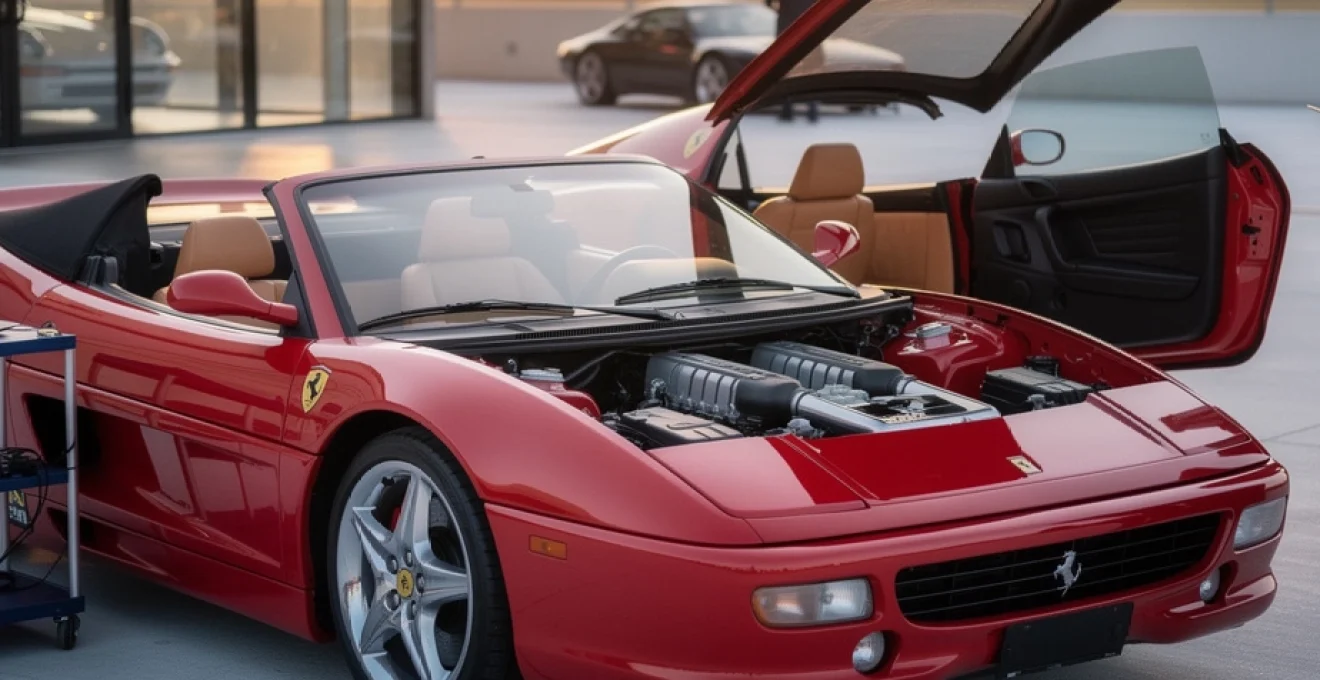
The Ferrari F355 GTS represents a pivotal moment in automotive history, bridging the gap between traditional Italian craftsmanship and modern supercar engineering. This mid-engined masterpiece, produced between 1994 and 1999, emerged as Ferrari’s answer to the Honda NSX challenge whilst establishing new benchmarks for naturally aspirated performance. The 1998 model year specifically marked the refinement of an already exceptional platform, incorporating subtle yet meaningful improvements that elevated the driving experience to extraordinary heights.
What makes the F355 GTS particularly compelling is its unique position as both a technological tour de force and an accessible Ferrari experience. Unlike its more temperamental predecessors, this model delivered genuine usability without compromising the visceral thrills that define the Prancing Horse legacy. The targa-top configuration offered the perfect compromise between the structural rigidity of the Berlinetta and the open-air freedom of the Spider, creating what many consider the most versatile F355 variant.
Ferrari F355 GTS design evolution and pininfarina collaboration legacy
The F355 GTS emerged from one of the most successful collaborations in automotive design history, representing Pininfarina’s mastery of proportion and Ferrari’s engineering excellence. This partnership, spanning decades of automotive innovation, reached a particular crescendo with the F355 series, where Italian styling tradition met cutting-edge aerodynamic science. The GTS variant specifically challenged designers to maintain the model’s visual purity whilst accommodating the removable roof mechanism.
Pininfarina’s berlinetta to targa transformation philosophy
Pininfarina’s approach to creating the GTS variant centred on preserving the Berlinetta’s essential character whilst enhancing its versatility. The design team, led by Lorenzo Ramaciotti, focused on maintaining the car’s flowing lines despite the structural modifications required for roof removal. This philosophy ensured that the GTS retained the same visual impact as its fixed-roof sibling, a challenge that many manufacturers struggle to achieve.
The transformation involved subtle yet significant modifications to the car’s silhouette. The rear buttresses, a defining feature of the F355’s design language, required careful reengineering to accommodate the targa mechanism whilst preserving their aesthetic contribution. This engineering feat demonstrates how functional requirements can enhance rather than compromise design excellence when approached with sufficient expertise and attention to detail.
Removable carbon fibre roof panel engineering solutions
The F355 GTS featured a sophisticated removable roof panel constructed from lightweight carbon fibre composite materials. This engineering solution provided optimal strength-to-weight ratios whilst ensuring proper sealing and structural integrity. The panel’s design incorporated precise mounting points and sealing systems that maintained the car’s weather resistance and acoustic properties when installed.
Storage considerations played a crucial role in the roof panel’s design. When removed, the panel fits neatly behind the seats in a purpose-built compartment, ensuring it remains secure during spirited driving. This practical solution eliminated the storage challenges often associated with targa-top vehicles, where roof panels can become cumbersome accessories rather than functional components.
Aerodynamic coefficient changes from F355 berlinetta baseline
The transition from Berlinetta to GTS configuration necessitated careful aerodynamic recalibration to maintain the car’s high-speed stability and efficiency. Wind tunnel testing revealed minimal changes in drag coefficient, with the GTS achieving a Cd of 0.33 compared to the Berlinetta’s 0.32. This marginal difference demonstrates the effectiveness of Pininfarina’s aerodynamic solutions and Ferrari’s commitment to performance consistency across the model range.
Airflow management around the targa bar required particular attention, as this structural element could potentially create turbulence affecting high-speed stability. Engineers developed specific contours and edge treatments to ensure smooth airflow transition, maintaining the car’s exceptional high-speed composure that became a defining characteristic of the F355 series.
Scuderia shield integration and ferrari prancing horse positioning
The iconic Ferrari badge placement on the F355 GTS follows traditional Maranello positioning conventions whilst accommodating the model’s unique design requirements. The Prancing Horse appears prominently on the nose cone, rear deck,
rear panel, and steering wheel boss, reinforcing brand identity from every viewing angle.
On many 1998 Ferrari F355 GTS examples, factory-fitted Scuderia Ferrari shields on the front wings provide an additional visual connection to the marque’s racing heritage. These enamel shields are more than cosmetic flourishes; their placement is carefully aligned with the car’s shoulder line so they sit naturally within the body’s curvature, avoiding visual distortion. Together with the central rear Cavallino Rampante, they help visually lower and widen the car, emphasising its mid‑engined stance even when viewed at a standstill.
Tipo F129B V8 engine technical specifications and performance analysis
3.5-litre DOHC Five-Valve per cylinder architecture
At the heart of the 1998 Ferrari F355 GTS lies the Tipo F129B V8, a 3.5‑litre, 90‑degree engine featuring dual overhead camshafts and an advanced five‑valve‑per‑cylinder layout. Displacing 3496cc, it produces a quoted 375–380bhp at 8250rpm and 268lb ft of torque at 6000rpm, depending on market and test standard. When it launched, this gave the F355 the highest specific output of any naturally aspirated production engine, at around 109bhp per litre.
The five‑valve configuration – three intake, two exhaust – was adopted directly from Ferrari’s contemporary Formula 1 learnings to improve volumetric efficiency at very high engine speeds. By allowing a larger total valve area and reduced valve mass, the engine breathes more freely beyond 7000rpm, which is why the F355 feels increasingly urgent as you approach its 8500rpm redline. For anyone used to modern turbocharged torque curves, this engine is the automotive equivalent of a concert grand piano: it rewards deliberate, skilful input and comes alive when fully “played.”
Bosch motronic M5.2 engine management system capabilities
For the 1998 model year, European‑spec F355s typically used the Bosch Motronic M5.2 engine management system, an evolution of the earlier 2.7 setup. M5.2 consolidated many functions into a more sophisticated single‑MAF architecture, improving idle stability, cold‑start behaviour and overall emissions. It integrates fuel injection, ignition timing, knock control and lambda feedback into a unified control strategy, constantly optimising combustion across the rev range.
In practice, this means the 1998 Ferrari F355 GTS feels smoother and more refined in everyday use than early cars, particularly at part‑throttle and low speed. Throttle response is still razor‑sharp compared with modern drive‑by‑wire systems, but there is less of the “on/off” character some owners report in 2.7 cars. From an ownership perspective, the M5.2 system also simplifies diagnostics, with OBD capabilities that allow specialists to interrogate fault codes and live data – an underrated advantage when you are trying to keep a high‑revving Italian V8 in perfect health.
Titanium connecting rods and Flat-Plane crankshaft engineering
Part of what makes the F355’s V8 so distinctive is its combination of lightweight titanium connecting rods and a flat‑plane crankshaft, an arrangement more common in the world of racing than in road cars of the mid‑1990s. Titanium rods reduce reciprocating mass, allowing the engine to rev more freely and reducing stress on the crankshaft and bearings at high rpm. This is one of the key enablers of the car’s 8500rpm redline and its instantaneous response to throttle inputs.
The flat‑plane crankshaft, with its 180‑degree pin arrangement, further accentuates this character. Compared to a cross‑plane V8, it offers more even firing intervals per bank and reduces the need for heavy counterweights, but at the cost of increased vibration and a more “edgy” sonic signature. At low revs, the engine note can sound almost industrial, but as the revs rise the harmonics align into the familiar Ferrari shriek. It is a reminder that this powerplant is, philosophically, much closer to a race engine than to the relaxed, torquey V8s you might find in a contemporary GT.
Variable intake plenum geometry and power delivery characteristics
To broaden the usable powerband without sacrificing top‑end performance, Ferrari equipped the F355 with a variable‑length intake system. At lower engine speeds, longer intake runners help to maximise low‑ and mid‑range torque by taking advantage of pressure wave tuning, similar to how a musician might use a longer instrument body to generate deeper notes. As revs climb, the system switches to a shorter path, reducing restriction and enabling the engine to keep pulling strongly right up to its redline.
On the road, this manifests as a distinct change in character around 5500rpm, where the 1998 Ferrari F355 GTS seems to gather itself and lunge toward the red paint on the tachometer. Below that threshold, progress is brisk but not overwhelming – ideal for everyday driving and urban traffic. Above it, the car feels every inch the thoroughbred Maranello supercar, encouraging you to work the gearbox and keep the flat‑plane V8 on the boil. It is this dual personality that makes the F355 so addictive once you learn how to “read” the engine’s intentions.
Ferrari F1-Derived technology integration points
Beyond the headline five‑valve cylinder heads, the F355 integrates several other F1‑inspired technologies that were advanced for a mid‑1990s road car. The dry‑sump lubrication system, for example, ensures consistent oil supply during sustained high‑g cornering and hard acceleration, much like a racing engine operating under high lateral loads. This also allows the engine to sit lower in the chassis, reducing the centre of gravity and benefiting handling.
Materials technology borrowed from the race programme is equally important. The extensive use of lightweight alloys in the block and heads, combined with titanium internals and advanced surface treatments, contributes to the engine’s durability when regularly taken to high rpm. Even the exhaust system, which on many cars is upgraded with a Tubi or Capristo system, was designed to minimise back pressure while meeting increasingly strict emissions rules of the era. For drivers, the net effect is that you can drive the 1998 Ferrari F355 GTS as it was intended – hard and often – provided that you respect its service schedule and keep ahead of age‑related wear.
Six-speed manual gearbox and chassis dynamics assessment
The 1998 Ferrari F355 GTS is at its most immersive when paired with the traditional six‑speed manual gearbox and open‑gate shifter. The steel gate is more than a styling flourish; it guides the slender lever through precisely machined channels, turning every shift into a tactile, mechanical event. Throws are short but require deliberate effort, and the best results come when you synchronise clutch release, throttle blip and lever movement as a single fluid motion. It is a learning curve, but once mastered, few modern paddle‑shift systems offer the same sense of involvement.
Mounted behind the cabin is a steel monocoque with a tubular steel rear subframe, supporting unequal‑length double wishbones at each corner. The suspension features electronically adjustable dampers with two primary modes: comfort and sport. In comfort, the F355 GTS rides with a suppleness that surprises anyone expecting a harsh, track‑biased setup, absorbing poor surfaces while maintaining body control. Switch to sport and the dampers firm up, reducing roll and pitch for more precise control during aggressive driving, though never to the point of punishing occupants on typical B‑roads.
Steering is via a power‑assisted rack, relatively light by modern standards but rich in feedback once you learn to trust the front end. Initial turn‑in is crisp rather than hyper‑agile, yet mid‑corner balance is where the chassis truly shines. The 1998 Ferrari F355 GTS pivots just behind the driver’s hips, giving you a clear sense of the car’s rotation and available grip. With no traction control or stability systems to intervene, you are responsible for managing weight transfer and throttle inputs – a reminder that this is an analogue supercar from an era before electronic safety nets became ubiquitous.
Braking is handled by large ventilated discs with ABS, offering strong, repeatable stopping power when properly maintained. Pedal feel is firm and linear, encouraging confident heel‑and‑toe downshifts for those willing to practise. If you are coming from modern, over‑boosted systems, the initial effort may feel high, but the reward is far greater precision when trail‑braking into a corner. Combined with the high‑revving V8 and manual gearbox, the chassis makes every stretch of road an opportunity to engage, rather than simply transport, the driver.
1998 model year updates and competition with porsche 911 carrera
Revised interior ergonomics and connolly leather appointments
By 1998, Ferrari had spent several years refining the F355’s cabin, and the GTS benefitted from incremental improvements in ergonomics and perceived quality. Connolly leather, long synonymous with the marque, is used extensively across the seats, dashboard and door panels, giving the interior a rich, traditional ambiance. Later cars often show better panel fit and fewer squeaks and rattles than early production examples, a direct result of Ferrari’s push towards higher manufacturing standards in the Montezemolo era.
The driving position in the 1998 Ferrari F355 GTS remains classic Ferrari: low‑slung, with slightly offset pedals and a relatively upright steering wheel. However, switchgear layout and stalk design became more intuitive as production evolved, making everyday operation less idiosyncratic. For taller drivers, the targa configuration can actually feel more accommodating than the Berlinetta, as the removable roof panel creates extra headroom and a greater sense of space – a useful consideration if you plan to spend more than a few hours at a time behind the wheel.
Updated climate control system and electrical architecture
One of the subtler but important areas of development for late‑run F355s was the climate control and electrical architecture. Ferrari worked to improve both reliability and usability, addressing some of the niggles that had affected earlier cars. Although the basic layout of rotary dials and push‑buttons remained, sensor calibration and control logic were revised to deliver more consistent cabin temperature regulation, especially in mixed conditions where lesser systems tend to “hunt.”
From an ownership perspective, the later electrical loom and control units in a 1998 Ferrari F355 GTS are generally considered more robust, particularly when it comes to intermittent faults and ghost warnings. That said, this is still a mid‑1990s Italian supercar, so preventative maintenance such as cleaning earth points, checking fusebox integrity and replacing ageing relays is wise. Treat the electrical system like the nervous system of a classic athlete: keep it healthy, and the rest of the car responds with far fewer surprises.
Performance benchmarking against contemporary lamborghini gallardo predecessors
In period, the F355’s most direct rivals were the Porsche 911 (993 and early 996) and, to a lesser extent, V8 offerings from Aston Martin and TVR. Lamborghini’s direct answer – the Gallardo – would not arrive until 2003, but the F355 was already setting the performance benchmark for mid‑engined Italian exotics. With a claimed 0‑62mph time of around 4.6–4.7 seconds and a top speed near 183mph, the car comfortably out‑paced many of its contemporaries whilst offering a more exploitable chassis than the older, more intimidating Diablo.
If we compare the F355 retrospectively to early Gallardo models, the contrasts are striking. The Lamborghini brings more power, all‑wheel drive security and greater outright speed, but it also feels heavier and more insulated. The 1998 Ferrari F355 GTS, by contrast, is lighter on its feet and more communicative; every input is mirrored back through the steering, pedals and seat of your pants. For enthusiasts who prioritise connection over numbers, the F355 still holds a unique appeal – it is less about chasing lap times and more about the quality of each interaction between driver and machine.
Market positioning within ferrari’s Mid-Engine sports car hierarchy
Within Ferrari’s own hierarchy, the F355 occupied the core mid‑engined V8 slot – above the front‑engined 456 grand tourer and below the flagship V12s such as the F512M and later 550 Maranello. It was designed to be Ferrari’s volume model, yet one that represented a significant qualitative leap over the 348 in both engineering and usability. The GTS variant added a unique dimension, giving buyers a more flexible alternative to the Berlinetta without committing to the fully open Spider.
Today, the 1998 Ferrari F355 GTS sits at an interesting crossroads in the brand’s lineage. It is often described as the last truly “classic‑looking” V8 before the more architectural forms of the 360 Modena and F430, and the last hand‑finished model before production volumes and processes accelerated. For many buyers, it hits a sweet spot between old‑world charm and modern capability – more forgiving than the 308/328 generation, yet far more analogue than anything that followed. That positioning underpins both its enduring desirability and its strengthening values on the classic market.
Ownership experience and ferrari classiche certification process
Owning a 1998 Ferrari F355 GTS is as much about stewardship as it is about enjoyment. This is a car that rewards regular use and diligent maintenance; leave it sitting for long periods and age‑related issues can accumulate. Key recurring tasks include the three‑year timing belt service, which requires engine removal and is often combined with ancillary work such as water pump replacement, cam seal inspection and exhaust manifold checks. Sensible owners budget for this major service in advance, treating it like a scheduled “health reset” rather than an unwelcome surprise.
On the road, the day‑to‑day experience is more approachable than legend might suggest. Visibility is good for a mid‑engined supercar, the clutch is manageable once warmed, and ground clearance is acceptable if you treat speed bumps with respect. Fuel consumption in mixed driving sits around the 18–22mpg mark, and many owners find that insurance premiums are surprisingly reasonable when using specialist classic policies with limited mileage. The greater challenge is often psychological: you are piloting a six‑figure, hand‑built Ferrari, and learning to relax into that responsibility takes time.
For buyers focused on long‑term value and authenticity, Ferrari Classiche certification has become increasingly important. The Classiche programme verifies that a specific car retains its original specification, including chassis, engine, gearbox and key body panels, and that any restoration work has been carried out to factory standards. A successful inspection results in a “Red Book” certificate, which has become a powerful signal of provenance in the global Ferrari market.
Securing Classiche certification for a 1998 Ferrari F355 GTS typically involves a comprehensive documentation review, visual inspection and measurement of major mechanical components. Any non‑original elements, such as aftermarket exhausts, wheels or interior trims, may need to be reversed if you are aiming for full compliance. While the process carries a cost, the benefits are twofold: you gain an authoritative assessment of your car’s originality, and you enhance its desirability to future collectors who increasingly prioritise documented, matching‑numbers examples.
Investment potential and classic ferrari market valuation trends
Over the past decade, values for the Ferrari F355 range have moved from “attainable dream” to firmly established modern classic territory. Around 11,000 examples were produced across all body styles and transmissions, making it one of the most numerous Ferraris of its era. Yet supply has not prevented appreciation: UK‑market data shows average asking prices rising from roughly £55,000 in 2018 to close to £100,000 by the mid‑2020s, with the best manual GTS and Berlinetta cars commanding six‑figure sums and sometimes more.
The 1998 Ferrari F355 GTS occupies a particularly strong niche within this trend. Manual, low‑mileage, well‑documented cars in classic colours such as Rosso Corsa over crema, or more understated combinations like Argento Nürburgring over black, are increasingly sought after. Targa models offer a blend of coupe rigidity and open‑air theatre that appeals both to drivers and collectors, placing them above F1‑gearbox Spiders in most valuation guides. As a rule of thumb, you can expect to pay a meaningful premium for right‑hand‑drive, Classiche‑certified, three‑pedal GTS cars with full service histories from recognised specialists.
Will values continue to rise? No one can guarantee future appreciation, but several macro trends work in the F355’s favour. Enthusiasts who grew up in the 1990s are now entering their peak earning years, fuelling demand for poster‑car icons. At the same time, the industry shift toward turbocharging, downsizing and electrification is increasing the allure of high‑revving, naturally aspirated engines with manual gearboxes. In that context, the 1998 Ferrari F355 GTS ticks almost every box: design pedigree, motorsport‑inspired engineering, analogue involvement and relatively limited supply of top‑tier examples.
For prospective buyers viewing the F355 purely as an investment, it is worth remembering that condition and provenance matter far more than chasing the lowest entry price. A seemingly “cheap” example that needs engine, suspension and cosmetic work can erase any notional saving and then some, while a meticulously maintained car with fully documented history is more likely to retain or enhance its value over time. If you approach the purchase with both heart and head aligned – accepting that some running costs are inevitable in exchange for a genuinely special driving experience – the 1998 Ferrari F355 GTS stands out as one of the most compelling modern classic Ferraris you can own.